Contents:
Key Takeaways:
1. Track changes in hiring velocity and mix, not raw posting counts. Postings are noisy: stale requisitions stay online, roles get reposted across cities, and evergreen ads build pipelines rather than signal real hiring. The more useful signals are a rise in a role family, new job titles, or a shift between locations. Even then, a pattern only suggests intent, since acquisitions or replacement hiring can look the same, so check it against other evidence before acting.
2. Competitive talent intelligence is a strategy function, not an extension of HR dashboards. It looks outward at competitor behavior, skills demand, pay, and supply, and works best when connected to strategy, finance, real estate, and business unit leaders. Start from two or three decisions to improve, such as cutting time-to-hire for senior data engineers in three European hubs, and name your real talent competitors, who often differ from your commercial ones. Give every recurring insight an owner and a cadence, or you end up with benchmarking reports that change nothing.
3. Treat forecasts as estimates, and check how vendors handle data quality, privacy, and bias. Ask how forecasts performed against actual outcomes, what uncertainty ranges they report, how duplicate postings are removed, and how undisclosed pay is estimated. Aggregated data is the safer default, but it doesn’t guarantee compliance: scraping public information doesn’t remove privacy obligations, so ask about legal basis and anonymization. Under the EU AI Act, some employment-related AI is high-risk depending on its purpose, so check the current rules rather than assuming one classification fits every tool. Build the ROI case on conservative levers: time-to-hire, acquisition costs, and compensation accuracy.
—-----------------------------------------------------------
Beyond Data: Gaining Your Strategic Talent Advantage
Many enterprises still set salary bands, choose hiring locations, and size recruiting teams using labor market data that may be months old by the time it reaches a planning meeting. This article covers what competitive talent intelligence includes, which data points matter, where AI helps, how to evaluate a platform, and how to estimate its return.
The cost of stale data shows up quickly. A machine learning engineer requisition sits open for four months because the approved range falls below what competitors now pay. An engineering hub opens in a location that looks affordable, only for a hyperscaler to announce a nearby campus. A quant team loses employees to a rival running a targeted poaching campaign.
These are illustrative scenarios, but they highlight a practical challenge: public job postings and other labor market data can reveal changes in hiring demand, skills requirements, and advertised wages. However, postings do not always represent genuine hiring intentions, and duplicate advertisements can distort apparent demand.
Competitive talent intelligence (CTI) addresses this gap. Collecting data is only the starting point; its value comes from improving hiring speed, acquisition costs, location strategy, and compensation decisions through a current view of competitor behavior and talent supply.
Defining Competitive Talent Intelligence vs. General TI
Talent intelligence is the broad umbrella covering data and analytics used to inform people decisions, including internal workforce analytics such as attrition modeling, performance distributions, and internal mobility.
Competitive talent intelligence narrows the focus to external markets and competitor behavior. It asks questions that an HRIS cannot answer:
-
Which roles are competitors hiring for, in what volume, and where?
-
Which skills are appearing in their job postings, and how is demand changing?
-
What are they paying for roles we need to fill?
-
Where is the talent we need concentrated, and who else is competing for it?
-
How does our workforce composition compare with peers on DE&I measures?
Core components include competitor hiring analysis, skills analysis, compensation benchmarking, talent supply and demand mapping, and diversity benchmarking. These rely on external data such as job postings, public professional profiles, compensation disclosures, government labor statistics, education and graduate output data, and company announcements.
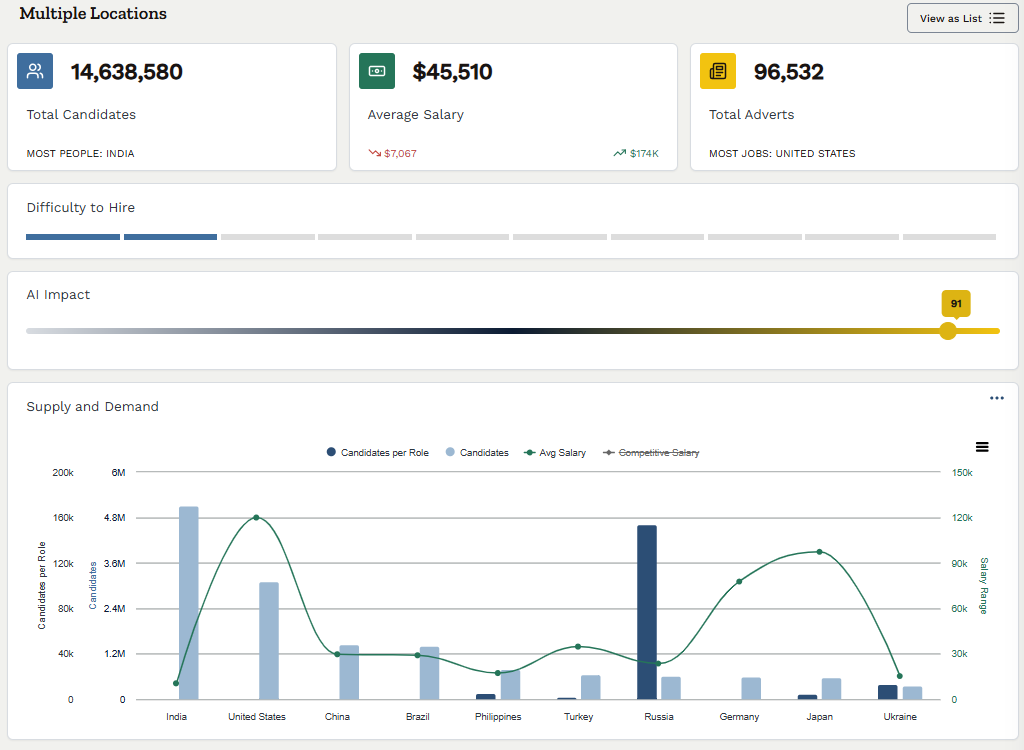
A view of supply and demand in Horsefly
The distinction matters organizationally. Internal people analytics typically sits with HR operations, while CTI works best when connected to strategy, finance, real estate, and business unit leaders. Treating it as an extension of internal dashboards can produce benchmarking reports without changing decisions.
The Strategic Imperative: Why CTI is a Business-Critical Function
The strongest case for CTI extends beyond HR.
Anticipating competitor moves
Hiring can provide an early indication of changing business priorities. A competitor posting forty battery chemistry roles in a region where it has no presence could signal a strategic move before a public announcement. However, hiring patterns alone cannot establish intent; acquisitions, replacement hiring, and other factors can produce similar signals.
De-risking expansion
Site selection decisions commit capital for years. CTI assesses whether a location has sufficient talent, how quickly its talent pool is growing, how many employers compete for the same skills, and how wages are changing.
Controlling labor costs
Compensation decisions materially affect operating costs. Paying above market may increase expenditure unnecessarily, while paying below competitive levels can make recruitment more difficult. Role and location specific benchmarks help enterprises optimize spending where the market demands it.
Sharper workforce planning
CTI adds external supply data to strategic workforce planning, helping organizations assess whether future skills needs can be met, at what cost, and whether to build, buy, or borrow those skills.
Faster, cheaper talent acquisition
Understanding where candidates work, what they earn, and which competitors recruit them helps recruiters target searches, set appropriate salary ranges, and reduce failed offers. These insights can improve recruitment strategies and the overall recruitment process.
Retention
Monitoring competitor demand and compensation premiums for the profiles you employ can reveal emerging retention risks before they appear in exit interviews.
The Core Data Points That Drive Competitive Advantage
CTI programs can track too many metrics without acting on them. The following data points are particularly useful because they connect market signals to decisions.
Competitor hiring volume and roles
Raw posting counts are noisy. Companies leave stale requisitions online, repost roles across cities, and use evergreen postings to build pipelines. The OECD also identifies duplicate listings and advertisements that do not reflect immediate hiring intentions as limitations of online vacancy data.
The more useful signals are changes in hiring velocity and composition: increases in a role family, new job titles, or shifts between locations.
For example, a competitor moving from sales engineers toward customer success managers may be changing its go-to-market model. That possibility should be investigated alongside other evidence rather than treated as a confirmed conclusion.
Strategic response: Adjust sourcing priorities, anticipate potential poaching, and share relevant signals with product and strategy teams.
In-demand skills and skills gaps
Job titles are poor descriptors of work. A data scientist might build dashboards or develop advanced predictive models. Skills-level analysis reveals what employers specify in job advertisements and how those requirements change over time.
Comparing market demand with your workforce's skills identifies gaps, while comparing demand with external supply shows which gaps can realistically be filled through recruitment. Reliable skills data also helps identify adjacent skills and opportunities for upskilling and reskilling.
Job advertisements do not necessarily capture every skill required to perform a role, so they should be interpreted alongside workforce information and other labor market sources.
Strategic response: Decide which skills to hire, which to develop internally, and which workforce requirements need to be reconsidered because supply is too limited or expensive.
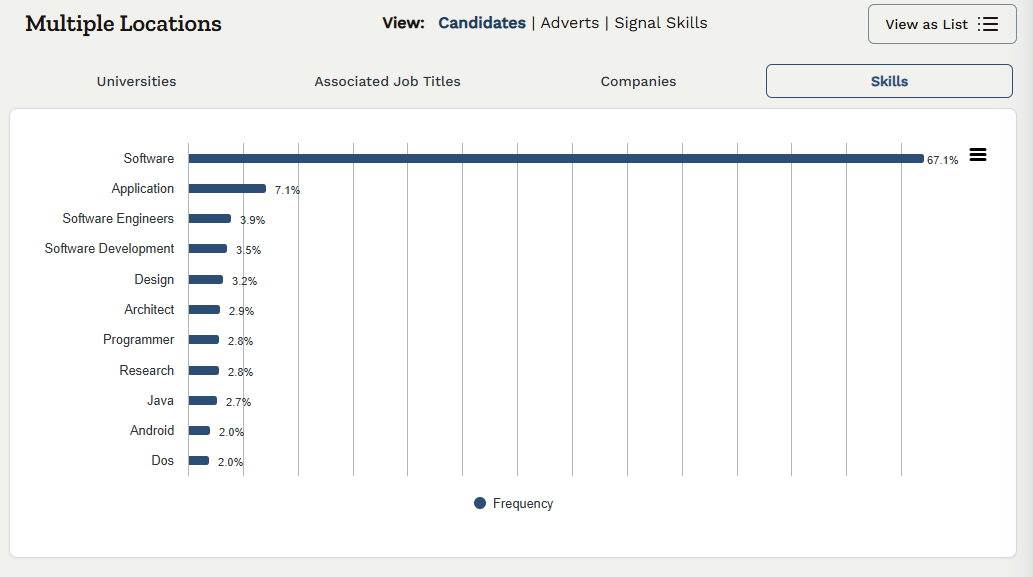
Skills data from the Horsefly platform
Compensation and benefits packages
Annual surveys remain useful, but they can lag behind market changes and offer limited granularity. Posted salary ranges provide another source of compensation information where employers disclose them.
Pay transparency requirements vary by jurisdiction. For example, New York State requires covered employers with four or more employees to include compensation ranges in advertised job, promotion, and transfer opportunities, subject to the law's scope and conditions.
Benefits also affect competitiveness. Remote work policies, equity, parental leave, and learning budgets can influence candidate decisions, particularly in technology.
Benchmarking against an industry median may be less useful than comparing packages with the specific employers that attract your candidates. Effective salary benchmarking helps HR professionals identify where compensation adjustments may improve offer acceptance and retention.
Strategic response: Set ranges by skill and location, target retention adjustments where competitor premiums are greatest, and consider how benefits can strengthen total rewards.
DE&I metrics
Candidate representation varies by skill, location, and education pipeline. Comparing workforce composition with the available talent pool, rather than national population figures, provides a more relevant basis for examining representation gaps.
The results depend on the quality, coverage, and lawful use of the underlying data. Market benchmarks should inform investigation rather than be treated as definitive measures of fairness or as a substitute for examining an organization's own recruitment outcomes.
Strategic response: Set targets that reflect talent availability, direct sourcing toward locations and institutions with stronger representation, and identify where candidates are lost during recruitment. This supports more evidence-based diversity and inclusion strategies.
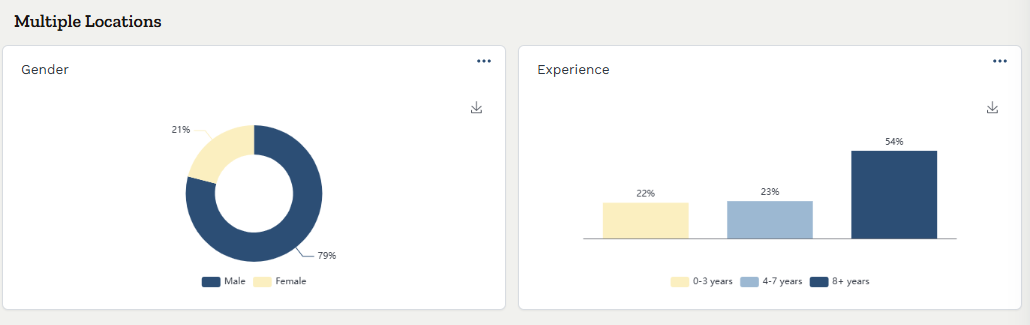
An example of some DEI data from Horsefly
Location hotspots
Talent clusters vary by occupation and change over time. Remote work has changed where some roles can be performed, while specialized hardware and manufacturing skills may remain tied to particular locations.
Track talent supply, competitor concentration, wage growth, and graduate output for each potential location. Online job postings can help identify emerging local demand, but they should be combined with other sources because online advertisements do not capture every vacancy or worker.
Strategic response: Shortlist sites for new hubs, identify secondary cities with less competition, and monitor when existing locations become more expensive or difficult to recruit in.
Using AI and Analytics for Deeper Insights
Labor market data spans job postings, professional profiles, and compensation records across countries, languages, and job title conventions. AI can help process this information, but its value depends on the quality of the underlying data and the relevance of its outputs. A well-designed talent intelligence solution combines AI and machine learning with reliable data analytics to support workforce planning and talent acquisition.
Three applications are particularly useful.
Normalization and skills taxonomies. The same job can appear under different titles, with skills described inconsistently across languages and employers. Models that map titles and descriptions to standardized taxonomies make comparisons easier. Taxonomy quality is therefore an important point of difference between vendors.
Pattern detection. Models can flag anomalies, such as a competitor's sudden hiring surge in a new skill cluster, more consistently than manual monitoring. Analysts still need to check whether the change reflects genuine demand, duplicated postings, or other factors.
Forecasting supply and demand. Predictive models estimate how talent supply and demand may change based on historical trends, graduate pipelines, and hiring velocity. These forecasts support planning but should be treated as estimates rather than facts. Unexpected events and changes in employer behavior can undermine historical assumptions. Ask vendors how their forecasts performed against actual outcomes and what uncertainty ranges they report.
The practical shift is from descriptive to predictive analysis. A descriptive report might show the median salary for cloud architects in Toronto last quarter. A predictive view might indicate that supply growth is slowing while several competitors are expanding, suggesting that current salary ranges could become less competitive. The prediction should be tested against the assumptions and evidence behind it before it informs a budget decision.
AI does not replace judgment. A hiring surge could reflect strategic expansion or an acquisition integration. Analysts who understand the business must interpret the output and distinguish meaningful signals from noise.
A Framework for Implementing Your CTI Strategy
CTI programs are more effective when they start with business decisions rather than data collection.
1. Define business objectives
Select two or three decisions CTI should improve and set measurable outcomes. Reducing time-to-hire for senior data engineers in three European hubs is more actionable than simply aiming to understand the talent market.
2. Identify key competitors and data points
Talent competitors often differ from commercial competitors. A regional bank may compete for engineers with technology firms, consultancies, and insurers. Identify where successful candidates come from and where departing employees go, then select data points aligned with your objectives.
3. Choose your technology partner
Building a platform in-house requires data licensing, normalization, taxonomy development, and ongoing data collection across jurisdictions. Most enterprises should evaluate existing providers before attempting this.
4. Integrate with internal systems
Combining external data with HRIS and ATS information enables comparisons between market compensation and offer acceptance rates, or between internal skills and external demand. Mapping internal job architectures to external skills taxonomies can be a significant implementation challenge. Integration with applicant tracking systems also helps recruitment teams connect market insights with their existing workflows.
5. Develop reporting and action cadences
Establish who receives insights, how often, and which decisions they inform. For example, executive teams might receive quarterly competitor briefings, while compensation teams receive monthly alerts. Every recurring insight should have a clear owner and purpose.
6. Measure and refine
Track progress against the original objectives and review competitor sets and data points annually as markets evolve. Monitor relevant talent metrics, including time-to-hire, offer acceptance, and retention, to assess whether the intelligence is improving outcomes.

Selecting the Right Talent Intelligence Platform
Vendor demonstrations can look similar, but differences in underlying data and methodology affect the usefulness of the results. Evaluate platforms against the following criteria.
-
Global data coverage. Assess the depth of coverage across countries and cities, particularly in difficult markets such as Vietnam, Poland, or Mexico.
-
Data freshness and granularity. Establish how frequently data is refreshed and whether analysis is possible at the skill and city level rather than only by broad role or country.
-
Skills taxonomy depth. Ask how many skills are covered, how the taxonomy is maintained, and how quickly emerging skills are added. Test it against a niche skill relevant to your business.
-
Predictive analytics capabilities. Check whether the platform forecasts supply, demand, and compensation trends, and ask for evidence of forecast accuracy.
-
Ease of integration. Review available APIs and connectors, and assess the work required to map your existing job architecture.
-
Methodology transparency. Ask how duplicate postings are removed, how undisclosed compensation is estimated, and how data quality is validated.
Run a proof of concept using a live business question. Give two or three shortlisted vendors the same challenge, such as identifying a suitable location for a 200-person engineering team, and compare their findings with internal knowledge. The 200-person figure is an illustrative test scenario, not a market statistic.
Estimating ROI
Build the business case around measurable outcomes and your own baseline figures.
-
Reduced time-to-hire: Days saved per hire × number of hires × daily cost of a vacancy, including lost productivity, contractor backfill, and delayed revenue.
-
Lower acquisition costs: Reductions in agency fees and sourcing expenditure from better-targeted searches.
-
Compensation accuracy: Savings from appropriately calibrated salary ranges and avoided costs associated with failed offers.
-
Retention: Avoided departures in at-risk populations × replacement cost per employee.
-
Avoided decision errors: The value of preventing costly mistakes, such as selecting a location with insufficient talent supply.
Be conservative. The first three levers alone may provide a defensible business case, without relying on difficult-to-quantify strategic benefits. Calculate benefits using your own baseline data and document assumptions so finance teams can challenge and validate them.
Handling the Ethics of Talent Data
Ethics and privacy are essential considerations in CTI because misuse of personal data creates regulatory and reputational risks.
CTI should focus on aggregated market data wherever possible. Questions about the number of people with a particular skill in Munich or what competitors pay for a role do not ordinarily require tracking named individuals.
However, aggregation alone does not guarantee compliance. Enterprises should ask vendors how they source data, establish their legal basis for processing, anonymize outputs, and prevent information from being traced back to individuals. Under the UK GDPR, organizations must identify a lawful basis for processing personal data and handle it lawfully, fairly, and transparently.
The California Consumer Privacy Act, as amended, also establishes privacy rights and obligations for businesses within its scope. Its application depends on the organization, the data, and the processing involved. Scraping publicly accessible information does not automatically remove privacy obligations, and legal responsibility depends on the circumstances and the roles of the parties involved.
Algorithmic bias is another risk. Skills-matching models and other AI systems can produce misleading or unfair results if their data, design, or use disadvantages particular groups. Vendors should explain how they test for bias, what they find, and what corrective measures they take.
Organizations should also establish internal governance before expanding CTI use, including access controls, approved applications, and rules for incorporating insights into employment decisions.
Regulatory requirements also need to be checked against the intended use of a system. Under the EU AI Act, certain AI systems used in employment are classified as high-risk, depending on their purpose and circumstances. The Act's application timetable includes different dates for different provisions and system categories; the consolidated regulation specifies December 2nd 2027 for the application of certain high-risk requirements under Annex III. Organizations should consult the current legislation and applicable guidance rather than assume every HR analytics tool has the same classification or deadline.
Future-Proofing Your Workforce with Advanced Intelligence
Workforce planning is increasingly shifting from job titles to skills. Skills-based hiring can reveal candidates who would be overlooked by conventional searches, such as a logistics analyst with Python and optimization skills who could move into supply chain data science.
This approach depends on reliable skills-level market data. Without it, organizations cannot adequately assess transferable capabilities or determine whether the market can supply the skills they need. Talent intelligence brings together external market insights and internal workforce information to help close skill gaps and make smarter hiring decisions.
Predictive analytics can also strengthen succession planning. Combining internal readiness data with external demand and hiring costs helps decide whether to develop internal talent or recruit externally for critical roles.
CTI is not a one-time benchmarking exercise. Competitor strategies and labor markets change continuously, so organizations must connect insights to recurring decisions and refine their approach as conditions evolve.
At Horsefly Analytics, we work with talent, workforce planning, and strategy leaders who need a continuous view across global markets: where skills are concentrated, who is competing for them, and what they cost. If your workforce plans still rely on last year's survey data and recruiter instinct, we'd be glad to show you what your market looks like with a clearer view.
See competitive talent intelligence in action. Schedule a strategic consultation:

Frequently Asked Questions
What is competitive talent intelligence, and how does it differ from general talent intelligence?
Competitive talent intelligence focuses on external market and competitor behavior to inform workforce decisions. General talent intelligence also includes internal workforce analytics, such as attrition modeling and internal mobility.
Why is competitive talent intelligence a critical business function for companies?
CTI helps organizations anticipate possible competitor moves, assess talent availability before expanding, manage labor costs, plan for future skills needs, improve recruitment efficiency and identify emerging retention risks.
What specific types of data are most important for effective competitive talent intelligence?
Key data includes competitor hiring patterns, in-demand skills, compensation and benefits, workforce representation, and location-specific talent supply. Together, these provide an actionable view of external labor markets, provided the limitations of each data source are understood.
How can organizations successfully implement a competitive talent intelligence strategy?
Define measurable business objectives, identify relevant talent competitors and data points, select a suitable platform, integrate external insights with internal systems, establish reporting and action cadences, and measure results.
Where does artificial intelligence specifically add value in competitive talent intelligence analysis?
AI helps standardize job titles and skills, detect unusual hiring patterns, and estimate future talent supply, demand and compensation trends. Forecasts remain uncertain and require human interpretation and validation.
What ethical considerations should companies be aware of when using competitive talent intelligence?
Organizations should prioritize privacy, use appropriately aggregated data, verify vendors' data sourcing and legal compliance, test models for bias, and establish governance for the use of insights in employment decisions.
How often should competitive talent intelligence data be reviewed and updated to remain effective?
Data should be refreshed continuously where possible, with reviews scheduled according to the decision involved. Quarterly executive briefings and monthly compensation reviews are examples of useful cadences.
Sources: Horsefly Analytics, EU AI Act, EUR-Lex, OECD, New York State Department of Labor, GDPR, ICO, CPPA