Contents:
-
Building the Foundation: Key Pillars of Your Diversity Hiring Strategy
-
Measuring What Matters: KPIs for Diversity Talent Acquisition
Key Takeaways:
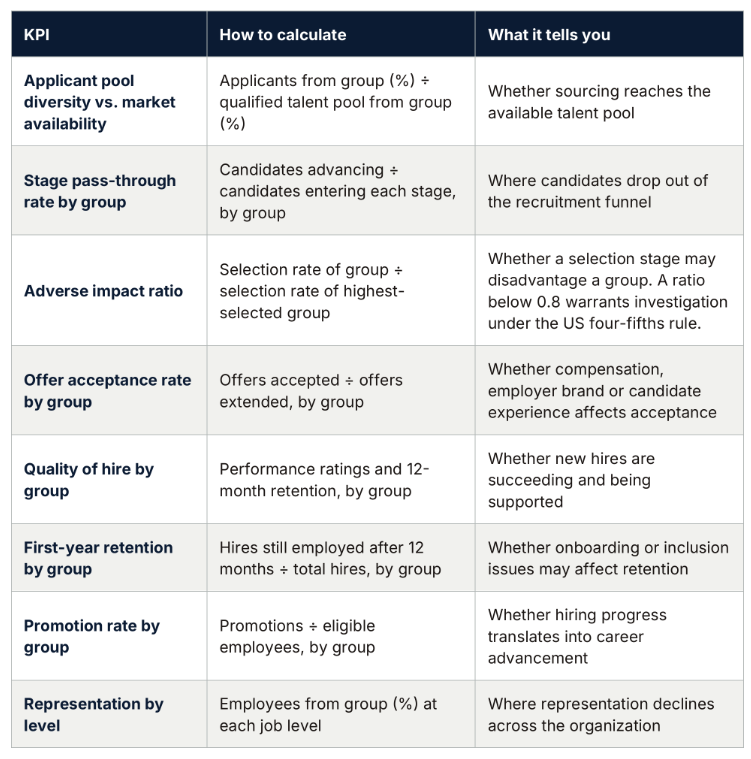
1. Compare your applicant pool to the qualified talent pool, not the general population, to find where the problem sits. If women are 22% of qualified cloud architects in a market but 12% of your applicants, sourcing isn’t reaching enough of them. If they’re 22% of applicants but 10% of hires, the issue is more likely in selection. That stops you spending on more advertising when the real problem is biased screening. Pair it with stage pass-through rates by group and the adverse impact ratio, where below 0.8 warrants investigation under the US four-fifths rule. Where hiring volumes are low, aggregate by job family or quarter, since small samples give unreliable ratios.
2. Change the process, not just awareness, at each stage. Bias training alone is unlikely to fix it. Use structured interviews with the same core questions, a defined scoring rubric, and independent scoring before discussion. Rotate diverse panel members instead of leaning on the same underrepresented employees, and recognize that work in performance reviews. In job descriptions, separate true requirements from preferences, name the skill instead of using a degree as a proxy, and publish pay ranges. Replace vague “culture fit” with defined, job-related behaviors.
3. Check AI tools before adopting them, and know the legal limits by region. Ask vendors what data trained the model, whether it has had adverse impact testing, and whether the results are available. Skills-based matching and inclusive language analysis are lower-risk uses. NYC Local Law 144 requires annual bias audits of certain tools, and the EU AI Act treats many recruitment systems as high-risk. The law on diversity hiring also differs by region: the US generally permits outreach but not quotas, the UK allows limited positive action, and EU rules restrict sensitive demographic data. A global strategy needs consistent objectives with locally adapted data collection.
—----------------------------------------------------
Building a diverse workforce starts with how organizations attract, assess, and hire talent. However, setting representation targets is only part of the challenge. Employers also need to understand where qualified candidates are, whether their sourcing strategies reach them, and where bias may be limiting access to opportunities.
A successful diversity talent acquisition strategy combines inclusive recruitment practices with accurate labor market data. By understanding talent availability across different roles and locations, organizations can set realistic hiring goals, broaden their sourcing efforts, and identify gaps throughout the recruitment process.
This guide explores how to build a more inclusive talent acquisition strategy, from expanding talent pipelines and reducing hiring bias to using AI responsibly, measuring recruitment outcomes, and calculating ROI.
What Is Diversity Talent Acquisition?
Diversity talent acquisition is the process of designing recruitment strategies to attract, assess, and hire candidates from a wider range of backgrounds. It means looking beyond familiar universities, competitor networks, and employee referrals to reach the full pool of qualified talent.
A strong strategy has two key considerations:
-
Understanding the business case: Diverse teams can bring different perspectives, challenge assumptions, and support better decision-making. Research has also found a correlation between leadership diversity and business performance, although correlation does not prove causation.
-
Setting realistic hiring goals: Diversity targets should reflect the availability of qualified talent in each role and location. Labor market data helps organizations understand where talent exists, identify gaps in their sourcing strategies, and set achievable goals.
Building the Foundation: Key Pillars of Your Diversity Hiring Strategy
A workable diversity hiring strategy rests on three things: where you source, how you describe the job, and what candidates see when they look you up.
Diverse Talent Pipelines
Start by reviewing where you source candidates. Referral programs can reinforce existing workforce demographics because employees often refer people from similar backgrounds and networks. Rather than removing referrals, track their demographic outcomes and balance them with other sourcing channels.
Expand your reach through channels such as:
-
Professional associations: Build relationships with networks representing women, ethnic minorities and other underrepresented groups in your target disciplines through events, mentoring and ongoing engagement.
-
Alternative education pathways: Source candidates through coding bootcamps, apprenticeships, community colleges, and returnship programs.
-
Veteran and disability networks: Partner with organizations that connect employers with skilled veterans and candidates with disabilities.
-
Geographic expansion: Include secondary cities and remote-eligible regions to access talent pools beyond your usual hiring locations.
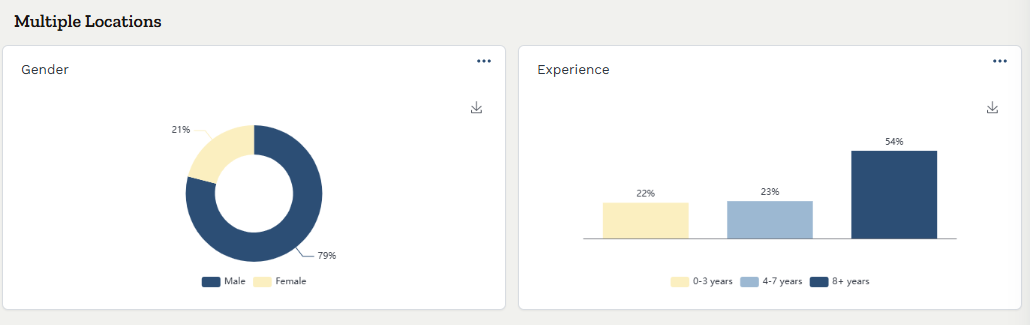
Image shows some DEI data from Horsefly
Inclusive job descriptions
Job descriptions filter candidates before a recruiter sees a single application. The most common failures we see:
1. Inflated requirements. Listing ten "required" qualifications when four matter. Research cited widely in the field suggests women are less likely than men to apply unless they meet nearly all listed criteria. Separate true requirements from preferences, and cut the preferences list hard.
2. Gender-coded language. Words like "dominant," "rockstar," and "aggressive" skew masculine in tone. Neutral alternatives describe the work itself.
3. Degree requirements that the role doesn't need. If a degree is a proxy for a skill, name the skill instead.
4. Missing flexibility and pay information. Salary ranges are now legally required in several US states and under the EU Pay Transparency Directive. Publishing them also lifts applications from candidates who assume they'll be lowballed.
5. Generic diversity statements. Boilerplate at the bottom of the posting changes nothing. A specific line about accommodations, parental leave, or flexible schedules does more.
Employer brand and career sites
Candidates from underrepresented groups research employers carefully. They check whether leadership pages show any diversity, whether employee resource groups exist and are funded, and what current employees say on review sites. Your career site should show real employees in real roles, state your accommodation process clearly, and work properly on mobile and with screen readers. Stock photography of a diverse team that doesn't match your actual leadership page does more harm than having no photos at all.
How to Reduce Bias at Each Stage of Recruitment
Unconscious bias refers to automatic assumptions that influence decisions without deliberate intent. In recruitment, it can affect who recruiters source, how resumes are assessed, how candidates are interviewed, and who ultimately gets hired.
Bias training alone is unlikely to address these issues. Organizations also need practical changes to their recruitment processes.
Sourcing
Recruiters often return to channels that have worked before, which can reinforce existing hiring patterns. Set sourcing targets across different channels and review search criteria for potential proxies, such as specific universities or previous employers.
Screening
Names, photographs, addresses, and educational backgrounds can influence how recruiters assess resumes. Blind screening removes these details during the initial review to help keep the focus on relevant skills and experience. However, anonymization can also remove useful context, so some organizations apply it only at the first screening stage.
Interviewing
Unstructured interviews leave more room for subjective judgments. Structured interviews create a consistent basis for assessing candidates:
-
Ask every candidate for the same role the same core questions.
-
Use a scoring rubric with clearly defined criteria.
-
Have interviewers score candidates independently before discussing their assessments.
-
Include diverse interview panels, with representation beyond the immediate hiring team.
Diverse panels can bring different perspectives to hiring decisions and help candidates see the organization's commitment to inclusion. However, avoid repeatedly relying on the same underrepresented employees. Rotate panel members and recognize their contribution in performance reviews.
Hiring Decisions
Bias can re-enter during final discussions. Require interviewers to support their scores with evidence from the assessment rubric. Avoid using vague terms such as "culture fit" unless they refer to clearly defined, job-related behaviours.
Using Technology and AI for Fairer Hiring
Technology can reduce bias or industrialize it. Amazon's abandoned recruiting algorithm, which learned to penalize resumes containing the word "women's," remains the reference case for what goes wrong when a model is trained on historically skewed hiring data.
The tools that tend to help:
-
Inclusive language analysis. AI-powered tools scan job ads for gendered, exclusionary, or jargon-heavy language and suggest alternatives before posting. These are low-risk and quick to roll out.
-
Skills-based matching. Instead of keyword-matching on job titles and employers, skills-based hiring tools infer capabilities from experience and match candidates to required skills. This surfaces career changers and candidates from non-traditional backgrounds that title-based search misses.
-
ATS anonymization and structured workflows. Modern Applicant Tracking Systems (ATS) can redact identifying information, enforce standardized scorecards, and track demographic pass-through rates at each stage when candidates self-identify.
-
Talent intelligence. Talent intelligence draws on external labor market data to show where talent with specific skills is concentrated, how competitive each market is, and what the available pool looks like demographically. This is the input that makes sourcing strategy and goal-setting realistic.
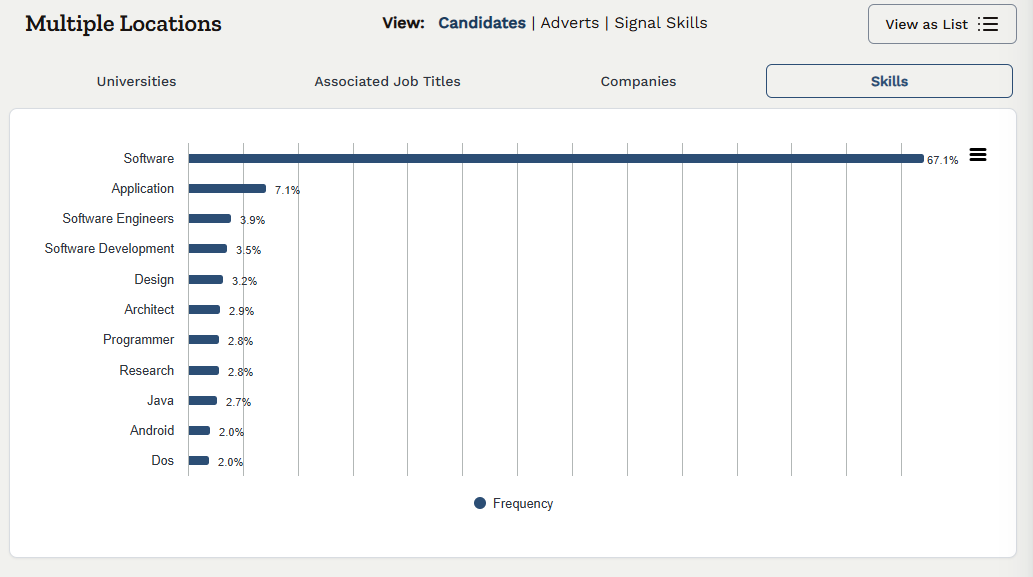
Image shows Skills data from Horsefly
Before adopting an AI screening tool, organizations should assess how it makes decisions and whether it could disadvantage certain candidate groups. Ask vendors what data was used to train the model, whether it has undergone adverse impact testing, and whether the audit results are available.
Regulatory requirements are also evolving. New York City's Local Law 144 requires annual bias audits of certain automated employment decision tools, while the EU AI Act classifies many AI systems used in recruitment as high-risk, subjecting them to additional obligations. Organizations should prepare for increasing scrutiny by keeping human oversight in hiring decisions and monitoring selection rates across candidate groups after implementation.
Measuring What Matters: KPIs for Diversity Talent Acquisition
Most organizations track the percentage of hires from underrepresented groups, but this figure alone doesn't show where recruitment is succeeding or where candidates are dropping out. To understand the effectiveness of your strategy, measure diversity at every stage of the recruitment funnel.
Core diversity metrics
Using Benchmarks Correctly
Compare your applicant pool against the qualified talent pool for the same occupation and location, not the general population. For example, if women make up 22% of qualified cloud architects in a particular market but only 12% of your applicants, your sourcing strategy may not be reaching enough candidates. If women account for 22% of applicants but only 10% of hires, the issue is more likely to lie in the selection process.
This distinction helps organizations identify where recruitment is falling short and direct resources accordingly, rather than investing in more advertising when the real issue may be biased screening.
Keep two points in mind when interpreting the data:
-
Sample size: Small candidate pools can produce unreliable ratios. Where hiring volumes are low, aggregate data by job family or quarter.
-
Self-identification: Demographic data often relies on voluntary disclosure. Explain why the information is collected and how it is protected to encourage participation.
Calculating the ROI of Diversity Initiatives
To assess the return on diversity initiatives, organizations need to compare the cost of their recruitment efforts with the business benefits they deliver.
Program costs
Include the resources needed to implement the strategy, such as recruitment partnerships, sourcing tools, recruiter time, training, and additional interview hours.
Business benefits
Look at the improvements that can be linked to your diversity initiatives:
-
Lower employee turnover: Better recruitment and onboarding can improve retention, reducing the costs associated with replacing employees.
-
More efficient hiring: Broader sourcing strategies can reduce reliance on recruitment agencies, lower hiring costs, and help fill vacancies faster.
-
Stronger talent pipelines: Reaching new candidate groups can increase the availability of qualified applicants for hard-to-fill roles.
-
Better business outcomes: Different perspectives can support innovation, problem-solving and a stronger understanding of diverse customer markets. These benefits can be harder to measure directly.
Putting the numbers into perspective
For example, an organization that reduces early employee turnover and recruitment agency costs through more effective sourcing may save more than it spends on its diversity initiatives. The exact return will depend on the program's costs and measurable outcomes.
To make the assessment credible, talent acquisition and workforce analytics teams should work together to track these results and ensure the figures are supported by internal data.
Overcoming Common Hurdles in Diversity Recruitment
Implementing a diversity recruitment strategy involves more than changing hiring practices. Organizations also need to secure leadership support, manage limited resources, address resistance, and navigate different legal requirements.
Leadership Buy-in
Executive support can fade after the initial announcement. To maintain accountability, include diversity metrics in business unit reviews, give hiring managers visibility into their recruitment data, and link progress to executive goals. Presenting the business case through measurable outcomes, such as reduced turnover and recruitment costs, can also help secure ongoing support.
Budget Constraints
When budgets tighten, diversity initiatives can be among the first programs cut. Rather than relying on additional funding, review how existing recruitment budgets are spent. Redirect some job board spending toward partnerships that reach a broader talent pool. Structured interviews and inclusive job descriptions can also improve recruitment without significant additional costs.
Resistance to Change
Hiring managers may resist structured interviews or unfamiliar sourcing channels. Start with willing teams, measure the results, and share evidence of improvements in hiring outcomes. Demonstrating what works in practice can help build wider support for change.
Legal Considerations for Diversity Hiring
Diversity recruitment laws vary across regions, so global strategies must account for local requirements. Key differences include:
-
United States: Title VII prohibits employment discrimination based on protected characteristics. Outreach and pipeline expansion are generally permitted, but preferential selection and quotas can create legal risks.
-
United Kingdom: The Equality Act 2010 permits certain positive action measures, including targeted outreach and limited tie-break provisions. Positive discrimination remains unlawful.
-
European Union: GDPR places additional requirements on the collection and processing of sensitive personal data, including information about racial or ethnic origin and health. Rules and practices around demographic data also vary between member states.
-
South Africa and India: South Africa's Employment Equity Act requires designated employers to implement and report on employment equity measures. India's reservation policies apply primarily to the public sector, while private-sector inclusion requirements differ.
The key takeaway is that a single global diversity framework cannot rely on identical data categories and practices everywhere. Organizations should establish consistent overall objectives while adapting data collection and recruitment processes to local laws.

Integrating Talent Acquisition and DEI
Talent acquisition (TA) and diversity, equity and inclusion (DEI) teams need to work together to make diversity goals achievable. When DEI sets representation targets without input from TA, or TA focuses only on time-to-fill, diversity can become a reporting exercise rather than part of the recruitment strategy.
A more integrated approach involves shared responsibility across four areas:
-
Shared goals: Set realistic representation goals together, using labor market data to understand talent availability.
-
Co-owned metrics: Track recruitment funnel performance alongside retention, promotion, and engagement across employee groups.
-
Joint process design: Combine DEI expertise in bias and accessibility with TA's practical recruitment experience to create more inclusive hiring processes.
-
Full employee lifecycle: Extend inclusion efforts beyond recruitment to onboarding, sponsorship, internal mobility, and promotion. Monitor exit feedback to identify potential issues before they affect retention more broadly.
Embedding a DEI partner within the TA leadership team and sharing responsibility for diversity sourcing budgets can further strengthen collaboration.
Building Cognitive Diversity into Your Hiring Strategy
Demographic diversity helps broaden representation, but it doesn't automatically mean teams approach problems differently. Cognitive diversity refers to differences in how people think, process information, and solve problems. These differences can come from varied disciplines, industries, career paths, cultural backgrounds, and neurotypes.
For example, a product team that includes an engineer, a former teacher and an operations professional may approach customer challenges from very different perspectives.
Organizations can encourage cognitive diversity by looking beyond traditional hiring criteria:
-
Explore problem-solving approaches: Ask candidates how they approached an ambiguous challenge, what alternatives they considered, and what changed their thinking.
-
Use open-ended assessments: Include practical exercises with multiple valid solutions and assess candidates on their reasoning rather than whether they follow familiar approaches.
-
Assess existing team strengths: Before opening a role, identify the perspectives and skills the team lacks instead of simply looking to replace someone with a similar profile.
Cognitive diversity should complement, not replace, demographic diversity. The two are not interchangeable, and using "diversity of thought" as a substitute can distract from the need to address representation gaps.
Include neurodiversity in your approach. Traditional interviews may not give every candidate an equal opportunity to demonstrate their abilities. Providing questions in advance, offering work-based assessments and making reasonable accommodations can help neurodivergent candidates showcase their skills more effectively.
Making Diversity Part of Global Workforce Planning
Diversity should be built into workforce planning rather than treated as a separate recruitment initiative. Organizations need to consider talent representation alongside skills availability, headcount forecasts, and location strategies.
Include Diversity in Workforce Planning
When planning future workforce needs, consider the demographic composition and depth of talent pools alongside skills availability and labor costs. For example, choosing a location for a new engineering hub should involve assessing whether the local market offers access to a broad and diverse talent pool.
Use Labor Market Data to Guide Decisions
Reliable global labor market data helps organizations move beyond assumptions and make informed decisions about diversity hiring. It can help teams:
-
Identify where diverse talent pools are concentrated.
-
Understand competition for talent across different markets.
-
Set realistic representation benchmarks by role and location.
-
Identify gaps between available talent, sourcing reach, and recruitment outcomes.
This is where Horsefly Analytics supports workforce planning and talent acquisition leaders. Its talent intelligence provides labor market insights to help organizations understand talent availability, market competition, and realistic hiring opportunities across locations.
Turn Diversity Goals into Measurable Outcomes
With reliable data, organizations can move beyond broad representation targets and give leadership a clearer picture of progress. They can identify where qualified talent exists, how effectively recruitment reaches those candidates, where potential barriers arise and what addressing those gaps could mean for the business.
This makes diversity talent acquisition a measurable part of global workforce planning and a more informed approach to competing for talent.
Schedule a strategic consultation to see how labor market intelligence supports smarter, more inclusive hiring decisions.

Frequently Asked Questions
What are practical ways to remove bias from resume screening?
Implement blind resume reviews to strip identifying information like names, photos, and graduation years, which helps reduce unconscious bias. Some organizations anonymize only for the initial screen to retain important context later. This process can be easily integrated into most applicant tracking systems.
How do I calculate the return on investment for diversity recruitment programs?
Calculate ROI by dividing the quantified benefits (like reduced turnover costs, lower cost-per-hire, wider candidate pools) minus program costs, all by the program costs. This framework demonstrates financial value to stakeholders beyond correlation studies.
What kind of language should I avoid in job descriptions to make them more inclusive?
Avoid gender-coded terms like "dominant" or "rockstar," and excessively inflated requirements. Focus on skills and true necessities over proxies like specific degrees. Instead, use neutral language describing the actual work and provide clear information on salary and flexibility.
Which key performance indicators should I track to measure diversity hiring success effectively?
Track applicant pool diversity against market availability, stage pass-through rates by group, adverse impact ratios, and offer acceptance rates. Also, monitor quality of hire, first-year retention, and promotion rates by group to diagnose successes or failures across the entire recruitment funnel.
What are the legal considerations for diversity hiring in different regions like the US and EU?
Legal frameworks vary significantly. The US prohibits quotas, while the UK permits "positive action." The EU restricts collecting certain demographic data, and some countries like France may forbid ethnic data collection entirely. Global programs require local counsel to ensure compliance.
How can companies expand their talent pipeline beyond traditional sourcing methods?
Broaden sourcing beyond typical referral networks and university programs. Engage with professional associations for underrepresented groups, explore non-traditional education routes like bootcamps, and partner with veteran transition or disability employment programs. Consider geographic expansion to new markets.
What specific accommodations help neurodiverse candidates succeed in job interviews?
To support neurodiverse candidates, offer interview questions in advance, allow work-sample assessments instead of conversational interviews, and clearly communicate available accommodations. This approach helps reduce disadvantages inherent in traditional interview formats for individuals with conditions like autism or ADHD.
Sources: Horsefly Analytics, EU Pay Transparency Directive, PwC, New York City's Local Law 144, Deloitte, EU AI Act, Title VII, Equality Act 2010, GDPR, South Africa's Employment Equity Act