.png?width=2000&name=Horsefly-Logo-NewTag_White%20(3).png)
Why Strategic Workforce Planning is a Global Imperative
Many organizations still approach hiring reactively. A position opens, a job description is written, recruiters start sourcing, and the search begins.
That approach is manageable when the required talent is readily available. It becomes much harder when you're looking for specialized skills or competing for talent in a small number of global markets.
The issue isn't necessarily a lack of recruiting effort. It's a lack of visibility.
Without a reliable understanding of where talent is located, what skills are available, what compensation looks like, and how heavily competitors are hiring, workforce decisions are often based on assumptions. A company might choose a location because office costs are attractive, only to discover that the local talent pool is too small. Compensation may be set using broad benchmarks that don't reflect current market conditions. Succession plans may depend on internal candidates whose capabilities don't quite match what the business will need next.
At the same time, skills are changing quickly. Areas such as cybersecurity, data science, AI, and specialized engineering remain highly competitive, while remote and distributed working models have made it easier for employers to compete for talent across borders.
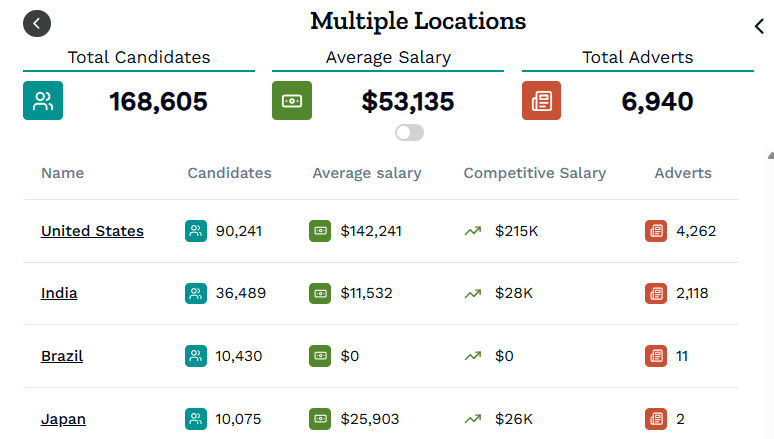 Example of cybersecurity engineer location data from within Horsefly
Strategic workforce planning is designed to connect people decisions with business strategy. To do that effectively, organizations need a better understanding of the markets they're hiring from.
That's where global talent mapping comes in.
What is Global Talent Mapping?
Traditional recruitment starts with a vacancy:
Who can fill this role?
Global talent mapping starts further upstream:
Where is the talent we may need, and what does the market look like?
Recruitment is usually triggered by an immediate requirement. Talent mapping is an ongoing process that examines the broader labor market, including people who aren't actively looking for a new job.
That can include looking at:
-
Where specific skills and roles are concentrated
-
Which organizations employ those people
-
How talent supply compares with demand
-
Typical compensation levels
-
Competitor hiring activity
-
Emerging talent markets
-
Skills that are becoming more or less available over time
A strong global talent mapping strategy should also connect external market intelligence with your internal workforce.
Internally, that means understanding the skills your employees have today, where capability is developing, which roles may be vulnerable to attrition, and where future successors are likely to come from.
Externally, it means understanding the wider market and identifying talent pools that could support future hiring needs.
The result is a much broader view of your talent supply. Rather than starting from scratch whenever a role opens, you have an existing picture of the market to work from.
The Core Benefits of Global Talent Mapping
There are several reasons organizations invest in talent mapping, but three tend to have the greatest strategic value.
Identifying and Bridging Global Skill Gaps
Most organizations know they have skills gaps. The harder question is exactly where those gaps are and how significant they are.
Talent mapping helps make that assessment more precise by comparing the capabilities your workforce has today with the capabilities your business strategy is likely to require.
For example, a financial services organization may have strong statistical and risk expertise across its workforce but limited experience with newer machine learning technologies. That could lead to several different decisions: developing existing employees, hiring externally, acquiring a team, or looking at locations where the relevant skills are more readily available.
The important point is that the decision starts with an understanding of the gap.
Building Stronger Global Talent Pipelines
When a critical employee leaves unexpectedly, organizations often have to begin the search from scratch.
That can mean agency fees, extended vacancies, significant recruiter time, and compromises on candidate fit.
Talent mapping allows companies to build relationships with relevant talent pools before the need becomes urgent. You can identify where suitable candidates are likely to be found, understand the competitive landscape, and establish a realistic view of what it will take to attract them.
The result isn't a guarantee that the right person will be available when you need them. It is a much better starting position than having no market intelligence at all.
Strengthening Succession Planning
Succession planning can become too internally focused.
An organization might identify a high-potential employee as a future successor without fully understanding the capabilities that role will require or how long it will take to develop them.
Combining internal talent assessment with external market intelligence provides another layer of context.
For example, if an internal successor is likely to need three years of development but the business expects the position to become vacant within 18 months, the organization has a decision to make. It can accelerate development, restructure responsibilities, or look externally.
That is a much more useful conversation than simply identifying a successor and hoping the timing works out.
The Business Case for Talent Mapping
The financial case for talent mapping isn't captured by one universal ROI figure. The impact will vary considerably depending on the organization, industry, role types, and scale of the workforce.
The value tends to show up in a few familiar areas.
Lower Cost-per-Hire
Knowing where relevant talent is concentrated can reduce wasted sourcing activity. Instead of relying heavily on agencies, job boards, or broad searches, recruitment teams can focus their efforts on markets and talent pools with a stronger likelihood of success.
Better Retention
Hiring the wrong person is expensive, particularly in senior or highly specialized positions.
Current compensation intelligence can also help organizations make more informed offers. Salary surveys can be useful, but they may not capture rapidly changing conditions in a specific location or skill market.
Understanding current supply, demand, and compensation gives hiring teams more context when deciding how competitive an offer needs to be.
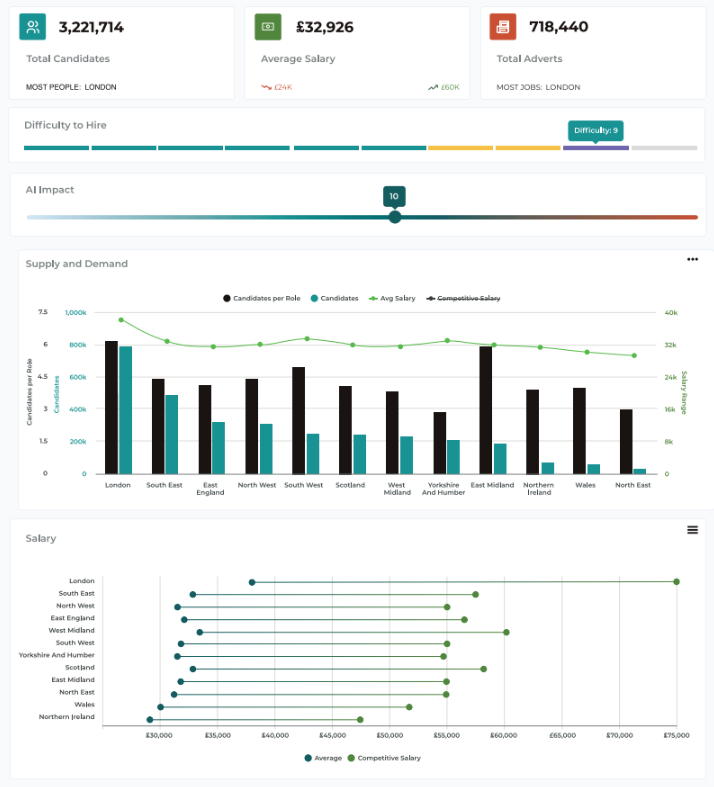
A view of supply and demand data from Horsefly
Faster Time-to-Fill
The earlier an organization understands its talent market, the less it has to start from zero when a vacancy appears.
That matters particularly for roles where an extended vacancy has a meaningful operational or financial impact, such as sales leadership, product management, engineering, or plant operations.
For organizations looking to build a hard-number business case, one of the most useful exercises is to calculate the cost of vacancy and the cost of a poor hire using internal data. Those figures will usually be more meaningful than relying solely on generic industry averages.
The Anatomy of a Global Talent Mapping Strategy
A useful talent mapping strategy brings several types of information together.
Internal Talent Assessment
Start with the workforce you already have.
A useful skills inventory should go beyond performance ratings. It should help answer questions such as:
-
What technical capabilities exist today?
-
Which leadership capabilities are developing?
-
Where are the critical dependencies?
-
Which roles are difficult to replace?
-
Where are there potential succession gaps?
Frameworks such as competency matrices and the 9-box grid can help organize the information.
The important part is connecting the assessment to business strategy. If the organization plans to develop AI-driven products, for example, knowing that employees have "AI" listed somewhere in their profiles isn't enough. You need to understand what they can actually do.
External Market Intelligence
This is often the most difficult part of global talent mapping.
Organizations need a view of talent supply, demand, compensation, geographic distribution, and competitor activity. They may also need to understand how those factors are changing over time.
Doing this across multiple countries and at a useful level of detail is difficult to maintain manually. Data can quickly become outdated, and differences between markets can make broad comparisons misleading.
Skills Taxonomy and Critical Roles
Not every role needs the same level of analysis.
Start by identifying the positions and capabilities that matter most to the business. Critical roles are often those that are difficult to replace, closely tied to revenue or operations, or dependent on scarce skills.
A clear skills taxonomy also makes it easier to compare internal capabilities with external talent markets.
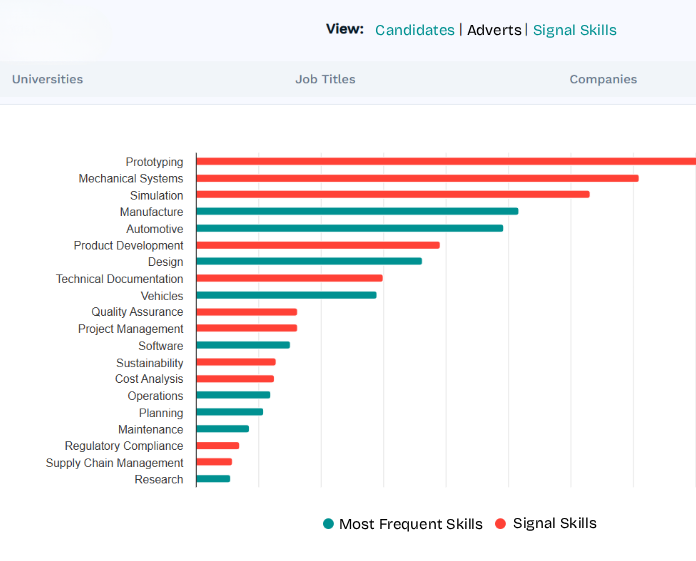
The Signal Skills functionality gives an insight into which skills are gaining traction in real time
Competitive Environment Analysis
Your talent market is also your competitors' talent market.
If several competitors are hiring the same type of specialist from the same geographic pool, competition for those skills is likely to increase.
Understanding where competitors are hiring, which skills they are targeting, and how crowded a particular market has become can help organizations identify alternative locations and sourcing strategies before the market becomes even more competitive.
How to Implement Your Strategy: A 5-Step Framework
Step 1: Start with Business Objectives
Begin with the business strategy rather than the existing organizational structure.
What markets are you entering? What products or services are you developing? What capabilities will those plans require?
This keeps talent mapping focused on future business requirements rather than simply reproducing the workforce you already have.
Step 2: Define Scope
Trying to map every role in every country at once is likely to create more complexity than value.
Start with a specific business unit, geography, or critical role family.
A manufacturer might begin by mapping plant leadership across its Asia-Pacific operations. A technology company might focus on senior software engineering talent in a handful of emerging markets.
Once the approach is working, it can be expanded.
Step 3: Gather and Analyze Data
Bring together internal workforce data and external labor market intelligence.
The quality of the output depends heavily on the quality of the underlying data. Incomplete skills records, inconsistent job titles, or outdated market information can quickly undermine the usefulness of the analysis.
Data cleaning, validation, and consistent skills definitions are therefore important parts of the process, rather than administrative tasks to deal with later.
Step 4: Build Talent Profiles and Scenarios
For critical roles, define the capabilities, experience, location requirements, compensation expectations, and other relevant criteria.
Then consider what could change.
What happens if attrition rises? What if a competitor opens a large operation in the same market? What if the business needs a capability earlier than expected?
Scenario planning turns a talent map into something that can support actual workforce decisions.
Step 5: Activate, Monitor, and Refine
A talent map has little value if it ends up in a presentation and isn't used again.
Connect the insights to recruitment, workforce planning, succession, compensation, and budgeting processes. Then keep the information current.
Talent markets change. Competitors enter and leave markets. Skills evolve. Compensation moves.
For that reason, global talent mapping works best as an ongoing capability rather than a once-a-year exercise.
The Role of AI in Global Talent Intelligence
It is possible to build a talent map using spreadsheets, manual research, and publicly available information.
The challenge is keeping it comprehensive and current at global scale.
A single workforce planning question might require an organization to identify people with a particular skill set, assess where they are concentrated, understand who employs them, estimate compensation, examine supply trends, and compare several potential locations.
Repeating that analysis across multiple countries and roles quickly becomes difficult for a human team to maintain.
AI-powered talent intelligence platforms can automate much of this work and identify patterns across large datasets.
At Horsefly Analytics, our platform is designed to help organizations analyze global labor markets across areas such as talent supply, demand, compensation, skills adjacencies, and competitive hiring activity.

One of the advantages of AI is the ability to analyze relationships across large volumes of data. That can help surface emerging talent clusters, identify adjacent skills that may broaden a sourcing strategy, and highlight changes in supply and demand before they become obvious through traditional research.
The result is a shift away from static talent reports toward a more continuously updated view of the labor market.
For example, if a competitor announces a new R&D operation in a particular city, workforce planners may want to understand how that could affect the local talent market, compensation, and competition for specific skills.
Combining those signals with compensation data can also help organizations make more informed decisions about where to hire and what those decisions are likely to cost.
Global Complexities: Ethics, Data Privacy, and Bias
Talent mapping involves workforce data, so the process needs to account for more than business value.
Privacy, responsible data use, and algorithmic bias should be considered from the beginning.
Data Privacy Across Jurisdictions
Global organizations operate across very different regulatory environments. Requirements under frameworks such as GDPR in Europe, LGPD in Brazil, PIPL in China, and US state privacy laws can affect how personal data is collected, processed, stored, and used.
The practical implications depend on the specific data and use case, which is why organizations should not assume that an approach that works in one market will automatically work in another.
Privacy-by-design is an important principle here.
At Horsefly Analytics, we use aggregated and anonymized labor market data to provide market-level intelligence without requiring organizations to expose individual identities. This supports workforce analysis while helping organizations operate within the privacy requirements relevant to their markets.

Mitigating Bias in AI and Assessment
AI doesn't automatically remove bias from workforce decisions.
If the data used to build or train a system contains historical biases, those patterns can potentially be reproduced or amplified.
Organizations using AI for talent intelligence should therefore consider regular testing and auditing, diverse data sources, appropriate human oversight, and clear limits on how automated insights are used.
The objective isn't to claim that a system is completely free from bias. It is to identify risks, measure them, and improve the system over time.
Supporting DE&I Objectives
Talent mapping can also help organizations broaden their approach to sourcing.
If a company has historically recruited from the same universities, cities, or countries, a broader analysis of the labor market may reveal other locations with relevant skills and more diverse talent pools.
That outcome isn't automatic, however. Diversity considerations need to be part of the strategy from the beginning.
Organizations can incorporate relevant diversity measures into their talent profiles, monitor pipeline composition, and assess whether new sourcing markets are actually expanding access to talent.
Global Talent Mapping in Action
The following scenarios illustrate how organizations can use talent mapping to inform workforce decisions.
Finding Specialized Skills in New Markets
A technology company needs specialists in a highly competitive area of AI. Traditional markets such as San Francisco, London, and Toronto are expensive and already crowded with employers.
A broader talent market analysis identifies a growing pool of relevant specialists in Eastern Europe, giving the company another option to explore for remote or distributed hiring.
The decision isn't based simply on lower compensation. The organization can compare skill availability, competition, compensation, and other market factors before deciding whether the location makes sense.
Preparing for Leadership Succession
A global manufacturer expects a number of plant directors across its Asia-Pacific operations to retire over the coming years.
Rather than handling each vacancy independently, the organization maps its internal talent against the capabilities required for plant leadership. It identifies development gaps, creates targeted development plans, and uses external market intelligence to understand where additional candidates could be sourced if needed.
The result is a succession strategy based on both internal capability and external market reality.
Supporting a New Market Entry
A consulting firm is considering two cities for a new delivery center.
Instead of comparing office costs alone, the organization looks at the available talent pool, competitor presence, compensation levels, and other labor-market factors in each location.
One city may appear cheaper from a property perspective, but if its relevant talent pool is considerably smaller and several established competitors are already hiring there, the overall business case may be weaker.
Talent mapping gives the organization another layer of evidence to use in making the location decision.
Build Your Future Workforce with Data-Driven Insights
Global talent mapping is becoming increasingly important for organizations that need to make workforce decisions across multiple markets.
The companies that get the most value from it tend to treat workforce planning as an ongoing business process. They invest in reliable data, connect talent intelligence to broader business strategy, and regularly revisit their assumptions as markets change.
The alternative is to wait for a vacancy, start searching, and discover the limitations of the talent market after the hiring process is already underway.
Horsefly Analytics helps organizations build a clearer picture of global labor markets, combining intelligence on talent supply, demand, compensation, skills, and competitive dynamics.
For CHROs, talent acquisition leaders, and workforce planning teams, that intelligence can provide a stronger foundation for decisions about where to hire, which skills to develop, and how to prepare for future workforce requirements.
The talent market is constantly changing. The earlier you understand the landscape, the more options you have.

Frequently Asked Questions
What is global talent mapping and how does it differ from traditional recruitment?
Global talent mapping provides a continuous view of the talent market, including relevant skills, locations, employers, compensation, supply, and demand. Traditional recruitment is generally focused on filling a specific vacancy. Talent mapping takes a broader, proactive approach that can inform hiring and workforce decisions before a role becomes urgent.
What are the key benefits of implementing a global talent mapping strategy?
Global talent mapping can help organizations identify skills gaps, build stronger talent pipelines, support succession planning, and make more informed decisions about where and how to hire. It can also help reduce sourcing costs and improve time-to-fill by giving recruiting teams a clearer understanding of relevant talent markets.
How can global talent mapping help identify and close skill gaps?
Talent mapping compares the capabilities available within an organization with the skills required to deliver its future business strategy. Once gaps are identified, organizations can decide whether to address them through hiring, reskilling, upskilling, team restructuring, or a combination of approaches.
What steps should an organization follow to implement global talent mapping effectively?
Start by connecting the initiative to business objectives and defining a manageable scope. Gather relevant internal and external data, build talent and role profiles, model potential workforce scenarios, and then connect the resulting insights to recruitment, succession, workforce planning, and budgeting processes. The map should also be reviewed regularly as labor markets change.
How do data privacy regulations impact global talent mapping initiatives?
Global talent mapping needs to take account of the privacy requirements that apply in each market. Regulations such as GDPR, LGPD, and PIPL can affect how personal data is collected, processed, stored, and used. Organizations should use privacy-by-design principles and consider whether aggregated or anonymized data can provide the required market intelligence without unnecessarily exposing individual information.
What types of technology are best for managing global talent mapping data?
AI-powered talent intelligence platforms can be useful for organizations managing large, complex labor-market datasets. They can help analyze talent supply and demand, compensation, skills, geographic distribution, and competitive hiring activity at a scale that would be difficult to maintain manually. The right technology should also provide appropriate data governance, transparency, and privacy controls.
Is global talent mapping only for large enterprises, or can smaller companies use it?
Talent mapping isn't limited to large enterprises. Smaller organizations can apply the same principles on a narrower scale, focusing on critical roles, specific skills, or the markets most relevant to their growth plans. The level of analysis can be scaled according to the organization's needs and resources.
Sources: Horsefly Analytics, GDPR, CCPA, LGPD, PIPL