
Contents:
Key Takeaways:
1. Segment KPIs and define quality of hire simply. An average time-to-hire of 42 days can hide data engineering roles in Warsaw taking 90. Pair cost-per-hire with 12-month retention and performance, since chasing cheaper sources can drive early attrition. Choose a defensible quality-of-hire definition, such as first-year retention plus a six-month manager rating, and apply it consistently. A basic metric teams use beats a sophisticated one they don’t.
2. Use AI to rank and surface candidates, not to reject them. The three real applications are predictive analytics (flagging early that a requisition is unlikely to fill in 60 days), NLP screening, and market discovery outside your ATS. Screening carries the most legal and reputational risk under rules like NYC Local Law 144 and the EU AI Act, so require vendors to explain match scores and share bias audit methodology. Also ask whether your data trains models serving other customers, and where it is stored.
3. Analyze DEI by funnel stage, and set targets against the available talent pool. If women are 30% of applicants, 28% at phone screen, and 12% of final-round candidates, the drop-off shows where to investigate, though it doesn’t prove the cause. A 50% target in a market where women are a much smaller share of qualified professionals is either impossible or, set too low, not credible. Several countries restrict collecting demographic data and sample sizes can be small, so analyze at a meaningful level of aggregation and say plainly where data is incomplete.
—-----------------------------------------
Moving Beyond Gut-Feel: The Strategic Imperative for TA Analytics
Hiring decisions based on historical data and recruiter experience alone can leave organizations with an incomplete picture of the talent market. Talent acquisition analytics software helps bridge that gap by combining recruitment performance data with external labor market intelligence.
For organizations hiring across multiple locations, this broader view is particularly valuable. Talent availability, salary expectations, and competition for skills can vary significantly between markets. Understanding these differences helps talent acquisition teams assess whether hiring plans are realistic, identify potential challenges early, and make more informed decisions about where and how to recruit.
This guide explores the features to look for, how AI can support talent acquisition analytics, and what organizations should consider when evaluating and implementing these platforms.
Essential Features of Modern Talent Acquisition Software
Every vendor demo will show you a dashboard. The dashboard tells you very little. What matters is whether the numbers behind it can be trusted and whether anyone acts on them.
KPI Tracking That Holds Up to Scrutiny
Track core recruitment KPIs such as time-to-hire, time-to-fill, cost-per-hire, offer acceptance rate and quality-of-hire. Segment the results by role family, geography, business unit and recruitment source to see where performance differs. Without that context, an average time-to-hire of 42 days could hide the fact that data engineering roles in Warsaw take 90 days to fill.
Two common mistakes can undermine your reporting:
-
Treating cost-per-hire as a standalone goal. Focusing only on reducing costs can favor cheaper recruitment sources that lead to early attrition. Pair cost-per-hire with 12-month retention and performance data to get a more meaningful picture.
-
Using a vague definition of quality-of-hire. This metric is difficult to measure because it relies on post-hire performance data from the HRIS, which may be missing or inconsistent across regions. Choose a simple, defensible definition, such as first-year retention combined with a manager rating at six months, and apply it consistently. A basic metric that teams actually use is more valuable than a sophisticated one they don't.
Funnel Analysis
Your talent acquisition funnel, from application and screening through interviews, offers and acceptance, should show conversion rates and the time candidates spend at each stage. This helps identify where candidates are dropping out or delays are slowing the process. For example, analysis might reveal that hiring managers are taking too long to review shortlists or that a technical assessment is causing a high rate of candidate drop-off.
Identifying the specific bottleneck makes it easier to address the problem, whether that means setting clearer review deadlines, simplifying assessments, or improving communication with candidates.
Data Visualization
Dashboards should be built for the decisions each audience makes. Recruiters need requisition-level views. TA leaders need pipeline health across regions. The CHRO and CFO need a few forward-looking indicators tied to business plans. One dashboard serving everyone usually serves no one.
ATS and HRIS Integration
Your hiring analytics software needs reliable data from your applicant tracking system (ATS) and human resource information system (HRIS). Without consistent data across these systems, it becomes difficult to track recruitment performance and connect hiring activity to post-hire outcomes.
When evaluating vendors, consider the following:
-
Integration method: Does the platform use APIs to sync data regularly, or rely on scheduled flat-file exports?
-
Data mapping: Can it map requisition IDs, job codes and organizational structures across multiple ATS instances, particularly after acquisitions?
-
Job title variations: Can it account for different job titles used for the same role across countries?
-
Pre- and post-hire data: Can it connect candidate records in the ATS with employee records and outcomes in the HRIS? This is important for measuring quality-of-hire.
Clear answers to these questions will help you assess whether a platform can provide consistent, reliable data without creating additional manual work for your team.
How AI and Predictive Analytics Can Improve Hiring
Most "AI-powered" recruitment features are rules engines with a new label. The real applications fall into three groups, and each comes with tradeoffs you should understand before you buy.
Predictive Analytics
Predictive analytics for hiring uses historical patterns to estimate future outcomes: how long a requisition is likely to take, which open roles are at risk of missing their target date, which candidates in late stages are likely to decline. The useful version flags a risk early enough to act. If a model tells you in week two that a requisition for a quantitative analyst in Singapore has a low probability of filling in 60 days, you can widen the search, adjust compensation, or reset expectations with the business before the date slips.
Prediction is only as good as its training data. A model trained on five years of your hires will reproduce whatever patterns existed in those hires, including the biased ones. A model trained only on your data also knows nothing about markets you have never hired in, which is usually where you need help most.

Machine Learning for Candidate Screening
Natural language processing can parse resumes and match skills to job requirements more flexibly than keyword filters. It recognizes, for example, that "built streaming pipelines in Kafka" is relevant to a data engineering role even if the phrase "data engineer" never appears.
This is where you need to be more cautious. Automated candidate screening is where AI in recruitment carries the most legal and reputational risk. Regulations such as New York City's Local Law 144 and the EU AI Act place hiring-related AI under specific scrutiny, including bias audit and transparency obligations. Our position: use machine learning to rank and surface candidates for human review, not to reject them automatically. And require any vendor to explain which factors drive a match score.
AI-Powered Sourcing and Market Discovery
The highest-value use of machine learning, in our experience, is outside your ATS entirely. AI-powered sourcing and market analysis can process millions of job postings, profiles, and labor data points to show where specific skills are concentrated, which adjacent skills transfer well, and which markets have growing supply that competitors have not yet targeted. This is how a manufacturer finds that a mid-sized city two hours from its planned site has more qualified controls engineers than the capital. Your internal data cannot answer that question at all.
Keeping Data Safe When Using AI for Recruitment
Before choosing an AI-enabled platform, senior leaders should understand how it handles sensitive candidate and employee data. Ask vendors:
-
Model training: Is your data used to train AI models that serve other customers?
-
Data storage and processing: Where is data stored and processed? Does this meet GDPR and local data residency requirements in the countries where you operate?
-
Anonymization: How is personal data anonymized or aggregated before analysis?
-
Security standards: Does the vendor hold certifications such as SOC 2 Type II or ISO 27001, and when were they last audited?
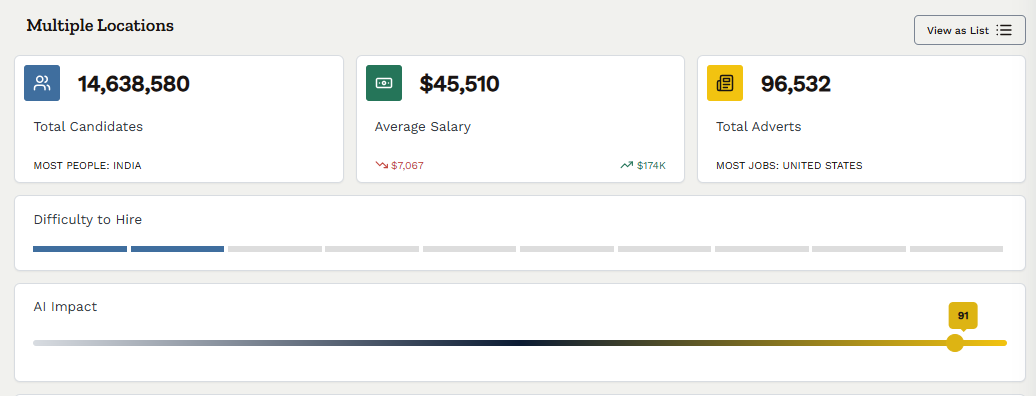
A view of the AI Impact functionality in Horsefly
It's also important to understand the difference between platforms that analyze aggregated, anonymized labor market data and those that process personal candidate records. They involve different types of data and carry different privacy and security considerations.
Using Recruitment Data to Identify Gaps in Representation
Many DEI reports focus on hiring outcomes, such as the percentage of women hired into engineering roles. While useful, this tells you little about what happened during the recruitment process or where disparities may have occurred.
Analyzing candidate progression at each stage gives you a more detailed picture. Track the proportion of candidates from different demographic groups who progress from application to screening, interview and offer. For example, women might account for 30% of applicants for software roles, 28% of candidates reaching the phone-screen stage and 12% of final-round candidates.
This pattern suggests that women's representation decreases as the recruitment process progresses. To understand where this happens, compare the proportion of candidates from each group who advance at every stage. Differences can highlight areas worth investigating, such as screening criteria, technical assessments or interview practices.
These findings don't automatically establish the cause of a disparity, but they give recruitment teams a clearer starting point for reviewing their processes and deciding where changes may be needed.
Reducing Bias in the Hiring Process
Two upstream interventions consistently produce results:
-
Job description language analysis. Gendered phrasing, inflated requirement lists, and unnecessary degree requirements shrink applicant pools before anyone reviews a resume. Analytics tools can flag these patterns and test whether revised descriptions change applicant mix.
-
Structured interview tracking. Comparing interviewer scoring patterns can reveal individuals whose ratings differ consistently by candidate group. Handle this carefully, as coaching material, not as a disciplinary tool.
Setting Realistic Diversity Targets
Diversity metrics mean more when compared against the available talent pool. A goal of 50% women in hardware engineering hires may be aspirational in a market where women make up a much smaller share of qualified professionals. Without external labor market data, targets are either too timid or impossible, and both outcomes damage credibility. Representation data for the relevant labor market lets you set targets that stretch the organization while remaining defensible to the board.
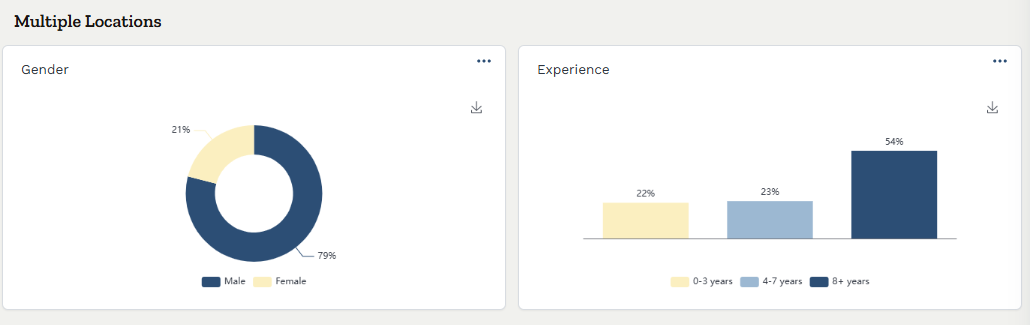
Image shows some DEI data that Horsefly can provide
Challenges of Measuring DEI Across Markets
Global DEI analytics comes with real constraints. Several countries restrict collecting ethnicity or other demographic data, and self-identification is voluntary nearly everywhere, which leaves gaps in your data. Sample sizes for specific roles in specific locations are often too small for reliable conclusions. Analyze at a level of aggregation where the numbers are meaningful, and say plainly in reports where data is incomplete.
Comparing the Top Talent Acquisition Analytics Platforms
To compare hiring analytics options fairly, run each vendor through the same three real scenarios from your hiring plan and compare the answers. Demos built around a vendor's chosen examples tell you nothing about your markets. Here's a quick comparison:
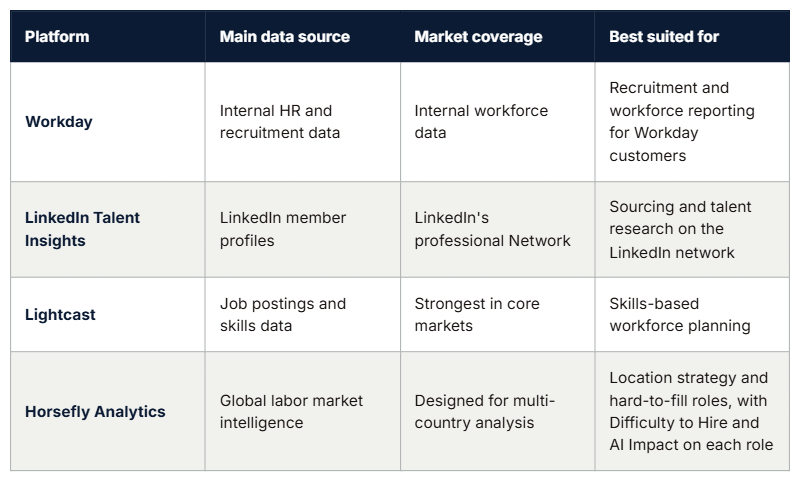
No single platform covers every need, and anyone claiming otherwise is selling. The top talent acquisition software options split into types: tools that analyze your internal process, tools that describe the external market, and combinations of both. Below is our view of four widely evaluated options, including our own.
Horsefly Analytics
Strengths: At Horsefly Analytics, we focus on global labor market intelligence: talent supply, demand, competition, and cost data across the markets where enterprises hire. Our platform uses AI to process that data into insights leaders can act on, such as where a scarce skill is available, how much competition you will face for it, and what that means for cost and time to hire.
We built it for the questions that internal data cannot answer: where to locate a new hub, whether a hiring plan is achievable, and how to reach talent in markets you have not recruited in before. Data security is part of how we design the product, not an add-on.
Weaknesses: We are a labor market intelligence platform, not an ATS or HRIS. You will still need your internal systems for requisition management and process reporting. The strongest setups pair our external view with good internal funnel data.
Ideal use case: Global enterprises in tech, finance, and manufacturing making location, workforce planning, and hard-to-fill hiring decisions across several countries, where getting the market wrong is expensive.
Workday (HRIS-Native Recruiting Analytics)
Strengths: For organizations already running Workday HCM and Workday Recruiting, native reporting avoids integration work entirely. Pre-hire and post-hire data sit in the same system, which makes quality-of-hire and retention analysis simpler.
Weaknesses: The analytics are inward-facing. They describe your process well and tell you little about external talent supply, competitor demand, or markets you have not entered. Advanced analysis often requires additional modules or analyst resources.
Ideal use case: Enterprises standardized on Workday that need reliable operational reporting on their own hiring process.
LinkedIn Talent Insights
Strengths: Built on LinkedIn's member data, it provides useful views of talent pools, skill concentrations, and where talent moves between employers. Recruiters already familiar with LinkedIn Recruiter adapt quickly.
Weaknesses: Coverage reflects LinkedIn's user base, which is uneven across countries, industries, and seniority levels. In markets where professionals rely on local networks, or for skilled trades and manufacturing roles, the picture can be incomplete.
Ideal use case: Tech and professional services firms focused on white-collar talent in markets with high LinkedIn usage.
Lightcast
Strengths: A large job postings and skills dataset with a well-developed skills taxonomy. Strong for skills-based workforce planning and for analyzing employer demand trends, particularly in the US and UK.
Weaknesses: Its strength in skills and demand data is most pronounced in some regions. Enterprises hiring across Asia-Pacific, Latin America, or Eastern Europe should test coverage for their specific markets.
Ideal use case: Organizations building skills taxonomies or doing workforce planning concentrated in its strongest geographies.
A Framework for Choosing Your Analytics Partner
When choosing recruitment software, use these evaluation criteria in roughly this order of importance.
1. Data Scope and Quality
-
Does the platform cover every country where you hire now and plan to hire in the next three years?
-
What are the data sources, how often are they refreshed, and how is duplicate or low-quality data filtered out?
-
Will the vendor validate its numbers against a market where you already know the answer?
2. Integration Capabilities
-
Are there proven connectors for your specific ATS and HRIS, including versions and configurations?
-
Can it handle multiple instances of the same system from acquired companies?
-
Who owns integration maintenance when your systems are upgraded?
3. Scalability
-
Can it support new business units, countries, and users without re-implementation?
-
How does pricing change as usage grows? Per-seat models can make it costly to extend access to hiring managers.
4. Data Security and Compliance
-
Does it hold current SOC 2 Type II or ISO 27001 certification?
-
Are GDPR, data residency, and AI-specific regulatory requirements covered in each jurisdiction?
-
Are role-based access controls granular enough to restrict sensitive compensation and DEI data?
5. AI Transparency
-
Can the vendor explain what drives its predictions and match scores?
-
Has it run bias audits, and will it share the methodology?
6. Time to Value and Support
-
How long until the first decision-ready insight? Tip: ask for a realistic answer, not a best case.
-
Does the vendor provide analysts or advisors who understand labor markets, or only technical support?

Implementation and Adoption: Maximizing Your Software's ROI
Software implementation fails more often on adoption than on technology. Plan for both.
Clean the Data First
Analytics applied to messy data produces confident, wrong answers. Before go-live, audit your internal data:
-
Normalize job titles and map them to a consistent job architecture across regions.
-
Standardize source tracking. If recruiters tag "LinkedIn," "LI," and "LinkedIn Recruiter" separately, your source-of-hire analysis is broken.
-
Fix requisition status hygiene. Requisitions left open after roles are filled distort time-to-fill.
-
Confirm that hire dates and start dates in the ATS match the HRIS.
This work is tedious and usually takes longer than the technical integration. Budget for it honestly.
Change Management That Works
Recruiters will not adopt a tool that feels like surveillance. Hiring managers will not adopt one that adds steps. Approaches that work:
-
Start with a recruiter problem. Show recruiters how market data helps them push back on unrealistic hiring manager requirements. Once a recruiter uses salary and supply data to reset a requisition that was never going to fill, adoption follows.
-
Build analytics into intake meetings. The intake conversation between recruiter and hiring manager is the best moment to use labor market data, because expectations are set there.
-
Find a visible executive use case. When a business leader cites the data in a planning review, user adoption among everyone below them speeds up.
-
Limit the initial rollout. Pilot with one region or role family, prove value, then expand. Global big-bang launches tend to produce global indifference.
Measuring Success
Set baselines before go-live, or you will have nothing to compare against. Track two layers:
-
Leading indicators: active users, number of requisitions where market data informed intake, share of hiring plans validated against market supply.
-
Lagging indicators: time-to-fill for hard-to-fill roles, agency spend, offer acceptance rates, first-year attrition, and the share of hiring plans delivered on time.
Recruitment analytics ROI is most persuasive to finance when tied to avoided costs: agency fees not paid, vacancy days reduced on revenue-generating roles, and location decisions that avoided an under-supplied market. Translate each improvement into money, and review quarterly with finance in the room.
Make Smarter Workforce Decisions with Horsefly Analytics
Successful workforce planning starts with understanding the talent market beyond your organization. Internal recruitment data can show how efficiently you hire, but it can't tell you whether the skills you need are available, what they're likely to cost or how competitive a particular market will be.
That's where external talent intelligence makes a difference. Horsefly Analytics helps organizations explore labor market conditions across locations, assess talent availability, benchmark salaries, and understand competition for in-demand skills. This gives decision-makers a clearer picture of what's achievable before committing to a hiring plan, expanding into a new market, or investing in new capabilities.
Rather than relying on assumptions or fragmented market data, organizations can use Horsefly's labor market intelligence to make more informed, evidence-based decisions. Whether you're planning a new location, assessing hard-to-fill roles, or preparing for changing workforce demands, understanding the market puts you in a stronger position to act.
Want to see what better talent intelligence could mean for your organization?
Book a strategic consultation with Horsefly Analytics to explore how our platform can help you make more confident workforce and talent acquisition decisions.

Frequently Asked Questions
What is the difference between talent acquisition analytics and talent intelligence?
Talent acquisition analytics focuses on internal recruitment performance, such as time-to-hire, cost-per-hire, and offer acceptance rates. Talent intelligence looks beyond the organization to external labor market conditions, including talent availability, salary expectations, skills supply, and competitor demand. Combining both gives businesses a more complete picture of their hiring challenges and opportunities.
What should organizations look for in talent acquisition analytics software?
Look for software that provides reliable reporting, integrates with existing HR systems and allows you to segment recruitment data by role, location and business unit. If your organization hires across multiple markets, external labor market intelligence is also important. Consider data coverage, accuracy, methodology and how easily teams can turn insights into decisions.
How does labor market data support workforce planning?
Labor market data helps organizations understand whether the skills they need are available in their target locations, how competitive those markets are, and what recruitment may cost. This information can inform decisions about expansion, hiring priorities, salary budgets, and alternative talent pools before plans are finalised.
Can AI predict future recruitment needs?
AI and predictive analytics can use historical recruitment and workforce data to identify patterns and estimate potential outcomes, such as hiring timelines or future skills demand. However, predictions depend on the quality and relevance of the underlying data. They should support planning and decision-making rather than be treated as guaranteed outcomes.
How can organizations benchmark salaries across different countries?
International salary benchmarking requires more than converting salaries into a common currency. Organizations need to account for local pay conditions, job responsibilities, experience levels, and differences in labor markets. Reliable market data helps businesses compare compensation more accurately and assess whether their offers are competitive.
How can organizations identify where talent is available for hard-to-fill roles?
Start by identifying the specific skills and experience required, rather than relying on job titles alone. Then compare talent availability across relevant locations, considering the size of the potential talent pool, competition for those skills, and salary expectations. Labor market intelligence platforms such as Horsefly Analytics can help organizations explore these factors when assessing recruitment markets.
How does Horsefly Analytics support talent acquisition and workforce planning?
Horsefly Analytics provides external labor market intelligence to help organizations assess talent availability, compare markets, and make more informed decisions about recruitment and workforce planning. Its insights complement internal HR and recruitment data by giving businesses a broader view of the markets in which they operate.
Sources: Horsefly Analytics, GDPR, LinkedIn, New York City's Local Law 144, Deloitte, EU AI Act