.png?width=2000&name=Horsefly-Logo-NewTag_White%20(3).png)
The half-life of labor market data has collapsed. A compensation benchmark from six months ago may already be irrelevant in fast-moving sectors like AI engineering or cloud security. Remote work has blown open geographic boundaries, meaning your talent competitors now include companies in cities and countries you've never recruited from. And yet, many global enterprises still rely on annual salary surveys, recruiter intuition, and job board metrics to make hiring decisions worth millions.
Here's what that actually costs you:
-
Slower time-to-fill because your team is chasing candidates in oversaturated markets while ignoring viable talent pools elsewhere
-
Offers that either overshoot (wasting budget) or undershoot (losing candidates to better-informed competitors)
-
Workforce plans that assume yesterday's labor supply will look like tomorrow's
The shift we see among the most effective talent organizations isn't just about getting better data. It's about getting faster data, from broader sources, with enough granularity to act on. That requires moving beyond traditional sourcing and into continuous talent market analysis.
The Core Components of Modern Talent Market Analysis
Talent market analysis is a set of interconnected intelligence streams that, when combined, give you a real picture of where talent lives, what it costs, who else wants it, and how the supply is shifting.
Skills Demand Mapping
You need to know: Which skills are growing in demand across your industry and adjacent sectors? Which are declining? This isn't about job titles. Two companies can post the same "Data Engineer" role with radically different skill requirements. Tracking skills at the granular level (specific programming languages, certifications, domain expertise) reveals what the market actually values versus what your job descriptions assume.
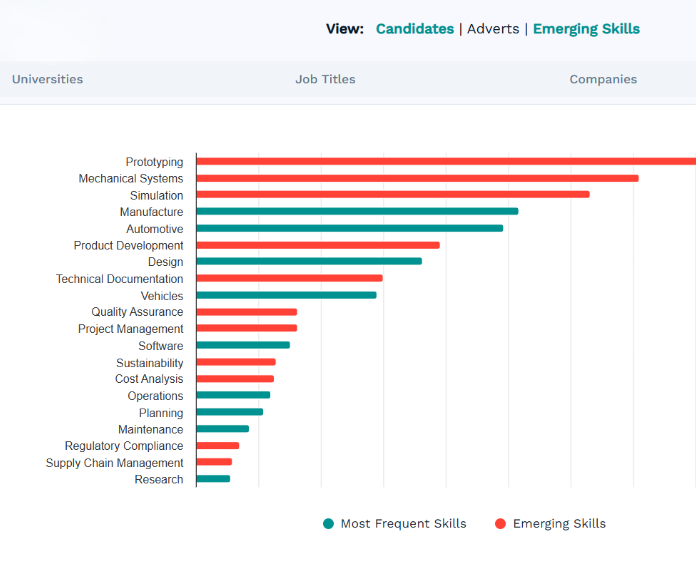
Image shows the Signal Skills functionality within Horsefly
Talent Pool Identification
Where are the people with the skills you need, geographically and organizationally? How large are those pools? How many are actively looking versus passively employed? A talent pool of 50,000 software engineers in a region sounds promising until you discover 80% work for three companies with retention rates above 90%.
Competitor Analysis
This goes well beyond knowing which companies post similar roles. It means understanding their hiring velocity, which skills they're prioritizing, where they're expanding, and how their employer brand positions them relative to yours.
Compensation Benchmarking
Real-time salary data, segmented by skill, experience level, location, and industry, is the difference between making competitive offers and recycling last year's ranges. This includes base salary, equity, bonuses, and benefits packaging.
Diversity Data
Understanding the demographic composition of available talent pools helps you set realistic DE&I goals and identify underrepresented sources of skilled candidates.
None of these components works in isolation. The value comes from layering them: knowing not just that a skill is in demand, but where the supply is concentrated, who's competing for it, and what the market rate looks like in each location.
How Horsefly Analytics helps: Rather than gathering skills, compensation, competitor, and talent-pool data from multiple sources, Horsefly Analytics brings these intelligence streams together on a single platform. HR and talent teams can explore global labor markets, benchmark locations, compare competitors, and identify talent opportunities in minutes instead of weeks.
Identifying and Closing Critical Skills Gaps
Skills gap analysis is where talent market analysis becomes directly operational. The question isn't abstract ("Do we have the right skills?"). It's specific: "We need 40 machine learning engineers in Southeast Asia within 18 months. Can the market support that, and at what cost?"
Start with what you actually need. Map the skills required for your strategic priorities over the next one to three years. Then compare that against your internal inventory (what your workforce has today) and the external market (what's available to hire or develop).
The gap between those two views tells you whether to build, buy, or borrow talent. In some cases, the external supply is so thin that hiring your way out of a skills gap is unrealistic, and upskilling or reskilling programs become the only viable path. In others, you'll discover that the talent exists but is concentrated in locations you haven't considered, which opens the door to new site strategies or remote hiring.
What most organizations get wrong here is treating skills gaps as a recruitment problem alone. If your analysis shows that a particular skill has a global supply-to-demand ratio of 1:5, no amount of recruiter effort will close that gap fast enough. That's a workforce planning problem that requires a mix of internal development, contingent labor, and strategic partnerships
Building an accurate picture of external talent availability is often the hardest part of skills gap analysis. Horsefly Analytics combines global labor market data with skills intelligence to help organizations understand where talent exists, how competitive each market is, and whether hiring, reskilling, or relocating offers the strongest path forward.

Uncovering Your True Talent Competitors
Most companies can name their product competitors in seconds. Few can accurately name their talent competitors. And the two lists rarely overlap.
A financial services firm hiring cloud architects isn't just competing with other banks. It's competing with tech giants, fast-growing startups, consulting firms, and healthcare companies undergoing digital transformation. If your talent acquisition strategy only benchmarks against your industry vertical, you're blind to where your candidates are actually going when they reject your offers.
Talent competitor analysis identifies every organization that recruits for the same skill sets, regardless of sector. This reveals "hidden competitors," companies you wouldn't consider rivals, but that consistently win candidates from your pipeline. Once you know who they are, you can study their employer value proposition, compensation structures, and hiring patterns. That intelligence informs where you need to differentiate.
Maybe a competitor offers more equity. Maybe they have a stronger remote work policy. Maybe their employer brand resonates more effectively with a specific demographic. You can't counter what you can't see.
This analysis also surfaces competitive dynamics at the location level. A city might look attractive for a new engineering hub until you discover that two major employers are aggressively scaling there, driving salaries up and talent availability down. That's the kind of insight that prevents expensive mistakes, and it only emerges from systematically mapping hiring activity across the market.
The Advantages of Platforms vs. Manual Research
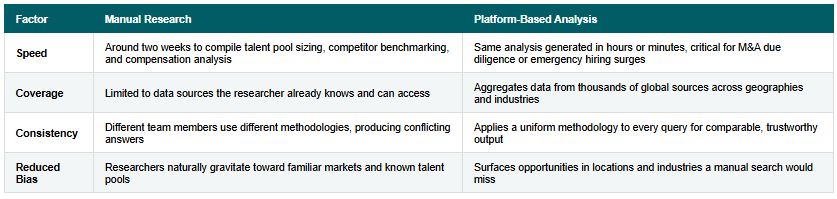
Manual talent market research, pulling data from job boards, salary surveys, LinkedIn searches, government statistics, and broker reports, has three problems that don't go away no matter how good your team is: it's slow, it's incomplete, and it's inconsistent.
A dedicated talent market intelligence platform such as Horsefly Analytics changes the equation by bringing together global labor market data, talent supply, compensation benchmarks, competitor intelligence, and workforce insights in a single platform. Here’s what to consider:
Speed
What takes an analyst two weeks to compile manually (talent pool sizing across five regions, competitor benchmarking, compensation analysis) can be generated in hours or minutes. For time-sensitive decisions like M&A due diligence or emergency hiring surges, that speed difference is the difference between informed action and reactive guessing.
Coverage
Manual research tends to rely on whatever data sources the researcher knows and has access to. A platform aggregates data from thousands of sources globally, covering geographies and industries that no individual analyst can track. This is especially relevant for organizations operating across multiple countries with varying data availability.
Consistency
When different team members run analyses using different methodologies and different source sets, you get conflicting answers to the same question. A platform applies a uniform methodology to every query, ensuring comparable and trustworthy output.
Reduced Bias
Human researchers naturally gravitate toward familiar markets and known talent pools. AI-driven platforms surface opportunities in locations and industries that wouldn't appear in a manual search, broadening the aperture for sourcing.
Integrating External Market Data with Internal Analytics
Your HRIS tells you who works for you, what they're paid, how long they've been there, and how they perform. It doesn't tell you whether their skills are becoming obsolete, whether their compensation is market-competitive, or whether the talent to replace them exists if they leave.
External market data fills those gaps. But the real value emerges when you combine the two.
For example, if your internal data shows rising attrition among mid-level data scientists, that's a signal, but not a diagnosis. Layer in external data showing that competitor hiring for data scientists in your region increased 30% year-over-year and median compensation rose 15%, and now you have a diagnosis. Your people are being recruited away by competitors offering more money in a tightening market.
That combined view changes the response. Instead of a generic retention initiative, you can target salary adjustments to the specific roles and locations where competitive pressure is highest, while simultaneously identifying alternative talent pools to backfill departures.
Integration also strengthens workforce planning models. Internal succession planning is more realistic when you know the external availability (or scarcity) of the skills you'd need to hire if internal candidates don't materialize. Expansion planning is more accurate when you can overlay your growth targets against actual talent supply in target locations.
The organizations doing this well are connecting people analytics platforms with external labor market intelligence and reviewing the combined picture continuously, not just once a year during planning season.
Metrics for Your Talent Intelligence Dashboard
The right metrics depend on what decisions you're trying to inform. But across the organizations we work with, these consistently prove most actionable:
Skills Metrics
-
Skills in rising demand (by region and industry)
-
Skills in declining demand (signaling automation or market shifts)
-
Supply-to-demand ratio for priority skills
Talent Pool Metrics
-
Pool size by skill, location, and experience level
-
Geographic concentration (risk of over-reliance on a single market)
-
Active vs. passive candidate ratios
Compensation Metrics
-
Median base salary by skill, role, and location
-
Total compensation benchmarks (including equity and benefits)
-
Year-over-year compensation movement for target roles
Competitor Metrics
-
Competitor hiring volumes by skill and location
-
New market entries (competitors opening offices or hiring in new geographies)
-
Competitor attrition signals (layoffs, restructuring, negative employer reviews)
Efficiency Metrics
-
Time-to-fill benchmarked against market averages
-
Cost-per-hire relative to local market conditions
-
Offer acceptance rates compared to competitor benchmarks
The point isn't to track everything. It's to track what changes your decisions. A metric that sits in a dashboard but never triggers an action is noise, not intelligence.

The Role of AI in Shaping Future Recruitment
AI's impact on talent acquisition is already significant and accelerating. At the most basic level, AI automates candidate sourcing and screening at a scale no human team can match. But the more strategic applications are in pattern recognition and prediction.
AI algorithms can analyze hiring trends across industries and regions to identify emerging skills before they appear in mainstream job postings. They can predict which talent pools are likely to tighten based on investment patterns, university enrollment data, and immigration policy changes. They can flag compensation trends that signal you'll need to adjust offers within a specific window to remain competitive.
What AI doesn't do well, at least not yet, is replace human judgment on context-dependent decisions. An algorithm can tell you that a candidate's skill profile matches your requirements. It can't tell you whether they'll thrive in your company culture or whether their career trajectory suggests they'll stay.
There's also the question of algorithmic bias, which deserves direct attention rather than a footnote. AI models trained on historical hiring data can perpetuate existing biases in who gets sourced, screened, and shortlisted. Any organization using AI in talent acquisition needs to audit its models for bias regularly and ensure that diversity goals are embedded in the system's design, not treated as an afterthought.
Turn Talent Market Analysis into Better Hiring Decisions
Talent market analysis shouldn't be something you revisit once a year. Organizations gaining a competitive advantage are using real-time labor market intelligence to guide hiring, workforce planning, expansion strategies, compensation decisions, and skills planning every day.
That requires more than spreadsheets and static reports. It requires a platform that brings together global labor market data, talent supply, competitor activity, compensation benchmarks, skills intelligence, and workforce analytics in one place.
Horsefly Analytics helps organizations answer questions such as:
-
Where is the best location to hire for this role?
-
Which companies are competing for the same talent?
-
How large is the available talent pool?
-
What salary will it take to attract candidates?
-
Which skills are becoming harder to source?
-
Where should we expand next?
Instead of spending weeks gathering information from disconnected sources, your team can access continuously updated market intelligence that supports faster, more confident workforce decisions.
Whether you're planning global expansion, building a future skills strategy, or improving recruitment performance, Horsefly Analytics gives HR and talent leaders the data they need to reduce hiring risk and uncover new opportunities.
Ready to make smarter talent decisions?
See how Horsefly Analytics helps organizations transform labor market data into actionable talent intelligence.
Book a strategic consultation and discover how data-driven talent market analysis can strengthen your hiring strategy.
Frequently Asked Questions
Why is traditional talent sourcing no longer effective for modern hiring?
Traditional talent sourcing, relying on outdated data and methods, fails because the labor market changes too rapidly. Static annual surveys or intuition cannot keep pace with dynamic compensation, evolving remote work landscapes, or emerging skills demands, leading to missed hires and inefficient spending.
What are the essential components of a comprehensive talent market analysis?
A modern talent market analysis includes skills demand mapping, talent pool identification, competitor analysis, real-time compensation benchmarking, and diversity data. These interconnected intelligence streams provide a holistic view of talent availability, cost, and the competitive landscape.
How does talent market analysis help organizations close critical skills gaps?
Talent market analysis identifies critical skills gaps by comparing strategic needs with internal capabilities and external market supply. This insight determines whether to build talent internally through upskilling, buy from the market, or borrow through contingent labor, ensuring a comprehensive workforce strategy.
How can my organization identify its true talent competitors beyond direct industry rivals?
Organizations identify true talent competitors by analyzing all entities that recruit for similar skill sets, regardless of industry. This approach reveals "hidden competitors" such as tech giants or startups, allowing companies to understand their employer value proposition, compensation, and hiring patterns to differentiate effectively.
What advantages do talent market intelligence platforms offer over manual research?
Talent market intelligence platforms provide superior speed, coverage, and consistency compared to manual research. They aggregate data from thousands of global sources, generating comprehensive analyses in minutes. This reduces human bias and ensures uniform methodology, delivering trustworthy, actionable insights.
How can organizations mitigate algorithmic bias when using AI in talent acquisition?
Organizations mitigate algorithmic bias in AI-driven talent acquisition by regularly auditing models trained on historical hiring data. It is crucial to embed diversity goals directly into the system's design and ensure ongoing monitoring to prevent the perpetuation of existing biases in sourcing and screening.
What key metrics should a talent intelligence dashboard track for actionable insights?
A talent intelligence dashboard should track skills in demand/decline, talent pool size and concentration, median compensation movement, competitor hiring volumes, and efficiency metrics like time-to-fill. Focus on metrics that directly inform strategic decisions and trigger specific actions.
Sources: Horsefly Analytics