.png?width=2000&name=Horsefly-Logo-NewTag_White%20(3).png)
The gap between the skills your organization needs and the people available to fill those roles determines how fast you can grow, enter new markets, or launch new products. That's talent supply and demand in its simplest form. Supply is the pool of qualified candidates with specific skills in specific locations. Demand is the aggregate need for those skills across all employers competing for the same people.
When demand outstrips supply for a given skill set, compensation rises, time-to-fill stretches, and hiring quality drops as companies settle for "close enough" candidates. When supply exceeds demand, the dynamic reverses, but that surplus rarely lasts and is rarely uniform across geographies.
Here's what enterprise leaders can get wrong: they treat talent supply and demand as an HR problem instead of a business problem. A six-month vacancy for a specialized role doesn't just cost you a recruiter's time. It delays revenue, stalls projects, and shifts workload onto teams that are already stretched.
The companies performing the best in 2026 aren't the ones offering the highest salaries. They're the ones who understand where talent pools are concentrated, which skills are becoming scarce before scarcity hits, and how to position themselves in markets with lower competition. That requires data, not intuition.
The Current Talent Supply and Demand Environment
The conversation around skill shortages has been dominated by AI and machine learning for years now. Those shortages are real, but they're also well-documented and well-understood. The less visible gaps are the ones causing operational pain across industries right now.
Manufacturing
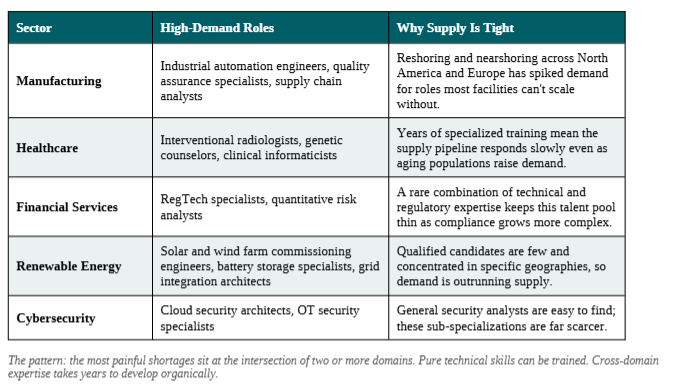
In manufacturing, reshoring and nearshoring trends across North America and Europe have created acute demand for industrial automation engineers, quality assurance specialists, and supply chain analysts. These aren't glamorous roles, but try scaling a new production facility without them.
Healthcare
Healthcare faces a different kind of pressure. The shortage of specialized clinical staff (think interventional radiologists, genetic counselors, and clinical informaticists) is compounding as populations age and diagnostic technologies advance. These roles require years of specialized training, which means the supply pipeline responds slowly to demand signals.
Financial Services
In financial services, regulatory technology (RegTech) specialists and quantitative risk analysts are in high demand as compliance requirements grow more complex across jurisdictions. The talent pool for these roles is thin because they require a rare combination of technical and domain expertise.
Renewable Energy
Renewable energy is another area where demand is accelerating faster than supply can respond. Solar and wind farm commissioning engineers, battery storage specialists, and grid integration architects are all roles where qualified candidate pools are small and geographically concentrated.
Cybersecurity
Cybersecurity remains persistently tight, but the specifics matter. General security analysts are easier to find than cloud security architects or operational technology (OT) security specialists for industrial environments. The difference in supply between these sub-specializations can be enormous.
The pattern across these examples is that the most painful shortages are in roles at the intersection of two or more domains. Pure technical skills can be trained. Cross-domain expertise takes years to develop organically.
Adopting a Talent Supply Chain Management (TSCM) Mindset
Supply chain management transformed manufacturing decades ago by replacing reactive purchasing with demand forecasting, supplier diversification, and inventory optimization. Talent supply chain management applies the same logic to people.
TSCM means treating your workforce pipeline as a system with inputs, throughputs, and outputs. You forecast demand based on business plans and market trends. You build and maintain multiple sourcing channels (internal mobility, university partnerships, contingent labor, geographic expansion). You monitor bottlenecks in real time, whether that's a slow interview process, a compensation gap, or a thin candidate pipeline in a specific market.
Traditional recruiting is reactive. A requisition opens, a recruiter searches, candidates are screened, someone gets hired. TSCM is continuous. You're always building relationships with talent pools you'll need in 12 to 24 months, even when you don't have open roles today.
The practical shift looks like this: instead of asking "how do we fill this role?" you ask "what skills will our business need in 18 months, where do those skills exist globally, what's the competitive intensity for them, and what channels give us the best access?"
One common mistake is treating TSCM as a technology project. Tools matter, but the real change is organizational. It requires workforce planning, talent acquisition, learning and development, and finance to operate from shared data and shared assumptions about future needs. Most enterprises don't have that alignment today, which is precisely why the ones that build it gain a meaningful advantage.
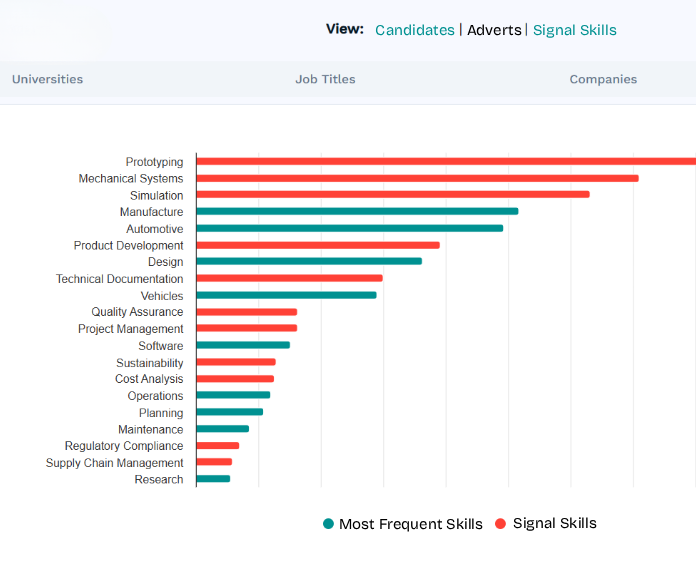
The Signal Skills capability in Horsefly Analytics
The Economic Levers: How Macro Trends Shape Your Talent Pool
Labor markets don't exist in a vacuum. Macroeconomic forces reshape talent supply and demand in predictable ways if you're watching the right indicators.
Interest Rates
Interest rate environments affect hiring velocity. When capital is cheap, startups and growth-stage companies hire aggressively, pulling talent away from larger enterprises. When rates rise, those same companies freeze headcount or reduce it, releasing talent back into the market. We watched this cycle play out in real time in the technology sector between 2021 and 2024. This is a supply-side effect, and it changes how many people are actively looking for work.
Trade Policy
Trade policy directly impacts where talent is needed. Tariffs and trade restrictions on semiconductor imports, for example, have driven demand for chip fabrication engineers in the United States and Europe, regions where that talent pool was historically small. Companies expanding domestic manufacturing capacity are now competing for the same process engineers that a handful of established fabs employed exclusively.
Immigration Policy
Immigration policy is another lever, and the U.S. has moved significantly on this one. A new $100,000 supplemental fee now applies to H-1B petitions filed for candidates outside the country, and as of February 2026, DHS replaced the traditional random H-1B lottery with a wage-weighted selection process that favors higher-paid, more senior applicants over entry-level ones.
Combined with the UK's points-based system and Germany's Skilled Immigration Act, these policies are actively redrawing where globally mobile talent concentrates; a tightening of visa pathways in one country can expand supply in another within months.
Inflation
Inflation works differently; it doesn't change how many people are available; it changes how willing they are to move. In high-inflation environments, candidates are more willing to leave for a 15% raise that merely keeps pace with cost-of-living increases. That creates churn, which looks like new supply but is actually just redistribution, since every hire you make this way creates a vacancy somewhere else.
Currency Fluctuations
Currency fluctuations affect the attractiveness of remote and offshore hiring. A weakening local currency makes a market's talent cheaper for foreign employers, which draws more competition into that pool. We see this repeatedly in markets like Poland, Colombia, and the Philippines.
The key takeaway is that your workforce data needs to account for these external forces. A talent pool that appears sufficient today can tighten or shift dramatically with a single policy change or economic event. At Horsefly Analytics, we integrate macroeconomic signals into our labor market intelligence for exactly this reason.

Proactive Workforce Planning and Predictive Forecasting
The difference between workforce planning and workforce tracking is the difference between looking through the windshield and looking in the rearview mirror. Most organizations still spend the majority of their analytical effort on historical reporting: how many hires there were last quarter, what attrition looked like, and how long roles stayed open. That's useful context. It's not a strategy.
Predictive workforce planning starts with your business strategy. If you're entering a new market, launching a product line, or automating a process, each decision creates specific talent implications. Map those implications forward in time, overlay them with external labor market data, and you get a picture of where you'll face constraints.
The practical steps:
Step 1
Translate your three-year business plan into a skills demand forecast. Not headcount by department, but specific capabilities by timeline. "We need 40 cloud infrastructure engineers by Q3 2027" is actionable. "We need more tech people" is not.
Step 2
Assess your internal supply. How many employees have adjacent skills that could be developed? What does your attrition model predict for your highest-risk roles? Internal mobility is faster and cheaper than external hiring when you invest in it early enough.
Step 3
Layer in external market intelligence. What's the available supply of your target skills in your target locations? What are competitors paying? How many employers are competing for the same profiles? This is where most organizations hit a wall because they lack reliable, real-time data across multiple geographies.
Step 4
Identify the gaps and develop sourcing strategies for each. Some gaps you'll close through hiring. Others through reskilling. Others by redesigning work to reduce the need for scarce skills entirely.
The companies that do this well don't treat it as an annual exercise. They update their models quarterly, incorporating new market data and revised business assumptions. Our platform supports this kind of iterative planning by providing continuously updated labor market intelligence across more than 190 countries.
Modernizing Recruitment: From Resumes to Performance-Based Hiring
Resumes are poor predictors of job performance. We all know this, yet they remain the primary screening mechanism for most enterprises. The result is that qualified candidates get filtered out, and credentialed-but-mediocre candidates advance.
Performance-based hiring flips the model. Instead of evaluating what candidates have done (which is heavily influenced by the opportunities they've had access to), you evaluate what they can do. This means designing assessments that simulate actual job tasks.
Let’s look at a concrete example: A cybersecurity analyst candidate works through a simulated incident-response scenario. A financial analyst builds a valuation model from a provided data set. A supply chain manager prioritizes competing logistics constraints in a timed case study. A software engineer completes a pair-programming exercise with a member of your team.
These assessments don't just predict performance better. They reduce bias by shifting evaluation away from pedigree (where someone went to school and which companies they've worked for) and toward capability. That directly supports DE&I objectives without requiring a separate initiative.
The tradeoff is real: performance-based hiring takes more upfront design effort. You need subject matter experts to build the assessments, calibrate scoring rubrics, and train interviewers. But the ROI shows up in higher-performing hires, lower early-stage attrition, and reduced mis-hire costs.
Pair this with labor market data that tells you where to source, and you stop wasting recruiter hours on channels that don't yield the right candidates. If your data shows that 70% of qualified cloud architects in a given market are passive candidates concentrated in three companies, your sourcing strategy should reflect that reality.

Boosting Retention Through Strategic Development and Culture
Hiring your way out of a talent shortage is expensive and slow. Retaining and developing the people you already have is nearly always the higher-ROI play.
The math is straightforward. Replacing a specialized employee costs between 100% and 200% of their annual salary when you factor in recruiting costs, onboarding time, lost productivity, and institutional knowledge that walks out the door. Investing 10% to 15% of salary in development and creating a culture people don't want to leave is a better trade.
Upskilling and reskilling programs do double duty: they address emerging skill gaps internally while giving employees visible career progression. But generic training catalogs don't move the needle. What works is mapping your future skill needs (from your workforce plan) to the adjacent skills your current employees already have, then building targeted learning paths that close specific gaps.
Culture matters more than most workforce planning discussions acknowledge. An employee who feels valued, sees a future, and trusts their leadership will stay through a rough quarter. An employee who doesn't will leave for a 10% raise. No amount of data can fix a broken culture, but data can tell you where your retention risks are highest and why, so you can intervene before the resignation letter lands.
Employer branding extends this further. In a competitive talent market, your reputation as an employer determines which candidates apply and which ones ghost your recruiters. Glassdoor ratings, word-of-mouth from former employees, and visible investment in people all shape that reputation.
Using Technology and Strategic Education Partnerships
Automation and AI are changing the composition of work, not just the tools people use. Roles that were 80% routine analysis five years ago might be 40% routine today, with the remaining time redirected to judgment, interpretation, and stakeholder communication. This shift changes the skills profile for those roles, even when the job title stays the same.
Intelligent systems handle pattern recognition, data aggregation, and process execution at speeds humans can't match. That's valuable. But it also means the premium skills are the ones machines can't replicate: critical thinking, cross-functional collaboration, creative problem-solving, and ethical judgment.
For workforce planning, this creates a dual challenge. You need to forecast how technology adoption will reshape skill requirements within existing roles and identify entirely new roles that don't yet exist.
Strategic education partnerships can accelerate supply development for both scenarios. Companies that co-develop curricula with universities and technical schools can shape the skills pipeline years before they need to hire from it.
Apprenticeship programs create an earn-and-learn pathway that builds loyalty while developing specialized capabilities.
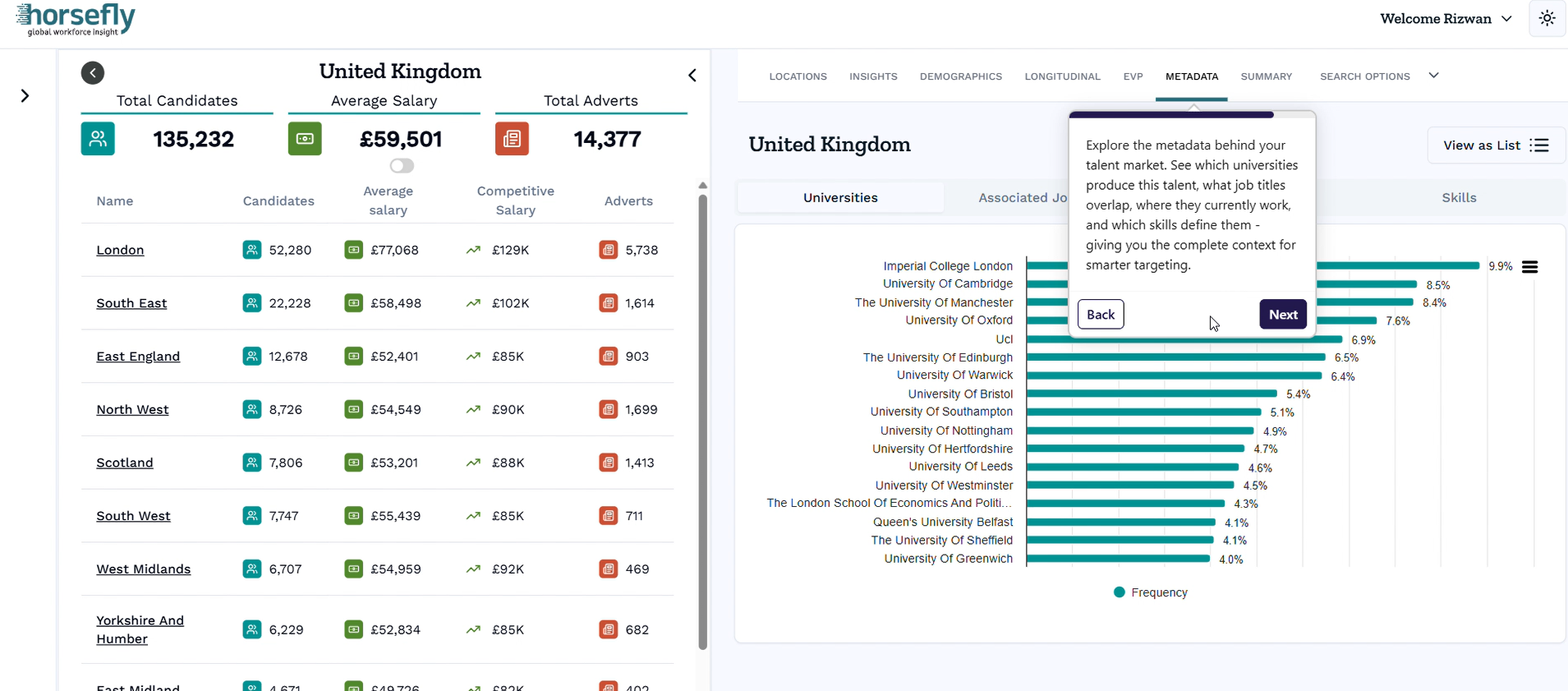
A view from the Horsefly platform that shows data helpful for understanding university pathways
Measuring What Matters: The ROI of Your Talent Strategy
If you can't measure your talent strategy's impact in business terms, you can't defend its budget. Time-to-fill and cost-per-hire are table stakes. They tell you about process efficiency, not strategic value.
A more complete measurement framework includes:
Quality of Hire
Measured by new hire performance ratings at 6 and 12 months, combined with manager satisfaction scores. Track this by source channel to understand which pipelines produce the strongest performers.
Cost of Vacancy
Calculate the daily revenue or productivity impact of an unfilled role. For a revenue-generating position, this might be the average daily revenue per employee. For a project-critical role, it's the cost of delay for the associated deliverable. This number gives you the business case for investing in faster sourcing.
Retention Rate of High Performers
Overall retention rates mask the problem. What matters is whether you're keeping the people who drive disproportionate value. Segment your retention data by performance tier and by role criticality.
Internal Fill Rate
The percentage of roles filled through internal mobility or development. A rising internal fill rate means your development programs are working and your talent supply chain has depth.
Workforce Plan Accuracy
Compare your forecasted needs from 12 months ago to your actual hiring activity. The gap between forecast and reality tells you how much your planning process needs to improve.
A Simplified ROI Formula For Your Talent Strategy
Subtract total talent investment (recruiting costs, development spend, technology costs) from the value generated (reduced vacancy costs, avoided turnover costs, productivity gains from better hires). Express the result as a ratio. Even rough estimates create accountability and justify continued investment.
Building Your Future-Ready Workforce Today
Talent supply and demand have become defining factors in business performance. Organizations that understand where talent is available, how competition is evolving, and which skills will become scarce are better positioned to hire faster, plan with confidence, and support long-term growth.
That requires more than historical HR reports or annual workforce planning exercises. It requires continuous access to accurate, real-time labor market intelligence that helps leaders anticipate change rather than react to it.
At Horsefly Analytics, we help organizations transform workforce planning through global labor market data covering talent supply and demand, skills, compensation, and competitive hiring activity. Our platform enables talent acquisition, workforce planning, and business leaders to make evidence-based decisions about where to hire, how to build sustainable talent pipelines, and how to stay ahead of changing market conditions.
Whether you're evaluating new locations, addressing critical skills shortages, or building a long-term workforce strategy, having the right market intelligence can be the difference between reacting to talent challenges and creating a lasting competitive advantage.
Ready to make more informed workforce decisions?
Discover how Horsefly Analytics can help you analyze talent supply and demand, uncover new talent opportunities, and build a workforce strategy backed by real-time labor market intelligence.
Book a strategic consultation to see how our platform can support your organization's hiring and workforce planning goals.
Frequently Asked Questions
How can businesses use data to improve their strategic workforce planning beyond basic HR functions?
Businesses can leverage real-time labor market data to understand talent supply, demand, and compensation globally, transforming workforce planning from a reactive HR task into a proactive strategic function. This data-driven approach allows for accurate forecasting of future skill needs and the identification of competitive advantages.
What does talent supply chain management mean and how is it different from traditional reactive recruitment processes?
Talent Supply Chain Management (TSCM) treats the workforce pipeline as a system, continuously forecasting demand, diversifying sourcing channels, and monitoring bottlenecks. Unlike traditional reactive recruiting, TSCM is proactive, building relationships with future talent pools even before specific roles become available, ensuring a continuous supply.
What are practical steps for implementing predictive workforce planning to forecast future skill demands?
To implement predictive workforce planning, translate your business plan into specific skill demands over time, assess internal supply for potential development, and integrate external labor market intelligence on availability and competition. Use this data to identify gaps and build diverse sourcing or reskilling strategies.
Can you give examples of performance-based hiring assessments that accurately predict job success?
Performance-based assessments simulate actual job tasks to evaluate capability. Examples include a cybersecurity analyst working through an incident response scenario, a financial analyst building a valuation model, or a software engineer completing a pair-programming exercise. These predict performance better than resumes.
What are the most important metrics to track for measuring the return on investment of a talent strategy?
Key metrics for talent ROI include quality of hire (new-hire performance), cost of vacancy (the daily revenue impact of unfilled roles), retention rate of high performers, internal fill rate, and workforce plan accuracy. These provide a comprehensive view of strategic value, not just efficiency.
What specific strategies can companies use to effectively address acute skill shortages in highly specialized technical roles?
To address niche technical skill shortages, focus on proactive talent supply chain management. This includes long-term university and technical school partnerships, targeted apprenticeship programs, and internal reskilling initiatives. Additionally, leverage global labor market data to identify underserved talent pools.
How do changing remote work trends impact the global talent supply and demand for specialized skills?
Remote work expands talent pools by removing geographic barriers, allowing companies to access specialists globally, potentially easing local shortages. Conversely, it intensifies competition for remote-friendly skills as employers worldwide can vie for the same candidates, influencing compensation and sourcing strategies.
Source: Horsefly Analytics, DHS, US Government, UK Government, German Government, Glassdoor