Contents:
Key Takeaways:
1. Location, cost, and talent availability should shape the plan, not react to it. In the traditional cycle, headcount requests go to finance and then to recruiters, who only then discover the skills are scarce or sit in cities where the company has no presence. Scenario modeling reverses that by comparing options like Singapore versus Berlin on talent pools, competitive hiring intensity, salary benchmarks, and time to reach target headcount. Many nearshoring plans fail on one point: the city looks cheap on paper, but your hiring would absorb much of the local talent pool and push wages up within two years.
2. Compare your skills inventory against the market, not just your own job descriptions. Comparing internal skills to your own targets only shows how far you are from a goal you set. The useful questions are which skills are rising in competitor postings, which are getting scarce in your key locations, and where pay for a skill is climbing fast enough to signal a shortage. Reskilling also takes longer than most plans assume, so pressure-test conversion targets against realistic completion and placement rates, with an external hiring contingency.
3. Keep attrition scores in aggregate planning, and be careful attributing ROI. Classification models are useful for supply forecasts, but individual risk scores shared with managers invite misuse and erode trust. A model trained on past promotions can also flag groups that advanced slowly as flight risks, shaping who gets retention investment. On ROI, a drop in time-to-fill may reflect a cooling market rather than better planning, so compare units that adopted the approach with those that didn’t, and present results as a range with transparent assumptions.
—---------------------------------------------------------------------------------------
Most annual workforce plans are out of date before the board even signs off. That’s because they were built on last year's headcount, a finance-approved budget, and assumptions nobody had time to test. In this article, we consider how AI changes that process, which model types do the work, where the payoff shows up, what to demand from vendors, how to manage bias, and how to build the ROI case.
In the traditional cycle, business units submit headcount requests, HR consolidates them in spreadsheets, finance trims them, and talent acquisition receives a list of requisitions and starts sourcing. Often, they only then discover that the skills are scarce, expensive, or concentrated in cities where the company has no presence. By the time anyone reviews external labor market data, the strategic decision is already made.
That sequence no longer makes sense. Location, cost, and talent availability should shape the plan, not react to it.
AI in HR makes this reversal practical. Predictive analytics can forecast demand from business drivers rather than manager requests, model supply from both internal mobility and external markets, and refresh those forecasts as conditions move. The result is strategic workforce planning that answers forward-looking questions instead of describing what already happened.
This doesn't mean AI can fix bad inputs. If your HRIS holds three different job architectures from past acquisitions and skills data that hasn't been touched since onboarding, the models will produce confident nonsense. Most of the early work in any AI planning initiative is data work, so if you want to see AI transformation, you need to look further than software alone.

Core Capabilities: How AI Transforms Workforce Analytics
Vendors often use "AI" as a catch-all, which often makes evaluation harder than it should be. In practice, predictive workforce planning relies on a handful of distinct model families, each suited to a different task.
Time-series forecasting for labor demand
Time-series forecasting uses historical data and business trends to predict future workforce needs. It combines past hiring patterns with leading indicators such as revenue growth, product launches, patient volumes in healthcare, or transaction growth in financial services. More advanced models also account for external factors. For example, a forecast for cloud engineers might consider both your organization’s growth plans and wider market trends in demand for those skills.
Classification models for attrition and supply
Supply forecasting depends on knowing who is likely to leave. Machine learning classifiers, typically gradient-boosted trees or similar, score attrition risk from employee data such as tenure, time since last promotion, compensation position relative to market, manager changes, and team turnover. Used well, these scores inform aggregate supply forecasts. Used poorly, they get turned into individual watch lists, which creates the ethical problems we cover later.
Natural language processing for skills
Job descriptions, resumes, performance reviews, learning records, and project documentation all contain skills information locked in unstructured text. NLP models extract and normalize those skills into a common taxonomy, so "built ETL pipelines in Spark" and "data pipeline engineering" resolve to related capabilities. This is what makes skills-based planning possible without asking 50,000 employees to fill out a profile.
Similarity and clustering models for adjacency
Once skills are structured, embedding and clustering models map how close one skill set sits to another. That tells you which internal populations could move into a new role with modest training, and which roles have no realistic internal feeder at all.
Simulation for scenario planning
Simulation techniques, such as agent-based modeling, help organizations explore how different conditions and assumptions could affect future workforce needs. By running thousands of possible scenarios, these models generate a range of potential outcomes rather than relying on a single forecast.
While these modeling techniques are well established, their value depends heavily on the quality of the underlying data. Detailed external labor market data, particularly at geographic and occupational levels, helps ensure scenarios reflect real-world conditions and produce insights relevant to an organization's workforce planning.
Identifying and Bridging Tomorrow's Skills Gaps Today
Job titles are a poor proxy for capability. Two "Senior Analysts" in the same bank can have almost nothing in common: one builds Python risk models, the other manages vendor relationships. Planning on titles hides both gaps and hidden strengths.
AI-driven skills management builds a dynamic inventory from the data sources described above, then keeps it current as people complete projects, earn certifications, and change roles. This inventory is the internal half of skills gap analysis.
The external half matters just as much. Often, organizations make the same mistake repeatedly: they compare their internal skills inventory against their own job descriptions, which only shows how far they are from a target they set. The useful comparison is against the market. Ask questions like:
-
Which skills are appearing in competitor job postings at a rising rate?
-
Which are becoming scarce in your key locations?
-
Where is compensation for a skill climbing fast enough to signal a shortage ahead?
Our global labor market data is built to answer these questions, turning a static gap list into a forward view of where pressure is building.
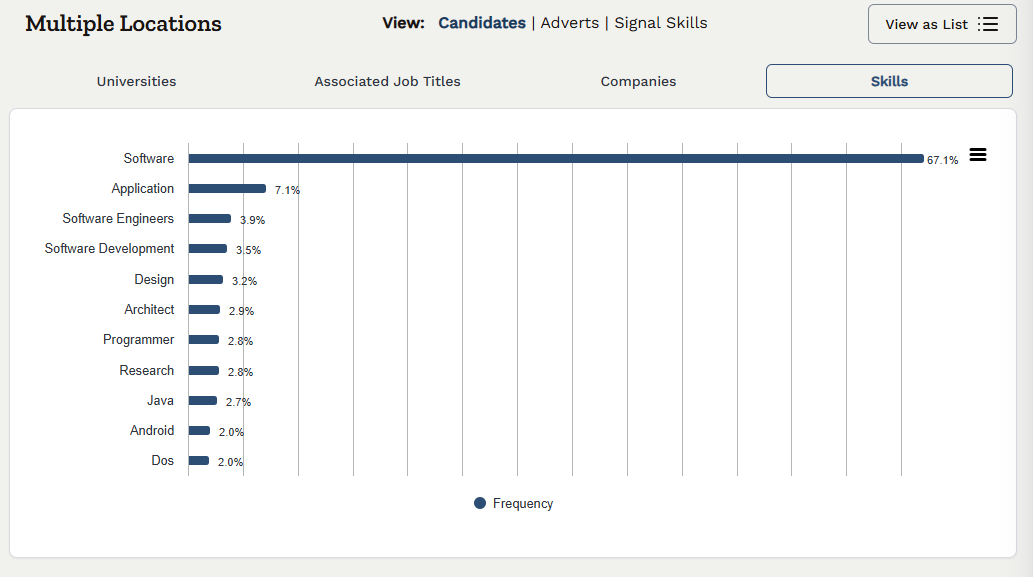
Image shows Skills capability within Horsefly
With both halves in place, the gap analysis produces three categories of action:
-
Reskilling candidates: Roles where adjacency models show internal populations within reach. A healthcare system might find that clinical informatics nurses are two or three competencies away from health data analyst roles that are expensive to hire externally.
-
Upskilling priorities: Skills your current workforce needs to deepen in place, such as generative AI tooling for software engineers or cloud security for infrastructure teams.
-
Build, buy, or borrow decisions: Gaps where no internal feeder exists, so the question becomes whether to hire, acquire, or contract, and where.
Talent identification inside the organization is where many companies underperform. Recruiters often can't find internal candidates because their skills aren't recorded anywhere searchable. Fix the visibility problem and internal fill rates tend to follow.
Keep in mind that reskilling takes longer than most plans assume. A plan that counts on converting 100 people into a new role within six months should be pressure-tested against realistic completion and placement rates, and backed by an external hiring contingency.
Managing Uncertainty with AI-Powered Scenario Modeling
Static headcount planning assumes only one future. Scenario modeling lets you compare several, quickly enough that the comparison can shape the decision rather than justify it afterward.
Consider the types of questions senior leaders actually bring to workforce planning teams:
"What is the workforce impact of opening a new R&D center in Singapore versus Berlin?"
A useful model compares available talent pools for the target skill mix in each city, competitive hiring intensity from other employers, salary benchmarks by role and seniority, time-to-hire estimates, and how quickly you could reach target headcount. The answer is rarely a clean winner. One city may offer a deeper supply of machine learning talent, while the other offers lower costs and easier access to adjacent EU markets.
"How will a 15% market share increase affect our need for software engineers?"
This scenario runs through the driver-based demand model. It should show not only the headcount delta but the timing, the skill mix (growth often shifts demand toward platform and reliability engineering rather than feature development), and whether your current locations can absorb the hiring without pushing compensation up.
"What is the cost and talent availability impact of shifting 30% of our operations roles to a lower-cost location?"
Here, the model needs to weigh the labor cost delta against transition costs, productivity ramp time, attrition during the move, and whether the destination market can actually supply the volume. Many nearshoring plans fail on that last point: the city looks cheap on paper, but your hiring would absorb a large share of the local talent pool and push wages up within two years.
The budget impact of each scenario should be visible alongside the talent impact, in a format finance will accept. Scenario modeling earns its credibility the first time it flags a risk early enough to change a decision, such as a location shortlist that falls apart once you look at actual supply for the required skills.
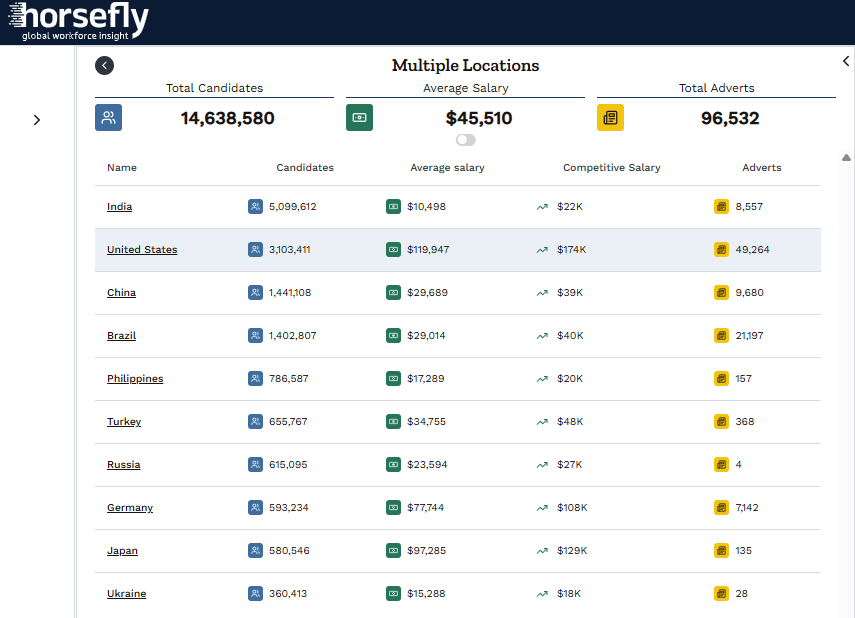
An example of Locations data within Horsefly
Improving Productivity and Talent Costs
Labor is one of the highest controllable costs in most technology, finance, and healthcare organizations. Even relatively small improvements in how workforce budgets are allocated can deliver significant savings over time. Better workforce planning helps organizations manage these costs while using their existing talent more effectively.
Reduce the cost of unplanned hiring
When workforce forecasts are inaccurate, organizations often respond with urgent recruitment. This can mean higher agency fees, signing bonuses and greater reliance on contractors, who typically cost more than permanent employees.
Healthcare organizations that use travel nurses to cover predictable seasonal demand are a good example. With better labor demand forecasting, organizations can anticipate and fill many of these requirements through planned recruitment, on more favorable timelines and terms. While forecasting cannot eliminate unexpected demand, it can reduce the need for costly reactive hiring.
Make better use of existing talent
Internal mobility is another way to manage workforce costs. Filling a vacancy internally can reduce external recruitment costs, shorten the time it takes for someone to become productive, and improve employee retention by creating opportunities for career development.
Redeploying existing employees also helps preserve valuable organizational knowledge and experience. These benefits can be difficult to quantify, but losing experienced employees often creates additional recruitment, training and productivity costs.
Optimize workforce location
Where an organization hires can significantly affect labor costs and access to talent. Accurate, city-level data on salaries and skills availability helps organizations identify locations where the right talent is available at a sustainable cost.
Rather than defaulting to established office locations or choosing markets based on salary alone, organizations can use this information to balance compensation costs, talent availability, and business requirements.
Measure productivity alongside workforce costs
Productivity is an important part of workforce planning, but it needs to be measured in context. Production per employee can provide a useful high-level indicator, but it can also be misleading when the workforce composition changes.
For example, replacing contractors with permanent employees might reduce measured output per employee while lowering the organization's overall labor costs. To get the full picture, consider productivity measures alongside total workforce costs, including permanent employees and contingent labor.
This gives organizations a more accurate view of whether workforce-structure changes are improving efficiency and delivering value.
Improve talent acquisition efficiency
Better workforce planning also improves recruitment effectiveness. When hiring teams receive requisitions with realistic salary ranges, clearly defined skill requirements, and locations validated against labor market supply, they have a stronger starting point.
Recruiters spend less time revisiting requirements, challenging unrealistic expectations, or recalibrating hiring managers. Instead, they can focus on identifying suitable candidates and progressing them through the recruitment process.

Key Features to Demand in an AI Workforce Planning Solution
Most AI workforce planning software demos well. The differences emerge in production. Use this checklist to separate a talent intelligence platform you can rely on from a dashboard layered over thin data.
Global data coverage
If you operate in 30 countries, coverage in 8 forces your team back to manual research for the rest. Ask for coverage specifics by country and occupation, not a headline count of data points.
Granular location analysis
National averages are rarely useful for site selection. Salary and supply for a cybersecurity engineer differ sharply between cities in the same country. Demand city and regional granularity.
Data freshness
Labor markets for in-demand skills move within quarters. Ask how often external data refreshes and how quickly market shifts appear in the platform.
HRIS integration
The platform must connect to your HRIS, ATS, and learning systems without a six-month custom project. Ask what connectors exist and who maintains them when your HRIS vendor changes its API.
Skills taxonomy flexibility
You need a taxonomy that maps to your job architecture and updates as new skills emerge, rather than one frozen when the vendor built it.
DEI analytics
Look for the ability to analyze representation in talent pools by location and role, and to test whether scenarios would improve or erode diversity in your pipeline.
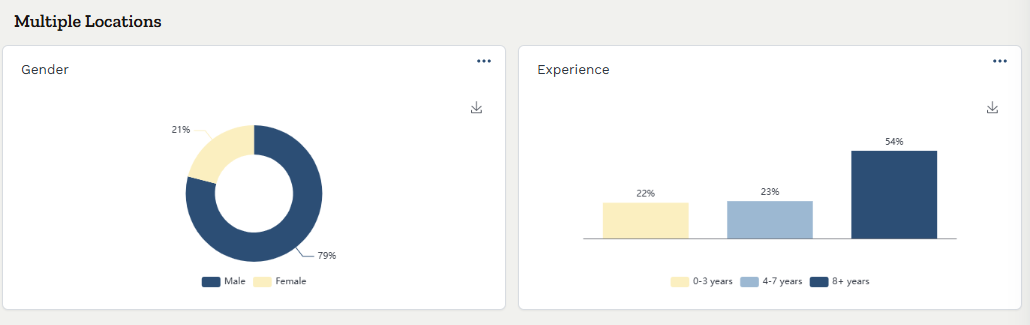
A view of Demographic data from Horsefly
Transparent modeling
Your team should be able to see which variables drive a forecast and adjust assumptions. If the vendor can't explain why the model recommended Kraków over Lisbon, you can't defend that recommendation to your CEO.
Scenario comparison
Side-by-side scenarios with cost and talent outputs, exportable in a format finance can use.
Security and compliance
Data residency options, role-based access to HR data, and clear documentation of how employee data is processed.
Weight the first three most heavily. Integration problems can be engineered around; thin external data cannot.
Managing the Ethical Risks of AI in HR
Ethical AI in workforce planning is a practical risk issue, and the risks are specific.
Algorithmic bias
Models learn from historical data, and past people-management decisions carry historical inequities. An attrition model trained on past promotions may learn that certain groups advance more slowly, then flag those employees as flight risks, which in turn shapes who gets retention investment. A skills inference model trained mostly on resumes from one demographic can systematically underrate how other groups describe equivalent experience.
Data privacy
Workforce planning touches compensation, performance, health-related leave in some jurisdictions, and other sensitive categories. GDPR and comparable regimes impose obligations around purpose limitation, data minimization, and transparency about automated decision-making. Works councils in several European countries have consultation rights over these systems, and skipping that step can stall a rollout entirely.
Mitigations that actually work:
-
Audit models on a schedule. Test outputs for disparate impact across protected groups at least annually, and after any significant retraining. Document the results.
-
Check training data diversity. Before deployment, examine who is represented in the data and who is missing. Gaps in the data become blind spots in the model.
-
Keep humans on individual decisions. Use AI for aggregate planning and to surface options. Decisions about specific people, such as promotions, redeployment, or exits, need accountable human judgment.
-
Separate planning from surveillance. Attrition risk scores belong in aggregate supply forecasts. Sharing individual scores with managers invites misuse and quickly erodes trust.
-
Explain the system to employees. Tell your workforce what data you use and why. Organizations that do this face fewer objections than those that discover the issue through a leak.
-
Minimize data. If a variable doesn't improve forecast accuracy meaningfully, remove it.
Bias auditing requires specialist statistical expertise that many HR teams may not have in-house. You should invest in developing this capability or work with external experts who can provide it.
Measuring Success: Calculating the ROI of AI-Powered Planning
HR leaders often struggle to build a business case because the benefits span recruiting, retention, real estate, and finance. A simple framework keeps it defensible.
Step 1: Set baselines before deployment. Capture 12 months of historical data on the metrics below. Without a baseline, every improvement becomes an argument.
Step 2: Track four core metrics.
-
Time-to-fill for critical roles. Multiply days saved by the daily cost of a vacancy (lost revenue, overtime, or contractor coverage).
-
Cost-per-hire. Compare agency fees, advertising, and recruiter time per hire against baseline, segmented by internal versus external fills.
-
Retention after redeployment. Compare 12-month retention of redeployed employees with that of external hires into similar roles. Each avoided departure saves a replacement cost your finance team can estimate.
-
Location planning savings. For roles placed using market data, compare fully loaded cost against what the same roles would have cost in the default location.
Step 3: Add avoided costs. Count reductions in contractor spend and emergency hiring premiums attributable to more accurate forecasts.
Step 4: Calculate.
ROI = (vacancy cost savings + hiring cost savings + retention savings + location savings + avoided contingent spend − total program cost) ÷ total program cost
Total program cost should include software, implementation, data cleanup, internal team time, and change management. Leaving out internal costs is the fastest way to lose credibility with the CFO.
Be cautious when attributing results to improved workforce planning. For example, a reduction in time-to-fill may reflect a cooling labor market as well as better planning. Where possible, compare business units or regions that have adopted the approach with those that have not, to help distinguish the impact of the intervention from wider market conditions.
Present the business case as a range of potential outcomes rather than a single precise figure. Finance teams are more likely to trust a business case that is transparent about assumptions and uncertainty than one built on precise estimates that are difficult to defend.

The Future-Ready HR Leader: Working with AI
The role of workforce planning leaders is evolving. Instead of spending most of their time producing reports and analyzing historical data, they can use AI to interpret insights, evaluate future scenarios, and advise the business. The most effective leaders bring evidence into executive discussions, helping decision-makers understand where to invest in skills and talent, where to build capability and what those decisions will cost.
Developing the skills to work with AI
This shift also changes the capabilities HR leaders need. Understanding data and interpreting probabilities are increasingly important, as is knowing how to challenge AI-generated insights. Leaders need to understand the assumptions behind a forecast, spot potential gaps or inaccuracies, and assess whether the results make sense in the business context.
The aim is not simply to understand what a model predicts, but to know how much confidence to place in its outputs and what action to take as a result.
Leading the move towards skills-based organizations
This capability becomes especially important as organizations shift from traditional job-based structures to skills-based workforce planning and talent management.
Making this transition requires an up-to-date understanding of skills supply and demand, both within the organization and across the external labor market. AI can help bring this information together, identify emerging skills gaps, and highlight where existing talent could be redeployed or developed.
However, technology alone cannot drive this change. HR and talent leaders bring the business understanding, relationships, and professional judgment needed to turn insights into decisions, while ensuring those decisions are fair and consider their impact on employees' careers.
Turning workforce insights into strategic decisions
Ultimately, HR's strategic value increasingly depends on its ability to provide business leaders with forward-looking workforce insights that support better decisions.
The question is no longer simply whether HR can report on the organization's current workforce, but whether it can identify what the business will need next, where potential challenges lie, and what action should be taken before those challenges become problems.
Build Your Strategic Workforce with Global Intelligence
AI is transforming workforce planning from a process focused on understanding the past into one that helps organizations make better decisions about the future. It lets leaders forecast workforce demand based on business needs, identify skills gaps against external market conditions, test different growth and location strategies, and direct talent investment where it delivers the greatest value.
However, these models' effectiveness depends on the quality of the data behind them. Forecasts built on national averages, outdated job postings, or limited geographic coverage can produce misleading insights, particularly when making global talent decisions. Knowing where to build teams, what to pay, and whether the required skills are available requires accurate, detailed, up-to-date labor market intelligence.
At Horsefly Analytics, we believe better workforce decisions start with better data. Our global labor market intelligence gives workforce planning, talent acquisition, and HR leaders the detailed, location-level insights they need to understand talent availability, benchmark compensation, and monitor changing competitive conditions across global markets.
Turn workforce intelligence into a strategic advantage.
Discover how Horsefly Analytics can help you make more informed decisions about where to find talent, how to invest in skills, and how to plan for future workforce needs.
Explore Horsefly Analytics and see how global labor market intelligence can strengthen your workforce strategy.

Frequently Asked Questions
How does AI transform traditional strategic workforce planning from reactive to predictive?
AI shifts workforce planning from reacting to past headcounts and budgets to proactively forecasting future needs. It uses predictive analytics to model labor demand from business drivers and supply from internal mobility and external markets, enabling continuous adjustments based on dynamic conditions.
What specific types of AI models are commonly used for predictive workforce planning?
Predictive workforce planning primarily uses time-series forecasting for labor demand, classification models for attrition and supply, and natural language processing (NLP) for extracting skills. Similarity models map skill adjacencies, and simulation models run robust scenario planning.
How can artificial intelligence help organizations identify and bridge future skills gaps effectively?
AI builds a dynamic internal skills inventory from unstructured text data and compares it against external market trends. This identifies roles where internal reskilling is possible, highlights upskilling priorities, and informs build, buy, or borrow decisions for skills missing internally.
What ethical risks are associated with using AI in human resources and workforce planning?
Key ethical risks include algorithmic bias, where models perpetuate historical inequities from training data, and data privacy concerns. Misuse of individual attrition scores for surveillance rather than aggregate planning also erodes trust and raises ethical issues.
What critical features should a company look for in an AI workforce planning software solution?
Essential features include global data coverage, granular city-level location analysis, and frequent data refreshes. Seamless HRIS integration, flexible skills taxonomy, DEI analytics, transparent modeling, scenario comparison, and robust security and compliance are also crucial.
How can a company accurately calculate the return on investment (ROI) for AI-powered workforce planning?
To calculate ROI, companies should establish baselines for time-to-fill, cost-per-hire, and retention after redeployment. Track savings from these metrics, plus location-planning efficiencies and avoided emergency-hiring costs, against total program expenditure, including software and implementation.
How important is data quality when implementing AI for strategic workforce planning?
Data quality is paramount for effective AI workforce planning. Poor inputs, such as inconsistent job architectures or outdated skills data, lead to inaccurate forecasts and unreliable insights. Dedicate significant initial effort to data cleanup and ensuring data integrity.
Sources: Horsefly Analytics, GDPR