.png?width=2000&name=Horsefly-Logo-NewTag_White%20(3).png)
Let's start with the headline numbers, because they're genuinely significant. Goldman Sachs estimates that AI could automate tasks equivalent to 300 million full-time jobs globally. McKinsey Global Institute projects that up to 30% of hours worked across the US economy could be automated by 2030. Those figures are attention-grabbing for a reason.
But automation of tasks isn't the same as elimination of jobs. Historically, every major technological shift has displaced some roles while creating new jobs elsewhere. The industrial revolution, the rise of computers, the internet: each wave caused significant disruption, but also generated entirely new categories of work that didn't exist before. AI and employment are following the same pattern, just faster.
The real disruption isn't uniform job losses, elimination or unemployment. It's task-level automation within existing roles. A data analyst's job doesn't disappear when AI tools can process datasets faster, but the role changes significantly with AI disruption. The work shifts toward interpretation, strategy, and judgment rather than manual processing, reflecting the changing demands of the occupational landscape. The same logic applies across sectors.
For workforce planners, this means the question isn't just "will this role survive?" but "how is this role going to evolve, and do we have the skills to evolve with it?" That's a fundamentally different planning challenge, and one that requires real market intelligence, rather than guesswork, to fully understand the potential labor market outcomes.
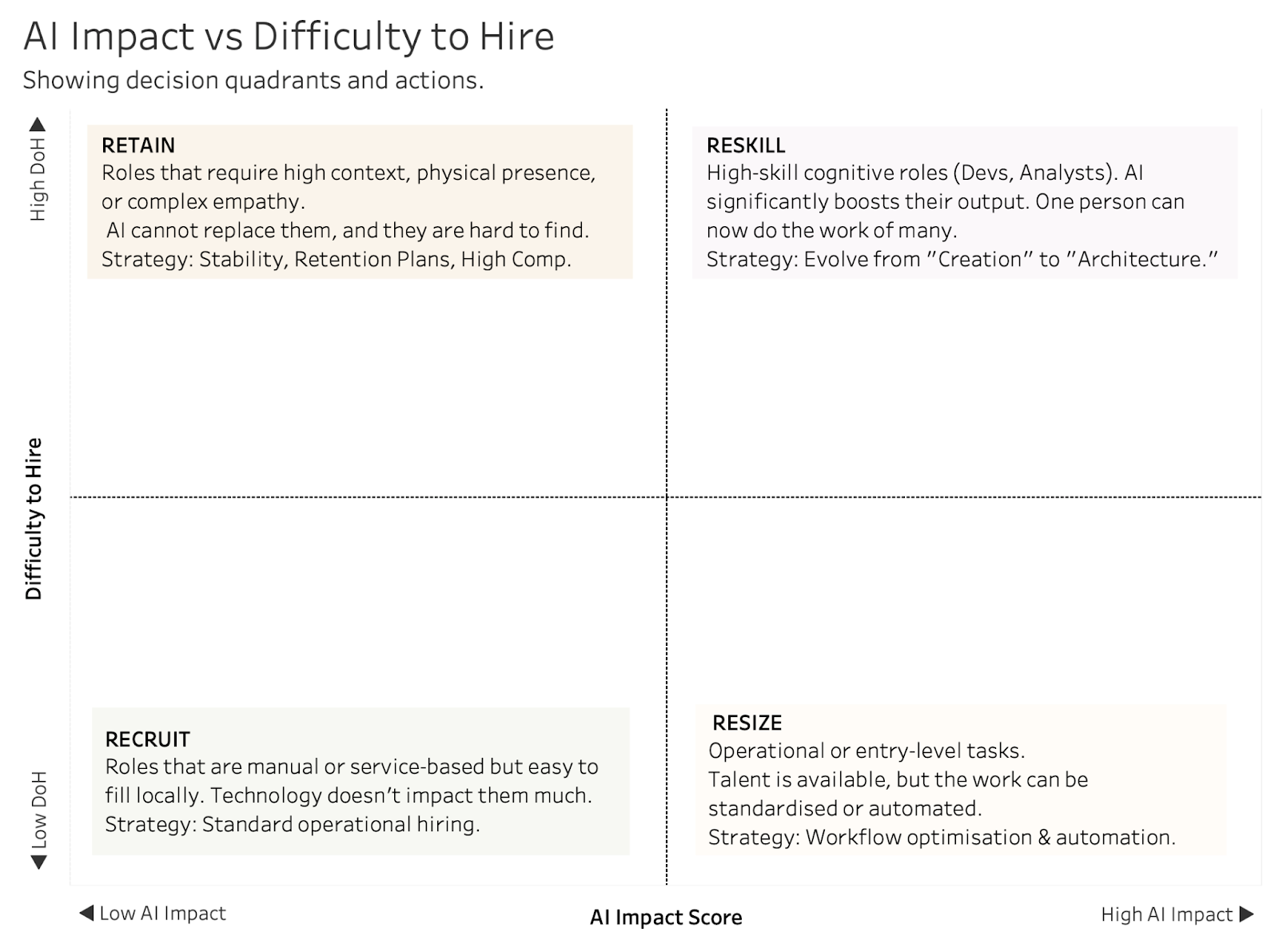
To fully understand the issue here, you need to look at how AI impact and difficulty to hire factors will come into play. This will then give you the insights required to see whether your company’s looking at putting more time into reskilling or recruiting etc. The chart below from Horsefly Analytics’ data clearly highlights what you need to be doing when considering if roles have a high difficulty to hire rating or a low AI impact score, for example, and where to go from there. This gives you the insights you need to put together an action plan for roles exposed to AI; the clarity gained leads to more strategic workforce plans being put in place for the future of work.
Not all roles are equally exposed to automation, and knowing which are most vulnerable is essential for proactive AI workforce planning to understand how AI in the labor force will work.
The roles most at risk share a common thread: they're built primarily around structured, repetitive tasks that can be codified and handed off to an algorithm. Customer service representatives handling standardized queries, data entry clerks, basic bookkeeping and accounting functions, and routine administrative roles are all squarely in AI's crosshairs. Generative AI job postings are up sharply across tech and financial services sectors, often explicitly designed for AI to replace or dramatically reduce manual processing work.
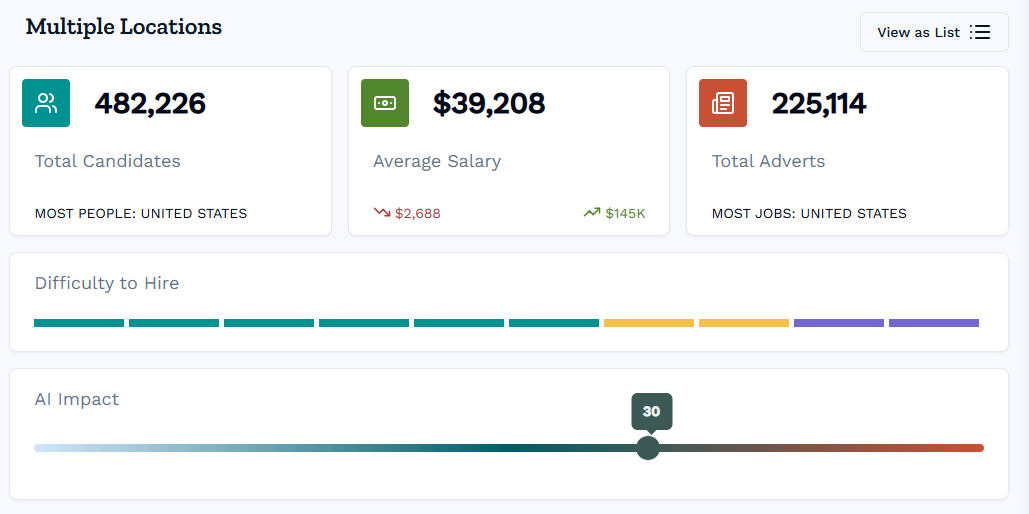
Image shows Horsefly evidence highlighting that AI usage is already starting to impact the Bookeeper role
Retail and warehouse roles face similar pressure. Automated checkout systems, AI-driven inventory management, and robotic picking in warehouses are already reducing headcount in ways that are measurable and accelerating. In sales, AI tools are taking over lead scoring, follow-up sequencing, and even initial outreach, compressing the need for junior sales staff in particular. However, it’s not just junior roles that we’re seeing are at risk, it’s also established roles in coding and engineering, for example, that could face displacement as AI takes on these expert capabilities.
This doesn't mean everyone in these roles is facing immediate redundancy, but it does mean that the profile of what these jobs require is shifting fast. The people who will thrive are those who can work alongside AI tools, interpret their outputs, and apply judgment where algorithms fall short. For organizations, the smart move is identifying which functions are most exposed and investing in reskilling before the disruption hits, not after.
If automation risk follows the logic of "structured and repetitive equals replaceable," then the mirror image holds: roles requiring nuanced human judgment, emotional intelligence, and creative problem-solving are significantly more resilient.
Healthcare professionals, particularly surgeons and psychiatrists, remain highly insulated. The stakes are too high, the judgment too complex, and the human connection too important to hand off to an algorithm anytime soon. Teachers and educators are in a similar position: AI can augment learning and personalize content delivery, but the relational and motivational dimensions of good teaching are irreducibly human.
Legal professionals, particularly those working on complex litigation or high-stakes advisory work, benefit from a combination of deep contextual judgment and professional accountability that AI cannot replicate. Directors, senior managers, and C-suite executives face a different kind of AI exposure: AI tools will increasingly inform their decision-making, but the accountability, stakeholder management, and strategic intuition at the top of organizations remain human-centric.
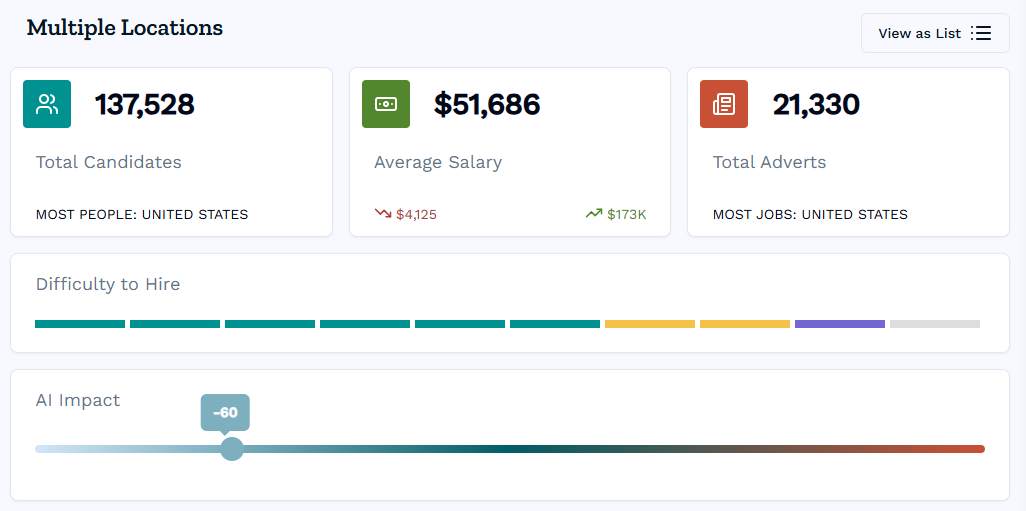
Image shows Horsefly data highlighting how little the position of Legal Professional is currently being affected by AI
HR professionals and talent specialists sit in an interesting position. AI adoption is transforming talent acquisition analytics and workforce planning in ways that are already visible in the data, but the human dimensions of people strategy, culture, and employee experience are far harder to automate. Artists and creative professionals remain resilient too, though generative AI is reshaping what creativity looks like in practice.
Computer systems analysts are also worth calling out: the labor demand for professionals who can design, implement, and oversee AI systems is growing rapidly. The builders, trainers, and overseers of AI infrastructure are among the biggest net beneficiaries of this shift.
The skills gap is real, and it's widening faster than most training pipelines can accommodate. However, this isn’t a future problem; it’s one that needs to be looked at now.
The good news is that the skills most valued in an AI-augmented workplace aren't all technical. On the technical side, the ability to work with data is foundational. That doesn't necessarily mean becoming a machine learning engineer or starting work in data science, but it does mean being comfortable with data analysis tools, understanding how AI-generated insights are produced, and knowing enough to ask the right questions of the outputs. Coding literacy, particularly in Python, is increasingly valuable across roles that wouldn't traditionally have required it, especially as more entry-level jobs involve AI tools. And familiarity with specific AI tools relevant to your industry is quickly becoming a baseline expectation rather than a differentiator.
On the human side, the skills that matter most are communication, critical thinking, adaptability, and the ability to collaborate across disciplines. These are the areas where humans consistently outperform AI, and they're increasingly what organizations are hiring for at every level.
For organizations, the practical implication is clear: workforce planning can't just be about headcount. It has to account for skills trajectories, identifying which skills your current workforce holds, which ones are becoming obsolete, which ones are emerging as critical, and what the gap looks like between where you are and where you need to be. That's a data problem, and it requires accurate labor market intelligence to solve well.
Platforms like Horsefly Analytics make this tangible. The Skills Insights capability allows organizations to benchmark their workforce's skill sets against industry standards and competitors, anticipate future skill requirements, and align training and development investments with actual market demand, rather than assumptions about what's likely to matter. The Signal Skills Intelligence capability goes further, spotting skills that are trending upward before they become mainstream requirements, giving talent and L&D leaders a meaningful head start. To find out how this can help your workforce challenges, get in touch today for more expert guidance.
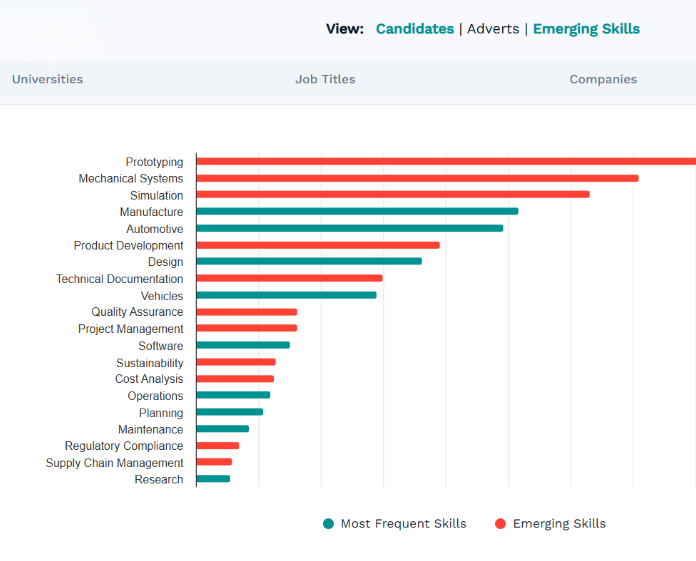
Image shows the Signal Skills functionality from the Horsefly platform.
It would be intellectually dishonest to talk about the impact of AI on the job market without acknowledging the real concerns. Job displacement, however inevitable some of it may be, creates genuine hardship for individuals and communities. The ethical obligations here fall on organizations implementing AI, governments designing policy, and the broader technology ecosystem.
For organizations, the core question is: are we managing this transition responsibly? That means investing in upskilling or reskilling rather than simply cutting headcount, being transparent with employees about how AI is changing their roles, and building AI systems that are designed to augment human capability rather than simply replace it.
Bias in AI systems is a particular concern in the hiring context. Algorithms trained on historical data can encode and amplify existing inequalities, producing outcomes that are discriminatory in effect even when no discrimination was intended. Organizations need to actively audit their AI-assisted hiring tools and ensure they're not inadvertently narrowing their talent pools in ways that undermine both fairness and performance.
On the policy side, governments are beginning to explore interventions ranging from expanded retraining programs to regulatory frameworks for AI deployment. Some economists advocate for universal basic income as a long-term response to structural automation. Whatever the right policy mix turns out to be, the organizations that will navigate this era best are those who engage with these questions proactively rather than waiting for external pressure to force their hand.
Companies that have handled AI-driven workforce transitions well tend to share a few characteristics: early and honest communication with employees, substantial investment in internal mobility and reskilling, and a genuine commitment to workforce planning that looks further than the next quarter. These aren't just ethical good practices; they're smart business, because talent that trusts its employer is more engaged, more productive, and more likely to stay.

Whether you're an individual thinking about your current career or a career change, or you’re an organization designing your workforce strategy, the fundamentals are similar: understand where you are, know where the market is heading, and close the gap between the two with intention.
For individuals, the most important move is to get comfortable with data and AI tools in your specific field, learn how to embrace AI, and learn the skills you’ll need to take advantage of this new technology. You don't need to become a machine learning researcher, but you do need to understand how AI is changing the tasks in your role and position yourself as someone who can work with those tools effectively, rather than being displaced by them. Certifications in data analysis, prompt engineering, or specific AI tools relevant to your sector are increasingly valued by employers.
For organizations, the priority is accurate intelligence. Workforce planning in the AI era can't be based on assumptions about which roles are at risk or which skills are becoming critical. It requires real-time, accurate labor market data: what's actually happening to supply and demand across roles and geographies, where skills gaps are materializing, and how compensation expectations are shifting as AI reshapes the value of different capabilities.
Horsefly's AI Impact Analysis capability is built directly for this challenge. Rather than guessing how AI might affect your workforce, it delivers data-driven insights on smart workforce planning, focused skills development, and proactive role evolution management. Combined with Longitudinal Intelligence, which tracks how roles and skills have shifted over time and models forward scenarios, organizations gain the ability to see pressure building before it becomes a crisis. Contact us for a custom consultation to hear how these AI capabilities can help you look at solutions for the challenges you’re facing at the moment.
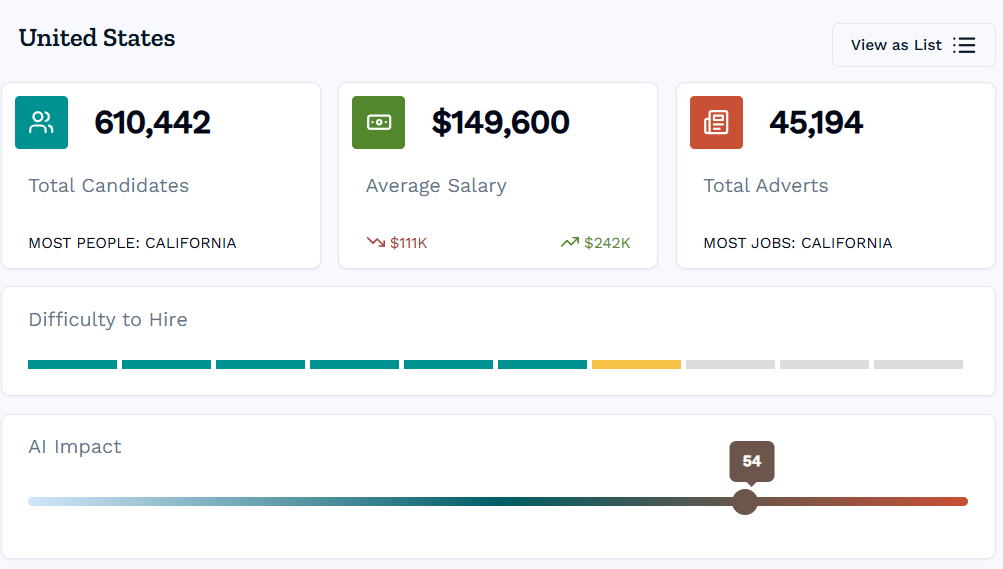
Image shows AI Impact information from the Horsefly platform
The organizations that will come out of this period in the best shape are the ones treating workforce planning as a continuous, data-led process rather than an annual exercise. That means monitoring AI labor market impact and signals regularly, adjusting hiring and development strategies in response to what the data shows, and building an internal culture where learning and adaptation are genuinely valued rather than just talked about.
The market for AI jobs is not a future problem to be solved when the disruption arrives. It's a present reality that rewards preparation and penalizes complacency. The data exists to make smart, forward-looking decisions about changes in employment and employment outcomes. The question is whether you're using it. If you’d like more information about this, get in touch to schedule a strategy session.
Sources: Horsefly Analytics, BBC, Mckinsey, LinkedIn, PwC, The World Economic Forum