Contents:
-
The AI Engine: Turning Workforce Data into Predictive Insights
-
The Business Impact: How to Quantify the ROI of Talent Intelligence
Key Takeaways:
1. The skills taxonomy is where most platforms succeed or fail. NLP turns messy resumes and job descriptions into structured data, and that feeds a taxonomy connecting skills, related capabilities, and roles. Context matters (“Python” in quant finance implies different adjacent skills than in marketing analytics), so a weak taxonomy produces skill counts that look precise but mislead. Test how a vendor handles emerging skills and thin markets before trusting its output.
2. Compare locations on depth, cost, and sustainability, not headline size. A city may have 50,000 software engineers but offer little relevant talent if most specialize in the wrong areas or are already heavily contested. Weigh five dimensions: relevant supply, competitive intensity, compensation trends, university pipeline, and attrition risk. The piece’s illustration shows why it matters: a 10% cost premium on a 500-person office is roughly $6 million a year.
3. Build the ROI case conservatively. The five value drivers are vacancy cost, agency spend, compensation decisions, location risk, and avoidable attrition, and the figures are illustrative until you swap in your own with finance. Claim only the portion of a saving that better intelligence could realistically recover. Not every gap from the market median is waste, since premiums may be justified by scarcity. Also separate employees retained by an intervention from those who would have stayed anyway.
—----------------------------------------------------------
Most enterprises today face a problem: workforce plans rest on labor market data that is already stale by the time someone pastes it into a spreadsheet. Below we explain how AI talent intelligence fixes that, how the underlying models work, how to put a figure on the return, and which questions separate a capable vendor from a polished demo.
The symptoms are familiar. A cloud security architect requisition sits open for four months because the salary band came from a survey published last year. A new engineering hub gets approved on the strength of a consultant's report, and eighteen months later the team competes for the same 2,000 qualified people as three hyperscalers that opened nearby offices. Finance wants a three-year headcount forecast, and the honest answer is that nobody knows where the skills will come from.
You need to recognize that these symptoms are not a lack of effort; they are a structural problem. Your Applicant Tracking System (ATS) holds applicant data, your Human Resources Information System (HRIS) holds employee data, compensation lives in a third tool, and external market data arrives as quarterly PDFs. These siloed systems were built to record transactions, but they do not tell you what will happen next in a talent market that shifts with every funding round, layoff wave, and visa policy change.
If you want a competitive edge in hiring, you can't base HR decisions on this kind of data. Instead, you need to connect internal and external sources and build models that can forecast and describe.
What is an AI Talent Intelligence Solution?
A talent intelligence platform combines your internal data (headcount, skills, performance, attrition, compensation) with external labor market data (job postings, candidate profiles, salary signals, education output, competitor hiring activity) and uses AI to produce forward-looking answers.
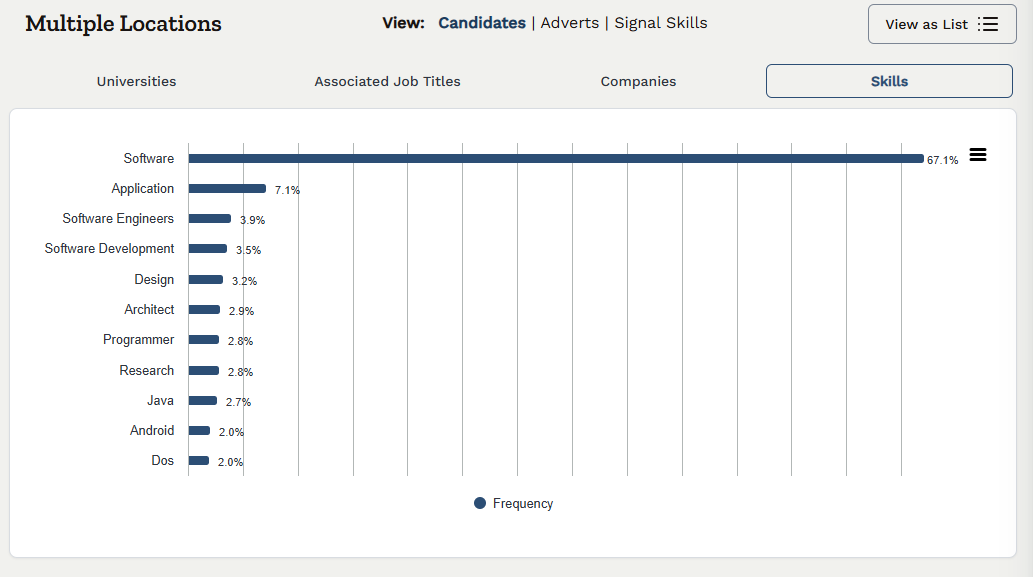
Image shows the Skills capability from Horsefly
The distinction that matters is predictive versus descriptive. Traditional HR analytics might tell you that attrition in your Bangalore data science team hit 22% last year. A talent intelligence platform tells you which roles are most likely to leave in the next two quarters, which competitors are pulling them, and what a retention adjustment would need to cost to change the outcome.
Here are the capabilities worth investing in, in our experience:
-
Real-time labor market intelligence: Supply and demand by location, skill, and seniority, updated continuously rather than annually.
-
Skills-based compensation benchmarking: Salary and total compensation data mapped to specific skills and experience levels, not just job titles.
-
A unified skills taxonomy: A common framework that connects inconsistent job titles, CV terminology, and skill descriptions, making roles and candidates comparable across markets.
-
Competitor hiring intelligence: Visibility into which competitors are hiring, for which skills, in which locations, and how their hiring activity is changing.
-
Predictive talent forecasting: Forward-looking estimates of talent availability, hiring costs, and potential skills shortages across relevant planning horizons.
Plenty of products marketed as talent intelligence are really sourcing tools with a dashboard attached. They help recruiters find candidates faster, which has value, but they cannot support strategic HR work, like deciding whether to build a 300-person team in Kraków or Monterrey.
The AI Engine: Turning Workforce Data into Predictive Insights
“AI-powered” is everywhere in HR tech. But what does it actually mean in practice? Here’s how machine learning turns fragmented workforce data into actionable intelligence, and why getting it right is harder than most vendors suggest.
Natural language processing turns messy text into structured workforce data
Job descriptions and resumes are unstructured, inconsistent, and full of jargon. One company's "Platform Engineer" is another's "SRE II" and a third's "DevOps Specialist." Natural language processing (NLP) models parse millions of these documents, extract the skills, tools, seniority signals, and certifications they contain, and normalize them.
This is harder than most vendors admit, and it is important to note that context matters: "Python" in a quant finance posting implies very different adjacent skills than "Python" in a marketing analytics role. Good NLP models use surrounding language to disambiguate in cases like this. Weak ones produce skill counts that look precise but mislead you.
The skills taxonomy is where most platforms succeed or fail
NLP outputs feed into a skills taxonomy: a structured map connecting skills, related capabilities, and job roles. This enables insights such as identifying employees who could transition into new roles with targeted training.
If the taxonomy is incomplete or outdated, every downstream insight suffers. When evaluating platforms, look for a taxonomy that captures transferable skills, reflects evolving job requirements, and supports realistic career pathways. A polished interface means little if you can't trust the underlying data.
Machine learning finds patterns humans miss
Once workforce data is structured, machine learning models can detect relationships across huge numbers of variables: which skill combinations command premiums, which career paths lead into hard-to-fill roles, and how compensation responds when a large employer enters a city. Clustering methods reveal adjacent talent pools. Regression and gradient-boosted models estimate pay for skill-and-location combinations with too few direct data points.
Predictive analytics forecasts supply and demand
Once workforce data is structured, machine learning can uncover relationships across thousands of variables: which skill combinations command higher pay, which career paths lead to hard-to-fill roles, and how a major employer entering a market affects compensation.
Clustering identifies adjacent talent pools, while regression and gradient-boosted models estimate pay for skill-and-location combinations where direct salary data is limited.
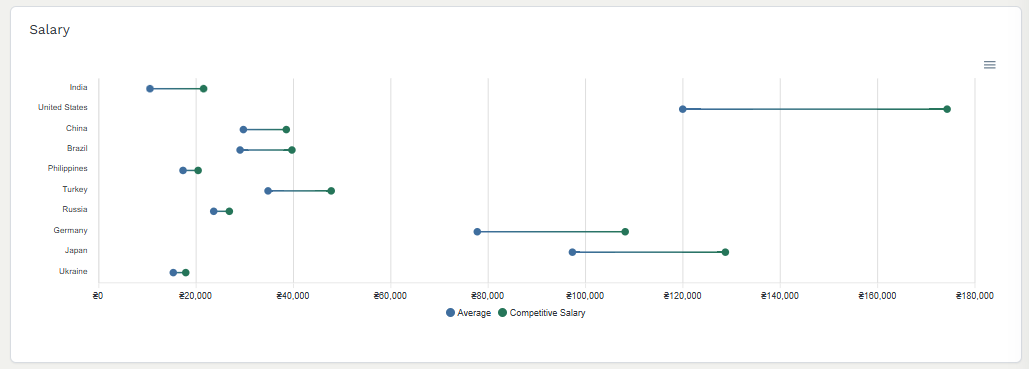
A view of the Salary functionality within Horsefly
Strategic Applications in Talent Acquisition
Proactive candidate sourcing
The standard sourcing playbook keeps fishing in the same pond: the same LinkedIn searches, the same competitor targets, the same top-tier universities. Talent intelligence widens the net by identifying adjacent talent pools. If you need embedded systems engineers, the data might show that automotive suppliers in a particular region employ hundreds of people with 80% skills overlap who are rarely recruited for technology roles.
This changes what a recruitment CRM is for. Instead of a database of past applicants, it becomes a pipeline built around where talent actually sits.
Reducing time-to-hire
Hiring delays often stem from three issues: a rare combination of required skills, limited talent availability in a given location, or a salary below market rates. Talent intelligence helps you identify these constraints before a role goes live, so you can adjust requirements, broaden the search, or revisit compensation early. For example, a supposedly essential skills combination might match just 40 people worldwide.
Skills-based matching can further accelerate recruitment by ranking candidates on demonstrated capabilities rather than keyword overlap. This helps you screen more efficiently and build stronger shortlists aligned with the role's actual demands.
Building offers that land
Annual salary surveys lag the market, and the lag hurts most in niche roles. When demand spikes for a specific skill (generative AI engineering is the obvious recent example), surveys can miss the movement for a year or more. Real-time compensation benchmarks drawn from posting data and other market signals let you size offers to the current market. That reduces declined offers and the costly cycle of reopening a search.
The tradeoff is that real-time data can be noisy. A few outlier postings can skew a benchmark for a thin market, so you need a platform that shows sample sizes and lets you judge how much to trust the number.

Transforming Strategic Workforce and Location Planning
For CHROs and workforce planning leaders, the larger payoff sits beyond recruiting.
Skills gap analysis
Map your workforce’s current skills against the capabilities your strategy will require, and the gaps become measurable. Next, decide whether to build, buy, or borrow the skills you need.
Labor market intelligence helps guide that decision. When external talent is scarce and expensive, upskilling employees with adjacent skills may offer better value and improve retention. When suitable talent is readily available, hiring may be faster.
Without this data, organizations often default to hiring when developing existing talent could be more cost-effective.
Succession planning
Traditional succession planning often relies on manager nominations, favoring visible talent over demonstrated capability. Skills intelligence helps you identify internal candidates who match critical-role requirements, including those outside traditional career paths.
It also flags succession risks early: critical roles with no ready internal successor, limited development pathways, or scarce, expensive external talent. This gives you time to develop future leaders or plan external recruitment before a vacancy arises.
Location planning
Location decisions carry long-term consequences. Choosing a city for a new office or nearshore center can commit an organization to years of operating costs and talent competition. Before deciding, compare candidate locations across five dimensions:
-
Relevant talent supply: How many people have the specific skills and experience you need?
-
Competitive intensity: Which employers are competing for the same talent, and how aggressively are they hiring?
-
Compensation trends: What are current salary levels, and how quickly are they rising?
-
Talent pipeline: How effectively do local universities and training programs produce the skills you need?
-
Attrition risk: How frequently do employees move between local employers, and what does that mean for retention?
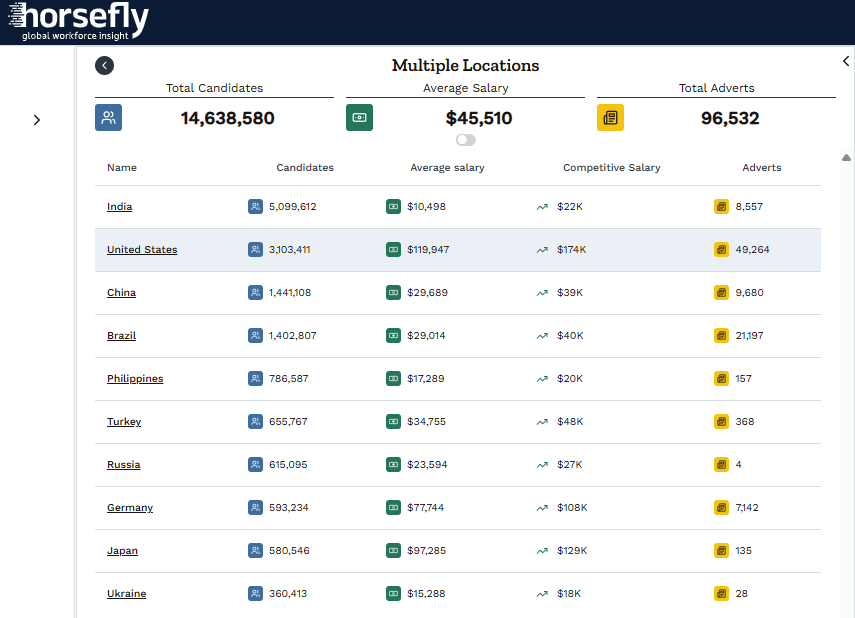
Location Planning capabilities within Horsefly
The biggest mistake is choosing a location based on headline workforce numbers or a competitor’s recent move. A city may have 50,000 software engineers but offer little relevant talent if most specialize in the wrong areas or are already heavily contested. Evaluate the depth, cost and sustainability of your specific talent pool, not just its size.
The Business Impact: How to Quantify the ROI of Talent Intelligence
Better insights alone rarely justify a budget. To secure investment, you need to show how talent intelligence translates into measurable savings, lower hiring costs, and better workforce decisions.
The following framework covers five potential value drivers. The figures are illustrative; replace them with your own data and validate the assumptions with finance.
Reduce the cost of vacancies
Estimate the daily cost of an unfilled role, including lost output, delayed projects, overtime, and contractor cover. Multiply that figure by the reduction in time-to-hire.
Illustrative example: You hire 100 engineers annually, with an average time-to-hire of 60 days. If each vacancy costs an estimated $1,000 per day, a 15% reduction in time-to-hire saves nine days per hire.
Annual value: 100 × 9 × $1,000 = $900,000
Use a defensible estimate of vacancy cost, adjusted for the role's actual business impact, rather than assuming every unfilled position creates the same daily loss.
Reduce agency and sourcing costs
Calculate annual agency spend using the number of agency placements, average salaries, and recruitment fees. Then estimate how many placements could realistically shift to direct sourcing through better market intelligence.
Illustrative example: Forty senior hires carry an average salary of $150,000 and an agency fee of 25%, generating $1.5 million in annual fees. If improved sourcing enables 25% of those hires to be made directly, the potential saving is $375,000.
Deduct any additional internal sourcing costs to calculate the net benefit.
Improve compensation decisions
Poor compensation decisions create costs in both directions. Paying above market rates without a clear reason inflates payroll; paying below market can lead to declined offers, prolonged vacancies, and avoidable attrition.
Use skills-based compensation benchmarks to identify pay misalignment, then quantify the potential impact of correcting it.

Measure:
-
Payroll savings from correcting unjustified premiums.
-
Changes in offer acceptance rates and time-to-fill.
-
Reductions in early attrition attributable to compensation.
Avoid treating every difference from the market median as a saving. Pay premiums may be justified by scarcity, performance, or strategic importance.
Reduce location decision risk
Location strategy can deliver the largest financial impact because decisions affect entire workforces over several years.
Illustrative example: A new 500-person office has an average fully loaded employee cost of $120,000. If a poorly chosen location creates a 10% cost premium over a viable alternative, the additional annual cost is:
500 × $120,000 × 10% = $6 million
That excludes potential costs from slower hiring, delayed ramp-up, and higher attrition.
Compare locations using role-specific talent availability, compensation trajectories, competitor hiring activity, and retention risk. Model the total cost difference over the planning horizon, including relocation, infrastructure, and other site-specific costs.
The business case should reflect the portion of that cost difference that better intelligence could realistically help avoid, not assume the entire premium is recoverable.
Reduce avoidable attrition
Replacing skilled employees can be expensive, including recruitment, onboarding, lost productivity, and the time it takes to reach full performance.
Talent intelligence can help identify retention risks by showing where employees' skills are in high demand, external opportunities are growing, or compensation lags the market.
Estimate the value using the number of avoidable departures, the cost per replacement, and the proportion of those departures that targeted interventions could realistically prevent.
Distinguish employees retained because of an intervention from those who would have stayed anyway.
Key Criteria for Evaluating AI Talent Intelligence Vendors
Vendor demos often look remarkably similar. Real differences emerge when you test the data, challenge the analytics, and see how well the platform fits your workflows. Use these criteria to separate genuine capability from polished presentation.
Data quality and global reach
Ask how many data points the platform holds, how many locations it covers, how often the data refreshes, and how it handles thin markets. Then test it. Pick a niche role in a secondary city you know well and see whether the output matches reality. Coverage that is strong in the US and UK but thin in Southeast Asia or Latin America will fail a global enterprise.
Analytical and predictive capabilities
Can the platform forecast, or only report? Does it show confidence levels? Can analysts build custom scenarios, or are they limited to canned reports? Ask to see how the skills taxonomy handles emerging skills that didn't exist two years ago.
Integration with your tech stack
Data integration with your ATS and HRIS determines whether insights reach recruiters' daily workflow or stay in a dashboard that three analysts open monthly. Ask for reference customers on your specific systems.
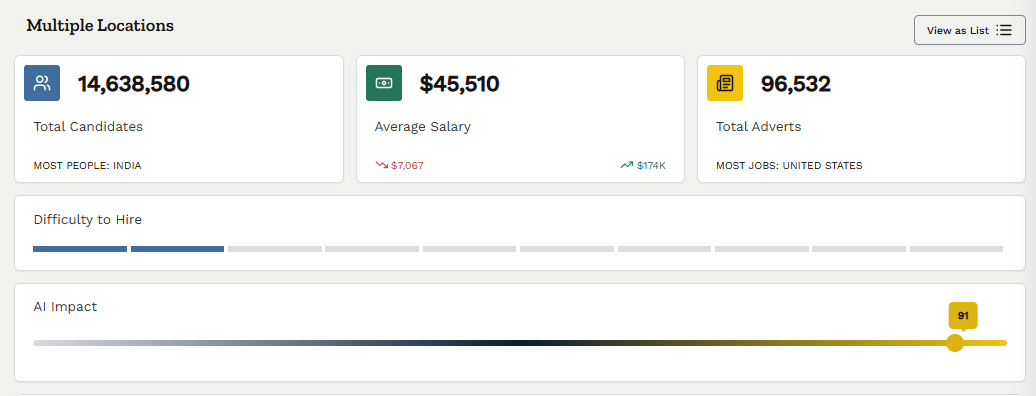
AI Impact capability from Horsefly
User experience and actionability
A hiring manager should be able to answer "Is this requisition realistic?" in minutes. A workforce planner needs deeper access. If insights require a data scientist to interpret, adoption will stall.
Vendor support and partnership
Find out whether the vendor offers analyst support, custom research, or advisory services alongside software. For high-stakes questions like location strategy, a team that can interpret the data with you matters as much as the platform.
Understanding pricing and total cost
Most vendors use annual subscriptions priced by user seats, data modules, geographic coverage, or a combination of these. Custom research, implementation, and integrations may incur additional charges.
Compare vendors against the total cost of delivering your priority use cases, not the headline subscription price.
Before committing, clarify:
-
Coverage: Are your required countries, roles, and datasets included?
-
Implementation: What will setup, data migration, and integration cost?
-
Access: Are API usage, additional users, or advanced analytics charged separately?
-
Expansion: How will costs change as you add markets, teams or use cases?
-
Support: Are analyst services and custom research included or billed separately?
A lower-cost license that excludes critical markets or requires expensive integration work may prove more costly in practice.
Handling Implementation and Ethical Considerations
Implementation
Technology is rarely the biggest implementation challenge. Internal data quality is. Inconsistent job titles, incomplete skills profiles, and duplicate employee records can undermine even the most sophisticated platform.
Before implementation, establish a consistent job architecture, identify authoritative data sources, and assign clear data-quality ownership. Then start with one high-value use case, such as compensation benchmarking for a hard-to-fill job family. Prove measurable value before expanding.
Deploying every module at once often creates complexity without adoption. A focused rollout gives teams time to validate insights, refine workflows, and build confidence in the results.
AI bias and diversity, equity, and inclusion
Concerns about AI bias in hiring are legitimate. Models trained on historical hiring decisions can reproduce historical bias. Ask any vendor how its models are trained and tested.
A well-designed platform can also reduce bias. When matching relies on skills and objective capability data rather than pedigree signals like specific universities or previous employers, it widens the candidate pool. Skills-based approaches surface people from non-traditional backgrounds who keyword filters and referral networks routinely miss. This supports DE&I goals with evidence rather than intention and leads to more equitable talent decisions.
Effective safeguards include regular bias audits, human oversight of consequential decisions, transparent recommendation criteria, and clear accountability for addressing disparities. Treat fairness as something to measure continuously, not a benefit to assume.
Data privacy and regulatory compliance
Global enterprises face GDPR, a growing number of US state laws, and data residency rules in markets such as China and India. Confirm how a vendor sources external data, whether it holds personal information, and how it stores and processes internal data.
Involve legal, privacy, and information security teams early, rather than waiting until procurement is nearly complete. Early scrutiny helps identify compliance gaps before they become costly implementation delays.
Ultimately, successful talent intelligence requires more than capable software. It depends on reliable data, responsible governance, and an implementation strategy that connects insights to real workforce decisions.
Why Global Leaders Choose Horsefly for Workforce Analytics
Horsefly Analytics is built on extensive labor market data, drawing on more than 1 trillion data points across more than 170,000 cities. This enables detailed analysis of talent availability and compensation by skill and location, helping global enterprises make informed decisions across diverse markets.
Our skills taxonomy connects job titles and skills across markets, supporting more accurate workforce comparisons, skills gap analysis, and talent forecasting. Combined with our RPO services, these insights help organizations turn market intelligence into effective hiring strategies.
From location planning to compensation benchmarking, Horsefly helps workforce leaders make evidence-based decisions rather than relying on assumptions.

Building Your Future Workforce with Data-Driven Strategy
The organizations that win the competition for talent will anticipate market shifts, identify emerging talent pools, and act before hiring costs rise.
AI-powered talent intelligence helps HR move beyond reporting the past to shaping the future, anticipating skills shortages, managing costs, and aligning workforce strategy with business growth.
Ready to make your next workforce decision with confidence?
Discover how Horsefly Analytics can help you identify talent opportunities, reduce hiring risks, and build a smarter workforce strategy.
Schedule a strategic consultation to see what better workforce intelligence can do for your organization.
Frequently Asked Questions
What is AI talent intelligence and how does it differ from traditional HR analytics?
AI talent intelligence combines internal and external data with AI to provide predictive workforce insights. Unlike traditional HR analytics, which describes past events like attrition rates, talent intelligence forecasts future trends, such as which roles are likely to leave or where talent gaps will emerge. It focuses on forward-looking strategic decisions.
How do AI talent intelligence platforms actually forecast future talent availability and cost?
Platforms use natural language processing (NLP) to structure messy text like resumes and job descriptions, feeding a sophisticated skills taxonomy. Machine learning models then identify patterns, and predictive analytics project talent availability and cost based on historical trends, hiring velocity, and migration patterns, often providing probability ranges.
What are the main business benefits of using AI for workforce planning?
AI talent intelligence offers significant benefits, including reducing vacancy costs by shortening time-to-hire and optimizing offers. It improves location planning by analyzing specific skill supply and competitive intensity, enables accurate skills gap analysis to guide build-buy-borrow decisions, and enhances succession planning by identifying internal candidates based on capability data.
How can AI talent intelligence platforms help reduce hiring time and make better job offers?
Talent intelligence reduces time-to-hire by identifying unrealistic skill requirements or insufficient local supply before a job opens. It provides real-time compensation benchmarks for niche roles, helping to size competitive offers that reduce declines. Skills-based candidate matching also shortens screening and improves hire quality, streamlining the process.
What are the most important criteria for evaluating AI talent intelligence vendors?
Key criteria include data quality and global reach, ensuring robust coverage for your markets. Evaluate analytical and predictive capabilities, checking if the platform offers forecasts with confidence levels. Strong integration with existing HR tech, an intuitive user experience, and comprehensive vendor support are also crucial for successful adoption and strategic impact.
Does AI in talent intelligence introduce bias, and how can it be mitigated?
AI models trained on historical hiring data can indeed reproduce existing biases. Mitigation involves training models on diverse datasets and testing for bias. Well-designed platforms can reduce bias by focusing on objective skills and capabilities rather than traditional pedigree signals, widening the candidate pool to include non-traditional backgrounds.
What data preparation steps are crucial before implementing an AI talent intelligence system?
Before implementation, organizations must address internal data readiness. This includes establishing a consistent job architecture, identifying authoritative internal data sources (e.g., HRIS, ATS), and resolving duplicate employee records or missing skills data. Starting with one high-value use case helps prove value and refine data processes iteratively.
Sources: Horsefly Analytics, GDPR