Contents:
-
Gathering Data: Traditional Surveys vs. Real-Time Intelligence
-
The Future of Compensation: AI, Transparency, and Remote Work
Key Takeaways:
1. Benchmark the job, not the title. The same title means very different things across industries and company sizes, so a title-matched benchmark gives confident-looking numbers that are wrong, and that is worse than no benchmark. Fix stale job descriptions first, match on scope, skills, and decision rights, and validate each match against role content. Compare total compensation (base, incentives, equity, benefits), not just base salary.
2. Use surveys and real-time data for different jobs. Annual surveys offer structure and peer validation, which suits executive pay reviews and board reporting, but their data can be well over a year old and skews toward large employers in major markets. Real-time data catches movement between cycles, prices emerging roles, and covers secondary cities. Pick one primary source per job family and use others as a reasonableness check, rather than averaging figures that may not be comparable.
3. Plan for the politically hard part before the findings land. Benchmarking often shows employees paid below market, and fixing that costs money, so build the remediation cost into the plan from the start or the results stall in a spreadsheet. Write down your compensation philosophy (lead, match, or lag by job family), and expect symptoms of stale data, like falling offer acceptance and longer time to fill, to show up long before anyone traces them back to the benchmark. Pay transparency rules and remote pay models (location-based, single rate, or tiered zones) make current, granular data more important.
—-------------------------------------------------------
If your salary bands were built from a survey fielded more than a year ago, you are pricing jobs against a market that no longer exists. That is why reliable compensation benchmarking is so important.
Below, we explain how compensation benchmarking works, where traditional methods break down, and a five-step process you can use to set pay with confidence across a global workforce.
What Does Benchmarking Compensation Mean?
Compensation benchmarking means comparing what you pay for a given role against what the market pays for equivalent work. Actually executing this can be hard, because the market for one specific role in a specific location behaves nothing like the market for a different role in a different place. But both shift faster than most HR data cycles can track.
We work with enterprise talent leaders who feel this gap every day. If your offers get rejected for reasons nobody can quantify, recruiters report that candidates want more, but finance asks for evidence, and hiring managers escalate exceptions until the exceptions become the policy, it’s likely you need to reassess your compensation benchmarking.
Benchmarking decides whether you can attract talent and retain talent in the roles that drive revenue. It belongs in the same conversation as headcount planning, location strategy, and budget forecasting.
The Strategic Imperative of Salary Benchmarking
Pay is typically the largest controllable cost in a knowledge-driven business, making it important to get compensation levels right. Paying too little can undermine retention and recruitment, while paying too much puts unnecessary pressure on budgets.
The effects of underpaying often build over time. Your strongest performers are frequently the first to leave for better offers, while vacancies remain open for months. Recruiters waste time on candidates who reject offers, and every lost hire brings replacement costs, reduced productivity, and valuable institutional knowledge that leaves with them.
Overpaying creates a different set of problems. Inflated salaries across an entire job family leave less budget for roles where higher compensation could make a meaningful difference. They can also create internal pay inequities that prove difficult to correct, particularly when employees have come to expect their current salaries.
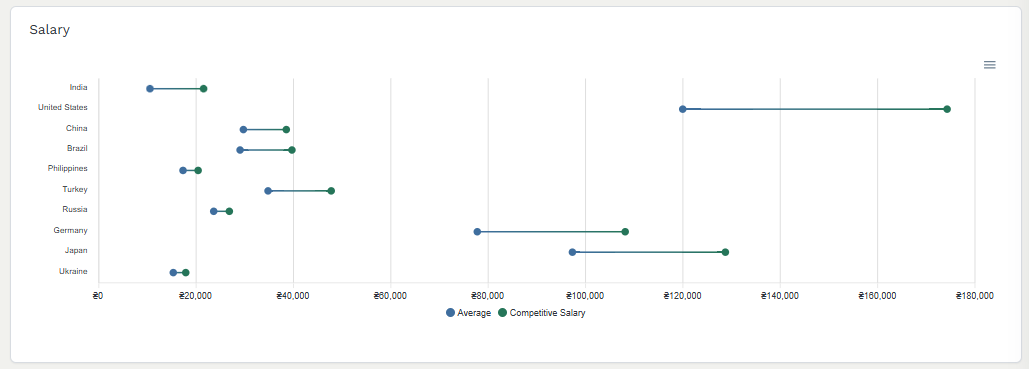
Example of Salary data from Horsefly Analytics
Effective benchmarking gives you three concrete capabilities:
-
Competitive pay where it matters: You can identify which roles need to sit above market (scarce, revenue-critical skills) and which can sit at or slightly below market without hurting employee retention.
-
Defensible pay equity: When two people doing comparable work earn different amounts, you can explain why with market evidence, or you can fix it before a regulator or a lawsuit forces you to.
-
Budgets that finance trust: A compensation strategy grounded in current data lets you forecast the cost of a hiring plan before you commit to it, and tie spending directly to business goals.
The organizations that struggle most here usually do benchmark, but they treat it as an annual compliance exercise rather than an input to decisions made every week.
Deconstructing a Compensation Benchmark
Every reliable benchmark rests on knowing exactly what job you are pricing.
This is where most errors begin. Job titles are nearly useless for comparison because the same title can mean very different things across industries or companies of different sizes. Correct job descriptions that capture scope, decision rights, required skills, and reporting relationships are what allow you to match job roles to market data with any accuracy. If your internal descriptions are stale or vague, fix them before you buy a single dataset.
Once the role is defined, you need to decide what you are comparing. Base salary is the easiest number to find, but it’s actually the least informative. Total compensation includes:
-
Base salary
-
Short-term incentives (annual bonuses, commissions, profit sharing)
-
Long-term incentives (equity, restricted stock, deferred cash)
-
Benefits (health, retirement contributions, leave policies)
-
Allowances and perks, which vary heavily by country
Then account for the variables that move the number:
-
Location: Cost of labor differs from cost of living, and the two get confused constantly. What matters is what employers in that market pay for that skill.
-
Industry: The same role in different industries may share a skill set but sit in different pay markets.
-
Company size and stage: Large enterprises and venture-backed firms structure pay differently, especially around cash versus equity.
-
Skills and level: Specific technical skills can carry premiums that broad job families hide entirely.
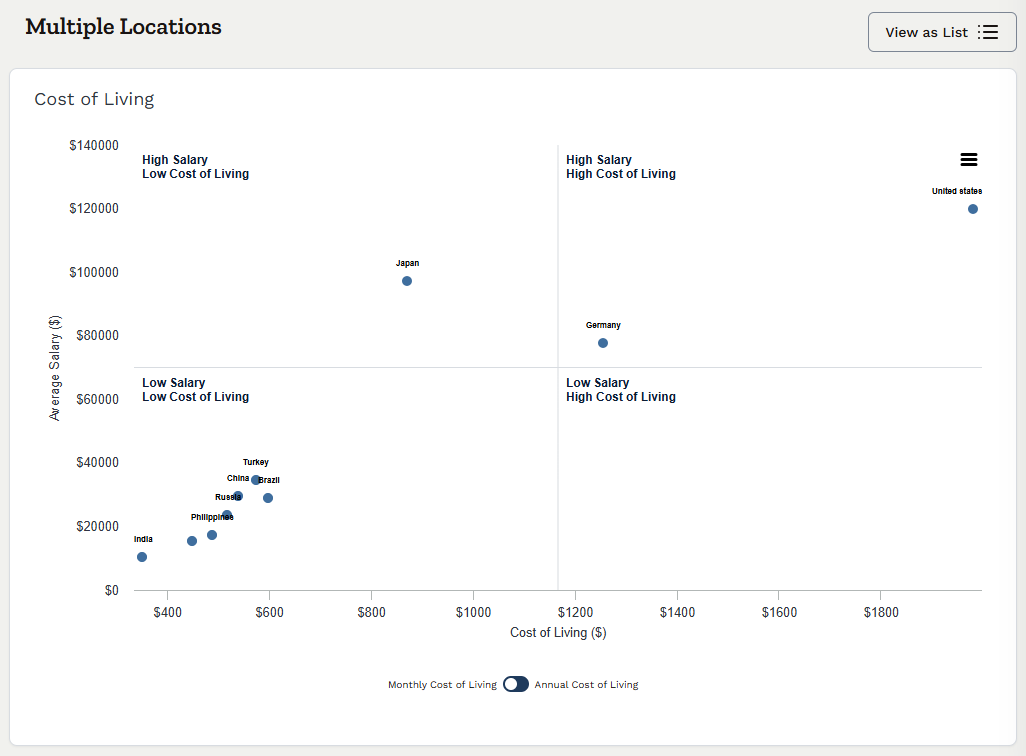
A view of Cost-of-Living data from Horsefly
Gathering Data: Traditional Surveys vs. Real-Time Intelligence
Annual salary surveys have been the default source of compensation data for decades, and they still have a place. They offer structured job matching, peer group filtering, and a methodology that compensation committees recognize.
But they have weaknesses that can’t be ignored; the main one being time. A typical survey collects data from participants, cleans and aggregates it, then publishes months later. By the time you apply it to a pay decision, the underlying figures can be well over a year old. Most teams "age" the data forward using an assumed percentage, which works acceptably in stable markets and badly in volatile ones. For hot skills such as AI engineering, cloud security, or quantitative finance, market salary trends can move sharply within a single survey cycle.
Surveys also have coverage gaps. They reflect the companies that chose to participate, which skews toward large, established employers in major markets. If you need to benchmark a niche role in a secondary city, the sample may be thin or nonexistent.
Real-time data platforms approach the problem differently. Instead of waiting for annual submissions, they continuously aggregate current labor market signals, so you see what the market is doing now rather than what it did last year. At Horsefly Analytics, we built our platform around this principle, offering real-time, global market data that lets talent leaders benchmark roles across locations as conditions change, rather than once a year.

Our recommendation is to stop treating this as an either/or choice. Use surveys where their structure and peer validation matter, such as executive pay reviews and board reporting. Then, use real-time data to catch movement between survey cycles, price emerging roles, and evaluate locations the surveys do not cover well.
A 5-Step Process for Effective Compensation Benchmarking
1. Define and evaluate your internal jobs
Start with a structured assessment of each role's scope, complexity, and impact. This produces a job grading framework that orders roles internally. Without it, you will benchmark individual positions in isolation and end up with a pay structure that has no internal logic. You do not need to evaluate every role at once. Begin with the job families that drive the most hiring volume or carry the highest turnover risk.
2. Identify your true comparator market
Ask where your candidates come from and where your employees go when they leave. That is your real talent market, and it is often broader than your industry peer list. Define comparator markets by role family, since your sales team and your engineering team likely compete against entirely different employers.
3. Gather reliable market data
Combine sources as described above. For each benchmark role, aim for data that matches on level, location, and industry. Document which sources you used and when the data was captured.
4. Analyze the data and match jobs
Accurate job matching is essential for meaningful benchmarking. Compare roles based on their responsibilities, scope, and required skills rather than relying on job titles alone. Where a role only partially matches a market benchmark, account for the differences rather than treating it as an exact match.
Compare salaries across the 25th, 50th, and 75th percentiles to understand the range of market pay, rather than relying solely on the median. Finally, compile the results into a benchmark job report showing how each role's current pay compares with market rates.
5. Build salary bands and integrate them into your compensation philosophy
Your compensation philosophy states where you intend to position pay relative to market. Some organizations lead the market for critical roles and match it elsewhere. Others pay at median and compete on equity or flexibility. Whatever you choose, write it down and apply it consistently. Translate the benchmark data into salary bands with defined minimums, midpoints, and maximums, then decide how you will handle employees who sit outside the new ranges.
This step is the hardest politically. Benchmarking often surfaces employees who are underpaid relative to market, and fixing that costs money. Build the remediation cost into your plan from the start so the findings do not stall in a spreadsheet.
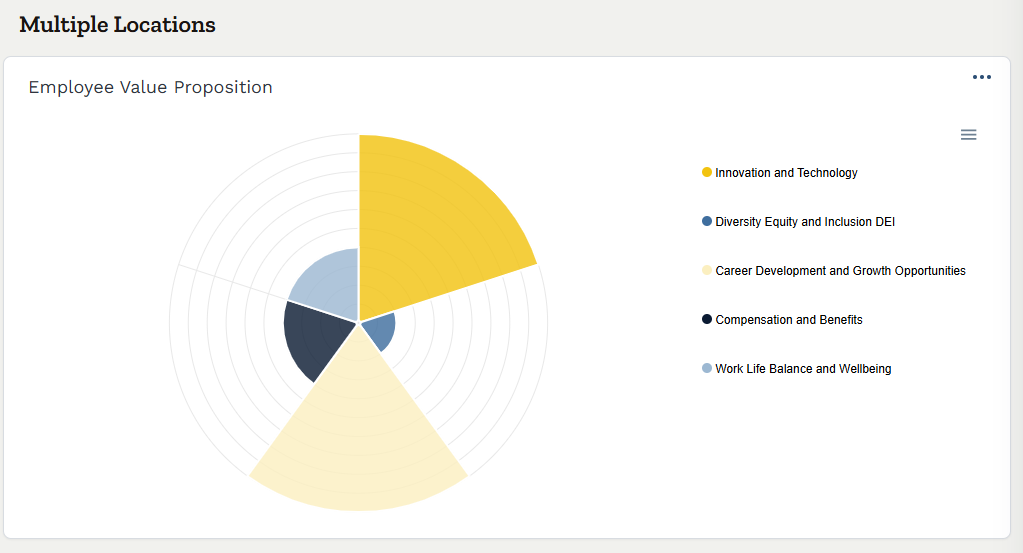
An example of EVP data from Horsefly that can be used to help identify what’s important across different roles
How to Handle Common Benchmarking Pitfalls
Matching on Titles
We see this constantly, and it produces confident-looking numbers that are wrong. A mismatched benchmark is worse than no benchmark, because it gives you false certainty. Require that every match be validated against role content, ideally by someone who understands the work.
Data Gaps in Niche Roles
Some roles have almost no comparable market data, like a specialist in a regulatory niche, or a hybrid role your organization invented. When data is thin, triangulate. Benchmark the component skills separately, look at adjacent roles, and widen the geographic lens before narrowing back down. Flag these roles as lower confidence and review them more often.
Inconsistent Sources
Salary surveys may use different criteria to classify job levels, define regions, and calculate compensation. Comparing figures without accounting for these differences can lead to misleading results. Choose one primary data source for each job family, then use other sources to check whether its figures are reasonable rather than averaging data that may not be directly comparable.
Outdated Market Data
This deserves repeating as a pitfall because its effects are easy to miss. Old data leaves you underpaying in markets that heated up and overpaying in markets that cooled, while your bands look perfectly reasonable on paper. The symptoms show up first in offer acceptance rates and time to fill, often long before anyone traces them back to the data.
Benchmarking Once and Stopping
Talent markets do not hold still between annual reviews. Set a cadence for refreshing the roles where you compete hardest, and monitor them continuously if you can.
The Future of Compensation: AI, Transparency, and Remote Work
Pay transparency
Pay transparency legislation is expanding across the US, with more jurisdictions requiring salary ranges in job postings. The EU Pay Transparency Directive is also introducing new requirements for recruitment transparency, employee access to pay information, and gender pay gap reporting.
As pay information becomes more accessible, outdated market data and overly broad salary ranges risk undermining trust with both candidates and employees. Review your salary bands against current market data before your next vacancy goes live, ensuring you can justify your ranges and explain your pay decisions.
AI-driven analysis
AI is changing how compensation teams work with data. Instead of manually matching hundreds of roles, teams can use AI to process large volumes of labor market information, surface patterns across skills and locations, and spot shifts earlier. The value lies in moving from describing what the market paid to anticipating where it is heading. AI does not remove the need for human judgment on job matching and philosophy. It removes the hours spent on data wrangling so that judgment can be applied where it counts.
Remote and distributed work
Remote work has made salary benchmarking more complex. When a role can be filled from anywhere, which market should you benchmark it against? Employers typically choose between location-based pay that reflects the employee’s local market, a single national or global rate, or tiered pay zones that group locations by labor costs. Each approach has trade-offs. Location-based pay helps control costs but can feel unfair when employees doing the same job earn different salaries. A single rate simplifies pay structures but may be uncompetitive in expensive markets and unnecessarily high in cheaper ones. Tiered zones offer a middle ground, but require regular reviews as local labor markets change.
Whichever model you choose, it depends on granular, location-specific data across your entire global workforce. That data has to cover the secondary cities and emerging talent hubs where distributed teams more often live, not only the major centers that traditional surveys favor.
Turn Compensation Data into Better Workforce Decisions With Horsefly Analytics' Salary Benchmarking Tool
Effective compensation benchmarking depends on accurate, up-to-date market data. Without it, you risk losing talent to better offers, setting unrealistic salary bands, and making hiring decisions that strain your budget.
Horsefly Analytics gives HR and talent leaders access to real-time, global labor market data to benchmark compensation, identify niche talent markets, and make more informed workforce planning decisions.
Ready to make your compensation strategy more data-driven? Explore Horsefly Analytics to see how real-time talent intelligence can support your next hiring and compensation decisions.

Frequently Asked Questions
How often should companies update their compensation benchmarks to stay competitive?
Companies should continuously monitor and update compensation benchmarks, especially for critical roles and volatile markets, rather than relying solely on annual reviews. Talent markets change rapidly, and outdated data can lead to underpaying or overpaying, impacting talent attraction and retention. Regular review ensures competitive and defensible pay.
What is the step-by-step process for conducting effective compensation benchmarking?
Effective compensation benchmarking involves five steps:
- Defining internal jobs
- Identifying your true comparator market
- Gathering reliable market data from diverse sources
- Analyzing and matching roles carefully
- Building salary bands aligned with your compensation philosophy.
This systematic approach ensures accurate and defensible pay structures.
Why is it important to define "total compensation" instead of just base salary when benchmarking?
Benchmarking total compensation, including base salary, short-term and long-term incentives, benefits, and perks, provides a more accurate market comparison. Focusing only on base salary can be misleading, especially in industries where equity or bonuses form a significant portion of an employee's overall earnings, like tech or finance.
How does remote work impact compensation benchmarking strategies for global teams?
Remote work complicates benchmarking by requiring decisions on whether to pay based on employee location, a single national/global rate, or tiered zones. Each approach has trade-offs in cost control, fairness, and administrative complexity. Granular, location-specific data for diverse talent hubs is essential for any model.
What are the biggest pitfalls to avoid when trying to benchmark salaries accurately?
Key pitfalls include matching jobs solely on titles, relying on outdated market data, using inconsistent data sources without normalization, and failing to address data gaps for niche roles. These mistakes can lead to inaccurate salary bands and poor hiring or retention outcomes. Always validate matches against actual role content.
How should companies communicate new salary bands to employees after compensation benchmarking?
When communicating new salary bands, explain the transparent and data-driven process used to establish them. Highlight the commitment to fair and competitive pay. Provide resources for employees to understand how the new bands apply to their roles, and offer clear channels for questions or concerns to build trust.
What should I do if employees are paid below the new market-aligned salary bands discovered through benchmarking?
If benchmarking reveals underpaid employees, create a clear remediation plan to adjust their salaries to the new bands. Factor these adjustment costs into your budget from the start. Prioritize roles critical for revenue or those with high turnover risk. Transparently addressing inequities builds trust and improves retention.
Sources: Horsefly Analytics