.png?width=2000&name=Horsefly-Logo-NewTag_White%20(3).png)
Enterprise workforce transformation is the deliberate, strategic process of realigning your organization's skills, roles, structures, and capabilities to match where the market is heading, not where it's been. It spans everything from redesigning job architectures to deploying AI tools that change how work gets done.
The reason this has migrated from HR's agenda to the C-suite's agenda is straightforward: the pace of skill obsolescence has outrun the pace of traditional talent acquisition. According to multiple industry analyses, the half-life of technical skills has shortened considerably, meaning the workforce you hired three years ago may already be mismatched to your current business needs.

What's Driving Workforce Transformation?
AI acceleration is the primary driver, but it's not the only one. Shifting demographics, deglobalization pressures, and the rise of distributed work have all compressed the window for reactive adjustment. Organizations that wait for talent shortages to become visible before acting are already behind.
Companies that proactively reshape their workforce report stronger revenue growth, lower cost-per-hire, and faster time-to-productivity. Those that don't face spiraling recruitment costs, widening capability gaps, and strategic plans that stall because the people to execute them simply aren't there.
This isn't a "nice to have" initiative. It's the mechanism through which business strategy becomes executable.
The 5 Core Pillars of a Successful Transformation
Five components consistently separate organizations that transform effectively from those that merely reorganize.
Strategic Realignment
Every workforce transformation must begin with a clear link between business objectives and talent strategy. What markets are you entering? What products are you building? What capabilities does that require in 18 months versus today? Without this alignment, reskilling programs become expensive distractions, and hiring plans drift from actual need.
Technological Integration
AI and automation tools aren't just changing what work gets done; they're changing how roles are structured. The question isn't whether to integrate these technologies but how quickly and where. Organizations that treat technology adoption as an IT project rather than a workforce design challenge consistently underperform.
 The Horsefly AI Impact score to help with workforce planning strategies
Talent Development
Reskilling and upskilling are cheaper than external hiring for most role transitions. Yet many enterprises still default to "buy" over "build" because they lack visibility into their internal skill inventories. The organizations getting this right invest in structured learning pathways tied to specific role transitions, not generic training catalogs.
Job Redesign
New technologies demand new role architectures. A financial analyst in 2026 doesn't do the same work as one in 2019. Effective transformation requires deconstructing existing roles into tasks, identifying which tasks shift to AI, and reconstructing roles around the human capabilities that remain and grow in value: judgement, relationship management, and creative problem-solving.
Change Management and Culture
This is where most transformations stall. Leadership can design the perfect strategy, but if employees don't understand why their roles are changing, if middle managers resist new workflows, or if the culture punishes experimentation, execution falls apart. Communication plans, manager enablement, and visible executive sponsorship aren't optional add-ons. They're structural requirements.
AI's Role in Reshaping Your Workforce
The conversation around AI and workforce transformation too often gets reduced to a binary: jobs that will be automated versus jobs that won't. That framing misses the bigger story.
AI Is Transforming Work, Not Just Replacing It
Most roles won't disappear; they'll simply change. Generative AI is already reshaping creative, analytical, and administrative work by handling routine cognitive tasks, from drafting initial code to summarizing regulatory documents to generating first-pass marketing copy. What remains is the human layer: interpreting outputs, making judgment calls, managing ambiguity, and building trust with stakeholders.
Workforce Planning Must Focus on Skills, Not Roles
Continuing on the previous point, this creates a specific workforce planning challenge. You need to forecast not just which roles will grow or shrink, but how the skill composition within existing roles will shift. A customer success manager who spends 40% of their time on data synthesis today might spend 5% on that task next year. That 35% gap needs to be filled with higher-value activities, and the person in the role needs new capabilities to perform them.
The organizations handling this well are mapping AI's impact at the task level, not the job level. They're identifying which tasks within each role are candidates for AI augmentation, then redesigning role profiles and training programs accordingly.
AI Adoption Requires Change Management
One common mistake is assuming AI adoption is self-executing. Tools like generative AI require significant change management. Employees need both technical training (how to use the tools effectively) and conceptual training (how to evaluate AI outputs critically). Without both, you get low adoption rates and unreliable results.
Building Future-Ready Skills: Reskilling and Upskilling Strategies
Reskilling trains employees for entirely new roles. Upskilling enhances capabilities within their current roles. Both are necessary, but they require different approaches.
Identify Skills Gaps Before Investing in Training
Start with identifying where the gaps are. This sounds obvious, but most organizations do it poorly. They survey managers, who report what they think they need, filtered through their own biases and limited visibility. A data-driven approach works better: analyze the skills your workforce currently holds against the skills your strategic plan requires, then quantify the gaps by role, function, and location.
Combine Internal Skills Data with Labor Market Intelligence
At Horsefly Analytics, we see organizations gain significant clarity when they layer labor market data over their internal skill inventories. External data reveals which skills are growing in demand, which are commoditizing, and where supply constraints will drive up costs. Internal data shows where you have hidden strengths and where you're most exposed.

Once gaps are identified, the execution strategy matters as much as the curriculum. A few principles that consistently drive results:
Best Practices for Reskilling and Upskilling Programs
-
Tie learning to career pathways. Adults learn when they see a direct connection between the training and their advancement. Generic "AI literacy" programs get low completion rates. Programs that say "complete these three modules, and you qualify for this specific internal role transition" get much higher engagement.
-
Mix modalities. Micro-learning for ongoing skill maintenance. Structured cohort programs for major reskilling. On-the-job rotations for applied learning. No single format works for everything.
-
Measure skill acquisition, not course completion. The number of employees who finished a module tells you almost nothing. Assessments, project-based demonstrations, and manager-validated skill certifications provide actual signal.
-
Prioritize ruthlessly. You can't reskill everyone for everything. Focus investment on the roles and skills with the highest strategic impact and the tightest external labor supply.
A Step-by-Step Roadmap for Implementation
Workforce transformation fails most often not because of bad strategy but because of poor sequencing. Here's a phased approach that reflects what we've seen work across global enterprises.
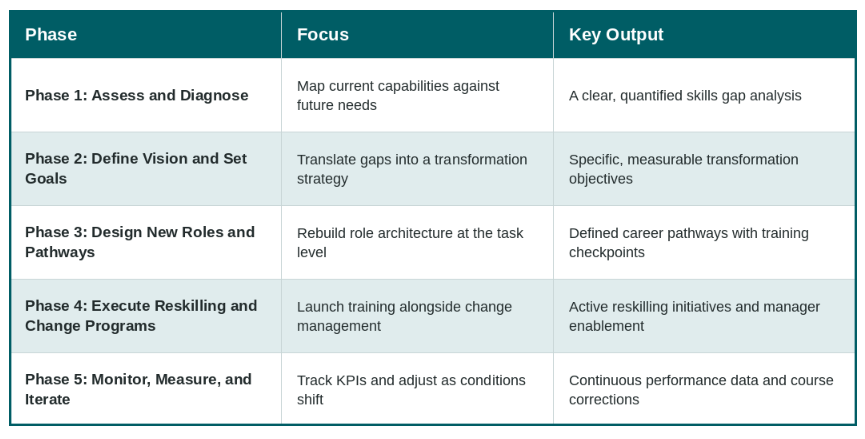
Let’s take a look at this in more detail:
Phase 1: Assess and Diagnose.
Map your current workforce capabilities against future business requirements. Use labor market intelligence to understand external talent availability, compensation benchmarks, and competitive hiring activity in your target skill areas. This phase should produce a clear gap analysis, not a vague sense that "we need more data scientists."
Phase 2: Define Vision and Set Goals.
Translate the gap analysis into a transformation strategy with specific, measurable objectives. "Increase internal AI capability" is not a goal. "Transition 200 business analysts to AI-augmented analyst roles within 18 months, reducing external hiring dependency by 30%" is a goal.
Phase 3: Design New Roles and Pathways.
Rebuild role architectures based on task-level analysis. Define clear career pathways from current roles to future roles, including the training, mentoring, and assessment checkpoints required at each stage.
Phase 4: Execute Reskilling and Change Programs.
Launch targeted training initiatives. Simultaneously invest in change management: manager enablement sessions, employee communication campaigns, and feedback loops that let you adjust in real time.
Phase 5: Monitor, Measure, and Iterate.
Workforce transformation isn't a project with an end date. Build continuous monitoring into your operations. Track KPIs (covered below), surface friction points early, and adjust your approach as market conditions and business priorities shift.
The biggest challenge across all five phases:
Maintaining executive commitment when results take time. Quick wins matter. Identify early-impact initiatives in Phase 2 that can demonstrate value within the first quarter, building the organizational confidence needed to sustain longer-term investments.
The Critical Role of Data Analytics in Transformation
Workforce transformation depends on accurate, up-to-date labor market intelligence. Decisions about which skills to build, where to hire, how much to pay, and where to locate teams are too important to rely on intuition or outdated surveys.
At Horsefly Analytics, we help organizations answer strategic workforce questions using real-time labor market data. From identifying where AI talent is growing fastest to benchmarking compensation across regions and tracking competitor hiring activity, our insights enable more informed workforce planning.
Predictive analytics goes a step further by helping organizations anticipate talent shortages before they occur. By analyzing hiring trends, skill migration, and education pipelines, businesses can proactively adjust hiring, reskilling, location, and compensation strategies instead of reacting to market changes.
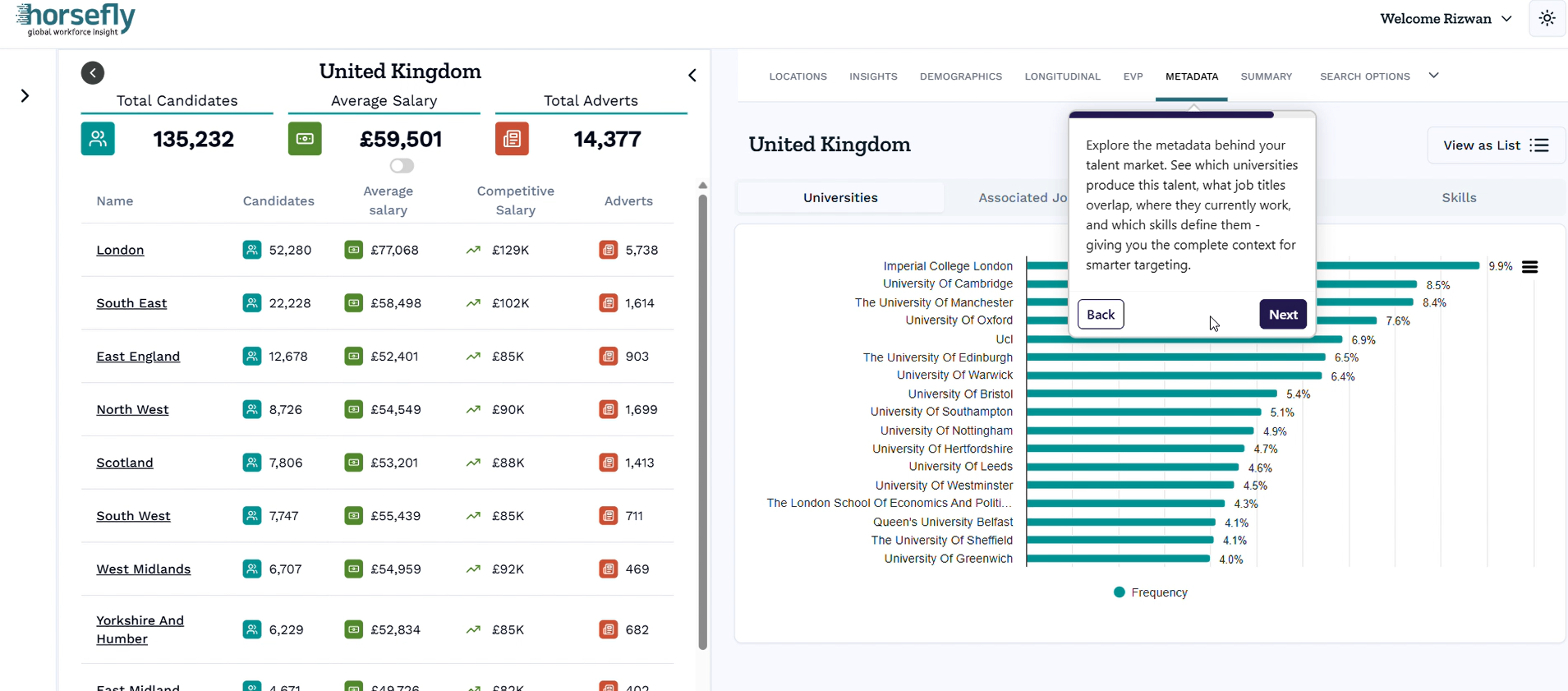
The image shows the Horsefly insights for education pipeline reviews
Ultimately, workforce transformation is only as effective as the data behind it. Reliable labor market intelligence turns workforce planning from a reactive process into a strategic advantage.
Measuring the ROI of Your Transformation Efforts
One of the most common gaps we see in transformation programs is ambitious strategy and zero measurement infrastructure. If you can't quantify the impact, you can't sustain executive support, and you can't course-correct when something isn't working.
Organize your KPIs into four categories:
Productivity Metrics
Output per employee, time-to-competency for reskilled workers, and automation rate (percentage of tasks within a role successfully shifted to AI tools). These tell you whether your transformation is actually changing how work gets done.
Talent Metrics
Employee retention rates (especially among reskilled employees), internal mobility rates, skill gap reduction percentage, and offer acceptance rates for newly designed roles. These measure whether your workforce is responding to the transformation.
Financial Metrics
Cost-per-hire trends, training ROI (measured as the cost of reskilling versus the cost of equivalent external hiring), and labor cost optimization across geographies. These determine whether the transformation is financially sustainable.
Business Outcome Metrics
Time-to-market for new products, revenue per employee, and customer satisfaction scores for teams that have been through transformation programs. These connect workforce changes to business results.
Keep in mind: It's best to track these quarterly, not annually. Workforce conditions shift too fast for annual reviews to catch emerging problems. And be honest about what the data shows. If a reskilling program isn't producing competent practitioners, restructure it rather than pointing to completion rates as a proxy for success.
Ethical AI in Workforce Management
AI is becoming an integral part of workforce management, from candidate screening to performance analysis and workforce planning. While these tools can improve efficiency and decision-making, they also introduce risks related to bias, privacy, and transparency. Addressing these challenges is essential for maintaining employee trust and ensuring responsible AI adoption.
Reducing Bias in AI-Driven Decisions
AI models trained on historical workforce data can unintentionally reinforce existing hiring and promotion patterns. Without regular oversight, they may disadvantage qualified candidates from underrepresented groups or perpetuate historical inequities. You should regularly audit AI outputs, use diverse training datasets, and ensure human oversight for high-impact employment decisions.
Protecting Employee Data and Building Trust
Employees and candidates increasingly expect transparency about how their data is collected, processed, and used. Clear data governance, well-defined privacy policies, and open communication about AI-assisted decision-making help build confidence while supporting compliance with evolving regulations.
Best Practices for Responsible AI Governance
Organizations should establish governance processes that ensure AI is deployed responsibly across the workforce. Key practices include:
- Conduct regular bias audits of AI-powered hiring and assessment tools.
- Keep human decision-makers involved in hiring, promotion, and termination decisions.
- Publish clear policies explaining how workforce data is collected and used.
- Include diverse stakeholders in the design, testing, and review of AI systems.
- Align AI governance with emerging regulations, including the EU AI Act and other applicable frameworks.
Ethical AI should be viewed as a business enabler rather than a compliance exercise. Those who embed fairness, transparency, and accountability into their AI strategy are more likely to build employee trust, improve adoption, and achieve long-term workforce transformation success.
Singapore: A National Transformation Model
Singapore offers a useful reference point for how workforce transformation can be supported at a systemic level.
The Enterprise Workforce Transformation Package (EWTP) provides grants to businesses for job redesign, skills training, and technology adoption. The SkillsFuture movement creates a national infrastructure for lifelong learning, giving workers access to subsidized training across technical and professional domains.
What makes Singapore's approach instructive isn't just the funding. It's the integration. Government agencies, educational institutions, and employers work from shared frameworks that connect national economic priorities to specific skill-building programs. Job redesign isn't treated as an HR initiative; it's treated as economic infrastructure.
For global enterprises, the takeaway is twofold. First, Singapore represents a talent market where government-backed programs actively support workforce modernization, making it an attractive location for operations that require continuous skill development. Second, the model demonstrates what's possible when reskilling is treated as a system-level priority rather than an individual company's problem.
We've seen through our labor market data that Singapore's tech talent pool, in particular, reflects the impact of these programs: strong and growing supply in AI, data science, and digital engineering, with relatively high skill currency compared to many other markets.

Building a Resilient, Future-Proof Organization
Workforce transformation is a continuous discipline, not a project. The organizations that sustain it share three characteristics.
1. They treat labor market intelligence as operational infrastructure, not an occasional input. Decisions about skills investment, hiring strategy, and location planning are continuously informed by current, accurate data.
2. They invest in adaptability over efficiency. Efficiency-optimized workforces are brittle. Workforces designed for adaptability, with broad skill bases, internal mobility pathways, and a culture that normalizes change, absorb disruption rather than breaking under it.
3. They act before the data is perfect. Waiting for complete certainty means waiting too long. The best workforce strategies use the best available data to make informed bets, then iterate as conditions change.
Why Choose Horsefly Analytics for Workforce Transformation
At Horsefly Analytics, we built our platform to support exactly this kind of continuous, data-informed workforce planning. Our global labor market intelligence gives you the visibility to make strategic decisions with confidence, whether you're assessing a new market, benchmarking compensation, identifying emerging skill shortages, or planning a multi-year reskilling program.
The enterprises that thrive through disruption won't be the ones that predicted the future correctly. They'll be the ones that build the organizational muscle to adapt as the future arrives.
Contact us for a strategic consultation, and find out how your organization can learn to adapt to changes.
Frequently Asked Questions
What does enterprise workforce transformation mean for my business?
Enterprise workforce transformation is the deliberate process of realigning an organization's skills, roles, and capabilities to match future market demands. It involves redesigning job structures, integrating AI tools, and developing talent to ensure business strategy is executable, preventing skill obsolescence and capability gaps.
How does AI change existing job roles instead of eliminating them completely?
AI primarily augments existing job roles by automating routine cognitive tasks, such as data synthesis, document summarization, or initial code drafting. This shifts human employees towards higher-value activities requiring judgment, creative problem-solving, and relationship management, fundamentally reshaping skill requirements within roles.
What are the key steps to implement a successful workforce transformation strategy?
A successful strategy involves five phases: assessing current capabilities against future needs, defining a clear vision and measurable goals, designing new role architectures and career pathways, executing targeted reskilling and change programs, and then continuously monitoring and iterating based on performance data.
How can organizations effectively identify critical skill gaps within their current workforce?
Organizations can identify skill gaps by analyzing their internal workforce's current skills against those required by their strategic plan. Layering this with external labor market data reveals in-demand skills, commoditizing skills, and potential supply constraints, offering a data-driven approach beyond manager surveys.
What are practical strategies to overcome employee resistance during workforce transformation?
Overcoming resistance requires a strong change management strategy, including clear communication plans explaining the 'why' behind changes and visible executive sponsorship. Empowering middle managers with new workflows and fostering a culture that encourages experimentation are also crucial to secure buy-in and sustain execution.
What specific metrics should a company track to measure the success of workforce transformation initiatives?
Track productivity metrics like output per employee and automation rates, talent metrics such as internal mobility and skill gap reduction, financial metrics like cost-per-hire trends, and business outcome metrics including time-to-market for new products. Monitor these quarterly for timely adjustments.
How can businesses proactively address ethical concerns when implementing AI in HR and workforce management?
Proactively address ethical AI by conducting regular bias audits on all AI tools, maintaining human oversight for high-stakes decisions, and publishing transparent data-usage policies. Involving diverse stakeholders in AI system design and aligning practices with emerging regulations helps build trust and ensure fairness.
Sources: Horsefly Analytics, EU AI Act, SBF