.png?width=2000&name=Horsefly-Logo-NewTag_White%20(3).png)
.png)
What Is Headcount Planning?
Headcount planning determines how many people an organization needs, which roles and locations are required, when they are likely to be needed, and what those roles are expected to cost.
Done well, it translates business strategy into an actionable workforce plan. It helps organizations anticipate hiring needs, understand workforce costs, and identify potential constraints before they affect delivery.
A useful plan considers more than open vacancies. Depending on the organization, it may account for:
-
Expected growth or contraction
-
Attrition and retirement
-
Internal mobility
-
New products or markets
-
Changes in operating models
-
Technology and automation
-
Skills requirements
-
Labor-market conditions
-
Compensation
-
Regulatory considerations
The external market is especially important when organizations plan for scarce skills or consider new locations. Internal workforce data can show what talent the organization already has, but it cannot by itself explain what is available in the wider market.
Headcount Planning vs Strategic Workforce Planning
Headcount planning and strategic workforce planning are closely connected, but they focus on different areas.
Headcount planning is primarily quantitative. It asks how many roles are required, where they should be located, when they are needed, and what they are likely to cost.
Strategic workforce planning (SWP) takes a broader view. It considers the skills and capabilities the organization will need to deliver its future strategy and how to meet those requirements.
That can include decisions about:
-
Hiring
-
Internal mobility
-
Upskilling and reskilling
-
Succession
-
Contingent workers
-
Automation
-
Changes to role design
For example, an organization may determine that it needs 50 additional software engineers. Workforce planning should then help answer what capabilities those engineers need and whether the organization needs to hire all 50 externally.
In practice, most organizations run these processes together rather than sequentially; the 7-step process below reflects that, drawing in capability and sourcing decisions (like upskilling or internal mobility) alongside the quantitative headcount forecast.
The 7-Step Headcount Planning Process
Effective headcount planning is ongoing, not a fixed annual exercise. A practical framework includes seven stages.
Step 1: Define Strategic Objectives
Begin with the business strategy rather than existing vacancies.
What markets are growing? What products or services are being developed? Are parts of the organization expanding, consolidating, or changing?
These objectives establish the workforce requirements that follow.
Step 2: Assess the Current Workforce
Build a reliable picture of the workforce today.
Depending on the organization, this may include:
-
Headcount by role and location
-
Skills and capabilities
-
Compensation
-
Tenure
-
Attrition
-
Internal mobility
-
Critical roles
-
Succession coverage
-
Employment type
Data quality matters at this stage. Inconsistent job titles, incomplete skills information, or outdated employee records can affect the quality of subsequent analysis.
Step 3: Forecast Future Requirements
Project the workforce the organization is likely to need over the relevant planning horizon, factoring in expected growth, attrition, internal movement, new business requirements, and technology changes.
There are several ways to build this forecast, statistical analysis, scenario planning, and demand-driver modeling, each suited to different situations.
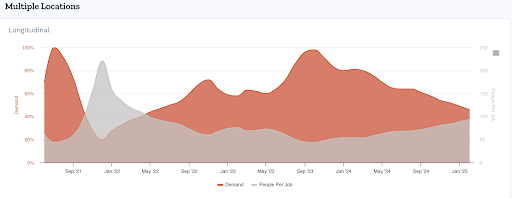
A view of the Longitudinal capability in Horsefly
Step 4: Analyze the Gaps
Compare the current workforce with the future requirement.
Gaps can be quantitative, such as needing additional engineers, or qualitative, where the organization has enough people numerically but lacks a particular capability.
External labor-market data can help determine how realistic a hiring requirement is.
If an organization needs 40 people with a particular skill in one location, for example, it is useful to understand how much relevant talent exists, how competitive the market is, and what compensation looks like.
Step 5: Decide How to Close the Gaps
Not every workforce gap needs external recruitment.
Potential approaches include:
-
External hiring
-
Internal mobility
-
Upskilling or reskilling
-
Succession development
-
Contractors or contingent workers
-
Outsourcing
-
Automation
-
Changes to role design
The right approach may differ by role and location.
Step 6: Build the Financial Model
Translate the workforce plan into financial terms.
Depending on the role and market, this may include:
-
Salary
-
Benefits
-
Employer taxes
-
Variable compensation
-
Recruitment costs
-
Relocation
-
Equipment
-
Onboarding
-
Training
It can also help to model the cost of delayed hiring, particularly for roles that directly affect revenue, delivery, or operational capacity.
Step 7: Monitor and Adjust
Review the headcount plan as conditions change.
Compare planned and actual headcount, costs, hiring timelines, and attrition. Review the assumptions behind the plan and update the forecast when those assumptions change.
This makes the plan a useful management tool, not a document that becomes outdated after the budget cycle.
How to Forecast Future Headcount Needs
No single forecasting method works for every organization. The methodology you choose should match your organizational context, data maturity, and planning horizon. Three approaches are particularly useful.
Statistical Forecasting
Historical workforce data can be used to identify relationships between headcount and business measures such as revenue, customer numbers, production volumes or project activity.
This can provide a useful baseline where historical patterns are reasonably stable.
The limitation is that past relationships may not hold after a significant strategic or market change.
Scenario-Based Forecasting
Scenario planning models different possible futures.
An organization might consider a higher-growth scenario, a base case, and a slower-growth scenario, then calculate the workforce and cost implications of each.
This approach is useful when uncertainty exists around growth, attrition, funding, market conditions, or other factors that could materially change workforce requirements.
Demand-Driver Modeling
Demand-driver models link workforce requirements to operational activity.
For example, a customer service organization could relate staffing requirements to ticket volumes, while a sales organization could model headcount against territories or revenue targets.
This can make workforce assumptions easier for business leaders to understand and challenge.
Combining Approaches
These methods don't have to be used independently.
Historical analysis can provide a baseline, scenario planning can test uncertainty, and demand-driver models can validate functions with clear operational relationships.
The Role of Labor-Market Intelligence
Internal workforce data tells you about your existing organization. External labor-market intelligence provides context about the talent market beyond it.
For headcount planning, useful external information can include:
-
Talent supply
-
Talent demand
-
Skills availability
-
Geographic distribution
-
Compensation
-
Competitor hiring activity
-
Changes in supply and demand
This information can help organizations test whether workforce plans are realistic.
For example, a company may plan to hire a large engineering team in a particular city. If the relevant talent pool is limited and several employers are recruiting for similar skills, the organization may need to consider different compensation, broader sourcing, alternative locations, or greater investment in internal development.
At Horsefly Analytics, our labor-market intelligence provides organizations with external data on talent supply, demand, compensation, skills, and competitive activity across global markets.
The objective isn't to replace internal workforce data. It adds the market context needed to make better-informed workforce decisions.

Connecting Headcount Planning With Finance
Headcount planning and financial planning need to work together.
The workforce model should provide finance with the information needed to understand expected labor costs, while financial constraints should feed back into workforce decisions.
For example, if the available budget changes, leaders can model the impact of delaying selected hires, changing locations, increasing internal mobility, or reprioritizing roles.
Compensation is another important connection. The amount budgeted for a role may not reflect current market conditions, particularly for specialized skills or highly competitive locations.
External compensation intelligence can therefore help organizations assess whether their assumptions remain realistic before hiring begins.
Consider the Cost of Vacancies
An unfilled position can reduce salary expenditure, but it can also create other costs.
Depending on the role, these may include:
-
Lost productivity
-
Delayed projects
-
Reduced revenue capacity
-
Overtime
-
Increased pressure on existing employees
-
Additional recruitment expenditure
The workforce model should consider both the cost of hiring and the potential cost of leaving important roles vacant.
Consider the Total Workforce
Headcount planning can also overlook contractors, temporary workers, and outsourced roles.
Where these forms of labor are significant, organizations should consider them alongside permanent employees when assessing total workforce requirements and costs.
Building Cross-Functional Alignment
Headcount planning involves several different perspectives.
HR may focus on workforce capability and talent availability. Finance may focus on cost and budget. Business leaders may focus on delivery and growth.
A cross-functional planning process helps bring these perspectives together.
Useful practices include:
Establish Shared Ownership
Bring together relevant stakeholders from HR, finance, talent acquisition, and business functions.
Define who owns the workforce model, who provides the inputs, and who has authority to approve changes.
Use Consistent Data
A shared planning model reduces the need for teams to reconcile different versions of headcount, cost, and hiring data.
Document Assumptions
Record assumptions around attrition, hiring timelines, compensation, internal mobility, and time to productivity.
When assumptions are explicit, stakeholders can challenge and update them more effectively.
Measuring Headcount Planning Performance
The right KPIs depend on your organization's objectives, but useful measures can include:
Financial Metrics
-
Budget vs actual labor cost: Compares planned workforce expenditure with actual spend.
-
Cost per hire: Tracks recruitment expenditure against hiring outcomes.
-
Revenue per employee: A productivity benchmark showing business output relative to headcount, which is useful alongside cost metrics, though it doesn't account for cost directly.
Operational Metrics
-
Time to fill: Measures the time required to fill approved vacancies.
-
Forecast accuracy: Compares planned and actual headcount over a defined period.
-
Requisition aging: Identifies roles that remain open beyond their expected fill date.
Strategic Metrics
-
Quality of hire: Can incorporate new-hire performance, retention, and hiring-manager feedback.
-
Skills-gap closure: Tracks how identified capability gaps are addressed.
-
Internal fill rate: Measures the proportion of roles filled through internal mobility.
-
Attrition variance: Compares actual turnover with the assumptions used in the plan.
These measures are most useful when tracked over time and considered alongside business outcomes.
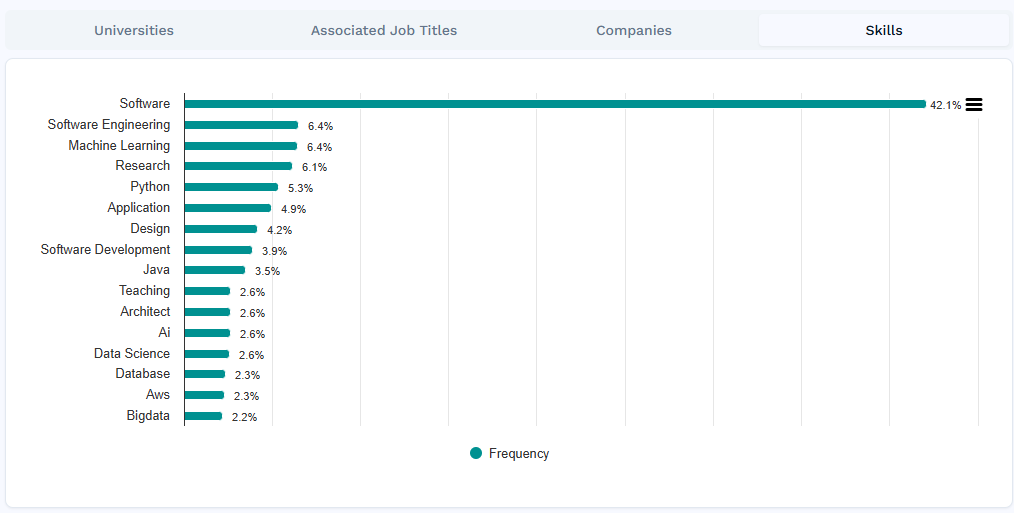
An example of the Skills capability in Horsefly
Technology for Data-Driven Headcount Planning
Spreadsheets can be useful for straightforward planning. As organizations add more employees, locations, stakeholders, and scenarios, maintaining complex workforce models manually becomes more difficult.
A technology-supported approach can bring together three main data layers.
Internal Workforce Data
HRIS and ATS systems provide information about employees, roles, compensation, vacancies, and recruitment activity.
Planning and Modeling
Workforce planning tools can support scenario modeling, forecasting, workflow management, and variance tracking.
This makes it easier to test questions such as what happens if hiring is delayed, attrition increases, or roles move between locations.
External Labor-Market Intelligence
External data adds information that internal systems don't provide, such as talent availability, compensation, skills distribution, and competitive hiring activity.
Connecting these layers gives workforce planners a broader basis for evaluating workforce decisions.
Global Planning: Handling Ethical and Legal Complexities
Planning across multiple countries introduces additional complexity.
Employment regulations, benefits, taxes, notice periods, consultation requirements, and restructuring processes vary between jurisdictions. Workforce plans therefore need to reflect relevant local conditions rather than applying the same assumptions everywhere.
Responsible Use of Workforce Data
Workforce analytics also raises questions around privacy and bias.
Organizations should consider:
-
Data quality and provenance
-
Privacy requirements
-
Human oversight
-
Appropriate use of automated insights
-
Regular testing and auditing
-
Diversity and inclusion objectives
Where market-level information is sufficient, aggregated or anonymized data can reduce the need to work with identifiable individual information.
Supporting Diversity and Inclusion
Talent-market analysis can also help organizations consider a broader range of locations and talent pools.
For example, exploring multiple markets may reveal relevant skills outside the locations an organization has traditionally recruited from.
Build diversity considerations into the planning process rather than treating them as a separate exercise.
Building a More Adaptive Workforce Plan
Effective headcount planning connects business strategy with workforce capability, financial planning, and labor-market conditions.
The process should help organizations answer practical questions before they become urgent:
-
Where should we hire?
-
Which skills will be difficult to source?
-
What will those skills cost?
-
Should we hire, develop, or redeploy?
-
What happens if market conditions change?
-
What is the potential cost of delaying a critical hire?
The answers depend on the quality of the information behind the plan.
Internal workforce data provides the foundation. External labor-market intelligence adds context about the markets in which organizations compete for talent.
Horsefly Analytics helps organizations bring that external perspective into workforce decisions, providing intelligence on talent supply, demand, compensation, skills, and competitive activity across global labor markets.
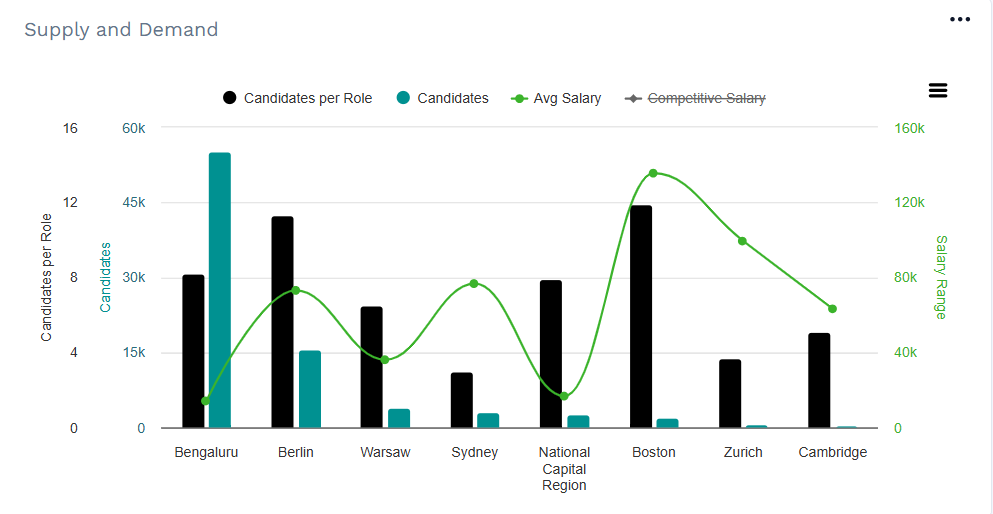
A view of the supply and demand functionality within Horsefly
For workforce planning, talent acquisition, HR, and finance teams, this can provide additional evidence for decisions about where to hire, which capabilities to develop, and how to plan for future workforce requirements.
A stronger headcount plan starts with a clearer understanding of both the organization and the talent market around it.
See What Horsefly Analytics Adds to Your Headcount Plan
Internal workforce data can tell you what you have. It can't tell you what's available, what it costs, or how competitive the market is for the roles you're planning to fill.
Horsefly Analytics gives HR, talent acquisition, and finance teams the external labor-market intelligence to pressure-test a headcount plan before it goes to budget: talent supply, compensation benchmarks, skills availability, and competitor hiring activity across global markets.
Build a headcount plan grounded in real market data.

Frequently Asked Questions
What is strategic headcount planning?
Strategic headcount planning connects workforce requirements with business objectives. It considers the number and type of roles required, where they should be located, when they are needed, and what they are likely to cost.
What is the difference between headcount planning and strategic workforce planning?
Headcount planning focuses primarily on the number, timing, location, and cost of roles. Strategic workforce planning takes a broader view, considering the skills and capabilities the organization will need and how to address those requirements through hiring, development, internal mobility, technology, and other approaches.
What are the key steps in headcount planning?
A practical process includes defining business objectives, assessing the current workforce, forecasting future requirements, identifying gaps, deciding how to address those gaps, building the financial model, and monitoring the plan over time.
How can organizations forecast future hiring needs?
Organizations can use historical analysis, scenario-based forecasting, and demand-driver modeling. Combining approaches can provide a more useful view of future workforce requirements, particularly when supported by external labor-market data.
How does labor-market intelligence support headcount planning?
External labor-market intelligence can provide information about talent supply, demand, skills availability, compensation, geographic distribution, and competitor hiring activity. This helps organizations assess whether planned hiring requirements are realistic and compare workforce strategies.
How should HR and finance collaborate on headcount planning?
HR and finance should use a shared workforce model and agree on key assumptions about headcount, compensation, hiring timelines, and workforce costs. Regular reviews can help ensure the workforce plan and financial plan remain aligned.
What metrics should organizations track?
Useful measures include budget-to-actual labor cost, cost per hire, time to fill, forecast accuracy, requisition aging, quality of hire, skills-gap closure, internal fill rate, and attrition variance.
How can technology support headcount planning?
Technology can connect workforce data with financial information, planning models, and external labor-market intelligence. Depending on the platform, this can support scenario modeling, forecasting, variance tracking, and workforce analysis.
Is headcount planning only relevant to large organizations?
No. Smaller organizations can apply the same principles at a narrower scale, focusing on critical roles, scarce skills, or the locations most relevant to their growth plans.
Sources: Horsefly Analytics