Contents:
Key Takeaway:
1. Treat the four analytics levels as a maturity model, and fix descriptive data first. If applicant counts differ depending on which system you pull them from, nothing built above that can be trusted. Descriptive says what happened, diagnostic says why, predictive forecasts, and prescriptive recommends. Skipping steps is the most common reason programs stall. Fix a few things properly: a common job architecture, shared definitions of each stage and metric, and a reliable way to match candidate and employee records.
2. Break metrics down by stage and standardize their inputs. An organization-wide time-to-fill of 45 days can hide a finance function at 25 days and R&D at 90, and the bottleneck is often the gap between final interview and offer approval rather than sourcing. Before benchmarking cost-per-hire across countries, agree what goes into it, or you’re comparing accounting conventions rather than recruiting performance. Pair speed and cost with quality of hire, since those metrics alone reward filling roles quickly and cheaply, which can push a team toward people who leave.
3. Predictive success profiles need bias audits, retraining, and an external view. A model trained on past hires can learn to prefer the narrow backgrounds that were hired before, so audit for adverse impact, remove proxy features, and keep human review on final selection. Profiles also go stale as roles change, and ones built on few hires deserve skepticism. Internal data is also a closed loop: it shows who succeeds among those who already apply, not where the people who never applied are, how many exist in a city, or what competitors pay. For niche skills, that external view is often the more important one.
—-----------------------------------------
Talent acquisition generates a huge amount of data, from application volumes and time-to-fill to candidate performance and retention. But collecting that information is only the starting point. The real value comes from understanding what the data says about the effectiveness of your recruitment processes, where improvements are needed, and how future workforce needs might change. HR analytics in recruitment provides a way to make those connections.
This guide to HR analytics looks at the four levels of analytical maturity, the metrics worth tracking, the data needed to support meaningful analysis, and how to build a talent acquisition function that uses evidence to make better decisions.
Beyond Gut Feel: The Shift to Data-Driven Recruitment
Recruitment analytics is the practice of collecting, analyzing, and interpreting data across the full talent acquisition lifecycle (sourcing, screening, interviewing, offer, onboarding, and early tenure) so that each stage can be measured and improved.
Intuition still has a role. Experienced recruiters notice things a model will miss, especially in senior or highly specialized searches. The problem is that intuition doesn't scale across forty countries and several thousand requisitions a year, and it rarely gets tested. A manager who believes candidates from a particular university outperform everyone else may be right. They may also be remembering three good hires and forgetting five average ones. Without data, nobody can tell.
In addition, when talent acquisition can show the CFO how a change in sourcing mix affected cost and retention, it starts operating as part of workforce analytics and business planning rather than as a fulfillment service that waits for requisitions.
The Four Pillars of Talent Analytics
We find it most useful to treat the four types of analytics as a maturity model. Each level depends on the one beneath it, and skipping steps is the most common reason analytics programs stall.
Descriptive analytics: what happened?
This is historical reporting: applicants per role, interviews scheduled, offers extended, acceptance rates, hires by region. Most organizations already have some version of it, usually spread across several dashboards that don't agree with each other.
Descriptive analytics is unglamorous and indispensable. If your applicant counts differ depending on which system you pull them from, nothing built above this level can be trusted.
Diagnostic analytics: why did it happen?
Diagnostic work investigates root causes. Offer acceptance in Germany dropped last quarter. Was it compensation, a slow approval process, a competitor entering the market, or a single manager whose interview style puts candidates off? Answering that requires cutting the data by stage, location, role family, and decision-maker, and then talking to people.
Diagnostic analysis explains problems after they occur. It doesn't prevent them.
Predictive analytics: what is likely to happen?
Models use historical patterns to forecast outcomes: how long a role will take to fill, which candidates are likely to accept, which employees are at risk of leaving in their first year, and where talent supply will tighten.
Prescriptive analytics: what should we do?
Prescriptive analytics recommends actions. If a model forecasts a 120-day time-to-fill for a data engineering role in Zurich, a prescriptive layer might suggest opening the search to Warsaw, adjusting the salary band, or reallocating sourcing spend to a channel with a better track record for that skill set.
Prescriptive recommendations are only as good as the forecasting models and data beneath them. The goal is actionable insights at every level, not a race to the top of the model.

Measuring What Matters: Key Talent Acquisition Metrics
There are dozens of staffing metrics. Most HR departments track too many and act on too few. These four carry the most weight with senior leadership.
Time-to-fill and time-to-hire
Time-to-fill runs from requisition approval to offer acceptance. Time-to-hire runs from a candidate's first contact to their acceptance. The first tells you how long the business waits; the second tells you how long the candidate waits. Both matter, and conflating them hides problems.
An organization-wide time-to-fill of 45 days can conceal a finance function that fills roles in 25 days and an R&D function that takes 90. Analytics becomes valuable when you break the process into stages and measure the dwell time in each. In our experience, the bottleneck is rarely where people assume. It is often not sourcing but the gap between final interview and offer approval, where requisitions sit waiting for a sign-off.
Cost-per-hire
Cost-per-hire combines internal costs (recruiter time, technology, employer branding) with external costs (agency fees, job board spend, assessment tools, relocation) divided by the number of hires.
Different regions classify costs differently, agency fees sit in business unit budgets rather than TA budgets, and recruiter time is rarely allocated by requisition. Before benchmarking cost-per-hire across countries, standardize what goes into it. Otherwise you will be comparing accounting conventions, not recruiting performance.
Once the inputs are clean, analytics shows which channels and processes drive cost. A common finding is that a handful of hard-to-fill roles account for a disproportionate share of agency spend, which points to a targeted fix rather than a blanket budget cut.
Quality of hire
Quality of hire typically combines first-year performance ratings, manager satisfaction, time to productivity, and retention at 12 or 18 months.
It is hard because the data sits outside HR systems, arrives months after the hire, and depends on performance ratings that vary in rigor by manager and region. Speed and cost metrics on their own reward filling roles quickly and cheaply, which can push a team toward selecting people who leave. Quality is the counterweight.
Source of hire
Source of hire tracks which channels produce candidates and, more usefully, which produce employees who perform well and stay. A job board might deliver the most applicants and the weakest twelve-month retention. Employee referrals might produce fewer candidates with better outcomes.
The analytical value comes from connecting source to downstream results rather than stopping at applicant volume. The practical difficulty is attribution: candidates often touch three or four channels before applying, and most ATS configurations record only one.
The Power of Predictive Analytics in Talent Sourcing
Predictive analytics moves talent acquisition from reviewing what happened to forecasting what will happen. Applied to sourcing and selection, it works roughly like this.
You start with the people you have already appointed. Using data on past successful employees (skills, prior experience, career trajectory, assessment results, source channel, and later performance and tenure), machine learning algorithms identify the characteristics that correlate with success in a given role. That becomes a success profile. New candidates can then be assessed against it, and sourcing can be directed toward pools that resemble it.
The same approach supports employee retention. If the data shows that employees who joined through a particular channel, or who experienced a long gap between offer and start date, leave at higher rates, you can intervene before the problem repeats.
Three cautions, from our own experience:
Historical data carries historical bias. If your past successful employees came mostly from a narrow set of universities or backgrounds, a model trained on them will learn to prefer those backgrounds. That is a fairness problem and a business problem, since it shrinks your talent pool. Models need regular auditing for adverse impact across demographic groups, and features that act as proxies for protected characteristics should be removed.
Success profiles go stale. The profile of a strong software engineer five years ago may not match what the role needs now. Retrain models as roles change, and be skeptical of any profile built on a small number of hires.
Internal data alone is a closed loop. A model trained only on your own applicants can tell you who succeeds among the people who already apply to you. It cannot tell you where the people who never applied are, how many of them exist in a given city, or what competitors pay them. For global enterprises seeking niche skills, that external view is often the more important one.
This last point is where we spend most of our time at Horsefly Analytics. Our work centers on global labor market data: understanding talent supply, demand, and competition across locations so that forecasting models reflect the market as it is, not just the organization's own history. When a model forecasts that a role will be hard to fill, external data tells you why (thin supply, heavy competition, salary expectations above your band) and where an alternative might exist.
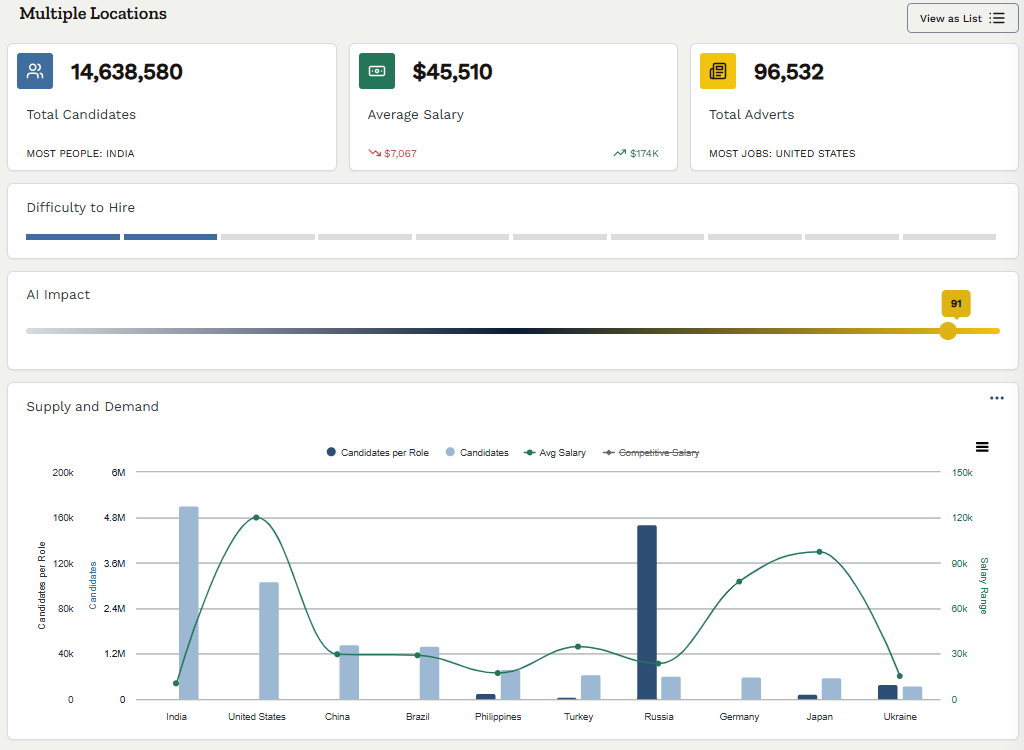
A view of the Supply and Demand functionality within Horsefly
Used well, these models shorten shortlists, direct sourcing budgets toward channels that work, and flag risks early. Used carelessly, they automate past mistakes. Human review of model outputs, especially for final selection decisions, is not optional.
Fueling Your Analytics Engine: Essential Data Sources
Every analytics program eventually runs into the same wall: the data. Model sophistication matters far less than the quality and breadth of what goes in.
The primary internal data sources are:
-
Applicant Tracking System (ATS): requisitions, applicants, stage progression, interview feedback, offers, and source. This is the backbone of process metrics like time-to-fill and conversion rates.
-
Human Resource Information System (HRIS): employee records after hire, including job history, performance ratings, compensation, promotions, and exits. Without HRIS data, you cannot measure quality of hire or retention.
-
Candidate Relationship Management (CRM): talent pools, campaign engagement, and pre-application touchpoints. This fills in the early-funnel picture that the ATS misses.
-
Assessment and interview platforms: structured scores that can be tested against later performance to see which assessments predict anything.
-
Finance and procurement systems: agency invoices, advertising spend, and technology costs for accurate cost-per-hire calculations.
The hard part is integration. In most global enterprises we work with, these systems were bought at different times, configured differently by region, and use inconsistent job titles, location codes, and candidate identifiers. Linking an applicant record in the ATS to the same person's employee record in the HRIS sounds trivial and often isn't, particularly after mergers or system migrations.
Our advice is to fix a small number of things properly rather than everything partially. Agree on a common job architecture, a shared definition of each stage and metric, and a reliable way to match candidate and employee records.
Then add external workforce data. Internal systems describe your organization. Labor market data on talent availability, competitor hiring activity, and compensation benchmarks by location describes the market you are competing in. For global workforce planning, you need both.
Strategic Benefits of Analytics in Talent Acquisition
For a senior audience, the case for data-driven talent decisions rests on outcomes the business already cares about:
-
Lower cost and faster hires. Stage-level analysis exposes the specific delays and channels that inflate time and spend, so improvement targets the actual problem. Reducing agency dependence on a defined set of hard-to-fill roles is often the quickest financial return.
-
Better outcomes. Linking selection data to later employee performance shows which assessments, interview formats, and sources correlate with success. Teams can then drop the steps that add time without adding signal.
-
Lower early attrition. When you can see which selection patterns precede first-year exits, you can address them at the point of selection rather than after the employee turnover rate has already climbed and the replacement cost has been paid.
-
Measurable progress on DEI. Funnel analytics shows exactly where candidates from underrepresented groups drop out, whether at application, screening, interview, or offer.
-
More credible workforce planning. Combining internal pipeline data with external labor market data lets leaders answer questions like "Can we staff this new site within 18 months?" or "Should this capability sit in Kraków or Austin?" with evidence.
Building a Data-Centric Talent Acquisition Function
Technology is the easy part of this. The harder parts are people, definitions, and habits.
Skills on the team
A common mistake is assuming the answer is hiring data scientists. You may need some, particularly for forecasting models. But the bigger gap in most TA functions is people who can interpret data and translate it into business decisions: someone who can look at a drop in offer acceptance, ask the right follow-up questions, and present a recommendation that a business unit leader will act on.
The people analytics professionals who add the most value combine reasonable statistical literacy with real business acumen. Recruiters themselves also need enough data fluency to trust the numbers and challenge them when something looks wrong.
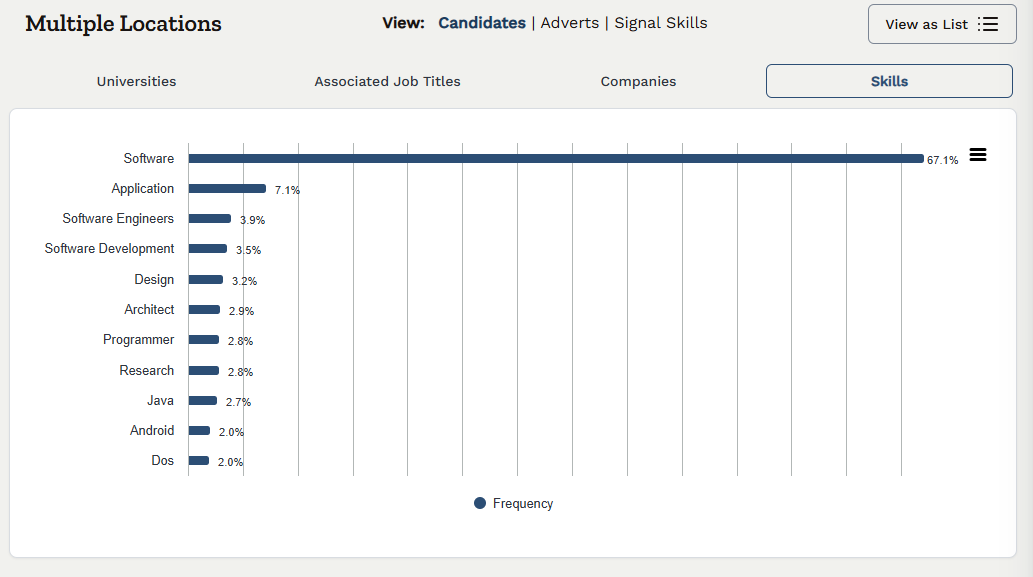
A view of Skills data from Horsefly
Choosing HR analytics tools
Without naming vendors, these are the questions we would ask of any HR analytics tool:
-
Integration: Can it connect to your existing ATS, HRIS, and CRM without a multi-year IT project? How does it handle mismatched records?
-
Usability: Can a TA leader answer their own questions, or does every new view require an analyst?
-
Data coverage: Does it include external labor market data for the countries and roles you recruit for, or only your internal data?
-
Transparency: For forecasting features, can you see which factors drive a prediction and audit the model for bias?
-
Scalability: Will it handle your requisition volume, your number of countries, and your data privacy obligations across jurisdictions?
Implementation that sticks
Start with one or two business questions that matter to leadership (for example, "Why are we losing finalists for engineering roles in Asia-Pacific?") rather than a broad mandate to "become data-driven." Answer them well, show the result, and expand from there.
Expect resistance. Hiring managers who have relied on their own judgment for years will not welcome data suggesting their preferred candidate profile performs no better than others. Evidence-based strategies take hold when leaders see analysis that helps them, so lead with problems they want solved.
Is Your Recruitment Strategy Ready for the Future?
The organizations making the strongest talent decisions share a few habits. They agree on what their metrics mean. They connect recruitment data to what happens after a hire. They test their assumptions instead of inheriting them. And they look outside their own walls to understand the labor markets they compete in.
None of this is primarily a technology project. The tools matter, but the bigger shift is in how decisions get made: where to locate a new team, which channels to fund, which candidates to prioritize, and when to tell the business that a plan isn't feasible with the talent available.
For global organizations, the hardest questions are about global talent: where it is, who else wants it, and what it will take to attract it. That is the part of the problem we focus on at Horsefly Analytics, using global labor market data to help talent and workforce planning leaders make smarter decisions about where and how to build their teams.
Learn more about Horsefly's Talent Intelligence Platform.

Frequently Asked Questions
What are the four levels of analytical maturity in recruitment?
Recruitment analytics progresses through four distinct levels: descriptive (what happened), diagnostic (why it happened), predictive (what is likely to happen), and prescriptive (what should be done). Each level builds upon the previous one, offering increasingly sophisticated insights and actionable recommendations for talent acquisition teams.
How do HR analytics help reduce staffing costs and time-to-fill?
HR analytics reduce costs and speed up the process by identifying specific bottlenecks and ineffective sourcing channels. By analyzing stage-level data, teams can pinpoint where delays occur and reallocate resources to more efficient methods.
How can organizations effectively measure the quality of new employees?
Quality of hire is effectively measured by combining metrics such as first-year performance ratings, manager satisfaction, time to productivity, and retention rates at 12 or 18 months.
What are the risks of using historical workforce data for predictive models?
Relying solely on historical data for predictive models carries risks such as perpetuating past biases, which can narrow talent pools. Models can also become stale as job requirements evolve, and internal data alone fails to capture crucial external labor market conditions, limiting accuracy.
What internal data systems are essential for robust HR analytics?
Robust HR analytics require integrating data from Applicant Tracking Systems (ATS) for process metrics, Human Resource Information Systems (HRIS) for post-hire performance, Candidate Relationship Management (CRM) for early-funnel insights, and finance systems for accurate cost-per-hire calculations and external spend.
How can HR teams overcome resistance when implementing data-driven recruitment?
To overcome resistance, HR teams should start by addressing one or two high-priority business problems important to leadership. Demonstrate clear, positive results from data insights and expand gradually.
Why is external labor market data important for strategic workforce planning?
External labor market data is vital for strategic workforce planning because internal systems only describe an organization's talent. It provides crucial insights into talent availability, competitor activity, and compensation benchmarks by location, enabling leaders to make informed decisions about new sites or capabilities.
Sources: Horsefly Analytics