.png?width=2000&name=Horsefly-Logo-NewTag_White%20(3).png)
Here's the honest answer: because decisions made without data are just expensive guesses.
Organizations that invest in people analytics consistently outperform those that don't. According to Deloitte, companies with strong people analytics capabilities are more than twice as likely to improve their recruiting efforts and more than three times as likely to achieve cost reductions. The CIPD has long advocated for evidence-based HR as a core component of good people management, and the data backs that up.
The benefits are real and wide-ranging. Better decision-making is the obvious one. When HR leaders can walk into the boardroom with data rather than anecdotes, they get taken seriously. When business leaders can see the cost of high turnover in black and white, they invest in fixing it. People analytics builds a data-driven culture across the organization, not just in HR.
What Measurable Improvements Can be Made with People Analytics?
Beyond decision-making, there are measurable improvements in business outcomes. Organizations that track and act on people data see improvements in employee engagement, reduced absenteeism, and lower early turnover rates. They can identify retention risks before they become resignations. They can build and implement more effective recruitment strategies based on what actually works, rather than what feels right.
Cost efficiency follows naturally. When you stop wasting budget on the wrong hire, the wrong location, or the wrong recruitment channel, the savings add up fast. People analytics also enables smarter workforce planning so you're not caught short when growth accelerates or market conditions shift.
To sum up, it's not a nice-to-have; it's how smart organizations operate.
Types of People Analytics
There's a useful framework for understanding the different levels, and it goes from "telling you what happened" all the way through to "telling you what to do about it."
Descriptive analytics is the starting point. It summarizes historical data to show what has already occurred:
-
Turnover rates last quarter
-
Headcount by department
-
Average time to hire
All useful context, but not yet actionable on its own.
Diagnostic analytics goes a step further and asks why. Why did turnover spike in Q3? Why is time to hire longer in one region than another? This type of analysis digs into the data to identify root causes and correlations.
Predictive analytics is where things get genuinely powerful. Using statistical modeling and machine learning, it forecasts future outcomes based on patterns in historical data. Common techniques include regression analysis (identifying relationships between variables, like the link between manager quality scores and team attrition) and classification models (predicting which employees are flight risks based on a set of behavioral and engagement signals). This is the level at which people analytics starts to shift from reactive to proactive. To understand more about How Horsefly Analytics uses predictive analytics, from longitudinal data to supply and demand, you can contact us for more expert guidance.

Prescriptive analytics takes predictions and turns them into recommendations. It doesn't just tell you that turnover is likely to increase. It tells you which interventions are most likely to prevent it, and what the expected impact of each would be.
Cognitive analytics sits at the leading edge, using AI and natural language processing to surface insights from unstructured data, like employee feedback, open survey responses, or performance notes, at scale.
Most organizations are still operating primarily at the descriptive level. The opportunity is significant.
Use Cases of People Analytics
Theory is fine but real examples are always better.
Employee engagement is one of the most common use cases. Rather than running an annual survey and hoping for the best, people analytics enables continuous listening and trend analysis. When engagement scores drop in a particular team or location, you can identify it early and act before it becomes a retention problem.
Employee retention is where people analytics delivers some of its most measurable ROI. By identifying the factors that predict voluntary attrition, such as tenure, engagement scores, compensation relative to market, and manager relationships, organizations can intervene at the right moment. Google famously used people analytics to identify that parental leave policies were contributing to higher female attrition, and fixed it. The result was a significant reduction in attrition among new mothers. Utilizing the EVP information is a crucial step for HR professionals to understand and get the most out of their workforce.
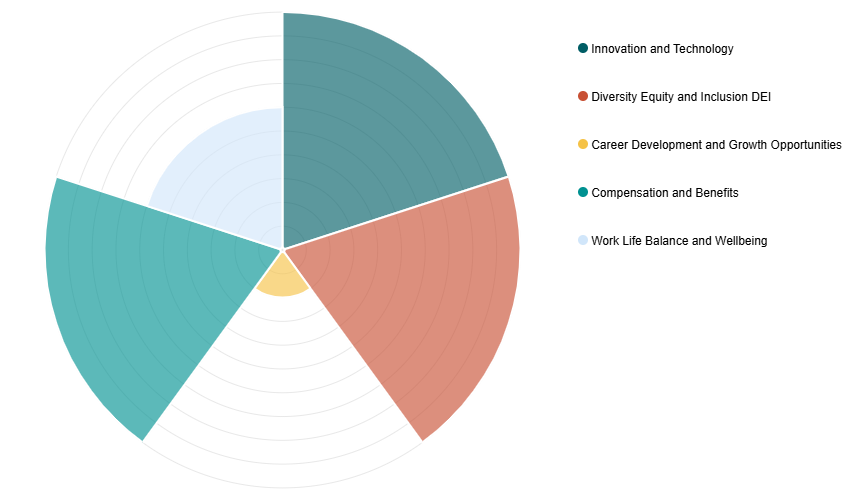
Image shows the EVP capability in the Horsefly platform.
DEI initiatives benefit enormously from accurate data. Without it, diversity goals are just aspirations. With it, you can track representation at every stage of the hiring funnel, identify where drop-off occurs, and benchmark your workforce against what's actually available in the labor market.
Recruitment and selection becomes far more effective when it's grounded in data. Understanding where your best hires come from, which assessments predict performance, and how your offer acceptance rates compare to market norms allows you to build a genuinely competitive hiring strategy.
Performance management shifts from an annual box-ticking exercise to an ongoing conversation when underpinned by data. Tracking performance trends over time, identifying high-potential talent early, and correlating development activity with output are all possible with the right analytics in place.
Developing a People Analytics Strategy
A people analytics strategy without a clear purpose is just a data collection exercise. Start with the problem, not the tool:
-
Define the business challenge first. What question are you actually trying to answer? "We want to reduce attrition" is a start. "We want to understand why attrition in our technology function has increased by 15% over 18 months and identify the most effective interventions" is a strategy.
-
Link everything to business goals. People analytics only gets boardroom buy-in when it speaks the language of business outcomes. Frame your analysis in terms of cost, revenue impact, productivity, or risk. HR metrics matter when they connect to things the business cares about.
-
Review your data sources. What data do you actually have? What's missing? This is where many organizations hit their first wall. Your HRIS (Human Resources Information System) holds internal data. Your ATS (Applicant Tracking System) holds recruitment data. But external labor market data, salary benchmarks, talent supply and demand, and competitor intelligence often require a dedicated platform to access reliably.
-
Build for actionable insights, not beautiful reports. The most sophisticated analysis in the world is worthless if nobody acts on it. Every piece of analytics output should come with a clear recommendation and a named owner.
-
Develop a communication strategy. How will you share insights across the organization? With what frequency? In what format? The best people analytics functions treat communication as seriously as analysis.
Key HR Metrics for People Analytics
You can track a lot of things. Here are the ones that actually matter.
Employee turnover rate measures the percentage of employees who leave over a given period. High turnover is expensive. Industry estimates put the cost of replacing an employee at anywhere between 50% and 200% of their annual salary, depending on seniority.
Absenteeism rate tracks unplanned absence as a percentage of total working days. Beyond the operational disruption, sustained high absenteeism often signals underlying engagement or wellbeing issues.
Time to hire measures the number of days from job requisition to accepted offer. It's a proxy for recruitment efficiency and also for the experience your prospective talent has during the process.
Cost per hire calculates the total investment required to bring a new person into the organization. Useful for benchmarking and for building the business case for investment in talent acquisition technology.
eNPS (Employee Net Promoter Score) asks employees how likely they are to recommend the organization as a place to work. It's simple, trackable over time, and surprisingly revealing.
Revenue per employee connects workforce size and composition to business performance. Particularly useful for workforce planning and productivity benchmarking.
Early turnover tracks attrition within the first 12 months of employment. High early turnover usually points to problems in the hiring process, onboarding experience, or role design, all of which are fixable with the right data.
Building a People Analytics Team
You don't need a team of data scientists on day one. You do need the right mix of skills as you scale. These skills can include:
-
Business acumen is non-negotiable. The best people analytics professionals understand the business they're working in. They know what keeps the CFO up at night. They can translate a regression output into a board-ready recommendation.
-
Data literacy across the team matters more than one heroic analyst. When HR business partners can read and interpret data, when hiring managers understand what a confidence interval means, the whole organization gets smarter.
-
Technical skills will depend on your maturity level. At entry level, strong Excel capability goes further than most people expect. As you scale, familiarity with SQL (the language used to query relational databases) and tools like R or Python for statistical analysis becomes valuable.
-
Communication skills are underrated in analytics roles. The ability to tell a story with data, to explain a complex finding simply, is what separates analytics that changes behavior from analytics that collects dust in a shared drive.
In terms of operating model, most organizations start with a centralized people analytics function and gradually move to a more federated model as data literacy builds across HR and the wider business.
Essential Tools for People Analytics
The right people analytics tool depends on where you are in your analytics journey.
Excel remains the workhorse of most HR teams and for good reason. It's flexible, widely understood, and capable of handling a surprising amount of analytical complexity. Don't dismiss it.
R and Python are the languages of choice for more advanced statistical analysis and predictive modeling. Both are open source and have extensive libraries built specifically for HR analytics applications.
Power BI and Tableau are the leading data visualization platforms. They connect to multiple data sources and allow you to build interactive dashboards that make insights accessible to non-technical audiences.
Visier, ChartHop, and Orgnostic are purpose-built people analytics platforms that sit on top of your existing HR systems and provide pre-built analytics functionality. They're particularly useful for organizations that want analytical capability without building it from scratch.
ChatGPT and generative AI tools are increasingly being used to query data in natural language, draft analytical narratives, and surface insights from unstructured text. The space is evolving fast.
For working with both internal and external labor market intelligence, platforms like Horsefly Analytics provide access to talent supply and demand data, salary benchmarking, diversity data, and skills trend analysis across 65 countries. This kind of external data is what turns internal HR analytics into genuine workforce intelligence. When you can see not just what's happening inside your organization but how it compares to what's happening in the market, your strategic decisions get significantly sharper. Get in touch for a custom consultation.

Choosing the right tool comes down to three things: the size and complexity of your organization, the technical capability of your team, and what questions you're actually trying to answer.
Ethical Considerations and Data Privacy
This is the section most people analytics guides skip past. We're not going to do that.
Collecting and analyzing data about your workforce is a significant responsibility. Employees have a reasonable expectation that their data will be used fairly, transparently, and in their interests as well as the organization's. When that expectation is violated, the damage to trust is real and lasting.
Data privacy regulations set the legal baseline. GDPR in Europe, CCPA in California and equivalent frameworks elsewhere, impose strict requirements on how personal data is collected, stored, used, and shared. People analytics functions need robust governance frameworks that aren't an afterthought.
Algorithmic bias is a genuine risk. If your historical hiring data reflects past discriminatory patterns, and you train a predictive model on that data, you will automate and scale that discrimination. Auditing your models for bias isn't optional; it's essential.
Transparency builds trust. Employees should know what data is being collected, why, and how it will be used. Organizations that communicate openly about their people analytics programs consistently see better employee response to engagement surveys and other data collection activities.
Accountability means having clear ownership of data governance, with named individuals responsible for ensuring ethical use. It also means being willing to stop using a model or dataset when the evidence suggests it's causing harm.
Data Visualization Techniques
Good data analysis presented badly is still bad communication. Here's how to get it right.
Choose the right chart type for the question. Bar charts for comparisons. Line charts for trends over time. Scatter plots for relationships between variables. Understand what works best for your needs and data.
Tell a story, don't just report numbers. Every visualization should have a point. What does this data mean? What should the reader take away? Build your visual around that message, not around the dataset.
Keep it simple. The most common mistake in data visualization is trying to show too much at once. One clear insight per chart. Minimal chart furniture. Color used purposefully, not decoratively.
Avoid misleading visualizations. Truncated y-axes, inconsistent scales, and cherry-picked time periods are the most common culprits. If your data tells a nuanced story, present it accurately rather than engineering a more dramatic visual.
Test with your audience. If the person you're presenting to needs more than 10 seconds to understand a chart, the chart needs work. Simplicity isn't dumbing down. It's doing the hard work of interpretation so your audience doesn't have to.
Evidence-Based HR vs. People Analytics
These two approaches are complementary, but they're not the same thing.
People analytics focuses primarily on internal and external data as the basis for decision-making. Evidence-based HR, takes a broader view and argues that good HR decisions should draw on multiple sources of evidence: organizational data, yes, but also published research, professional expertise, and input from the people affected by the decision.
The structured process of evidence-based HR asks practitioners to critically appraise the quality and relevance of evidence, including stakeholder feedback, before acting on it. That's a healthy discipline to bring to people analytics - models can be biased and dashboards can tell a story that looks compelling but doesn't hold up to scrutiny, so quality matters.
The best people analytics functions combine both approaches: the analytical rigor of data-driven decision making with the critical thinking and multi-source perspective of evidence-based HR. Neither alone is sufficient. Together, they're powerful.
If you want to see how Horsefly Analytics can sharpen your talent intelligence, schedule a strategic consultation with us.
Sources: Horsefly Analytics, GDPR, CCPA, Deloitte, CIPD, Google, Psychology Today, LinkedIn