.png?width=2000&name=Horsefly-Logo-NewTag_White%20(3).png)
An enterprise people analytics platform closes that gap. Not as a reporting dashboard layered on top of your HRIS, but as a strategic intelligence engine that connects internal workforce data with external labor market realities. Internal data tells you who you have, what they earn, and when they leave. External data tells you who else is available, what competitors pay, and where supply and demand dynamics are shifting before they hit your pipeline.
When those two data streams converge in a single platform, talent decisions stop being reactive. Workforce planning becomes something you can defend to the board with numbers, not narratives. And the talent acquisition function shifts from order-taking to advising the business on where, when, and how to build capability.
The rest of this article breaks down:
-
The core capabilities of an enterprise-grade platform.
-
How AI changes the forecasting equation.
-
What integration and security look like at scale.
-
Why external labor market data is the missing layer most platforms ignore.
-
How to measure whether any of this actually delivers returns worth the investment.

Core Capabilities of an Enterprise-Grade Platform
Not every analytics tool calling itself "enterprise-ready" actually is. The label gets applied liberally. Here's what separates a genuine enterprise platform from other tools on the market.
A Single Source of Truth Through Data Integration
The first requirement is the ability to ingest and normalize data from multiple HR systems simultaneously. A global enterprise typically runs some combination of an HRIS ( Workday, SAP SuccessFactors, Oracle HCM), one or more ATS platforms, regional payroll systems, and learning management systems. An enterprise platform must connect to all of them through live integrations that keep data current, not manual CSV uploads.
The goal is a unified data model. When a VP of Workforce Planning asks how many software engineers with cloud architecture skills the organization employs across APAC, the answer should come from one query, not four regional HR teams working off different taxonomies.
Advanced Analytics Beyond Descriptive Reporting
Descriptive analytics (headcount, turnover rates, time-to-fill) are table stakes. They tell you what already happened. Enterprise platforms need to support diagnostic analytics (why did attrition spike in your Berlin engineering team?), predictive analytics (which business units face the highest attrition risk in the next two quarters?), and prescriptive analytics (what compensation adjustment would reduce that risk most cost-effectively?).
The analytical engine also needs to handle workforce segmentation, skills adjacency mapping, and scenario modeling. If you're evaluating whether to build a data science team in Bangalore, Kraków, or Austin, you should be able to model labor supply, compensation ranges, competitive density, and ramp-up timelines for each location in a single view.
DEIB (Diversity, Equity, Inclusion, and Belonging) Analytics With Substance
DEIB analytics deserve specific mention because they're frequently treated as an afterthought: a demographic breakdown chart added to a dashboard. Enterprise-grade DEIB analytics go further. They track representation across the full employee lifecycle, from sourcing and interview-to-offer ratios through promotion velocity and pay equity analysis. They identify where bias may be entering the process, not just what the outcome numbers look like after the fact.
The platform should also allow leaders to model the downstream effects of DEIB-focused interventions. If you adjust sourcing strategy to increase candidate diversity in a specific function, what's the projected impact on representation at the manager level in three years? That kind of modeling turns good intentions into measurable strategy.
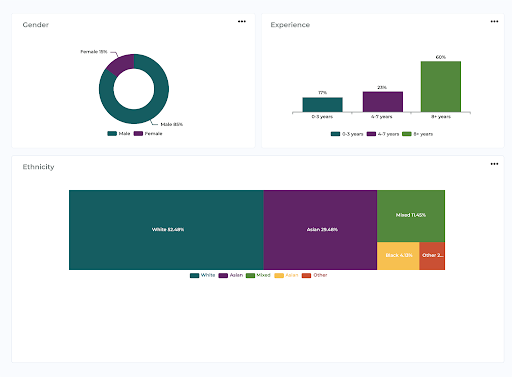
Image shows the DEI functionality in Horsefly
Configurable Dashboards and Storytelling
Enterprise users range from CHROs presenting to the board to regional HR business partners managing local headcount. The platform must support role-specific views with configurable dashboards that surface relevant KPIs without requiring a data analyst to build each one. Natural language summaries and automated insight generation help non-technical stakeholders act on data without interpreting complex visualizations.
The Power of AI in Predicting Your Workforce's Future
AI in people analytics gets oversold and underexplained in equal measure. Let's be specific about what it does and where it genuinely changes outcomes.
From "What Happened" to "What Will Happen"
Machine learning models excel at identifying patterns in large, messy datasets that human analysts would miss or take months to find. In workforce analytics, this translates to three practical applications.
Attrition Prediction
ML models trained on historical employee data (tenure, compensation history, manager changes, engagement survey responses, commute distance, promotion timing) can flag employees and cohorts at elevated risk of leaving. The value isn't in predicting that one specific person will resign next Tuesday. It's in identifying that your mid-career female engineers in the 3- to 5-year tenure band across three specific offices show a pattern of risk factors that preceded departures in similar cohorts. That gives HR leaders time to intervene with targeted retention strategies before the resignation letter arrives.
Skills Gap Forecasting
AI can analyze your current workforce skills inventory against projected business needs and external market trends to identify where gaps will emerge. If your product roadmap requires significant AI/ML capability within 18 months but your current team's skills profile is weighted toward traditional software development, the platform should surface that gap early enough to decide between build, buy, or borrow strategies.
Scenario Modeling
What happens to your total cost of workforce if you shift 200 roles from London to Lisbon? What if attrition in your nursing staff increases by 3% while labor supply in key metro areas tightens? AI-driven scenario modeling lets leaders pressure-test strategic decisions against multiple variables simultaneously, producing probability-weighted outcomes rather than single-point estimates.
Prescriptive Analytics: Recommendations, Not Just Forecasts
The step beyond prediction is prescription. Rather than simply flagging that your customer success team in North America has a 28% attrition probability over the next six months, a prescriptive engine recommends specific actions: adjusting compensation to the 65th percentile in key markets, implementing a structured career pathing program, or redistributing workload from the highest-risk team members. These recommendations should be grounded in data about what has worked in comparable situations, not generic best practices.
Conversational Analytics
One development worth watching is the rise of conversational analytics interfaces. Instead of managing complex dashboard filters, a user types or speaks a question: "What's our average time-to-fill for senior data engineers in EMEA compared to last year?" The platform interprets the query and returns a direct answer with supporting data. This reduces the dependency on dedicated analysts and puts intelligence directly in the hands of decision-makers.
Conversational interfaces should not be treated as a replacement for deep analytical capability, though. They're an access layer, not a substitute for rigorous modeling underneath.

Unifying Your Tech Stack: Integration and Implementation
Most enterprise analytics deployments succeed or stall at integration. The technology can be brilliant, but if it can't connect cleanly to your existing systems, adoption will suffer.
APIs and Pre-Built Connectors
Enterprise platforms need a library of pre-built connectors for major HR systems: Workday, SAP SuccessFactors, Oracle HCM, ADP, Greenhouse, iCIMS, and others. These connectors should handle bidirectional data flow and stay current with vendor API updates. For proprietary or legacy systems, the platform needs a well-documented open API that allows custom integrations without requiring the vendor's professional services team for every connection.
The Data Cleansing Reality
Most enterprise HR data is messy. Job titles aren't standardized across regions. Skills taxonomies differ between business units. Historical data has gaps, duplicates, and inconsistencies from years of M&A activity and system migrations.
A realistic implementation plan treats data cleansing and mapping as a major workstream, not a footnote. The platform should include tools for automated data normalization (for example, mapping 47 variations of "Software Engineer" to a standardized role taxonomy), but manual review will still be required. Skipping this step means your analytics will produce confident-looking outputs built on unreliable inputs.
Typical Implementation Timeline
For a global enterprise with 10,000+ employees, expect 12 to 20 weeks for a phased implementation. Phase one typically covers core data integration and dashboard deployment for a pilot group. Phase two expands to broader analytics capabilities and wider user access. Phase three introduces advanced features like predictive modeling and external data integration.
The biggest variable isn't the technology. It's change management. Getting HR business partners and line managers to actually use the platform instead of their familiar spreadsheets requires training, executive sponsorship, and early wins that demonstrate value. Without those, you'll have a well-integrated platform that nobody logs into.
Fortress-Grade Security and Global Compliance
For a CHRO at a global enterprise, the security conversation isn't optional. People data is among the most sensitive information an organization holds, and the regulatory environment around it grows more complex every year.
Encryption and Access Controls
At minimum, an enterprise platform must encrypt data both in transit and at rest using current standards (AES-256 for stored data, TLS 1.2+ for data in motion). Granular role-based access controls should allow administrators to define exactly who can see what data, down to the field level. A regional HR manager in Germany should not have access to individual compensation data for employees in Japan unless their role explicitly requires it.
Multi-factor authentication, single sign-on integration with enterprise identity providers (Okta, Azure AD), and detailed audit logs of all data access and changes are baseline requirements, not premium features.
Regulatory Compliance Across Jurisdictions
This is where global operations create genuine complexity. GDPR in the EU imposes strict requirements on data processing, storage, and the right to erasure. CCPA and its successors in the US apply different rules. Brazil's LGPD, Japan's APPI, and dozens of other national frameworks each have specific requirements for how employee data can be collected, processed, and transferred across borders.
The platform must support data residency requirements (for example, keeping EU employee data on EU-based servers) and provide mechanisms for data subject access requests and deletion. SOC 2 Type II certification is the standard proof that the vendor's internal controls around security, availability, and confidentiality have been independently audited. If a vendor can't produce current SOC 2 certification, that's a deal-breaker for enterprise procurement.
Anonymization and Aggregation
DEIB analytics and benchmarking often require analyzing sensitive demographic data. The platform must support automatic anonymization and minimum threshold rules (suppressing results when the sample size is too small to protect individual identities). This isn't just a compliance requirement. It's how you maintain employee trust in the platform and in the organization's use of their data.
Measuring What Matters: Demonstrating the ROI of People Analytics
The business case for people analytics has to be quantified in financial terms, or it will lose budget priority to the next initiative that can. Here's a practical framework.
Attrition Cost Reduction
Calculate your fully loaded cost of turnover per role (recruiting, onboarding, lost productivity during ramp-up, knowledge loss). If a platform's predictive models and the retention interventions they inform reduce voluntary attrition by even 2 to 3 percentage points in high-cost roles, the savings often exceed the platform's annual cost within the first year. For an enterprise with 20,000 employees and a 15% turnover rate, reducing that to 13% at an average replacement cost of $25,000 per employee saves $10 million annually.
Hiring Efficiency Gains
Quantify the cost of vacancy for revenue-generating or production-critical roles. If data-driven location targeting and compensation benchmarking reduce average time-to-fill by 10 to 15 days, multiply those days by the daily cost of vacancy. For specialized roles, that figure can reach $500 to $1,500 per day.
Workforce Planning Accuracy
This one is harder to quantify but often delivers the largest returns. When workforce planning is based on real supply-and-demand data rather than assumptions, organizations avoid expensive mistakes: building offices in talent-scarce markets, overpaying relative to local benchmarks, or under-investing in emerging talent hubs. A single location strategy decision informed by accurate labor market intelligence can save or generate millions.
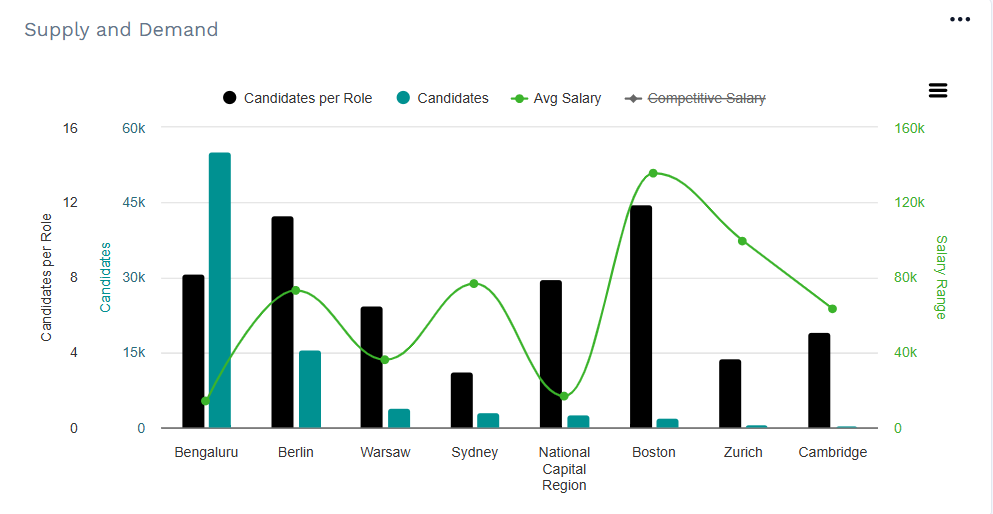
A view of the Supply and Demand functionality within the Horselfy platform
DEIB Program Effectiveness
Track representation metrics before and after data-informed interventions. Connect improvements in workforce diversity to documented business outcomes like expanded market reach, improved innovation metrics, or reduced compliance risk.
Credible ROI measurement starts with baselining. Before deploying the platform, document current metrics: turnover rates, time-to-fill, cost-per-hire, offer acceptance rates, workforce planning forecast accuracy. Without a baseline, even dramatic improvements are anecdotal rather than provable.
Evaluating Your Next Strategic Partner in Workforce Intelligence
If you're evaluating enterprise people analytics platforms, here's a checklist based on what we've seen matter most in practice.
Global Data Coverage
Does the platform provide labor market intelligence across all the geographies where you operate or plan to expand? A platform that covers North America and Western Europe well but has blind spots in Southeast Asia or Latin America will leave gaps in your workforce planning.
Integration Depth
Can it connect to your specific HRIS, ATS, and payroll systems with pre-built connectors? Ask for a technical architecture review, not just a sales demo. How does the vendor handle API versioning when your core HR system updates?
AI and ML Maturity
Ask to see the predictive models in action with sample data. What's the model accuracy? How does the vendor handle bias in ML models? Do they provide explainability for predictions, or is it a black box?
Security Certifications
SOC 2 Type II is the baseline. Ask about data residency options, encryption standards, and how they handle cross-border data transfers under GDPR and similar regulations.
Scalability
Will the platform perform at your data volume? Ask about response times for complex queries across datasets with hundreds of thousands of employee records.
Internal Plus External Data
This is the question most buyers don't ask until too late: does the platform only analyze your internal HR data, or does it integrate external labor market intelligence? The difference between those two capabilities is the difference between reporting and strategy.

Pricing Transparency
Enterprise pricing models vary widely. Some charge per-employee-per-month; others use tiered licensing based on module access and user count. Calculate total cost of ownership including implementation, data migration, training, and ongoing support. A lower license fee that requires $200,000 in professional services isn't actually cheaper.
Vendor Partnership
Organizations that achieve the greatest returns from people analytics have active vendor partnerships where the provider brings expertise, not just technology. Customer success resources, ongoing training, and advisory support on interpreting complex labor market data all contribute to adoption and impact.
The workforce intelligence space is maturing rapidly, and the platforms that will matter in three years are the ones that unify internal and external data in a single analytical layer. That's the standard we built our platform against, and it's the standard we'd encourage any enterprise buyer to demand.
The Horsefly Advantage: Integrating Global Labor Market Intelligence
A gap that most enterprise people analytics platforms leave wide open is analyzing what's happening inside your organization without adequate context about what's happening outside it.
Your internal data can tell you that attrition among cloud engineers increased 12% last quarter. It cannot tell you that three competitors opened offices in the same metro area and are paying 15% above market rate for the same skill set. Your HRIS can show you current headcount by location. It can't show you that the labor supply for manufacturing process engineers in a target expansion city is declining while demand from automotive and aerospace competitors is surging.
At Horsefly Analytics, we built our platform around this external intelligence layer. We aggregate and analyze labor market data across more than 170,000 locations globally, covering talent supply, demand trends, compensation benchmarks, skills availability, competitor hiring activity, and demographic distributions. This data is updated continuously, not quarterly or annually.
What this looks like in practice:
Location Strategy
When a financial services client evaluates opening a technology hub, we provide a comparative analysis of candidate supply for target roles across shortlisted cities, factoring in local competition for talent, prevailing compensation ranges, university pipeline strength, and cost-of-living adjustments. Recommendations are based on current market conditions, not assumptions from a consultancy report published six months ago.
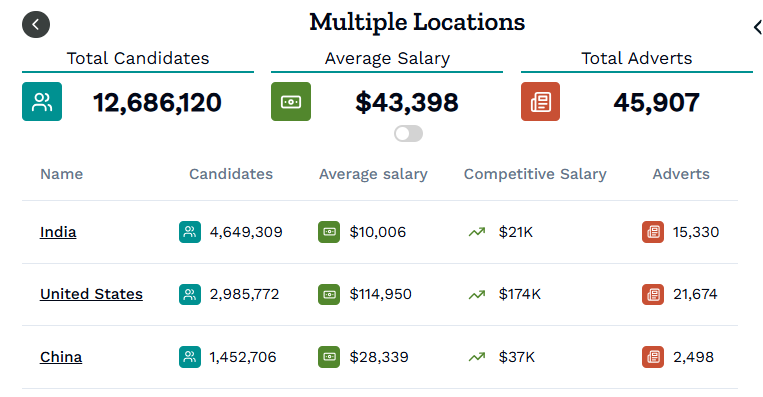
Location data from Horsefly
Compensation Benchmarking
Instead of relying on annual salary surveys that are outdated before they're published, our platform provides real-time compensation intelligence drawn from actual market activity. When you're losing cybersecurity analysts and need to know whether your compensation is competitive in specific metros, we deliver that answer with current data.
Skills-Based Workforce Planning
We map skills adjacencies across the external labor market to help organizations identify non-obvious talent pools. If you can't find enough qualified robotics engineers, our data might reveal that mechatronics engineers in specific regions have 85% skills overlap and are available at lower compensation levels with shorter hiring timelines.
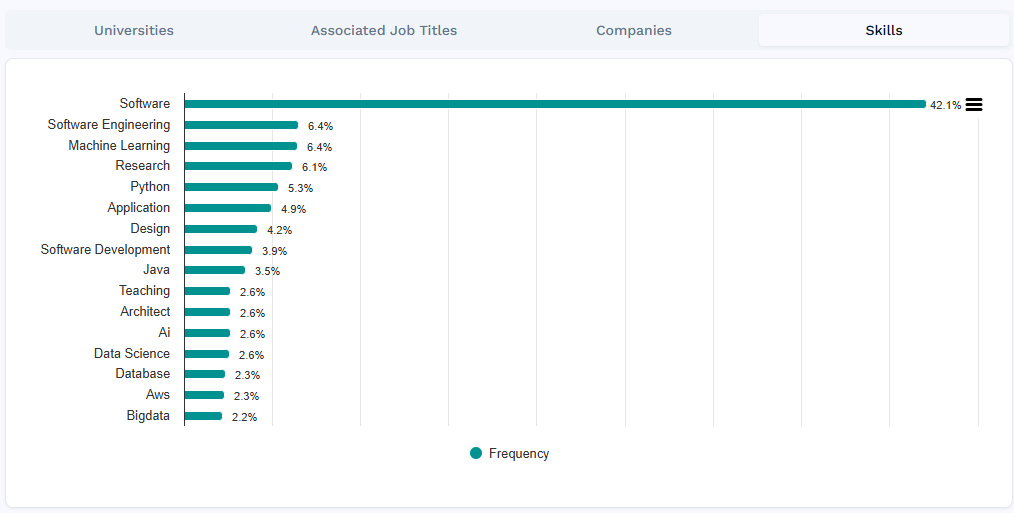
Example of Skills data from Horsefly
Competitive Intelligence
Understanding where competitors are hiring, for which roles, and in which locations provides strategic visibility that internal data alone simply cannot offer. If a major competitor is scaling its AI research team in a specific city, that affects your talent availability and cost projections for the same market.
This external layer doesn't replace internal people analytics. It completes it. Workforce planning decisions based only on internal data are like managing with a map that shows your current position but nothing about the terrain ahead.
See what your workforce data looks like with external market context added.

Frequently Asked Questions
How does enterprise people analytics help strategic workforce planning?
Enterprise people analytics merges internal workforce data with external labor market insights, creating a strategic intelligence engine. This enables data-driven decisions for talent acquisition, retention, and workforce development. It moves organizations beyond reactive reporting and proactively aligns talent with core business objectives.
What core capabilities should a robust enterprise people analytics platform offer?
A robust platform requires a single source of truth from integrated HR systems, advanced analytics (descriptive, diagnostic, predictive, prescriptive), comprehensive DEIB analytics tracking the full employee lifecycle, and configurable dashboards for diverse users. These capabilities ensure deep insights and actionable intelligence across the enterprise.
How does artificial intelligence enhance workforce forecasting and talent strategy?
AI significantly enhances workforce forecasting by using machine learning models to predict attrition risks, identify future skills gaps, and simulate various strategic scenarios. This moves planning from "what happened" to "what will happen," offering prescriptive recommendations for proactive talent management and decision-making.
What is involved in successfully implementing an enterprise people analytics platform?
Successful implementation involves clean integration with HR systems via pre-built connectors, thorough data cleansing and normalization, and phased deployment over 12-20 weeks. Strong change management, user training, and executive sponsorship are crucial for platform adoption, ensuring real value and impact.
What essential security and compliance features do global people analytics platforms need?
Global platforms demand robust security: data encryption, granular access controls, MFA, and audit logs. Compliance requires data residency support, adherence to global regulations like GDPR and CCPA, and SOC 2 Type II certification. These measures ensure data privacy, security, and integrity across all operations.
Why is integrating external labor market data essential for strategic people analytics?
External labor market data provides crucial context on talent supply, demand, competitive compensation, and skills availability beyond internal insights. This layer enables proactive location strategy, accurate compensation benchmarking, and informed workforce planning, completing the strategic picture and preventing costly assumptions.
How do organizations quantify the return on investment from a people analytics platform?
Organizations quantify ROI by calculating reductions in attrition costs, measuring gains in hiring efficiency (such as faster time-to-fill), and assessing improvements in workforce planning accuracy. Establishing clear baselines for these metrics before implementation is essential to demonstrate tangible financial and strategic benefits.
Sources: Horsefly Analytics, Workday, SAP SuccessFactors, Oracle HCM, GDPR, CCPA, LGPD, APPI,SOC 2 Type II