.png?width=2000&name=Horsefly-Logo-NewTag_White%20(3).png)
.png)
The Strategic Imperative of Closing the Enterprise Skills Gap
When a critical role sits open for months, the roadmap slips with it. When teams can't actually use the tools you bought them, the technology investment underperforms. And when a competitor has the right people already in place, they simply move faster than you do. None of this is abstract, it shows up directly in business performance.
The visible costs are easy to tally: recruiter fees, contractor premiums, overtime for teams stretched too thin. The costs that matter more are harder to see. Innovation slows down quietly. People leave because they've stopped believing they'll grow here. And in fields like cybersecurity, data engineering, and advanced manufacturing, you're drawing from the same shrinking pool everyone else is fishing in.
A static workforce strategy doesn't survive contact with this environment. The companies pulling ahead treat development as an ongoing capability rather than an annual event; they connect hiring to internal mobility, tie development spend to actual business needs, and use labor market data to decide, market by market, whether to hire, build, or contract for a given skill.
The real question isn't whether you invest in your workforce. It's whether you can afford to get that investment wrong.
A Data-Driven Framework for Identifying Critical Skills Gaps
Most skills gap analyses start in the wrong place. Companies survey managers, comb through job descriptions, and end up with a wish list of competencies; a snapshot that's already stale by the time someone finishes formatting the spreadsheet.
A better approach pairs internal performance data with external labor market data, so you get a live picture of where the gaps are, how serious they are, and how the market around you is shifting.
Start Inside, But Don't Stop There
Internal signals matter: performance reviews, project staffing patterns, and skills assessments all show where your teams are strong and where they're struggling. Comparing what job descriptions ask for against what employees can actually demonstrate is a reasonable starting point. But that data has a ceiling. It won't tell you that the AI/ML skills you're building in-house are in such demand externally that your newly trained people get poached within months of finishing the program. It won't tell you a competitor just opened an engineering hub in your hiring market and quietly changed the local talent supply.
Layer In Talent Intelligence
This is where external labor market data becomes a must-have. Real workforce planning means understanding supply and demand at a granular level, by geography, skill cluster, seniority, industry. You need compensation benchmarks to price retention correctly, and you need visibility into how fast particular skill categories are growing or shrinking in different markets.
The shift often happens when organizations move away from survey-based guesswork toward continuous monitoring of labor market data. The question changes from "what skills do we think we'll need next year?" to "what are our competitors hiring for right now, and where is supply most favorable?"
Benchmark Against Market Demand
The last step is prioritization, and not every gap deserves the same response. A shortage in a skill that's plentiful and easy to hire for is a different problem than a shortage in something where global supply is thin, and demand is climbing fast. Benchmarking your internal gaps against real supply-demand dynamics lets you decide, with confidence, where to build internally and where to go external. That decision shapes everything downstream.

Core Strategies: Upskilling and Reskilling Your Existing Workforce
Hiring your way out of every skills gap is expensive and slow. Bringing in an external hire with the capabilities you need can cost far more than the salary itself. When the foundational aptitude is already there, developing existing employees through upskilling and reskilling is often the cheaper, faster path.
Upskilling builds on capability someone already has: a data analyst picking up advanced machine learning techniques, a marketing manager growing into AI-driven campaign optimization. Reskilling moves someone into a genuinely different role: a customer service specialist becoming a UX researcher, a finance professional retraining as a data engineer.
Either way, it takes structure to work.
Start by identifying which employee groups sit closest to the capabilities you need, proximity matters, and reskilling works best when there's an adjacent skill base to build from. From there, define an actual learning pathway rather than a single course: map the progression from where someone is now to where you need them, including formal learning, project work, mentorship, and clear checkpoints along the way. Tie that pathway explicitly to career advancement. The single biggest reason upskilling programs stall is that employees can't see how finishing the program changes their trajectory; connect it to a defined role and a defined pay adjustment, and completion rates move noticeably.
Use data before you commit budget. Before reskilling 200 people into a given skill, check that the skill is genuinely in demand in your industry and that the market premium justifies the spend. We've watched organizations pour money into training for skills that were already becoming commoditized by the time the program launched, talent intelligence catches that in advance.
The payoff compounds. People who can see real investment in their growth are less likely to walk out the door, which makes development, done well, one of the strongest retention levers you have.
Designing a Balanced Development Portfolio: Technical, Workplace, and Leadership Skills
A common mistake in enterprise development is pouring resources into technical training because it's easy to measure and clearly tied to today's business needs. However, in doing so, communication, critical thinking, and leadership development quietly starve. The result is a technically sharp workforce that struggles to collaborate, adapt, or lead through change.
Technical Skills
These move fastest and matter most for immediate operations, AI fluency, data analysis, cloud architecture, digital literacy across the business. Let your gap analysis and market benchmarking decide which specific skills matter, rather than chasing whatever's trending.
Workplace Skills
Critical thinking, communication, cross-functional collaboration, and comfort with ambiguity are harder to train and harder to measure, but they determine whether your technical investment ever turns into a business outcome. A brilliant data scientist who can't explain findings to a room of stakeholders produces analysis nobody uses.
Leadership Skills
Most organizations dramatically underinvest in leadership development below the senior level. Mid-level managers sit where strategy meets execution, and their ability to lead through change, manage ambiguity, and develop their own people often determines whether the rest of your workforce development program actually sticks.
The right balance across these three depends on your strategic priorities, not on what's typical in your industry. A company mid-transformation might lean hard into technical skills for a year and a half, then pivot the emphasis toward change leadership once the new systems are actually in use.
Evaluating Enterprise Skills Solutions: From Platforms to Partnerships
The market for training solutions is vast, noisy, and genuinely confusing to navigate. For a global enterprise, the options roughly break down into four categories, each with its own trade-offs.
Large Online Learning Platforms
Coursera for Business, LinkedIn Learning, and Udemy Business offer breadth and scale. They’re a good fit for foundational and intermediate learning across a wide range of topics.
They’re weaker on deep specialization, hands-on technical work, or anything that requires real context from your business.
Vocational and Technical Partnerships
Community colleges, bootcamps, and specialist providers can work well for specific skill clusters, particularly in manufacturing, healthcare, and applied technology.
The content tends to be more hands-on, but these partnerships can be geographically limited and harder to scale across a global workforce.
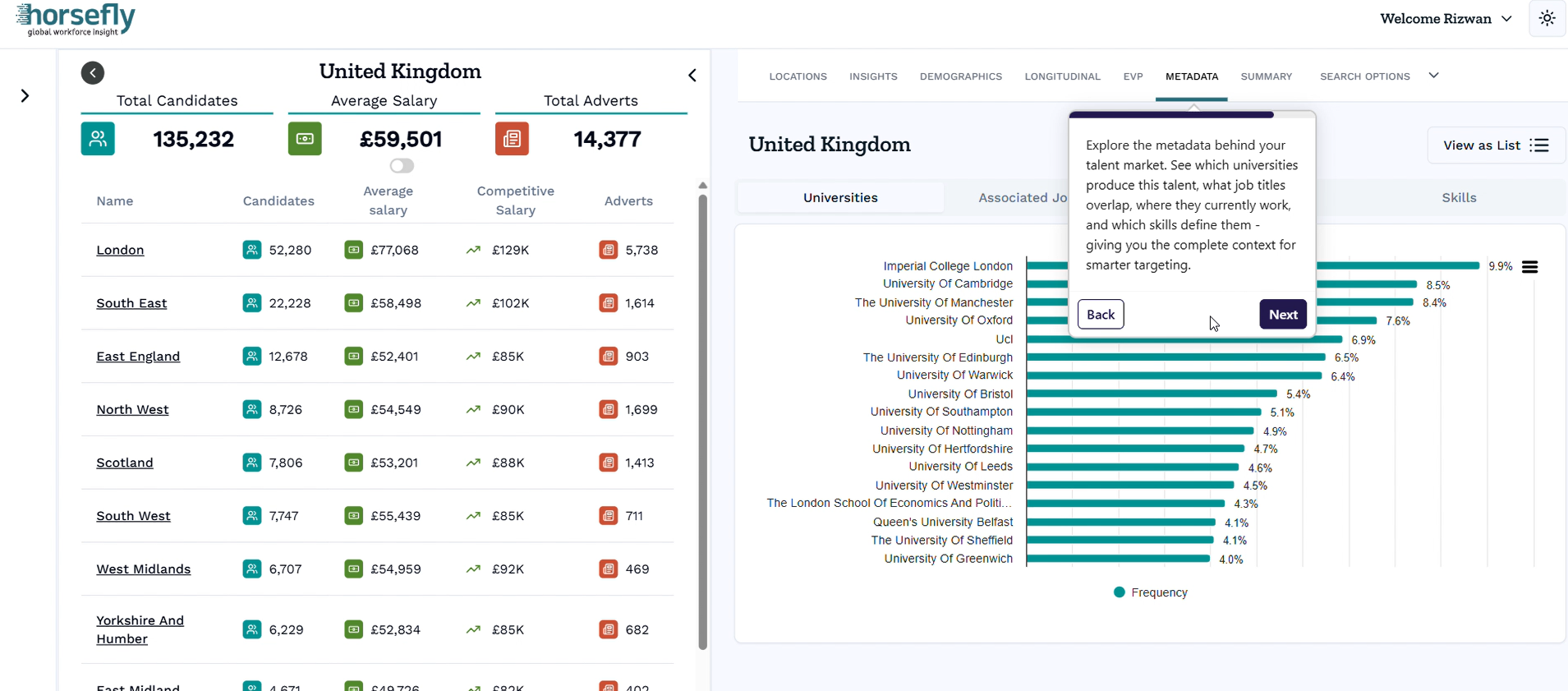
A view of the metadata in Horsefly that can help to find the right educational settings to partner with, for example
Custom Internal Programs
Internal programs fit your business best, but they require significant investment in instructional design and subject matter expert time.
They make the most sense for proprietary skills or highly specialized areas where off-the-shelf training won’t cut it.
Managed Learning and Consulting Partnerships
Managed learning services and consulting partners can help orchestrate a blended approach across multiple providers and delivery models.
The trade-off is cost, along with the risk of becoming dependent on an external partner over time.
Start With the Skills Gap, Not the Solution
Here’s where most organizations go wrong: they choose a solution before they’ve properly defined the problem.
Platform selection should follow the skills gap analysis, not lead it. Once you know which skills you need, where they’re needed, how many people need them, and at what level, the right delivery model becomes much clearer.
If your most urgent gaps are concentrated in three technical areas, a targeted bootcamp partnership will likely outperform a broad enterprise learning license. If gaps are spread across dozens of skills and thousands of employees worldwide, a platform approach makes more sense.
Let the data decide.

Using Technology for Scalable Workforce Development
Running development programs across a global enterprise without the right technology is a bit like managing supply chain logistics on spreadsheets; it holds up at small scale and falls apart at enterprise scale.
A learning management system is the baseline: it tracks enrollment, completion, and basic competency attainment. Modern LMS platforms connect to HR systems as well, linking learning activity to career progression, performance data, and workforce planning. If your LMS isn't talking to your HRIS and your talent management suite, you've built a data silo that will make ROI measurement nearly impossible later.
Applied to learning, analytics gets genuinely interesting. Which programs actually correlate with better performance ratings? Which pathways get finished and which get abandoned halfway through? Are certain geographies or functions engaging less with development, and if so, why?
AI-driven personalization helps here too, recommending content based on someone's current skills, target role, and learning history; a mid-career engineer and a junior analyst shouldn't see the same homepage.
Virtual and augmented reality remain niche but are growing, particularly for technical skills that benefit from simulation: surgical procedures, equipment maintenance, safety protocols. Costs are still high, though they're coming down.
Choose the technology stack after you've defined the development strategy, not before. We've watched organizations buy expensive platforms and then struggle to fill them with relevant content because they never did the skills analysis first. Technology enables the strategy. It can't substitute for one.
Measuring the True ROI of Your Development Investment
Completion rates tell you almost nothing on their own. Someone can finish every module in a pathway and still be unable to apply any of it on the job. Real ROI measurement means connecting learning activity to outcomes the business actually cares about.
Look at productivity: are teams or individuals performing measurably better after completing a program, whether that shows up as faster delivery, fewer errors, or better customer satisfaction scores? Look at internal mobility: are reskilled employees actually landing in the target roles, and how does their time-to-productivity compare with an external hire in the same seat? Look at retention: compare attrition between employees who participate in development and those who don't, controlling for obvious confounders. If development keeps people who'd otherwise have left, that's a real, quantifiable return.
Then there's talent acquisition cost. Every role you fill through internal development instead of external hiring carries a lower price tag, and it's worth calculating the delta explicitly: what would it have cost to hire that same capability from outside? And finally, speed to capability: how quickly can your organization stand up a new team capability compared with recruiting it from the market? In a fast-moving industry, that speed has direct revenue consequences.
The hard part is that most of these metrics require linking data across systems, LMS, HRIS, performance management, recruiting, and keeping that link intact over time. Organizations that treat workforce analytics as an afterthought tend to struggle proving ROI, which then makes it harder to secure budget for the next round. Build the measurement framework before the program launches, not after.
It's also worth benchmarking your internal development costs directly against external market data. If reskilling someone into a data engineering role costs $15,000 and the market compensation premium for that skill is $30,000 a year, the investment pays for itself in about six months of retention. Without solid labor market data behind that math, you're essentially guessing.
Overcoming Implementation Challenges and Building a Learning Culture
The biggest obstacle to enterprise development programs usually isn't budget. It's adoption.
Executive buy-in comes from speaking in business outcomes, not learning metrics. "We'll train 5,000 employees in cloud computing" doesn't land the way "we'll cut our cloud engineering vacancy rate from 14% to 6% within 18 months, saving roughly $X million in contractor costs" does.
Manager resistance is common, and it's often underestimated. Line managers tend to see development time as time lost from output, if a pathway takes ten hours a week for three months, that's ten hours a week someone isn't doing their day job. The fix is to build development time directly into capacity planning and hold managers accountable for their team's skill growth, not just its current output.
Employee apathy usually points to a design problem, not a motivation problem. If people aren't engaging, the content may not be relevant to their actual work, the link to career advancement may be unclear, or the platform itself may just be unpleasant to use. It's worth surveying the people who dropped out, not only the ones who finished.
Change management matters here as much as it does in any major initiative: communication, visible sponsorship from leadership, early wins worth talking about, and peer advocacy that feels more credible than another corporate email. Find employees who've genuinely benefited from a program and let them tell that story themselves; it lands better than anything from the comms team.
None of this builds a learning culture through mandate. It builds through evidence, people promoted after completing a reskilling program, internal mobility celebrated openly, and a visible, consistent line between development and advancement.
Future-Proofing Your Workforce: Anticipating Tomorrow's Skills
Nobody can predict exactly which skills will matter in five years. But spotting directional trends with enough confidence to act on is a different and much more achievable task.
The Skills Moving Up the Agenda
A few skill areas are clearly accelerating. AI and machine learning fluency is spreading beyond technical teams. Data literacy is becoming a baseline expectation rather than a specialist skill. As AI takes on more routine analysis, complex problem-solving, interpreting information, making decisions, and knowing what to do next, becomes more valuable.
Adaptability is becoming a skill in its own right, too. People who can learn new tools quickly, move between domains, and work through ambiguity will be better equipped as automation reshapes roles faster than formal training can keep up.
Emotional intelligence and cross-cultural collaboration are also becoming more important. Remote and distributed teams now span more time zones, languages, and cultural norms, creating a greater need for people who can work effectively across those differences.
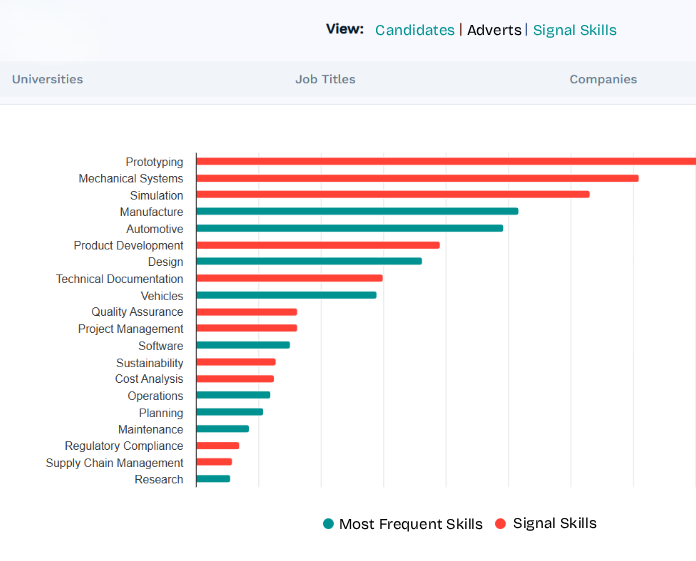 A view of Signal Skills in Horsefly that helps you find trending skills for your market
Balance Today's Needs With Tomorrow's
For workforce planning leaders, the practical question is how to divide investment between skills the business needs now and those it may need in the future.
A reasonable approach is a 70/20/10 split:
-
70% toward skills with clear, immediate business impact
-
20% toward skills showing strong growth signals over the next two to three years
-
10% toward emerging areas where the signal is less certain but the potential disruption is significant
The exact percentages will vary by organization, but the principle is useful: don’t put the entire development budget into today’s skills and leave yourself unprepared for what’s coming next.
Use Labor Market Data to Look Ahead
Making that approach work requires more than looking at current skills gaps. Workforce planning leaders need to understand where demand is heading.
That means using labor market data to answer questions such as:
-
Which skills are growing fastest in your industry?
-
Which regions are producing talent in emerging fields?
-
Where are competitors quietly building new capabilities?
The goal isn’t to predict the future perfectly. It’s to spot the signals early enough to make smarter decisions about where to hire, where to develop talent, and where to invest next.
The Intelligence Engine for Your Workforce Strategy
Every strategy above rests on the same foundation: accurate, granular, current data about global labor markets. Skills gap analysis needs visibility into what's available externally, not just what's missing internally. Designing upskilling and reskilling programs needs compensation and demand data to validate the investment. Measuring ROI needs a market benchmark to compare against. Future-proofing needs trend data spanning industries, geographies, and time.
Fragmented data, outdated reports, and regional blind spots make all of this harder. They introduce risk into workforce decisions, slow down planning cycles, and turn strategic conversations into arguments about whose numbers are correct.
We built Horsefly Analytics to solve exactly this problem, aggregating and analyzing labor market data across more than 30 countries, covering talent supply and demand, compensation benchmarks, skills clustering, competitor hiring activity, and demographic trends. It lets workforce planning leaders move from quarterly planning cycles to continuous, real-time intelligence that adapts as the market does.
Whether you're deciding where to open a new technology hub, which skills to build internally versus recruit for, or how to price compensation to keep the people you've just trained, the underlying question doesn't change: what does the data actually say?
That's the question we help you answer, because the organizations making smarter workforce decisions, faster and with better data, are the ones winning the talent competition. And when skills are the primary constraint on growth, winning that competition is winning the business.
Stop guessing where your skills gaps are - contact us for a strategic consultation.

Frequently Asked Questions
What is the impact of the enterprise skills gap on business revenue?
The enterprise skills gap directly impacts revenue by causing product roadmap delays, underperforming technology investments, and market-share loss due to slower innovation. Extended vacancies in critical roles also lead to higher recruiter fees and contractor premiums, affecting financial performance and overall profitability.
How can organizations accurately identify critical skills gaps within their workforce?
Organizations can accurately identify critical skills gaps by combining internal performance data with external labor market intelligence. This involves analyzing internal assessments and project staffing, then benchmarking against market supply-demand dynamics, compensation, and competitor hiring trends to prioritize development investments effectively.
What is the difference between upskilling and reskilling employees in an organization?
Upskilling enhances an employee's existing capabilities, such as a data analyst learning advanced machine learning techniques. Reskilling prepares someone for a fundamentally different role, like a customer service specialist transitioning into a UX research function. Both strategies build competencies for evolving business needs.
How do companies measure the actual return on investment (ROI) of workforce development programs?
Companies measure ROI by connecting learning activity to tangible business outcomes. Key metrics include improved productivity, increased internal mobility into new roles, reduced employee attrition, and lower talent acquisition costs for positions filled internally. Benchmarking against external market data also validates investment value.
What are common challenges organizations face when implementing workforce development programs?
Common challenges include securing executive buy-in, overcoming manager resistance who view development time as lost productivity, and addressing employee apathy due to unclear career connections or irrelevant content. Effective change management and a culture that links learning to opportunity are essential for success.
What types of non-technical skills are most important for employee development today?
Beyond technical expertise, critical non-technical skills for employee development include effective communication, cross-functional collaboration, critical thinking, and problem-solving under ambiguity. Adaptability and emotional intelligence are also vital for navigating rapid change and diverse global teams, translating technical investments into business outcomes.
How frequently should a company update its workforce skills development strategy?
A company should treat its workforce skills development strategy as a continuous, dynamic process. Leveraging real-time labor market signals and internal performance data allows for constant adaptation, moving beyond annual reviews. This ensures the strategy remains responsive to rapidly shifting demands and emerging skill requirements.
Sources: Horsefly Analytics, Coursera, LinkedIn Learning, Udemy Business