Contents:
Key Takeaways:
1. Every platform in this category runs on internal data, which leaves a blind spot. An ATS, CRM, or suite can tell you how many people applied for a data engineering role. It can’t tell you how many qualified engineers exist in the area, what they earn, or who else is hiring them. External labor market data fills that gap at four points: testing whether a hiring plan is realistic before a requisition opens, setting pay, choosing locations, and diagnosing a rising time-to-fill as a process problem you can fix or a market shift you need to plan around.
2. Select in order: needs first, then real users, then your own baseline. Start with your hiring profile (volume, countries, industry, centralized or decentralized model) before watching demos. Put real hiring managers in front of the tool, since a busy director who hires four people a year will ignore a clunky interface and break your structured evaluation process. Run the candidate flow on a phone in at least two languages. Ask vendors to demonstrate global compliance, like EU consent capture and data residency, rather than describe it. Build the ROI case on your own agency spend and time-to-fill, not vendor benchmarks.
3. Use AI as a filter that frees recruiter time, and write governance into the contract. Interview scheduling is often the most valuable and least glamorous AI feature. Screening models can reproduce biased hiring history, and organizations that cut recruiter headcount instead of redeploying saved hours tend to see quality slip within a few quarters. Require vendors to document how models are trained, run adverse impact audits, keep humans accountable for every rejection, and tell candidates when automated tools are used. With the EU AI Act treating recruitment AI as high-risk and rules like New York City’s on automated employment decision tools, a vendor that can’t answer these questions clearly is a risk you inherit.
—-------------------------------------------------------------------
Most talent acquisition platforms can tell you exactly how many people applied for your data engineering role, but none of them can tell you how many qualified data engineers actually exist in the area, or what they earn. This article gives you a working framework for selecting talent acquisition software across enterprise, mid-market, and SMB tiers, along with an honest look at where these tools fall short and how to fill the gap.
Beyond the ATS: The Modern Talent Acquisition Stack
The applicant tracking system was built to solve an administrative problem. Applications arrived by email or job board, recruiters lost track of them, and compliance teams needed an audit trail. The ATS gave everyone a single record of who applied, who moved forward, and why.
That problem is solved. The harder problem, finding and winning the best talent who were never going to apply, is what drove the shift to full talent acquisition suites. Today's recruitment software covers the whole hiring process: employer branding and job distribution at the top, sourcing and relationship management for passive talent, screening and assessment in the middle, and offer management and onboarding at the end.
Core Components of a Talent Acquisition Suite
Applicant Tracking System (ATS)
The ATS remains the workflow engine. It routes requisitions through approval, posts jobs, moves candidates through stages, collects interviewer feedback, and generates the records you need for EEO reporting, GDPR data subject requests, and local labor law compliance in each country where you hire.
For global enterprises, the compliance layer is where ATS platforms separate. Supporting consent capture in the EU, data residency requirements, and country-specific offer letter templates sounds routine until you try to configure it across 30 markets. Ask vendors to demonstrate this, not describe it.
Candidate Relationship Management (CRM)
A CRM manages people before there is a job for them. It holds silver-medalist candidates from past searches, event attendees, referrals, and sourced prospects, then lets recruiters nurture them with targeted campaigns until a role opens.
This is the component most organizations underuse. We regularly see enterprises paying for a CRM module that holds thousands of contacts and runs almost no campaigns, because no one owns pipeline building as a job. If your team works purely requisition to requisition, a CRM will become an expensive address book. Budget for the people and process to run it, or skip it.

Sourcing and Engagement Tools
Sourcing tools search beyond your own database: public profiles, professional networks, code repositories, and aggregated talent pools. Many now include outreach sequencing, so a recruiter can find a candidate and launch a multi-step email campaign from the same screen. Some suites build this in natively. Others rely on third-party integrations, which is fine as long as sourced candidates flow cleanly into the ATS without duplicate records.
The Impact of AI and Automation in Recruiting
AI-powered sourcing works well when the role is clearly defined, and the skills are common enough to appear consistently in profiles. The system reads the job requirements, searches available profiles, and ranks matches. It struggles with niche roles where the right candidates describe their experience in unusual terms, or where the best people have thin public profiles. A specialist in power electronics for EV battery systems may not use the keywords your job description does.
Automated resume screening ranks applicants against job criteria and pushes the strongest to the top. For roles receiving hundreds of applications, this saves recruiters real hours. The risk is that the model learns from your historical hiring decisions, including the flawed ones. If your past hires skewed toward certain universities or employers, the screening model may quietly reproduce that pattern.
Intelligent interview scheduling is the least glamorous AI feature and often the most valuable. Coordinating five interviewers across three time zones with a candidate who has a day job used to eat days of recruiter time. Scheduling automation that reads calendars and offers candidates self-service slots removes that delay almost entirely. If you prioritize one automation feature, make it this one.
The common mistake is treating AI as a replacement for recruiter judgment instead of a filter that frees up time for it. The organizations that get the most from automation redeploy the hours they save toward candidate conversations and hiring manager advisory work. The ones that simply cut recruiter headcount tend to see quality slip within a few quarters.
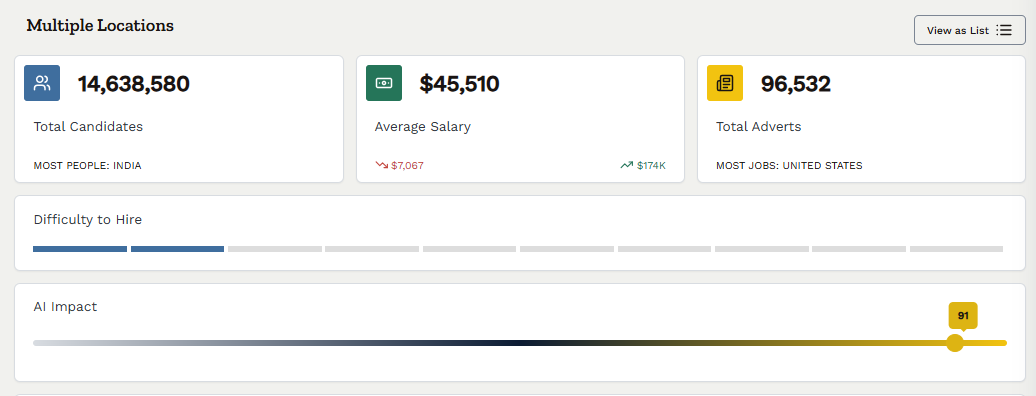
Image shows the AI Impact functionality within Horsefly’s platform, highlighting an example of how data can offer information on automation in recruiting
Strategic Benefits: More Than Just Hiring Faster
Faster hiring is the headline benefit, and it is real. Automated scheduling, structured workflows, and quicker screening compress time-to-hire, which matters most for roles where top candidates accept competing offers within days. Cost-per-hire drops when you rely less on agency fees and more on your pipelines and direct sourcing.
Quality improves through two mechanisms. First, wider talent pools: when sourcing tools and CRMs give you access to passive candidates, you are choosing from a better set, not just a faster one. Second, structured evaluation: platforms that enforce consistent scorecards and interview plans reduce the variance that comes from each hiring manager running interviews their own way. Measuring the quality of hire is still hard. Most organizations use some mix of performance ratings, retention at 12 months, and hiring manager satisfaction, and none of these are perfect. Pick a definition, track it consistently, and connect it back to source and process data in your TA platform.
Candidate experience is the benefit that gets the least executive attention and causes the most quiet damage. Candidates who wait weeks without an update, or who fill in the same information three times, talk about it. In tight specialist markets, your reputation among a few thousand professionals travels fast. Recruiting software that keeps candidates informed and reduces friction protects your ability to hire next year.
A Framework for Choosing the Best Recruiting Software
1. Assess Your Actual Needs
Start with your hiring profile, not the vendor's feature list. Consider:
-
Volume and mix. Are you hiring 200 people a year or 20,000? Mostly salaried professionals, mostly hourly, or both? High-volume hourly hiring needs mobile-first applications and heavy automation. Specialist hiring needs strong sourcing and CRM.
-
Global reach. How many countries? Which languages? What local compliance requirements apply? A platform that handles the US and UK well may falter in Brazil, Japan, or the Gulf states.
-
Industry specifics. Regulated industries such as healthcare, financial services, and defense need credential verification, background check integrations, and audit trails that other sectors can do without.
-
Organizational model. Centralized TA function or decentralized hiring by business unit? This shapes how much configurability you need.
2. Evaluate Integration Capabilities
Your TA platform has to live inside your HR tech stack. Map every system it must connect to: HRIS or HCM, background screening, assessments, video interviewing, payroll, onboarding, and your analytics or data warehouse.
Then ask hard questions. Are integrations native, built by a partner, or custom API work you'll own? Does data sync in real time or in batches? What happens to a candidate record when it converts to an employee? Integration failures rarely show up in demos. They show up six months after go-live, when your workforce analytics team discovers that requisition data and HRIS position data don't reconcile.
3. Prioritize User Experience on Both Sides
Recruiters will work around a clunky interface. Hiring managers will ignore it entirely. If managers won't log in to submit feedback, your structured evaluation process collapses, and recruiters chase scorecards by email.
During evaluation, put real hiring managers in front of the tool. Not your HRIS team. Not your TA operations lead. The busy director who hires four people a year and resents every extra click. Also run the candidate application flow on a phone, in at least two languages you hire in.
4. Scrutinize Analytics and Reporting
Every vendor demos a dashboard. Fewer can answer the questions you actually need answered: Which sources produce hires who stay past 18 months? Where do candidates drop out of the funnel by role, family, and country? How does time-to-fill for engineering in Poland compare with India?
Test whether you can build custom reports without vendor services, and whether raw data exports cleanly to your own BI tools. Many enterprises end up doing serious analysis outside the TA platform anyway, so data accessibility matters more than built-in visualization.
5. Understand Pricing Models and Total Cost
Pricing models vary: per employee, per recruiter seat, per active job, or tiered by module. Enterprise contracts often bundle core ATS functionality and charge separately for CRM, sourcing, AI features, and premium support.
Calculate total cost of ownership over three to five years, including implementation services, integration work, internal project staff, training, and annual price escalators. Then build your ROI case against specific baseline metrics such as agency spend, time-to-fill on priority roles, and recruiter capacity, not against vendor-supplied benchmarks.
Comparing Enterprise-Grade Recruitment Software
Workday Recruiting
Workday Recruiting's main advantage is that it sits inside Workday HCM. If your organization already runs Workday for core HR, the requisition-to-employee data flow is native, position management is unified, and reporting draws from one data model. That is a meaningful advantage for global talent acquisition, where reconciling headcount data across systems is a constant headache.
The tradeoff: recruiters often find it less intuitive than specialist ATS platforms, and many Workday customers add third-party CRM or sourcing tools to fill gaps. It makes the most sense when HCM consolidation is a priority, and you have the internal capability to configure it well.
iCIMS
iCIMS is a dedicated talent acquisition platform with broad functionality across ATS, CRM, career sites, and onboarding, plus a large partner marketplace. It handles high volume and complex configurations, which suits large employers in retail, healthcare, and financial services.
Implementations can be long, and the depth of configuration that makes it powerful also means you need skilled administrators to maintain it.
SmartRecruiters
SmartRecruiters has built its reputation on a more modern interface and a collaborative hiring model that tends to get better hiring manager adoption than older enterprise tools. Its marketplace supports a wide range of integrations.
Organizations with very complex, highly customized workflows sometimes find it less flexible than the heavier platforms.
Across all three, expect high licensing costs, implementation timelines measured in months rather than weeks, and a degree of rigidity once configured. Changing a global workflow after go-live is a project, not a setting. These platforms fit organizations where compliance, standardization across regions, and integration with enterprise HCM outweigh speed of change.
Evaluating Mid-Market and High-Growth Solutions
Greenhouse and Lever dominate conversations among scaling companies, and both have moved upmarket into larger organizations.
Greenhouse built its following around structured hiring. Interview kits, scorecards, and defined evaluation criteria are central to the product rather than add-ons. This makes it a strong choice for organizations trying to bring rigor to hiring decisions and reduce interviewer inconsistency. Its integration marketplace is extensive, which lets teams assemble a best-of-breed stack around it.
Lever combined ATS and CRM in a single platform from early on, so sourcing, nurturing, and tracking happen in one candidate record. Teams that do heavy proactive sourcing often prefer this model, since there's no handoff between a CRM and a separate ATS.
Both excel at collaborative hiring. Hiring managers tend to actually use them, which is not a small thing. Where they can fall short for global enterprises is in country-level compliance depth, complex multi-entity configurations, and advanced workforce analytics. A company hiring in five countries will likely be fine. One hiring in 40, with distinct legal entities and works council requirements, should test those scenarios carefully before committing.
Software for SMBs and Staffing Agencies
At the smaller end, Workable, Zoho Recruit, and Manatal are common choices, and some enterprises will encounter them through acquired subsidiaries or recruitment partners.
Workable focuses on getting a small team hiring quickly: broad job distribution, a clean interface, built-in sourcing, and quick setup. Zoho Recruit offers editions for both corporate HR teams and recruitment agencies, and fits naturally for organizations already using other Zoho products. Manatal competes on affordability and ease of use, with AI-driven candidate recommendations and a setup that agencies can get running fast.
These tools support fast-paced SMB recruiting and staffing agency software needs well: client management, quick candidate submission, and simple pipeline views. Their limitations show up in deep analytics, customization of complex approval workflows, and enterprise-grade security and compliance controls.
The Missing Layer: Integrating External Labor Market Intelligence
Every platform we have discussed shares one structural limitation. They all run on internal data: your applicants, your requisitions, your past hires, and your offers. That tells you a great deal about your recruitment process, but almost nothing about the market you're hiring into.
-
How many qualified cloud security architects exist in Singapore, and how many employers are competing for them right now?
-
Is your offer for a senior data scientist in Toronto above or below what the market is actually paying this quarter?
-
If you need to hire 150 software engineers next year, which three cities give you the deepest supply at a sustainable cost?
-
Why has time-to-fill for a role family doubled? Is it your process, or did demand in that market spike?
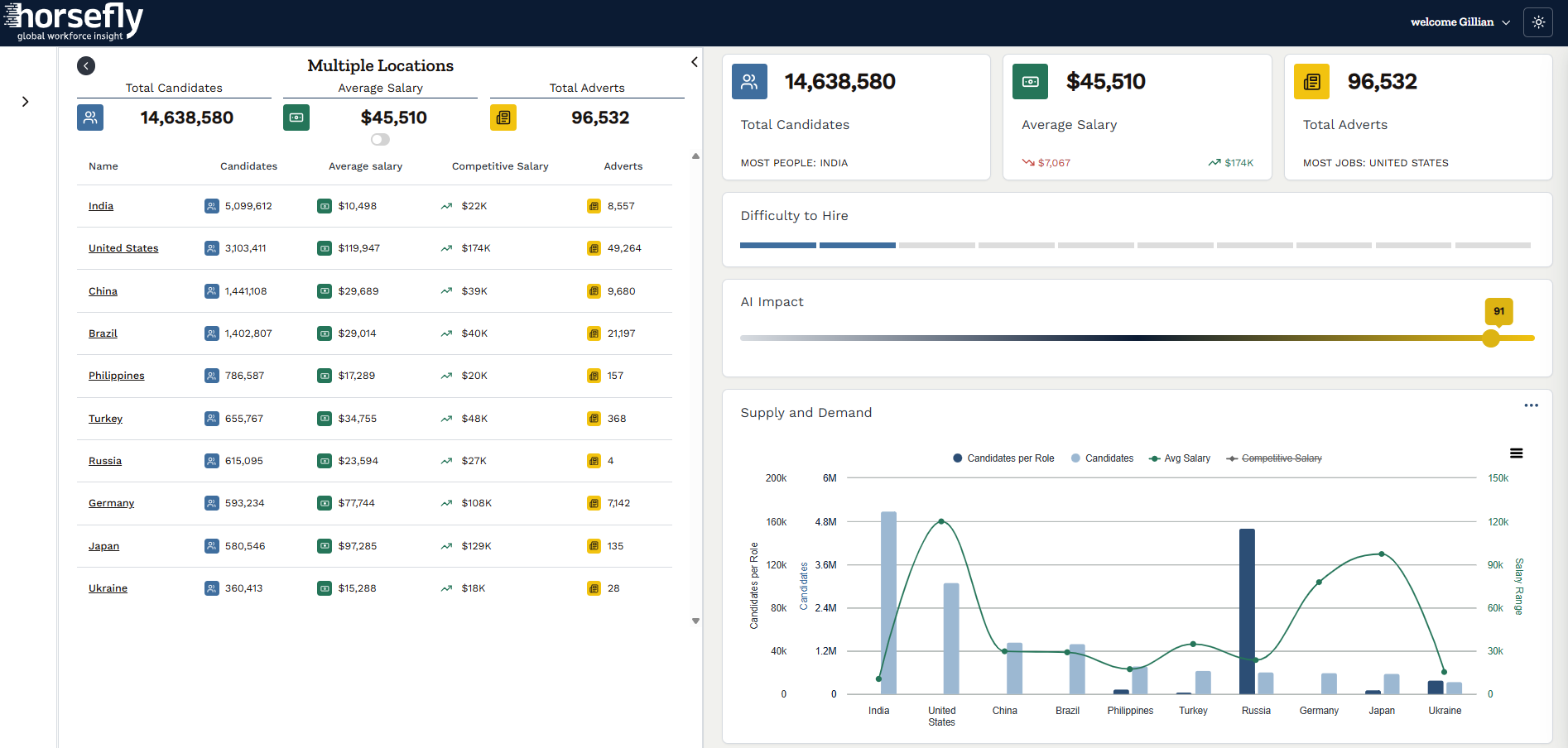
Image shows a platform view of data within Horsefly
At Horsefly Analytics, we built our platform to fill this gap. We provide global labor market data on talent supply and demand, compensation benchmarks, and competitor hiring activity, so TA and workforce planning teams can see the market their software doesn't. We don't replace your ATS or CRM. We add the external view that makes the data inside them more useful.
In practice, this changes decisions at several points:
Before a requisition opens. Workforce planning teams can test whether a hiring plan is realistic. If the local talent pool for a niche skill is thin and heavily contested, that's better known in budget season than three months into a failed search.
When setting compensation. Accurate, current compensation benchmarks by role and location reduce the cycle of lowball offers, rejections, and re-approvals that drags out time-to-hire and frustrates candidates.
When choosing locations. For new hubs or expanded teams, supply and demand data shows where talent actually concentrates and where competition is lighter.
When diagnosing performance. If time-to-fill rises, market data helps you separate process problems you can fix from market conditions you need to plan around. That distinction keeps you from reorganizing a recruiting team for a problem it didn't cause.
Managing the Future: Trends and Ethical AI
The ethical questions around AI in hiring deserve more attention than most vendor content gives them.
Algorithmic bias is the central risk. A screening or matching model trained on historical hiring data inherits historical patterns. If certain groups were underrepresented in past hires, the model may score similar candidates lower, not because of intent but because of correlation. These effects can be invisible unless you look for them.
Data privacy grows more complex as AI tools ingest more candidate information, including data scraped from public profiles that candidates never submitted to you. Regulations differ by jurisdiction, and requirements for transparency and candidate notice around automated decision-making are expanding. The EU AI Act classifies AI systems used in recruitment as high-risk, and several US jurisdictions, including New York City, have introduced rules on automated employment decision tools.
Transparency is where many vendors are weakest. If you can't explain why a model ranked one candidate above another, you can't defend that decision to a candidate, a regulator, or your own board.
Organizations handling this well do several concrete things. They require vendors to document how models are trained and what data they use. They run regular adverse impact audits on AI-driven screening outcomes, segmented by demographic group where legally permitted. They keep humans accountable for every rejection decision, using AI to prioritize rather than eliminate. They tell candidates when automated tools are involved. And they put AI governance under a named owner, often a joint responsibility between TA, legal, and data teams, rather than leaving it to whoever configured the tool.
Add these requirements to your RFP. A vendor that can't answer them clearly is a risk you will inherit.
Secure Top Talent With A Data-Driven Acquisition Strategy
Run the selection in the right order. Define your needs before you watch demos. Test integrations and the hiring manager experience with real users. Build your ROI case on your own baseline metrics. Write AI governance requirements into the contract, not into a later policy document.
Then accept the limit of what any platform can do. Your TA software will make your process faster and more consistent, and it will give you good workforce analytics on your own funnel. It cannot tell you whether the talent you need exists where you're looking, what it costs, or who else is competing for it. That context comes from outside your organization.
At Horsefly Analytics, we see the strongest competitive edge in organizations that pair well-chosen TA software with external labor market intelligence. They make smarter decisions about where to hire, what to pay, and which plans are achievable before they commit budget. The software runs the process. The market data tells you which process to run.
See how global labor intelligence transforms your TA Strategy.

Frequently Asked Questions
What are the essential components of a modern talent acquisition suite?
A modern talent acquisition suite typically includes an Applicant Tracking System (ATS) for workflow and compliance, a Candidate Relationship Management (CRM) system for nurturing passive talent, and sourcing tools to find candidates beyond your existing database. These pillars streamline the entire hiring lifecycle from initial outreach to onboarding.
Which AI feature in talent acquisition software provides the most practical value?
Interview scheduling tools are often the most valuable AI feature in talent acquisition software. They automate the complex coordination of multiple interviewers and candidates across different time zones, significantly reducing administrative time for recruiters. This frees them to focus on candidate engagement.
How can organizations prevent algorithmic bias in AI-powered hiring tools?
To prevent algorithmic bias, organizations should require vendors to document model training and data sources. Regularly conduct adverse impact audits on AI screening outcomes, segmenting by demographic where legal. Ensure humans remain accountable for final rejection decisions, using AI for prioritization, not elimination.
What is the crucial first step when selecting new talent acquisition software?
The crucial first step when selecting new talent acquisition software is to assess your actual hiring needs. Consider your volume and mix of hires, global reach, industry-specific requirements, and organizational model before looking at vendor features. This ensures the chosen platform truly aligns with your strategic objectives.
Why do talent acquisition platforms still need external labor market intelligence?
Talent acquisition platforms primarily use internal data, limiting their insight into the broader market. External labor market intelligence provides crucial context on talent supply and demand, current compensation benchmarks, and competitor hiring activity. This data informs strategic decisions like location choices and realistic hiring plans.
How can companies maximize the effectiveness of their Candidate Relationship Management (CRM) module?
To maximize CRM effectiveness, organizations must assign ownership for pipeline building, ensuring someone actively nurtures prospective candidates. Consistently run targeted campaigns to engage silver medalists and sourced prospects. Allocate resources to the people and processes needed to use it fully, preventing it from becoming merely an address book.
What specific global compliance features should I look for in talent acquisition software?
For global hiring, prioritize recruitment platforms that demonstrate robust compliance capabilities. Look for support for EU consent capture, data residency requirements, and country-specific offer letter templates. Verify how it handles local labor laws across all your hiring markets, ideally through vendor demonstration, not just description.
Sources: Horsefly Analytics, Workday, iCIMS, SmartRecruiters, Greenhouse, Lever, Workable, Zoho Recruit, Manatal, EU AI Act