.png?width=2000&name=Horsefly-Logo-NewTag_White%20(3).png)
Talent forecasting is the practice of using data to anticipate your organization's future talent needs and forecast talent requirements six months, two years, or even five years into the future, and then building a pipeline to match it. Its purpose is specific: to ensure the right talent with the right skills and competencies is available at the right time, in the right locations, and at the right cost.
This is different from workforce planning, which is broader. Workforce planning is the full strategic roadmap: organizational design, location strategy, budget allocation, restructuring decisions. Talent forecasting is one of its sharpest tools. Think of workforce planning as the navigation system and talent forecasting as the radar that tells you what's ahead. Human resource planning (HRP) aligns workforce investments, talent management, and talent development with broader business goals.
Real talent forecasting is predictive, not projective. It accounts for volatility. It factors in competitive dynamics, shifting skill demands, labor market tightness in specific geographies, and internal attrition patterns that HR leadership often senses but can't quantify.
The competitive edge goes to organizations that know what talent they'll need before the need becomes urgent. Reactive hiring is expensive hiring. When you're backfilling a role under pressure, you pay more in agency fees, you accept weaker candidate pools, and you lose productivity during the vacancy window. Forecasting doesn't eliminate all of that friction, but it compresses it dramatically.
The AI Revolution in Workforce Prediction
For decades, forecasting meant spreadsheets, gut instinct, and a finance team's headcount assumptions. AI and predictive analytics have changed the game in a specific way: they can process the volume, velocity, and variety of data that human analysts simply cannot.
Here's how it works in practice. Machine learning algorithms ingest historical datasets (hiring patterns, performance trajectories, promotion velocity, turnover rates, even employee engagement survey data) and identify predictive relationships and patterns that traditional analysis misses. For example, a model may identify that employees who remain in-role significantly longer than peers are substantially more likely to leave.
Three types of predictive models matter most for talent forecasting:
🟢Time-Series Models
Time-series models analyze historical hiring and attrition data to forecast future demand by accounting for seasonal patterns, growth trends, and cyclical fluctuations. These work well for roles with predictable demand curves, like retail or seasonal manufacturing.
🟢Classification Models
Classification models predict categorical outcomes. Will this employee leave within 12 months? Might this candidate accept an offer? These models use features like tenure, compensation relative to market benchmarks, commute distance, manager tenure, and internal mobility history.
🟢Predictive Models
Regression and other predictive models estimate continuous variables such as expected salary ranges, time-to-fill, hiring volumes, or projected workforce demand under different business scenarios.
What makes AI genuinely different from older statistical methods is its ability to incorporate external data at scale. A strong forecasting system doesn't just look inward. It pulls in labor market supply-and-demand signals, competitor hiring activity, university graduation rates by discipline, immigration policy changes, and macroeconomic indicators.
Predictive analytics improves forecasting accuracy by surfacing non-obvious relationships in data and continuously recalibrating as new data arrives. But the models are only as good as the data feeding them, which brings us to implementation.

A Framework for Implementing Your Forecasting Strategy
A talent forecasting strategy doesn't start with technology. It starts with clarity about what you're trying to predict and why.
Here's a five-step framework we've seen work across global enterprises:
Step 1: Assess Your Current Workforce and Conduct a Skills Gap Analysis
Before you can forecast where you're going, you need an honest inventory of where you are. This means cataloging not just headcount by function and level, but skills, certifications, adjacencies, and development potential. Most organizations overestimate how well they know their own workforce. HRIS data captures job titles and salary bands. It rarely captures whether your senior Java developers can also write Python, or which of your finance analysts have the statistical modeling skills to transition into a people analytics role.
A skills gap analysis compares your current inventory against the capabilities your business strategy demands. The gap is what you need to fill through hiring, development, redeployment, or contingent labor.
Step 2: Analyze Historical Data and External Market Trends
Pull your internal hiring data, turnover data, time-to-fill metrics, offer acceptance rates, and promotion patterns from at least the last three to five years. Layer on external market intelligence: talent supply by geography and skill, compensation benchmarks, competitor hiring activity, and labor market tightness indicators.
This is where most organizations hit their first real obstacle. Internal data is often fragmented across multiple systems (ATS, HRIS, payroll, LMS) and inconsistent in format. We'll address this in the challenges section, but know that data integration is the prerequisite, not an afterthought.
Step 3: Align with Future Business Objectives
Forecasting without strategic context produces technically impressive but operationally useless models. If the business is planning to enter two new markets in Southeast Asia, double its AI engineering team, and divest a manufacturing division, those plans must be incorporated into the forecast. This requires structured collaboration between HR, finance, and business unit leaders. Quarterly alignment sessions work better than annual planning cycles.
Step 4: Develop Predictive Models and Scenarios
With clean data and strategic context, you can now build models. Start with the highest-impact areas: roles that are hardest to fill, functions with the highest turnover, or geographies where you're planning expansion.
Don't build one forecast when you can build three: a baseline scenario, an accelerated growth scenario, and a contraction scenario. The value of forecasting isn't predicting the future with certainty. It's preparing for multiple futures so you can move quickly when conditions shift.
Step 5: Monitor, Adjust, and Iterate
A forecast published once and filed away is worthless. Build feedback loops that compare predictions against actual outcomes quarterly. When the model predicted 12% attrition in engineering, and the actual number was 18%, investigate why. Was there a competitor that ramped up hiring? A change in remote work policy? Those insights make the next iteration sharper.
Talent acquisition plans should be living documents that respond to forecast updates, not static annual requisition lists.
Key Variables That Shape Your Forecasts
The accuracy of any forecast depends on the quality of the variables feeding it. Some are internal and within your control. Others are external and require sophisticated data collection.
Employee Turnover and Retirement Trends
Attrition is the single biggest source of forecast error for most organizations. Voluntary turnover is often underestimated because leaders assume their teams are stable. Retirement risk is underestimated because age alone is a poor predictor of when someone will actually leave.
Modeling turnover requires more than average attrition rates. You need to segment by role, tenure band, performance rating, manager, geography, and compensation quartile. A 10% overall attrition rate might mask the fact that your top-performing mid-career engineers are leaving at 22% while your administrative staff turns over at 4%. Those two problems require completely different responses.
Retirement modeling benefits from demographic data combined with pension eligibility dates and historical patterns of when employees in similar positions have actually retired, not just when they became eligible. Succession planning should be directly linked to these models so that leadership pipeline development runs in parallel with projected departures.
Market Dynamics and Competitive Intelligence
External variables often have more influence on your forecasts than internal ones. Talent supply in a given geography can shift quickly based on new university programs, immigration policy changes, competitor office openings or closings, and remote work trends that expand or contract the effective labor market.
Consider a concrete example: a global fintech company planning to build a data science hub in Kraków, Poland:
- The forecast needs to account for the number of qualified graduates entering the market annually
- The current employer demand for those skills in the region
- Prevailing compensation ranges, and whether major competitors such as Google or McKinsey are also scaling in that city.
If three large employers all decide to scale in the same market simultaneously, salary expectations will climb, and time-to-hire will extend. Forecasting without that competitive intelligence leads to budgets that are too low and timelines that are too short.
Technology Adoption and Skills Evolution
Some of the most important variables are the hardest to model. As automation reshapes job functions, certain roles will shrink while demand for new skills will surge. Generative AI is already changing the skill profiles of marketing, software development, customer support, and legal roles. A forecast built in 2024 that doesn't account for how AI adoption will change the composition of a 2027 workforce will be wrong.
This is where scenario planning becomes indispensable. You may not know exactly which roles AI will reshape, but you can model a range of adoption curves and build flexibility into your workforce plans.
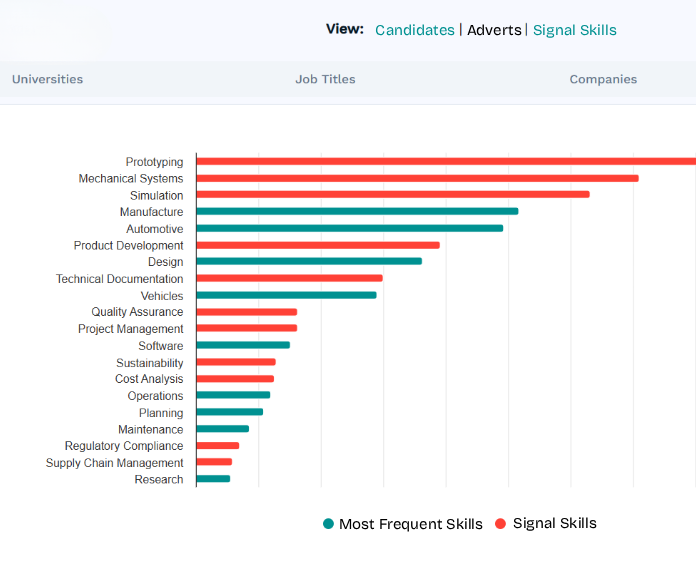
The Signal Skills capability from Horsefly
Overcoming Common Hurdles in Talent Forecasting
Every organization tends to run into the same three obstacles. None of them are insurmountable, but underestimating any of them will stall your initiative.
Data Quality and Standardization
Clean, integrated data is the foundation. If your ATS defines "software engineer" differently from your HRIS, if job titles are inconsistent across regions, if performance ratings use different scales across business units, your models will produce noise rather than signal.
Data integration work is the single highest-ROI investment in any forecasting program. Before selecting models or tools, audit your data sources. Map fields across systems. Establish consistent taxonomies for job families, skills, and locations. This work often takes several months for large enterprises, and skipping it is the most common reason forecasting projects fail.
Integrating Forecasting with Business Strategy
HR-led forecasting that operates in isolation from business strategy is an exercise in precision without relevance. The models might be technically sound, but if they don't reflect planned M&A activity, geographic expansion, product pivots, or cost restructuring, they're forecasting for a business that won't exist.
Breaking down silos requires executive sponsorship and a governance model that brings HR, finance, and operations leadership together on a regular cadence. In our experience, cross-functional governance helps forecasting programs remain aligned during organizational change. Those that live solely within HR often don't.
Securing Stakeholder Buy-in
Forecasting is only valuable if leaders act on the insights. And leaders won't act on insights they don't trust. Building credibility means starting small, proving accuracy on a contained problem (such as predicting Q1 attrition in a single business unit), and then expanding the scope as trust grows.
Present forecasts with confidence intervals, not false precision. Telling a CHRO "we predict 14% attrition in engineering next year" invites skepticism. Telling them "our model projects 12% to 16% attrition in engineering, with the upper bound driven by increased competitor hiring in Austin and Bengaluru" invites a strategic conversation.
Measuring the ROI of Accurate Talent Forecasting
The business case for talent forecasting is strongest when you quantify specific outcomes rather than claiming vague "strategic value."
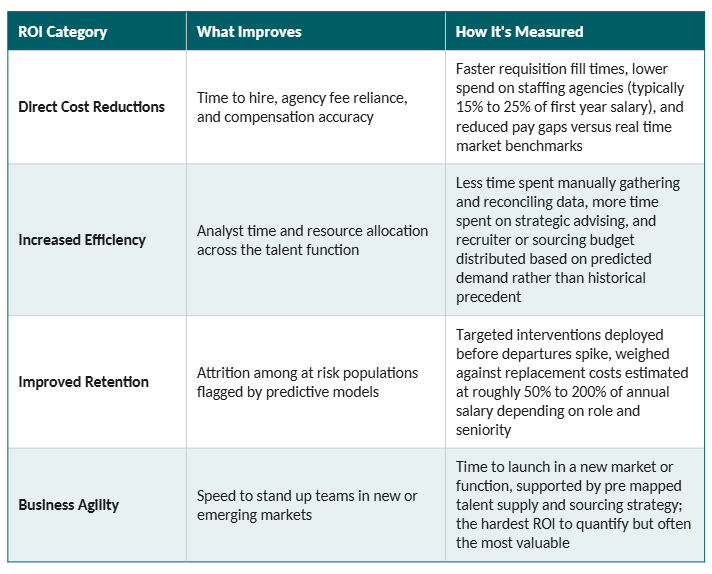
Direct Cost Reductions
Direct cost reductions are the easiest to measure. Forecasting reduces time-to-hire because you're building pipelines before requisitions open. Shorter time-to-hire directly reduces revenue lost to vacant roles, particularly for revenue-generating positions. It reduces reliance on staffing agencies, where fees typically run 15% to 25% of first-year salary. And it improves compensation accuracy: when you benchmark against real-time market data rather than outdated surveys, you avoid both overpaying (waste) and underpaying (which drives attrition and creates its own costs).
Increased Efficiency
Efficiency gains compound over time. When workforce analysts spend less time manually gathering and reconciling data and more time interpreting models and advising business leaders, the function's strategic contribution increases. Resource allocation improves because you're distributing recruiters and sourcing budgets based on predicted demand rather than historical precedent.
Improved Retention
Retention improvements are harder to attribute directly to forecasting but no less real. When attrition models flag at-risk populations, targeted retention interventions (compensation adjustments, career development programs, managerial training) can be deployed before departures spike. Various studies estimate replacement costs ranging from roughly 50% to 200% of annual salary depending on role and seniority. Preventing even a modest number of avoidable departures pays for the forecasting program many times over.
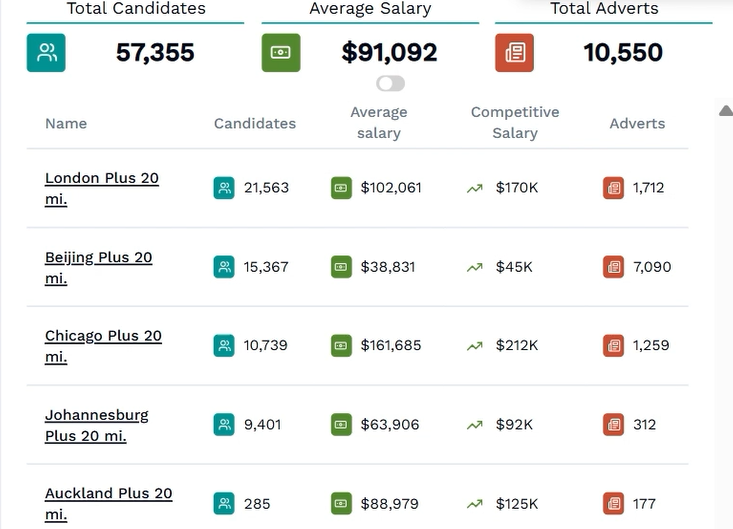
Image shows the Compensation capability within the Horsefly platform
Business Agility
Business agility is the hardest ROI to quantify but often the most valuable. Organizations that can spin up a new team in an emerging market in weeks rather than months, because they've already mapped the talent supply and built a sourcing strategy, gain first-mover advantages that compound over years.
Ethical Considerations in AI-Powered Forecasting
This is a topic most vendors and consultancies gloss over, and that's a problem. AI models trained on historical data will replicate historical biases unless you actively intervene.
If your past hiring data shows that your engineering teams have been predominantly male, a model trained on that data may learn to associate certain profile features with "successful hires" in ways that disadvantage women candidates. The same applies to racial, ethnic, and socioeconomic biases embedded in historical data on promotion, compensation, and performance.
Mitigation requires three commitments:
-
Diverse and representative training data: Audit your datasets for underrepresentation before building models. Where historical data is biased, consider techniques such as resampling or synthetic data to reduce skew.
-
Regular algorithmic audits: Don't assume a model that was fair at launch remains fair over time. Conduct bias audits at least annually, examining whether predictions differ systematically across demographic groups. Third-party audits add credibility and catch blind spots internal teams may miss.
-
Transparency with stakeholders: People affected by AI-driven decisions (candidates, employees, managers) deserve to understand how those decisions are informed. This doesn't mean publishing your source code. It means being able to explain, in plain language, what factors influence a prediction and how you ensure fairness. This transparency also supports DE&I initiatives by making inequities visible and measurable rather than hidden inside a black box.
Data privacy is equally non-negotiable. Forecasting models ingest sensitive employee data: compensation, performance ratings, demographic information, sometimes even sentiment data from engagement surveys. Strict access controls, anonymization protocols, and compliance with regulations such as the GDPR and local data protection laws aren't optional. They're the price of admission.
At Horsefly Analytics, we believe that ethical AI isn't a constraint on forecasting effectiveness. It's a precondition for building the organizational trust that makes forecasting programs sustainable over the long term.

Gaining a Competitive Edge with Global Talent Intelligence
Talent forecasting is moving from a periodic HR exercise to a continuous business intelligence function. The organizations pulling ahead are those that treat workforce analytics with the same rigor they apply to financial forecasting or supply chain management.
In a globalized market, this requires data that spans geographies, industries, and skill taxonomies at a level of granularity that most organizations can't build internally. How many machine learning engineers are available in Ho Chi Minh City versus Lisbon? What's the salary premium for bilingual product managers in Montreal? Which competitors have been hiring aggressively in a particular market, and what does that signal about their strategic direction?
These are the inputs that determine whether a site selection decision succeeds or fails, whether a compensation strategy attracts or repels talent, and whether a workforce transformation program meets its timeline or stalls.
We built the Horsefly Analytics platform to answer exactly these questions. Our data covers labor markets across the globe, combining supply and demand signals, compensation benchmarks, competitor intelligence, and skills taxonomy data into a single platform that enables real-time workforce analysis. We built it because we saw too many HR leaders forced to make high-stakes decisions with incomplete, outdated, or geographically limited data.
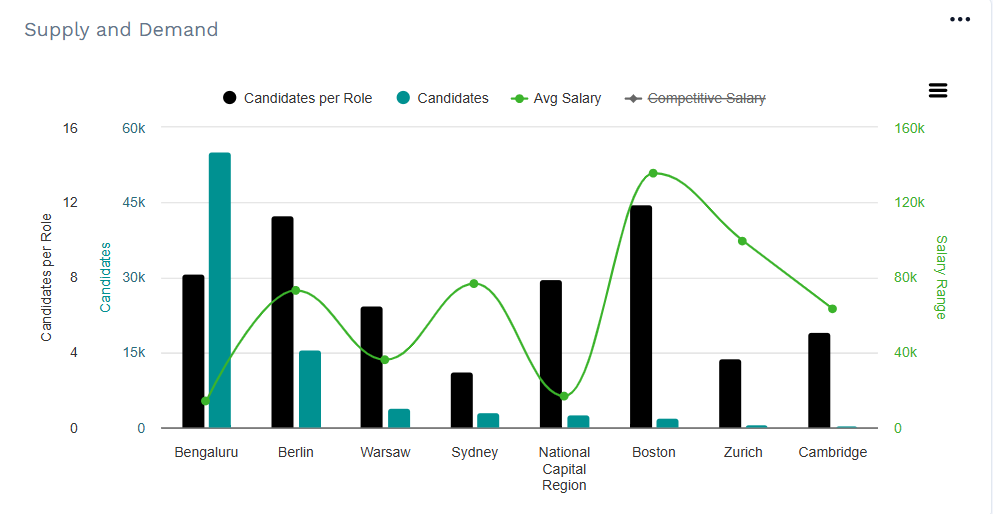
A view of the supply and demand functionality within Horsefly
The future belongs to organizations that can see around corners because they've invested in the data infrastructure, analytical models, and strategic processes to make smarter decisions faster. Talent forecasting, done well, is how you build a workforce that's ready for what comes next, not scrambling to react after it arrives.
Get in touch for a strategic consultation, and find out how Horselfy Analytics can help support your talent forecasting goals.
Frequently Asked Questions
How is talent forecasting different from general workforce planning?
Talent forecasting uses data to predict future talent needs and build pipelines, focusing on specific skills and availability. Workforce planning is a broader strategic roadmap that includes organizational design and budgeting, with forecasting as a critical analytical component.
What types of AI models are used for predicting future workforce needs?
Organizations primarily use time-series models for demand projections, classification models to predict outcomes such as attrition or offer acceptance, and regression models to estimate continuous variables such as future talent supply or required salaries. These leverage historical and external data.
What are the initial steps to begin building a predictive talent forecasting capability?
Start by conducting a thorough skills gap analysis and assessing your current workforce inventory. Simultaneously, analyze historical internal data alongside external market trends. Align these insights with future business objectives to ensure the forecast's strategic relevance.
What are the biggest data challenges when implementing AI-driven talent forecasting?
The most significant challenge is ensuring data quality and standardization, as internal information often resides in fragmented systems with inconsistent formats. Integrating and cleaning these disparate data sources is a crucial, high-ROI prerequisite for accurate model performance.
How does accurate talent forecasting reduce recruitment costs and improve efficiency?
Effective forecasting often reduces time-to-hire by enabling proactive pipeline building, minimizing reliance on expensive staffing agencies, and improving compensation accuracy. This directly lowers costs associated with vacant roles and ensures recruitment efforts are strategically focused on predicted demand.
What specific technology or tools do organizations use for advanced talent forecasting?
Organizations often use workforce analytics or talent intelligence platforms alongside HRIS and business intelligence tools that integrate internal HR data with extensive external labor market information. These specialized tools often incorporate machine learning capabilities to process vast datasets and identify complex predictive patterns.
How can organizations address potential biases in AI models used for talent forecasting?
Addressing biases requires using diverse training data, conducting regular algorithmic audits to identify and mitigate systematic disparities across demographic groups, and maintaining transparency with stakeholders. This proactive approach builds trust and ensures fairness in AI-driven decisions.
Sources: Horsefly Analytics, GDPR