.png?width=2000&name=Horsefly-Logo-NewTag_White%20(3).png)
Talent mobility strategy is the deliberate, planned movement of people through different roles, experiences, and opportunities within an organization. It's a structured approach to making sure the right talent is in the right place at the right time, and that employees are growing as the business grows.
Talent mobility covers the full spectrum of how people move through your organization: internal movement, promotions, lateral shifts, job rotations, cross-functional assignments, and project-based work.
Internal mobility program is the specific practice of moving existing employees into new roles or opportunities within the same business, rather than looking outside to recruit new talent.
At its core, talent mobility strategy aligns workforce capabilities with evolving business needs while giving employees a genuine reason to stay.
Benefits of a Strong Internal Mobility Strategy
The case for talent mobility is compelling, and the numbers back it up.
Research highlighted through Horsefly's own insights indicates organizations with strong internal mobility see up to 59% less turnover. That's not a marginal gain. That's a fundamental shift in how sticky your organization becomes.

Improved employee retention. People who see a path forward stay longer. Mobility turns "I need to job hunt" into "there's an opportunity here."
Reduced recruitment costs and faster time-to-fill. External hiring is expensive: advertising, agency fees, onboarding, and the productivity dip while someone gets up to speed. Internal movement sidesteps most of that.
Optimized skills development. Rather than hiring externally every time a skills gap appears, you develop the talent you already have. Upskilling from within is faster and more cost-effective than starting from scratch.
Increased organizational agility. When disruption hits, you need a workforce that can flex, not one siloed by department. Organizations that can redeploy talent quickly adapt better.
Stronger leadership pipelines. Growing leaders from within builds more resilient succession plans. You're developing people with institutional knowledge, not just technical skills.
Greater diversity and inclusion. Internal mobility creates varied career experiences and surfaces talent that might be overlooked in traditional external hiring.
Understanding the Types of Talent Mobility
Vertical mobility is the classic path: promotions and upward movement. It's the type most people think of first, but far from the whole picture.
Horizontal (lateral) mobility moves employees across roles at the same level. No promotion required, but offers real development potential. It broadens skill development and skill sets and prepares people for more senior opportunities down the line.
Cross-functional mobility takes employees across departments or business units entirely. This drives organizational cohesion and reduces the "us vs. them" dynamic between teams.
Global talent mobility involves relocating employees internationally. Significant logistical complexity, but significant value in building globally minded, culturally adaptable talent.
Virtual talent mobility allows employees to take on roles in different locations without physically relocating. In a remote and hybrid world, this has become a legitimate strategy in its own right.
Developmental and project-based mobility assigns employees to short-term projects or training programs to build specific skills. Lower-stakes, high-reward, and a great entry point for organizations new to mobility programs.
The variety of assignment types reflects the variety of business needs. No single model fits every situation, which is exactly why a deliberate strategy matters.
Challenges and Risks of Talent Mobility
Let's be honest: implementing talent mobility isn't without friction.
Talent hoarding is one of the biggest barriers. Managers who've invested in building strong teams are often reluctant to release top performers. Without cultural and structural change, this instinct wins every time.
Visibility gaps mean talented employees don't know what internal opportunities exist. Research from LHH indicates only around 8% of employees actively seek out internal roles. If mobility isn't actively communicated, it doesn't happen.
Compliance and legal risk is particularly relevant for global moves. Tax implications, immigration laws, employment legislation, and data privacy regulations vary significantly across jurisdictions.
Employee resistance can emerge if mobility feels like it's happening to people rather than for them. If certain groups feel overlooked, trust erodes. Transparency and fairness are non-negotiable.
Administrative burden increases with scale. Managing multiple concurrent moves requires systems, not spreadsheets.
Developing a Talent Mobility Strategy
Getting this right starts long before your first internal job posting goes live.
1. Gain executive buy-in. Without senior support, mobility stays an HR initiative rather than a business strategy. Frame the case early: retention costs, leadership pipeline, organizational agility.
2. Create a dedicated task force. Bring HR, business leaders, and key stakeholders together. Talent mobility cuts across the organization, so the team building the strategy should too.
3. Assess your current talent pool. You need to understand your existing skills landscape, identify critical skills gaps that are currently lacking in the workforce, and know where performance and potential are concentrated. Workforce planning at this level requires accurate labor market intelligence to align capabilities, not gut feel. Horsefly's Skills Insights gives organizations a real-time view of how their internal skills stack up against market demand, with data covering more than 170,000 locations across 65 countries.
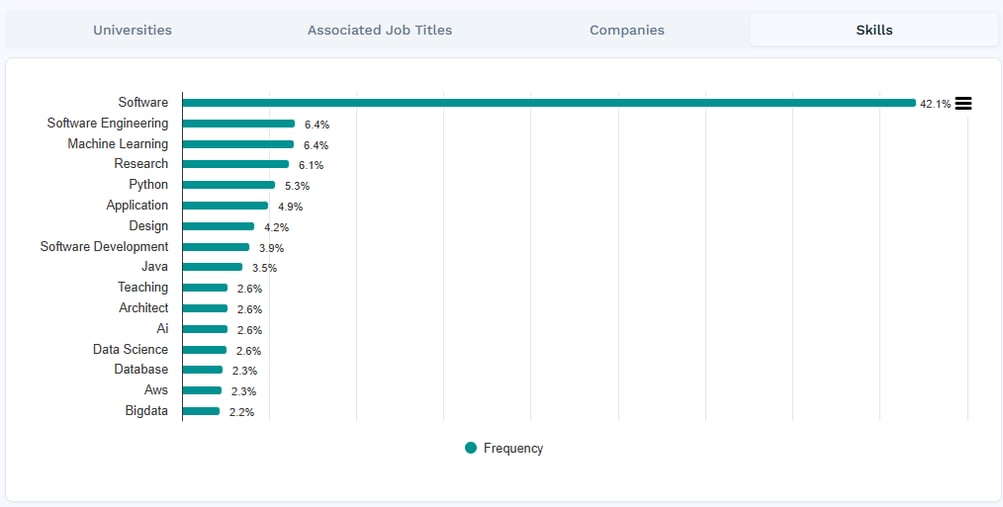
Image shows data from the Skills capability in the Horsefly platform
Skills gaps are the specific capabilities currently missing from your workforce that are needed to hit your business objectives. Identifying them honestly is foundational.
4. Define clear organizational goals using the SMART framework. Specific, Measurable, Achievable, Relevant, Time-bound. "We want more internal mobility" is not a goal. "30% of open roles filled internally within 12 months" is.
5. Establish a framework and governance. Document the policies, processes, and responsibilities. How are opportunities surfaced? What are the eligibility criteria? Who approves moves?
6. Integrate with succession planning and career pathing. Succession planning proactively develops internal talent for future leadership roles. Career pathing gives employees a clear line of sight to where they could go and what they need to get there. Talent mobility sits at the intersection of both.
Implementing Your Talent Mobility Program
Develop clear policies and procedures. Standardize the process so it's fair and repeatable. Ambiguity breeds inconsistency, and inconsistency breeds resentment.
Establish eligibility criteria. Define what makes an employee ready for an internal move: tenure, performance, skills. Be transparent so people know what to work toward.
Build a talent mobility platform or network. An internal job board or skills marketplace makes opportunities visible. The internal mobility rate tracks the percentage of open positions filled internally. If that number isn't moving, visibility is usually the issue.
Invest in manager training. Managers need to be talent scouts and career coaches, not gatekeepers. Reframing the manager role from "keep my best people" to "develop talent for the organization" is essential for tackling talent hoarding when managers are reluctant to release their top performers to new positions.
Implement tracking and monitoring systems. Measure retention rates (key metric to track the success of internal talent mobility efforts), time-to-fill comparisons between internal and external hires, and internal mobility rates to track the percentage of open positions filled by internal candidates. What gets measured gets managed.
Leveraging Technology for Talent Mobility
The right technology and talent mobility solutions make talent mobility scalable and smarter.
Skills-based platforms identify, track, and map employee skills across the organization, shifting the question from "who fits this job title" to "who has the right capabilities."
Workforce intelligence tools use AI-driven insights to surface employee strengths, skills gaps, and leadership potential. Horsefly's platform delivers this analytical depth, drawing on over 1 trillion data points, refreshed daily, supporting accurate decisions rather than assumptions.

Psychometric assessments provide data-rich insight into employee behavior and aptitude, helping determine readiness for a new role before the move is made.
Career pathing software maps potential trajectories for employees, making the mobility opportunity feel personal and achievable.
ROI and Financial Models for Talent Mobility
The financial case for mobility is strong. Start with what you avoid: external recruitment fees (typically 15 to 20% of a role's salary), advertising, agency costs, and the productivity cost of a longer time-to-fill. Add what you gain: higher retention, reduced turnover costs (estimated at 50 to 200% of annual salary depending on seniority), and faster time-to-productivity for internal hires.
A basic framework: calculate your average external hire cost, multiply by the number of roles filled internally in a year, add avoided turnover costs for retained employees, and compare against program investment. For most organizations, the math works comfortably in mobility's favor.
Post-Mobility Support
Moving someone into a new role is not the end of the process. Effective post-mobility support includes structured integration, follow-up coaching, mentorship within the new function, and performance evaluation criteria that account for the learning curve. Employees who feel supported through transitions perform better and stay longer. Those dropped into new roles without support often regret the move, and that outcome undermines the entire program.
Global Talent Mobility: Legal, Tax, and Compliance Considerations
Global mobility adds complexity that deserves careful attention: immigration and work permit requirements, tax obligations across multiple jurisdictions, employment law variations, and data privacy regulations, including GDPR. These vary significantly by country and change regularly. Engage legal and tax specialists early, especially for longer assignments or permanent relocations. Getting this right protects both the organization and the individual.
Future Trends Shaping Talent Mobility
Skills-first thinking is replacing role-based hiring. AI and predictive analytics are making it possible to identify internal talent for future opportunities before those opportunities are even posted. Internal talent marketplaces, modeled on gig economy principles, are becoming standard in larger organizations. The organizations getting ahead of these shifts are investing in the data infrastructure to support them now.
Frequently Asked Questions About Talent Mobility
What is internal talent mobility? The movement of employees into new roles within the same organization, rather than hiring externally.
How does talent mobility contribute to employee engagement? Employees who see genuine paths for growth are more engaged. Mobility signals investment, not just extraction.
How do you assess which employees are ready for internal mobility? A combination of performance data, skills assessments, psychometric tools, and manager input, aiming for an accurate picture of capability and readiness.
What are the benefits of global talent mobility? Building culturally adaptable leadership, strengthening international operations, and developing talent with genuine global perspective.
Why is talent mobility critical in today's hybrid environment? Physical location is no longer a barrier to internal opportunity. Virtual mobility means accessing your full talent pool for every role, not just those in the right office.
Unlock Your Workforce Potential With a Strategic Talent Mobility Approach
A robust talent mobility strategy is a competitive advantage; better retention, increased workforce agility, lower recruitment costs, stronger leadership pipelines. The evidence is consistent and clear. The businesses winning the talent game have stopped treating their workforce as a fixed resource. Invest in the right data infrastructure now, and get ahead of the curve with the strategic approach.
Ready to see what your talent landscape actually looks like? Contact Horsefly for a strategic consultation today.
Sources: Horsefly Analytics, LHH, Adecco Group, GDPR