.png?width=2000&name=Horsefly-Logo-NewTag_White%20(3).png)
Workforce strategy is the long-term plan that determines how an organization attracts, develops, deploys, and retains the talent it needs to achieve its goals. It is the bridge between business ambition and people reality.
It is worth distinguishing it from workforce planning, which tends to be more operational and shorter in horizon. Workforce planning asks: how many people do we need, doing what, and where? Workforce strategy asks: given where we are going as a business, what does our talent model need to look like, and how do we get there?
The CIPD defines strategic workforce planning as the analysis and forecasting of the talent a changing organization needs to meet its strategic objectives. It is proactive, evidence-based, and tied directly to business direction. Done well, it ensures you have the right people, with the right skills, in the right locations, at the right time.
Without it, you are hiring into the dark.
Why Workforce Strategy Matters Now More Than Ever
Organizations that align their people strategy with business goals outperform those that do not. That is not a theory, it’s what the data consistently shows. Grant Thornton and PwC research both point to workforce agility as a top differentiator among high-growth businesses.
The case for a robust workforce strategy includes:
-
Reduced labor costs through smarter resource allocation and reduced reactive hiring
-
Improved retention by understanding what talent actually values and acting on it
-
Greater agility - the ability to pivot your workforce as market conditions shift
-
Stronger talent management (the overarching process of attracting, developing, motivating, and retaining high-performing employees) and development by identifying skill gaps before they become business risks
-
Better diversity, equity, and inclusion outcomes through data-led decisions rather than guesswork
-
Direct alignment between HR initiatives and business strategy, which makes every people investment easier to justify
None of these outcomes happen by accident. They are the product of deliberate, structured thinking about the future of your workforce.
The Seven Stages of Workforce Strategy: A Practical Framework
There is no single right way to build a workforce strategy, but most effective approaches deliver results through recognizable stages. Here is a practical framework that works across sectors and organization sizes, promoting an inclusive workplace culture.
Stage 1: Understand Your Organization and Operating Environment
Start by getting clear on your business strategy, growth pipeline, and ambitions. What markets are you entering? What services are expanding? What capabilities will be non-negotiable in three years?
Then look outward. What is happening in the labor markets you depend on? Where is supply tightening? Which skills are becoming harder to source? External market intelligence, covering labor supply, economic trends, competitor hiring patterns, and skills availability, is foundational at this stage.
Stage 2: Analyze Your Current Workforce
Conduct an honest audit of what you have. That means skills inventories, diversity data, attrition rates (the rate at which employees leave an organization, a critical metric considered during workforce analysis), performance distributions, geographic spread, employee retention, and employee aspirations. You cannot plan forward from a position you have not clearly mapped.
Stage 3: Determine Future Workforce Needs
Based on your business strategy, forecast what your workforce needs to look like. Use scenario planning to stress-test different futures - best case, worst case, most likely. This is where strategic workforce planning earns its keep: it replaces gut feel with structured projection.
Stage 4: Identify Gaps and Challenges
Compare your current state with your future needs. Where are the skill gaps? Which roles are hard to fill in your target locations? Which teams face high attrition? Understanding your specific gaps - rather than generic sector trends - is what makes your response actionable.
Stage 5: Develop Action Plans
Now build the response. Your action plan should draw on multiple levers: attracting new talent from the right pools, retaining people who are flight risks, reskilling existing employees, reviewing your Employee Value Proposition (EVP) to stay competitive, and considering your location strategy based on where relevant talent concentrations actually exist.
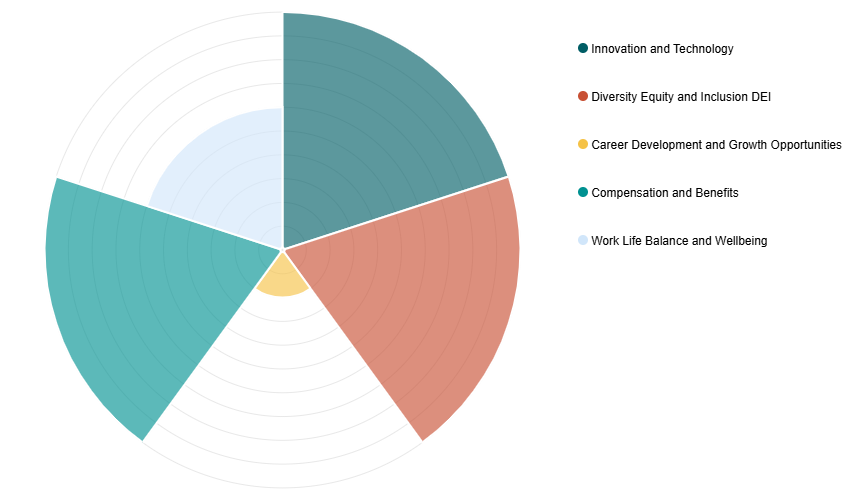
An example of the EVP data shown in the Horsefly platform
Think in terms of functional flexibility (can people perform a range of tasks?), numerical flexibility (can you scale up or down quickly?), and adaptational flexibility (can your workforce restructure around change?). The best workforce strategies build all three.
Stage 6: Implement with Buy-In
Workforce strategy lives or dies by execution. That means generating genuine consensus among senior leaders, clearly allocating responsibilities, and ensuring line managers have the information and support they need to act on the plan. A strategy that sits in a slide deck is not a strategy - it is a document.
Stage 7: Monitor, Evaluate, and Iterate
Set clear KPIs before you start so you know what success looks like. Review outcomes regularly. Capture learning. Maintain historical workforce data so your future decisions are informed by evidence of what worked. Workforce strategy is not a one-off exercise - it is an ongoing discipline.
The Data That Drives Good Workforce Strategy
A strategy is only as accurate as the inputs that inform it. An effective workforce strategy, especially a global workforce strategy, draws on three categories of data:
-
Internal data: skills audits, workforce demographics, performance data, attrition rates, employee aspirations, and diversity metrics
-
Organizational context: business strategy, growth plans, service commitments, and customer demand
-
External market intelligence: labor supply and demand dynamics, salary benchmarks, skills availability by location, competitor hiring activity, and macroeconomic trends
The external layer is where many organizations fall short. Internal data tells you about your own workforce and workforce development. External data tells you about the world your workforce has to compete in. You need both.
This is where labor market intelligence platforms like Horsefly Analytics add real value. Horsefly draws on over one trillion data points from thousands of online sources, covering 170,000 towns and cities across 65 countries, with a taxonomy spanning 815,000 job titles and skills in 39 languages. That kind of granular, global coverage means organizations can ground their workforce strategy in accurate, current market data rather than broad estimates.

Capabilities such as Supply and Demand Insights let you understand talent availability across regions and roles, while Difficulty of Hire Insights help you identify which positions need more time and resource investment before you start recruiting. Longitudinal Intelligence lets you track how roles, skills, and compensation have shifted over time -- giving you a forward-looking view rather than a snapshot.
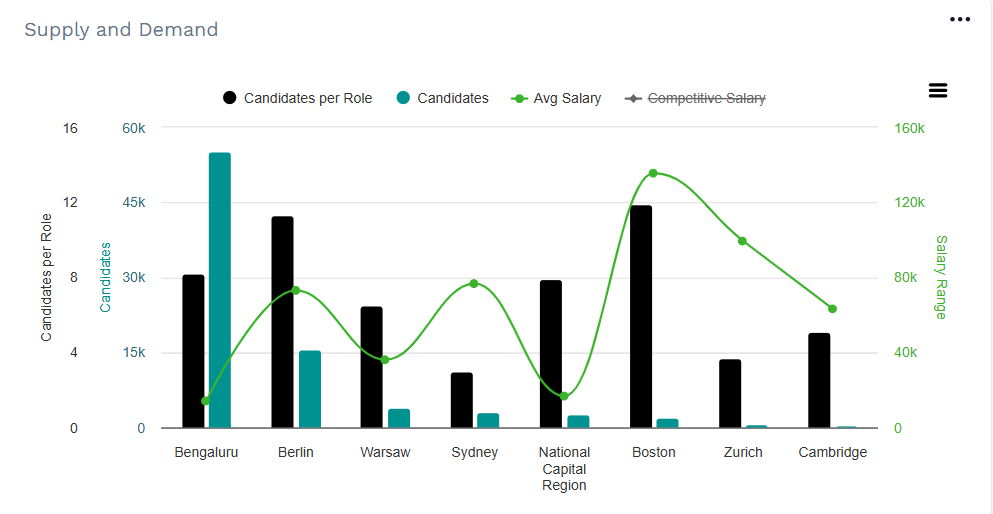
Supply and demand data from the Horsefly platform
How Workforce Strategy Connects to Broader HR Practice
Workforce strategy does not exist in isolation. It should directly inform succession planning (a process for identifying and developing new leaders or employees to replace existing ones when they leave, a key aspect of talent management) and talent pipeline management, recruitment and selection approaches, learning and development programs, reward and recognition frameworks, and EVP design. When Strategic Human Resource Management (SHRM) is functioning well, every people practice reinforces the same strategic direction rather than pulling in different directions.
Challenges and Emerging Trends to Navigate
Responsible and Effective AI and Automation
The World Economic Forum's Future of Jobs Report 2025 projects significant disruption to roles across virtually every sector. The question is not whether AI will affect your workforce - it is which roles, at what pace, and what that means for your talent model. Tools like Horsefly's AI Impact Analysis allow organizations to move beyond speculation, using data-driven insights to understand how specific roles are likely to evolve and plan reskilling accordingly. Get in touch to unlock more insights.

Image shows how the AI Impact tool appears in the Horsefly platform
The Blended Workforce
The growth of gig, contract, and freelance working means workforce strategy can no longer focus only on permanent employees. Organizations need a coherent approach to integrating non-traditional workforce segments - understanding where flexible talent fits within the overall model and ensuring compliance with relevant legal and regulatory frameworks in each jurisdiction.
Organizational Agility
The organizations that navigated recent disruption best were those with built-in workforce flexibility. Scenario planning (a technique used to explore how different potential future environments might affect people requirements, helping formulate contingency plans), skills-based hiring, and investment in continuous learning are the building blocks of a workforce that can adapt without needing to be rebuilt from scratch.
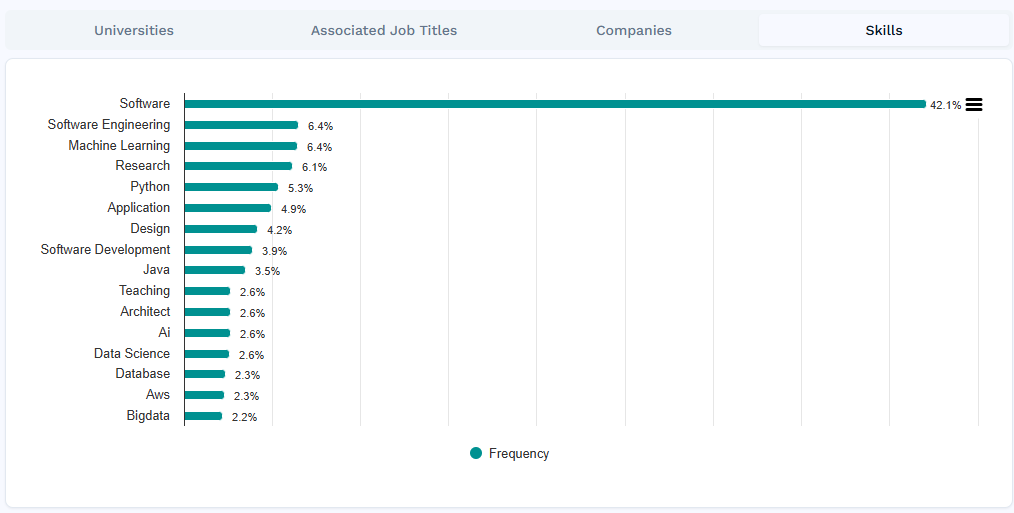
An example of the Skills capability within Horsefly
Measuring Success: ROI and Evaluation
If you cannot show the value of your workforce strategy, it will struggle for investment. The good news is that the metrics exist - you just need to define them upfront, and this is a core business process that can enhance stakeholder engagement.
Key performance indicators worth tracking include:
-
Reduction in voluntary turnover and associated replacement costs
-
Decrease in time-to-fill for critical roles
-
Cost-per-hire trends across target locations and role types
-
Skill gap closure rates measured against defined capability targets
-
Internal promotion and succession rates as a measure of pipeline strength
-
Productivity gains attributable to learning and development programs
The strongest case you can make to senior leaders is a financial one. If your cost-per-hire drops by 20%, or turnover in a hard-to-fill function falls by a third, that translates directly to the bottom line. Build the business case with numbers, and maintain historical data so the trend tells its own story over time.
Workforce strategy is not an HR luxury. It is a business necessity - and the organizations that treat it as such gain a measurable advantage in attracting talent, retaining it, and deploying it where it creates most value.
The shift from reactive hiring to proactive workforce planning requires better data, clearer frameworks, and the organizational will to invest in solutions before problems become emergencies. For organizations looking to build that foundation, a platform like Horsefly Analytics provides the external market intelligence layer that makes the difference between strategy built on assumptions and strategy built on evidence.
If you are ready to stop guessing and start planning with confidence, it is worth finding out what accurate, real-time global labor market data can do for your workforce strategy.
Schedule a strategic consultation with Horsefly Analytics today.
Sources: Horsefly Analytics, Grant Thornton, PwC, World Economic Forum, CIPD