
Contents:
Key Takeaways:
-
An internal pool only tells half the story. Your ATS shows who you know, not whether that represents 40% of the available market or 2%. Pair internal pool data with external supply, demand, and pay data so every coverage gap comes with a next step: which locations have the skills, how hard you will compete for them, and what it will cost.
-
Track coverage, not size. Total pool size tells you how much you have stored, not how much is usable. Coverage ratio (qualified, engaged talent in a segment divided by forecast hires) flags a gap months before a requisition opens. Pair it with data freshness and time since last meaningful contact as leading indicators, and pool-sourced hire rate plus cost and time against other channels as lagging ones.
-
Governance and consent come before growth. Adding people with no owner, required fields, or deduplication rules just builds a bigger version of the database you already can't use. For global pools, store consent per person by jurisdiction with timestamps and expiry. On ROI, expect the first two quarters to look flat, and lead executive reporting with outcomes, not activity.
Why Talent Pool Analytics Needs a Labor Market Lens
Most enterprises hold years of talent data in their applicant tracking systems, yet recruiters often go straight to external sourcing before checking who they already know. Previous finalists, former contractors, and company alumni are all strong sources of future hires, but their records tend to sit outdated, unsegmented, and overlooked.
Talent pool analytics turns that dormant data into something recruiters can act on. Combine skills data, engagement history, and role-fit scores, and you can find relevant people faster, see which segments convert best, and spot gaps against future hiring needs.
But spotting a gap is only half the job. The harder question is what to do about it, and your ATS can't answer that. It knows who has applied to you. It doesn't know how many qualified people exist in Kraków, how many other employers are hiring them, or what they expect to be paid.
Take a role you hire for every quarter, like cloud data engineers. Your pool analytics show only a handful of qualified, engaged people against a forecast of a dozen hires next year. Without external context, the default is to post the job in the same city and hope. With labor market data, you can compare candidate locations side by side on skills availability, hiring competition, and salary levels, then decide where to source next with evidence instead of instinct. Maybe a nearby city has twice the supply at a lower salary point, with far fewer employers competing for it.
That is the shift this article is about: treating talent pool analytics as an inside-out and outside-in discipline. Internal data tells you what you have. External labor market data tells you what's possible. Together they connect recruitment with strategic workforce planning, showing how much future demand your existing pool can cover and exactly where to look for the rest.
For enterprises with recurring hiring needs, measuring talent pools against the market should matter as much as measuring recruitment pipelines.
Talent Pool vs. Talent Pipeline: A Critical Distinction
These terms get used interchangeably, and the confusion causes measurement problems. A talent pipeline moves active applicants toward one open requisition. A talent pool is the broader reservoir of pre-qualified talent, much of it passive, that you maintain for roles that may not exist yet.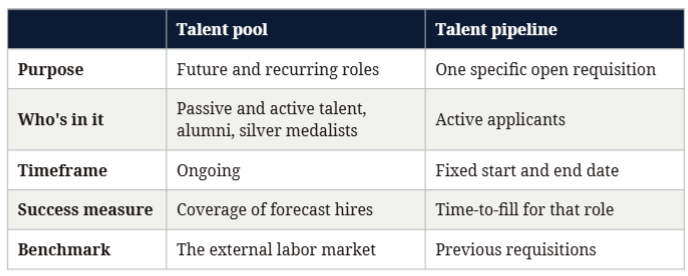
One pool supports many pipelines. The last row is the one most teams miss: a pipeline is judged against your own history, but a pool should be judged against the market it draws from.
Key Metrics for Measuring Talent Pool Health and Performance
Total pool size is the metric everyone reports, and the one we would drop first. Size tells you how much you have stored, not how much is usable. We group the KPIs that matter into four categories, the last of which looks outside your own data.
Quality and Fit
-
Qualified talent ratio: the share of pool members who meet the minimum requirements for at least one role family you hire for regularly. Track it by segment, not just in aggregate.
-
Skills match score: how closely profiles align with the skill requirements of forecast roles. This depends on skills intelligence, meaning structured, current skills data rather than job titles. A "Software Engineer" title tells you very little. Specific frameworks, cloud platforms, and years of applied experience tell you a lot.
-
Coverage ratio: qualified, engaged talent in a segment divided by forecast hires for that segment over the planning horizon. A ratio well below your historical conversion requirement flags a gap months before a requisition opens.
-
Data freshness: the percentage of profiles updated or verified within a set window, typically 12 months. Skills and locations change, so a three-year-old profile may describe someone who no longer exists in that form.
Engagement
-
Open, click, and response rates on nurture communications, broken out by segment. A segment-level drop often points to irrelevant content rather than a disengaged audience.
-
Time since last meaningful contact: a two-way interaction, not a newsletter send. This is the best single predictor of whether someone will respond when a role opens.
-
Re-engagement rate: the percentage of dormant pool members who respond to reactivation outreach. It shows how much of your "inactive" pool is recoverable.
-
Opt-out rate: a rising unsubscribe rate in one segment is an early warning that cadence or content is wrong.
Efficiency
-
Pool-sourced hire rate: the percentage of total hires that came from the existing pool. This is the headline number for executive reporting.
-
Time-to-hire, pool vs. non-pool: compare the two directly for the same role families. The difference is the speed value of the pool.
-
Sourcing cost per hire, pool vs. non-pool: include agency fees, job board spend, and an allocation of recruiter hours.
-
Quality of hire by source: performance ratings, first-year retention, and hiring manager satisfaction for pool hires compared with other channels.

Market Context
-
Market share of pool: your qualified pool for a skill set and location as a share of the total qualified talent available there. This is what turns coverage ratio from a guess into a benchmark.
-
Competition intensity: how many employers are actively hiring the same skills in the same market. A healthy coverage ratio in a crowded market is less safe than it looks.
-
Pay position: where your salary bands sit against the local market for each segment. Pool members who are priced out won't convert, however engaged they are.
Engagement and market context metrics are the leading indicators, and efficiency metrics are the lagging ones. If you only track the lagging group, you will learn about problems a quarter too late.
When Your Pool Runs Thin: Deciding Where to Source Next
A low coverage ratio for a role you hire regularly is a signal to look outward, not just to post more ads in the same place. The question becomes: where is the talent, and can we realistically win it?
Three factors answer that for any location you are considering:
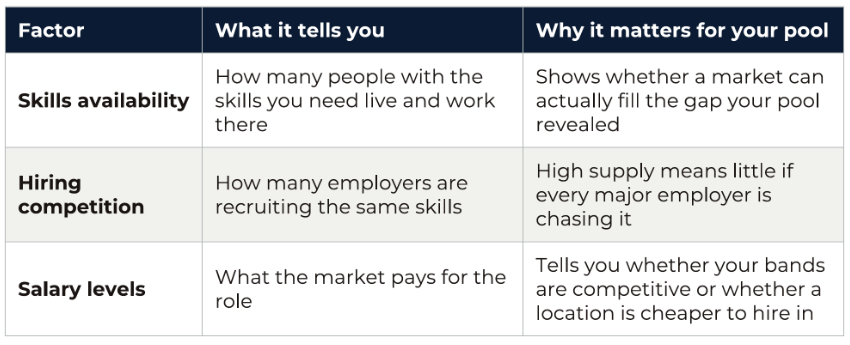
A practical workflow looks like this:
-
Identify the thin segments. Use coverage ratio by skill cluster and location to find where your pool won't meet forecast demand.
-
Shortlist candidate locations. Include your current hubs, nearby cities, and anywhere you could support remote or hybrid hiring.
-
Compare them on all three factors. A location with strong supply, moderate competition, and salaries within your bands is usually the best next move. One that scores well on supply but badly on competition may cost more than it saves.
-
Point sourcing and nurturing at the winner. Build a new pool segment for that location, set up localized nurture content, and track its coverage ratio the same way as the rest.
-
Revisit each planning cycle. Markets shift. A city that was undersupplied last year may have a new graduate pipeline or a large employer that just laid off talent.
This is where external labor market intelligence earns its place. Horsefly Analytics gives talent teams supply, demand, and salary data across 65 countries and 39 languages, so a thin pool becomes a sourcing decision rather than a dead end.
The Strategic Benefits of Talent Pools and Proving the ROI
The biggest time saving comes from having suitable people identified before a role opens. When a pool already holds screened, interested talent, sourcing and early screening can shrink from weeks to days.
Cost savings follow the same logic. Agency fees and premium job board spend are usually highest for specialist roles, which is exactly where an established pool makes the biggest difference. Filling those roles from the pool also frees recruiter time for other vacancies.
Quality of hire can improve too. Pool members often have an existing relationship with the organization, so both sides understand expectations before interviews begin. Candidate experience benefits as well: reconnecting with a previous finalist about a role that better matches their ambitions is far more personal than a cold approach.
Finally, talent pool analytics supports workforce planning. Set against external market data, it shows where your supply is strong, where you will need to recruit externally, and which locations give you the best odds when you do.
Proving the ROI
Finance teams will ask, so build the case from your own numbers:
-
Establish baseline cost-per-hire and time-to-fill for target role families over the previous 12 months, split by source.
-
Calculate the cost of running the pool: platform licensing, recruiter time spent nurturing, and content production.
-
After two or three quarters, multiply pool-sourced hires by the per-hire cost difference, then add the value of vacancy days avoided (some organizations use a daily revenue or productivity figure per role).
-
Add the savings from better location decisions: lower salary costs or faster fills in markets you chose using external data.
-
Subtract program cost.
Expect a slow start. Pools take time to mature, and the first two quarters often look flat. Set that expectation with leadership early, or the program gets cut before it pays back.
The Role of AI in Supercharging Your Talent Pool
When a requisition opens, AI-driven tools can rank existing pool members against the role's requirements in seconds, surfacing people a recruiter would never find with a keyword search. This supports skills-based hiring because matching runs on capabilities rather than titles and pedigree.
Models can also project future hiring needs from attrition patterns, growth plans, and historical hiring cycles, then compare that demand against current pool coverage. The output is a ranked list of segments where you will run short, and when. Two caveats apply. A model trained on last year's hiring won't know about the acquisition being negotiated this quarter, so use forecasts to start conversations with business leaders, not to replace them. And a forecast built only on internal data can't tell you whether the shortfall is easy or hard to close. That depends on the external market for those skills.
Personalized nurture sequences, triggered by segment, behavior, and time since last contact, keep thousands of people warm without a recruiter writing each message. The system can flag when someone's engagement spikes, such as repeated careers site visits or opening every message in a sequence, so a recruiter can step in personally at the right moment.
The downside is that AI matching inherits whatever bias exists in your historical data. If past hiring favored certain schools or career paths, the model will learn that preference. Audit match outputs by demographic segment regularly, and keep humans responsible for advancement decisions. Over-automating engagement is the other common error. People can tell when "personalized" means a first-name merge field, and engagement drops quickly when they notice. Let automation handle timing and scale, and let recruiters handle the messages that need judgment.
Essential Features of a Talent Pool Analytics Platform
Vendor demos all look similar. These are the capabilities we would test, with the question to ask for each.
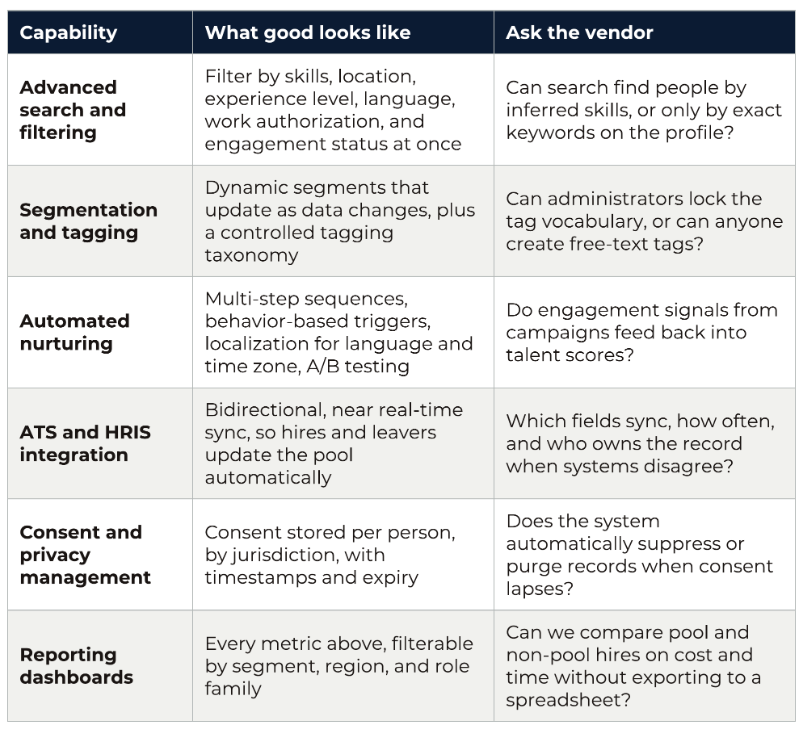
The Missing Piece: External Labor Market Context
This is the capability most pool platforms lack, and the one we consider most important for global enterprises. Your talent data shows who you know. It can't show how large the total qualified population is in a given city, what competitors are paying, or whether your pool represents 40% of the available market or 2%. Without that context, a coverage ratio has no benchmark and a sourcing gap has no obvious answer.
You don't need one system to do everything. Many teams get the best results by running their ATS or CRM for pool management and a dedicated labor market intelligence platform alongside it, reading internal coverage and external supply, demand, and pay data side by side when they plan.
Ask: How will we benchmark internal pool data against external supply, demand, and compensation data, and who on the team owns that comparison?
Building and Maintaining a High-Value Global Talent Pool
Start with governance before growth. Assign an owner for pool data, define required fields for every record (skills, location, source, consent status, last contact date), and set rules for deduplication and archiving. Adding people to a pool with no governance just produces a larger version of the database you already struggle to use.
Segmenting Beyond Job Titles
Job titles are the weakest segmentation variable you have, because the same title means different things across companies and countries. Segment by:
-
Skill clusters: groups of related capabilities that map to forecast roles, such as "data platform engineering" covering several title variants.
-
Career aspirations: what people told you they want next, whether that's management, technical depth, relocation, or a new domain. This is the data most often kept in a recruiter's head and never recorded.
-
Engagement level: hot, warm, and dormant tiers based on recency and depth of interaction, each with its own nurturing approach.
-
Geography and mobility: current location, openness to relocation, and remote-work preferences, which matter more for global pools than almost any other field.
-
Relationship type: silver medalists, alumni, referrals, event contacts, and internal mobility talent convert at different rates and respond to different messages.
Growing the Pool Where the Market Supports It
Growth should be deliberate, not just a byproduct of whoever applies. Use external labor market data to decide which locations and skill clusters deserve investment. If a market has deep supply and manageable competition for a skill you hire every year, build a dedicated segment there with events, employer brand content, and targeted outreach. If a market is saturated with competing employers, invest in fewer, higher-touch relationships instead.
Designing Nurturing Campaigns
Aim to contact passive talent every four to eight weeks, more often for those showing stronger interest. Vary the content, from team updates and relevant industry insights to event invitations and occasional personal check-ins from recruiters.
Keep messages relevant to each audience. A machine learning engineer in Toronto and a finance controller in Singapore have different interests, so tailor content and frequency to local expectations.
Nurturing is often the first thing to slip when hiring gets busy, and without regular contact even a strong pool goes cold fast. Give recruiters dedicated time to maintain it.
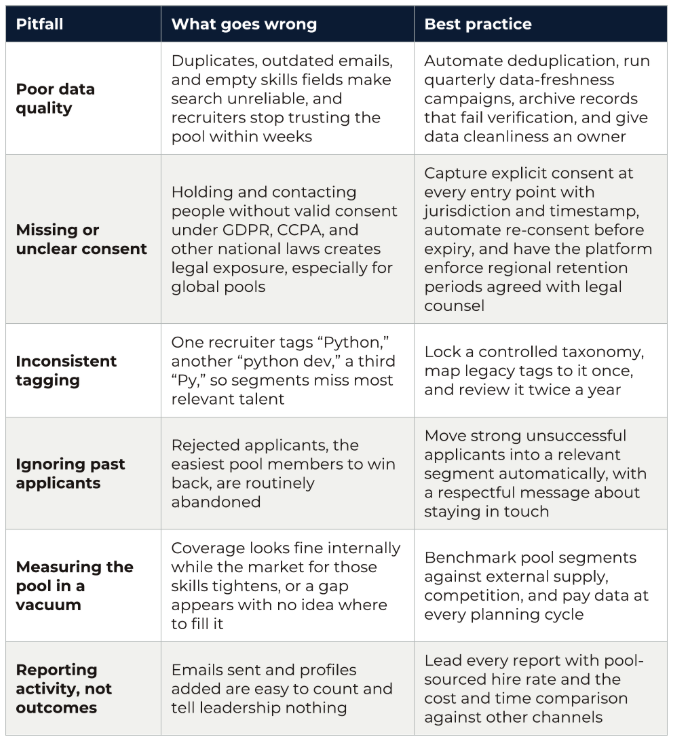
Common Pitfalls and Best Practices in Implementation
Most pool programs that fail do so for a small set of predictable reasons.
Activating Your Global Talent Intelligence with Horsefly
Your talent pool tells you who you already know. Horsefly Analytics tells you what's out there.
Horsefly is a global labor market intelligence platform covering 65 countries and 39 languages. It gives talent acquisition and workforce planning teams a clear view of talent supply, demand, and competition in every market they hire in. Used alongside your internal pool data, it helps you:
-
Benchmark coverage: see what share of the available talent your pool represents for each skill cluster and location.
-
Decide where to source next: when a pool is thin for a role you hire regularly, compare locations on skills availability, hiring competition, and salary levels before you commit budget.
-
Check pay competitiveness: understand whether your salary bands will convert pool members or price them out.
-
Pressure-test workforce plans: find out whether forecast hiring is realistic in your chosen markets, and where it would be easier to deliver.
The result is a talent pool strategy grounded in the market, not just your own database.
To see how Horsefly can benchmark your talent pools against the markets you hire in, schedule a strategic consultation.

Frequently Asked Questions
What is talent pool analytics?
Talent pool analytics is the practice of measuring and segmenting the talent an organization already knows, such as past finalists, alumni, and passive prospects, and benchmarking it against the external labor market. It shows who is ready to hire, where the pool falls short of future demand, and where to source next.
What is the difference between a talent pool and a talent pipeline?
A talent pool is a broad, ongoing reservoir of pre-qualified, often passive talent maintained for future roles. A talent pipeline is a linear process of active applicants moving toward one open requisition, with a defined start and end date. One pool supports many pipelines.
How does talent pool analytics reduce time-to-hire and recruiting costs?
It builds pre-screened shortlists of engaged talent before a role opens, removing initial sourcing time. Costs fall when niche roles are filled from the pool instead of through agency fees and premium job boards, and when recruiters spend less time on cold sourcing.
Why does talent pool analytics need external labor market data?
Internal data only shows who you know. External labor market data shows how much qualified talent exists in each location, how many employers compete for it, and what it costs. That context turns a coverage ratio into a real benchmark and tells you where to source when your pool runs thin.
What should I do if my talent pool is too small for a role I hire regularly?
Compare alternative locations on skills availability, hiring competition, and salary levels, then focus sourcing and nurturing on the market with the best balance of the three. Labor market intelligence platforms such as Horsefly Analytics make this comparison possible across countries.
What are the most important talent pool metrics?
For quality, track qualified talent ratio, skills match score, coverage ratio, and data freshness. For engagement, track re-engagement rate and time since last meaningful contact. For efficiency, track pool-sourced hire rate and compare time-to-hire and cost against other channels. For market context, track your pool's share of available talent, competition intensity, and pay position.
How can AI improve talent pool management?
AI can rank pool members against new role requirements in seconds, matching on skills rather than job titles. It also helps forecast hiring needs, identify skill gaps, and automate personalized engagement, flagging high-intent people for recruiter outreach. Match outputs should be audited regularly for bias.
What are common pitfalls when implementing a talent pool program?
The most common are poor data quality, missing consent, inconsistent tagging, ignoring past applicants, measuring the pool without external benchmarks, and reporting activity instead of outcomes like pool-sourced hires.
How often should you contact passive talent in a pool?
Aim for one meaningful contact every four to eight weeks, more often for people showing strong interest. Rotate content such as team stories, industry insights, and event invitations, and localize for language and cultural norms.
Sources: Horsefly Analytics, GDPR, CCPA