.png?width=2000&name=Horsefly-Logo-NewTag_White%20(3).png)
Workforce data is the full set of qualitative and quantitative information an organization holds about its people. That definition sounds simple, but the scope is broader than most HR leaders initially expect.
The core components break into several categories:
Workforce Demographics
Information such as location, education, diversity characteristics, and workforce composition helps organizations understand their current talent profile and identify workforce trends.
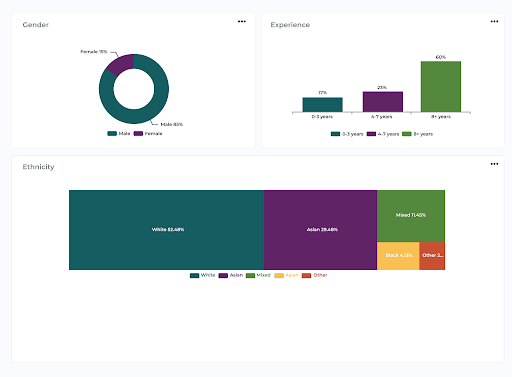
An example of DEI data showcasing gender, experience, and ethnicity within Horselfy
Employment Details
Job roles, departments, tenure, employment type, and reporting structures provide a clear view of how the organization operates and where critical capabilities sit.
Compensation
Salary, benefits, bonuses, and total rewards data help organizations remain competitive while making informed decisions about talent investment.
Performance Metrics
Understanding employee performance, capabilities, and skill development provides insight into current strengths, future gaps, and opportunities for internal mobility.
Skills and Competencies
Refers to what your workforce can actually do versus what their job descriptions say they should do. The gap between those two things is where most workforce planning efforts either succeed or fail.
Engagement and Sentiment
Employee feedback, engagement measures, and behavioral indicators help organizations understand retention risks and improve the employee experience.
Here's what most people get wrong: they treat these categories as separate data sets, each managed by a separate team. Compensation lives in finance. Performance lives in the HRIS. Skills data lives in a spreadsheet someone on the L&D team maintains. The strategic value of workforce data doesn't come from any single category. It comes from connecting them. An attrition number means little on its own. An attrition number cross-referenced with compensation quartile, manager tenure, and engagement scores tells you something you can act on.
That integration is where human capital data becomes a real asset rather than an administrative byproduct.
From Data to Insight: The Power of Workforce Analytics
Workforce analytics is the discipline that converts raw workforce data into intelligence you can use to make decisions. The distinction between "data" and "analytics" matters more than it seems. Data tells you what you have. Analytics tells you what to do with it.
There are four types, and they build on each other:
Descriptive Analytics
Answers "What happened?" This is your dashboard layer: turnover rates by quarter, headcount by region, average time-to-fill. Most organizations live here. It's necessary but insufficient. Knowing your attrition rate was 18% last year doesn't tell you why or what's coming next.
Diagnostic Analytics
Answers "Why did it happen?" This is where you start correlating variables. Did attrition spike in a particular business unit? Was it tied to a specific manager cohort, a compensation gap relative to market, or a restructuring? Diagnostic work requires cleaner data and more analytical muscle, which is why many teams skip it and jump straight to action based on descriptive numbers alone. That's a mistake.
Predictive Analytics
Answers "What will happen?" Using statistical models and, more recently, machine learning, predictive analytics forecasts outcomes. Which roles will be hardest to fill in Q3? Where will skills shortages appear in 18 months? This is where workforce analytics starts to earn back its investment, because acting on a prediction is cheaper than reacting to a crisis.
Prescriptive Analytics
Answers "What should we do?" It recommends specific actions: adjust compensation in these three markets, launch an internal mobility program for this role family, and source from these two universities for this emerging skill. Prescriptive analytics is the rarest capability and the most valuable one.
The progression from descriptive to prescriptive isn't just a maturity curve. It's a shift in how HR operates. Descriptive analytics supports reporting. Prescriptive analytics supports strategy. Most organizations we work with are somewhere between descriptive and diagnostic, trying to make the leap to predictive. That leap requires both better data infrastructure and a willingness to act on probabilistic insights rather than waiting for certainty.

Strategic Applications of Workforce Data Analysis
The real test of workforce data isn't whether it fills a dashboard. It's whether it changes a decision.
Talent Acquisition
Workforce data helps organizations move from reactive hiring to proactive talent strategies. By analyzing talent availability, sourcing performance, skills demand, and market competition, businesses can identify where to find the right candidates and when to engage them, all before critical hiring needs emerge.
Workforce Planning
Effective workforce planning connects future business objectives with current talent realities. Skills gap analysis helps organizations understand which capabilities they need to build, buy, or develop over the next several years. This enables smarter decisions around hiring, reskilling, automation, and workforce investment.
Employee Retention
Retention improves when organizations understand the factors influencing employee movement. Combining internal workforce insights with external market data helps identify where skills are at risk, where compensation may be falling behind, and where targeted interventions can protect critical talent.
Talent Management
Data-driven talent management helps organizations make better decisions around succession planning, internal mobility, and leadership development. By identifying hidden skills, emerging leaders, and development opportunities, businesses can unlock more value from the talent they already have.
The Tangible ROI of a Data-Driven Workforce Strategy
Let's get specific about value, because "data-driven HR" means nothing if it doesn't connect to outcomes.
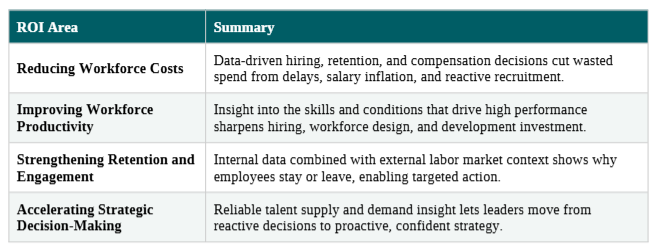
We can now drill down into this to get more insights and details:
Reducing Workforce Costs
Data-driven workforce planning helps organizations spend more effectively across hiring, retention, and compensation. By understanding where talent exists, which markets are competitive, and what skills are in demand, businesses can focus investment where it delivers the greatest impact.
Real-time market intelligence also helps prevent costly hiring delays, unnecessary salary inflation, and reactive recruitment decisions.
Improving Workforce Productivity
The right data reveals what skills, experiences, and conditions enable teams to perform at their best. Organizations can use these insights to improve hiring decisions, strengthen workforce design, and invest in development programs that close critical skill gaps.
Strengthening Retention and Engagement
Combining internal workforce data with external labor market insights helps organizations understand why employees stay, why they leave, and where action is needed. The goal is not simply to measure engagement, but to create better employee experiences through targeted decisions.
Accelerating Strategic Decision-Making
Workforce intelligence gives leaders the confidence to answer critical questions faster: Where should we hire? Which skills are becoming scarce? Can we support future growth in a new market?
With accurate talent supply and demand insights, organizations can move from reactive workforce decisions to proactive strategies that support long-term business success.
Global Talent Intelligence: Why External Data Is Important
Internal data tells you about the workforce you have. It tells you almost nothing about the workforce you could have.
For global enterprises, this blind spot is expensive. You might know your attrition rate in Singapore, but do you know the supply of qualified replacements in that market? You might know your compensation structure in Frankfurt, but do you know how it compares to what your direct competitors are paying for the same roles? Internal data alone can't answer these questions.
External labor market intelligence fills the gap. It includes data on talent supply and demand by geography and skill set, more frequently updated compensation benchmarks, and insight into where specific skills are concentrated globally.
We see this play out constantly in location planning decisions. A technology company considering a new engineering hub needs to know more than real estate costs and tax incentives. They need to know: How many software engineers with the right skills live within commuting distance? What are three or four competitor employers paying them? How fast is that talent pool growing or shrinking? What's the university pipeline for the next five years?
Without this external intelligence, location decisions get made on incomplete information and corrected expensively two years later when the talent isn't there.
The same logic applies to compensation benchmarking. Most compensation surveys suffer from participation bias and lag. By the time the data is published, the market has already moved. Real-time labor market data, sourced from billions of data points across job postings, professional profiles, and economic indicators, gives you a current picture rather than a historical one.
This is where workforce intelligence differs from workforce data. Data is the raw material. Intelligence is data enriched with external context and made actionable for specific decisions. Global organizations need both.

AI's Role in Workforce Analytics
AI and machine learning are changing what's possible with workforce analytics, though not always in the ways vendors claim.
The real value of AI in this space isn't flashy automation. It's pattern recognition at a scale humans can't match. A machine learning model can process millions of job postings, professional profiles, and economic indicators simultaneously to identify talent migration patterns, emerging skill clusters, or compensation shifts weeks before they show up in traditional surveys.
Specific applications that deliver real value today:
Skills Taxonomy Mapping
Organizations describe skills inconsistently. A single competency might appear as "machine learning," "ML," "predictive modeling," or dozens of other variations. Natural language processing helps normalize these differences across platforms, industries, and languages, creating a consistent skills taxonomy that makes downstream analysis far more reliable.
Demand Forecasting
Traditional workforce planning relies heavily on historical hiring data, making it inherently reactive. Machine learning models improve forecasts by incorporating leading indicators such as job posting trends, venture capital investment, patent activity, business formation, and regional economic signals. This enables organizations to anticipate shifts in talent demand rather than simply measure them after they occur.
Talent Supply Modeling
Estimating the available talent pool for a specific role has traditionally required time-consuming manual research. AI can combine labor market data, professional profiles, educational pipelines, geographic mobility patterns, and skills data to produce far more detailed estimates of talent availability by role, location, industry, and experience level.
Despite these advances, AI has clear limitations. It excels at finding patterns, forecasting trends, and surfacing insights, but it does not make strategic decisions.
A model can identify a decline in the supply of cybersecurity engineers in a particular market. It cannot determine whether the best response is to increase compensation, invest in internal reskilling, expand hiring into new regions, or acquire a company with the required expertise. Those decisions depend on business priorities, financial constraints, competitive strategy, and organizational context.
The organizations seeing the greatest value from AI use it as an analytical accelerator rather than a decision-maker. AI provides faster, more comprehensive intelligence; human leaders provide the judgment needed to turn that intelligence into effective action.

How the AI Impact rate appears in the Horsefly platform
Ethical Considerations: Data Governance and Mitigating Bias
The value of workforce analytics depends on more than technical capability. If organizations use workforce data in ways that undermine employee trust, create unfair outcomes, or violate regulatory requirements, the benefits of analytics can quickly disappear.
Data Privacy and Governance
Data privacy is the foundation of responsible workforce analytics. Regulations such as GDPR in Europe, CCPA in California, and similar frameworks worldwide place strict requirements on how personal data is collected, stored, processed, and shared.
For global organizations, compliance requires more than policies; it requires clear governance structures, defined data ownership, appropriate security controls, and ongoing oversight. The goal is not to collect as much data as possible, but to collect the right data while protecting individual privacy.
Algorithmic Bias and Fairness
Predictive models can reproduce the biases found in historical data. If past hiring decisions favored certain universities, locations, or demographic groups, an algorithm trained on those patterns may continue reinforcing them.
Mitigating bias requires active intervention: auditing models for disparate impact, testing outcomes across groups, and involving diverse perspectives in the design and evaluation of analytics systems. Without these safeguards, organizations risk limiting their talent pools and undermining inclusion efforts.
Building Trust Through Responsible Workforce Intelligence
Transparency is critical to adoption. Employees and candidates are more likely to trust workforce analytics when they understand what data is collected, how it is used, and what decisions it supports.
At Horsefly Analytics, we focus on aggregated and anonymized labor market data because strategic workforce intelligence does not require individual-level tracking. Organizations can understand talent supply, compensation trends, and skills availability without monitoring employee behavior.
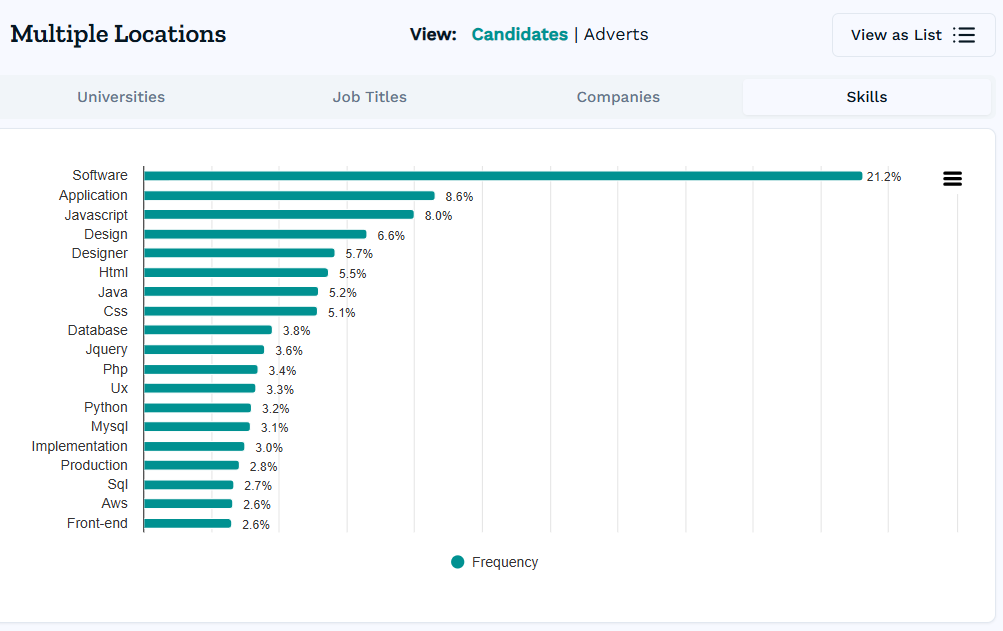
An example of how skills for various job roles are shown in the Horselfy platform
The distinction matters: workforce intelligence identifies market-level patterns, while employee monitoring focuses on individuals. Responsible analytics uses data to improve decisions while preserving the trust that makes those insights possible.
Data governance is not a one-time exercise. It requires ongoing policies, audits, and leadership commitment to ensure analytics creates value without compromising trust.
Activating Your Workforce Intelligence Strategy
Workforce data only becomes a strategic advantage when organizations can connect it to better decisions. The challenge for many enterprises is not a lack of information, it is fragmented data, limited market visibility, and uncertainty about how to translate insights into action.
This is where Horsefly Analytics helps. Internal systems such as HRIS platforms provide valuable insight into your existing workforce, but they cannot tell you what is happening beyond your organization: where critical skills are emerging, how talent markets are shifting, what competitors are paying, or which locations offer the strongest talent opportunities.
Horsefly Analytics combines global labor market intelligence with workforce analytics capabilities to help organizations answer strategic questions such as:
-
Where should we build our next talent hub?
-
Which skills will be hardest to hire over the next few years?
-
How does our compensation strategy compare with the market?
-
Where can we find the talent needed to support our growth plans?
The most effective workforce intelligence strategies start with business decisions, not technology purchases. By combining internal workforce data with external labor market intelligence, organizations can move from reactive hiring decisions to proactive workforce planning.
The organizations that build this capability today will be better positioned to compete for talent tomorrow. Horsefly Analytics helps enterprises understand changing labor markets, identify opportunities, and make faster, more confident workforce decisions.
Discover how Horsefly Analytics can help you turn workforce data into strategic advantage by booking a strategic consultation today.
Frequently Asked Questions
What is workforce data and how does it help a business strategically?
Workforce data is comprehensive information an organization holds about its people, encompassing demographics, compensation, and performance. Strategically, it converts raw numbers into actionable business intelligence, helping reduce recruitment costs, improve retention, and inform evidence-based expansion plans. This prevents decisions based purely on gut instinct.
What is the difference between workforce data and workforce intelligence?
Workforce data is the raw information organizations collect about their people and labor markets. Workforce intelligence combines this data with analysis and external context to support strategic decisions about hiring, skills, location, and workforce planning.
How do predictive analytics prevent employee turnover?
Predictive analytics forecasts which employees are at the highest flight risk by analyzing patterns in historical data. This allows organizations to intervene early with targeted retention strategies, such as compensation adjustments or development opportunities, before a resignation occurs. Acting proactively saves significant replacement costs annually.
Why do global enterprises need external labor market intelligence?
Global enterprises need external labor market intelligence to address critical blind spots that internal data cannot. It provides real-time insights into talent supply and demand, competitive compensation benchmarks, and skill concentrations by geography, enabling informed location planning and competitive strategy.
What ethical considerations are important when using workforce analytics?
Ethical considerations in workforce analytics involve ensuring data privacy by complying with regulations such as the GDPR and mitigating algorithmic bias. It also requires transparency with employees about data usage and the establishment of robust data governance. This builds trust, avoids legal risks, and ensures fair practices.
What is the primary difference between descriptive and prescriptive workforce analytics?
Descriptive analytics explains 'what happened,' providing basic insights like turnover rates. Prescriptive analytics, conversely, recommends 'what should we do,' suggesting specific actions to address business challenges. Prescriptive is the most advanced, directly supporting strategic decision-making over mere reporting.
How can a small business begin leveraging workforce data effectively?
A small business can begin leveraging workforce data by first auditing existing information across its systems, even simple spreadsheets. Focus on answering one specific business question, such as reducing hiring costs, rather than buying complex technology immediately. Start simple so that you can gradually build internal capability.
What are common challenges organizations face when implementing a workforce analytics strategy?
Common challenges when implementing workforce analytics include fragmented data across disparate systems and a lack of clean, integrated information. Organizations also struggle to develop the necessary analytical skills internally and to act on probabilistic insights rather than wait for absolute certainty.
Sources: Horsefly Analytics, GDPR, CCPA