.png?width=2000&name=Horsefly-Logo-NewTag_White%20(3).png)
Concerns about AI’s impact on the labor market accelerated after the public launch of ChatGPT in late 2022, which brought large language models and generative AI into mainstream business discussions. As organizations deepen their AI adoption, the focus has shifted from predicting disruption to understanding the practical effects of technological change on employment.
Across many advanced economies, employment levels remained relatively strong through 2023 and 2024, while businesses continued to experiment with AI tools. At the same time, demand for AI-related skills increased, with organizations seeking employees who can integrate AI into existing workflows.
The emerging pattern is not one of immediate job elimination. Instead, it is a process of workforce transformation: some tasks are being automated, some roles are changing, and new capabilities are becoming more valuable.
For workforce planners, this distinction is critical. Preparing for a skills transition requires a different strategy from preparing for large-scale workforce reductions.

The Difference Between Task Automation and Job Elimination
Much of the AI debate focuses on whether technology will replace jobs. A more useful question is: which parts of jobs are changing?
Most roles involve multiple tasks, and workers across different occupations have varying levels of exposure to AI depending on the nature of their work. Some occupations are highly exposed to AI because they involve information processing, analysis, or content creation, while others rely more heavily on physical activity, interpersonal skills, or real-world decision-making.
This distinction matters because AI adoption is often changing the composition of jobs rather than removing them entirely.
For HR and talent leaders, the practical implication is a shift from traditional job descriptions toward task-based workforce analysis. Organizations need to understand which activities AI can support, which require human judgment, and how employees can redirect their time toward higher-value work.
The companies adapting most effectively are evaluating roles based on their underlying tasks rather than job titles alone. They are asking:
-
Which responsibilities can AI automate or accelerate?
-
Which skills will become more valuable as AI adoption increases?
-
How should roles evolve as employees work alongside AI systems?
The answer to these questions will shape workforce strategies over the coming years.
How AI Drives Firm Growth and Sustains Employment
Task automation is only one part of AI’s impact on the labor market. The other side of the equation is productivity.
When AI helps employees complete tasks faster or enables organizations to deliver more value with existing resources, companies may expand into new markets, develop new products, and create demand for new capabilities.
This pattern has appeared throughout previous technology shifts. Automation has often changed the nature of work rather than simply reducing employment. The introduction of spreadsheets, for example, changed accounting by reducing manual calculations while increasing demand for higher-value financial analysis.
AI is likely to follow a similar path, although the transition will not be evenly distributed. Some functions may see reduced demand for certain activities while others experience growth as organizations build new capabilities.
For example:
-
Finance teams may reduce time spent on routine reporting while increasing focus on strategic analysis and forecasting.
-
Customer service teams may automate basic interactions while expanding roles focused on customer experience, AI oversight, and complex problem resolution.
-
Technology teams may use AI tools to accelerate development while increasing demand for specialists who can design, manage, and govern AI systems.
For workforce planners, the key consideration is balance. Organizations need to evaluate both sides of AI adoption: which tasks may decline and which new skills or roles will become necessary.
AI Adoption Across Industries
AI adoption varies significantly by industry. The impact depends on factors such as regulation, data availability, operational complexity, and the proportion of tasks that can be augmented or automated.
A single enterprise-wide AI workforce strategy is unlikely to work. Each function and business unit requires its own assessment of AI exposure, changing skill requirements, and future talent needs.
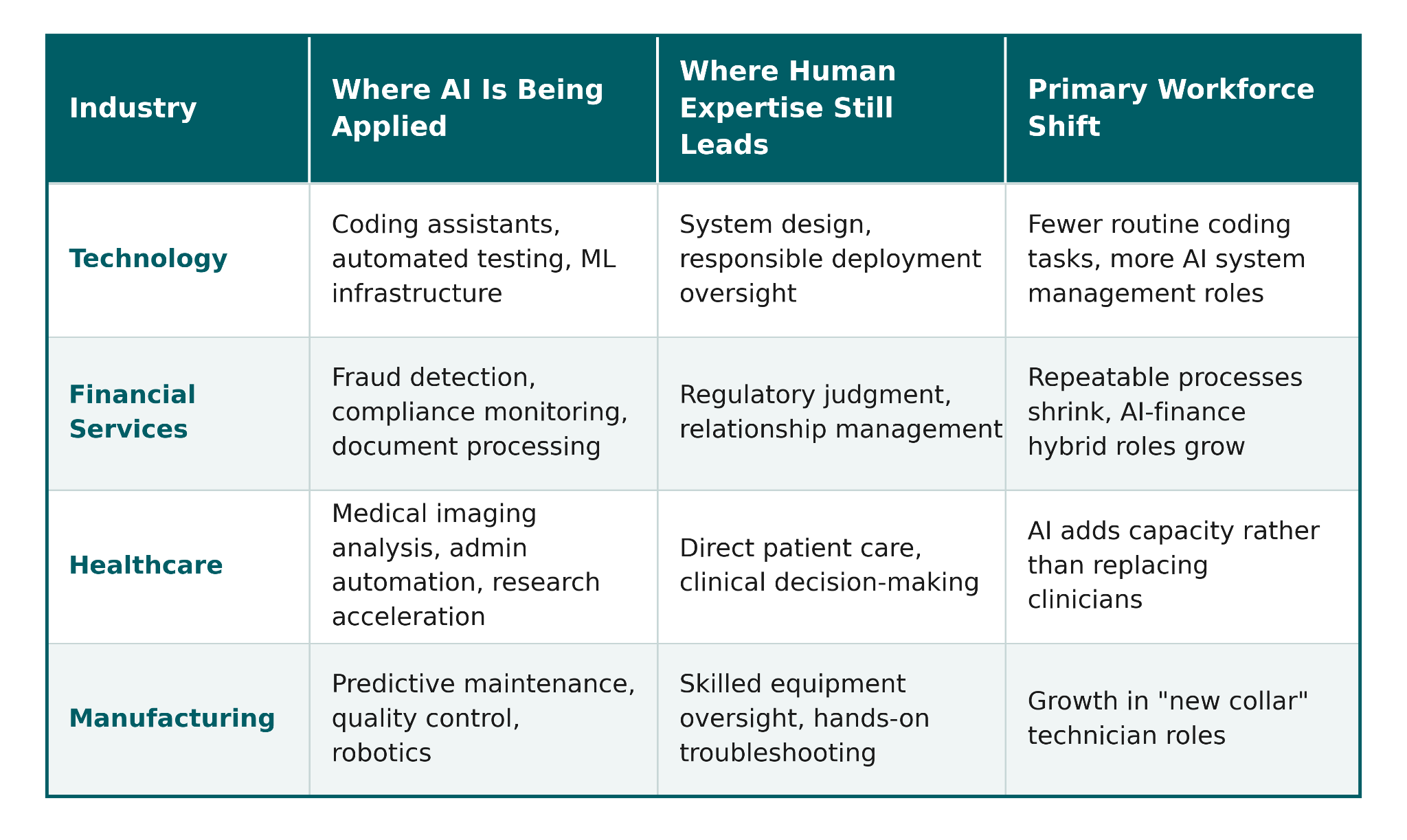
Let’s take a look at some industry highlights and then drill down into the details below.
Technology
Technology has been among the earliest adopters of AI, particularly in software development tools, automated testing, and machine learning infrastructure.
AI coding assistants are helping engineers accelerate development and improve productivity, but demand is also increasing for professionals who can build AI systems, manage data pipelines, evaluate model performance, and ensure responsible deployment.
The primary shift in technology is not simply about fewer engineers; it’s about changes in the skills and workflows required of engineering teams.
Financial Services
Financial services are among the industries with significant AI potential due to the volume of data-driven processes involved.
AI is being applied in areas such as fraud detection, compliance monitoring, document processing, and customer interactions. However, activities involving regulatory judgment, relationship management, and complex decision-making continue to require human expertise.
The greatest workforce changes are likely to occur in roles with highly repeatable processes, while demand grows for professionals who can combine financial knowledge with AI capability.
Healthcare
Healthcare presents a different challenge. AI adoption is increasing in areas such as medical imaging analysis, administrative automation, and research acceleration, but regulatory requirements, privacy concerns, and the importance of human care limit the pace of change.
Rather than replacing clinical professionals, AI is more likely to support them by reducing administrative burdens and improving access to information.
Given ongoing healthcare talent shortages, AI may become an important tool for increasing workforce capacity rather than reducing headcount.
Manufacturing
Manufacturing has experienced automation for decades, but AI introduces new opportunities through predictive maintenance, quality control, robotics, and supply chain optimization.
Traditional production roles continue to evolve, while demand for technicians and operators who can manage AI-enabled systems is increasing.
This represents the growth of “new collar” roles: positions that combine technical understanding with practical industry knowledge rather than requiring a traditional academic pathway.
The Rise of AI-Enabled Roles and New Workforce Opportunities
AI is not only changing existing jobs; it is also creating new categories of work.
Some emerging roles include:
- AI Trainers, who help improve model performance through data preparation and human feedback.
- AI Product Managers, who connect business needs with AI solutions.
- Machine Learning Operations (MLOps) Engineers, who manage AI systems after deployment.
- AI Governance and Responsible AI Specialists, who help organizations address issues such as transparency, fairness, and compliance.
While some AI-related job titles have gained attention quickly, the broader trend is more important: organizations increasingly need employees who can combine domain expertise with AI literacy.
For example, an AI governance specialist in healthcare needs more than technical knowledge; they need an understanding of clinical processes and regulatory requirements. A finance professional working with AI needs knowledge of both financial systems and responsible AI use.
This creates opportunities for internal mobility. Many organizations may already have employees with the industry expertise needed to transition into AI-related roles, provided they receive the right training and development support.
However, hiring for these positions remains challenging. Talent pools are still developing, job titles are inconsistent across companies, and compensation benchmarks continue to evolve.
Organizations need better labor market intelligence to understand where AI talent exists, how competitive hiring markets are changing, and how emerging roles should be benchmarked.

The Skills Shift: Redefining Workforce Value in the AI Era
AI is changing which skills create value in the workplace. The capabilities that helped employees succeed in the past will not disappear, but the balance between technical knowledge, human judgment, and AI fluency is shifting.
AI is particularly effective at supporting routine cognitive tasks such as information processing, pattern recognition, summarization, and generating content based on existing data. As these capabilities become more accessible, organizations will place greater emphasis on skills that complement AI rather than compete with it.
Skills likely to become increasingly valuable include:
-
Critical thinking and the ability to evaluate AI-generated outputs
-
Complex problem-solving and strategic decision-making
-
Creativity and the ability to generate new approaches
-
Cross-functional collaboration
-
Domain expertise combined with AI literacy
Technical AI knowledge is also becoming less of a specialist requirement and more of a workplace capability. Marketing teams need to understand AI-enabled content tools. Finance teams need to evaluate AI-generated analysis. HR teams need to understand how AI affects recruitment, workforce planning, and employee development.
The challenge for employers is that many existing workforces were not built with these capabilities in mind. Upskilling cannot be treated as a one-time training initiative; it needs to become part of ongoing workforce development.
Organizations that create continuous learning pathways will be better positioned to adapt as AI capabilities continue to evolve.
AI, Compensation, and Workforce Inequality
The impact of AI on wages remains one of the most complex areas of workforce analysis.
Research suggests that many highly skilled and highly compensated roles have significant exposure to AI because they involve analytical, technical, or information-based work. For these employees, AI may increase productivity and potentially increase the value of certain skills.
At the same time, the benefits of AI adoption may not be distributed evenly. Workers who have fewer opportunities to access AI tools, training, or career development may not experience the same productivity gains.
There is also the possibility that AI could expand access to expertise by enabling less experienced employees to perform tasks that previously required greater experience. Whether this reduces skill gaps, changes wage structures, or creates new forms of differentiation remains an ongoing area of research.
For compensation leaders, the implication is clear: traditional benchmarking approaches may become less reliable as AI changes how productivity and capability are measured.
Organizations will need to consider not only job titles and experience levels but also the evolving skills required to perform effectively in AI-enabled environments.

Understanding AI Impact with Horsefly
Strategic Workforce Planning in the Age of AI
Understanding AI trends is only the beginning. The challenge for talent leaders is turning those insights into workforce decisions.
1. Analyze Roles at the Task Level
Traditional workforce planning often begins with job titles. AI requires a more detailed approach.
Organizations should evaluate the tasks within each role and determine:
- Which activities can be automated or accelerated?
- Which responsibilities require human judgment?
- Which new skills will employees need as workflows change?
This provides a more accurate view of workforce impact than simply predicting which jobs will disappear.
2. Build Internal Mobility Pathways
Many organizations may already have employees with the knowledge required for emerging AI roles.
A compliance professional may have the expertise needed for AI governance. A customer service specialist may understand the workflows required to improve AI-powered support systems.
Creating pathways for employees to transition into these roles can help organizations address talent shortages while retaining valuable institutional knowledge.
3. Move Beyond Annual Workforce Planning
AI capabilities are evolving faster than traditional workforce planning cycles.
Organizations increasingly need scenario-based planning that accounts for different rates of AI adoption, changing skill requirements, and shifting talent availability.
4. Use Real-Time Labor Market Intelligence
Effective AI workforce planning depends on accurate data.
Organizations need visibility into:
- Where talent exists
- Which skills are increasing in demand
- How compensation is changing
- Which locations offer access to emerging capabilities
At Horsefly Analytics, we help organizations analyze global labor market data to support decisions around talent strategy, workforce planning, location analysis, and compensation benchmarking.
Whether organizations are building AI teams, assessing talent availability, or understanding changing workforce dynamics, better data enables more informed decisions.
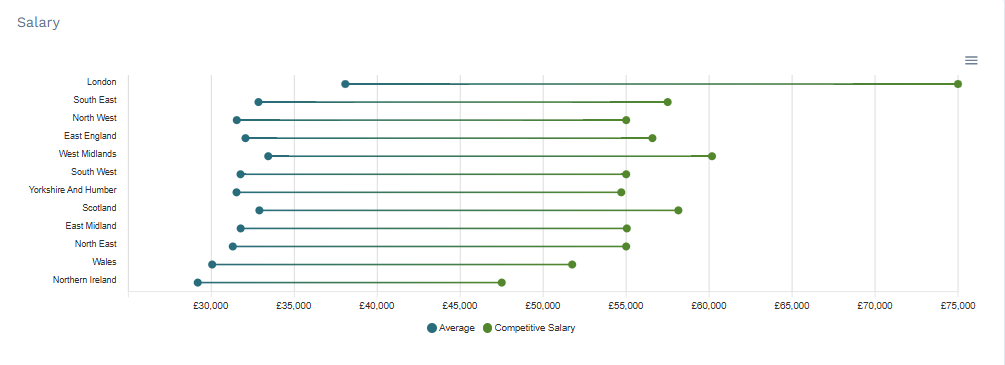
An example of how salary data appears in the Horsefly platform for starting to understand compensation benchmarking.
5. Align Upskilling Investment With AI Exposure
Functions experiencing significant AI-driven change require investment in learning and development.
Reducing training budgets during a period of technological transition risks creating larger capability gaps. The organizations most prepared for AI adoption will be those that continuously develop employee skills alongside new technology.
Building a Future-Ready Workforce With AI-Powered Labor Market Intelligence
The impact of artificial intelligence on the labor market is not simply a story of job replacement. It is a story of workforce transformation: tasks changing, roles evolving, new skills emerging, and organizations rethinking how work gets done.
For talent leaders, the challenge is gaining the visibility needed to make informed decisions. Understanding AI’s impact requires insight into changing skills demand, emerging roles, compensation trends, and where critical talent is available.
Horsefly Analytics helps organizations navigate this shift through global labor market intelligence, providing data on talent supply, demand, skills trends, compensation benchmarks, and workforce opportunities. Whether assessing emerging AI capabilities, identifying talent pools, or planning future workforce needs, Horsefly enables organizations to make decisions based on evidence rather than assumptions.
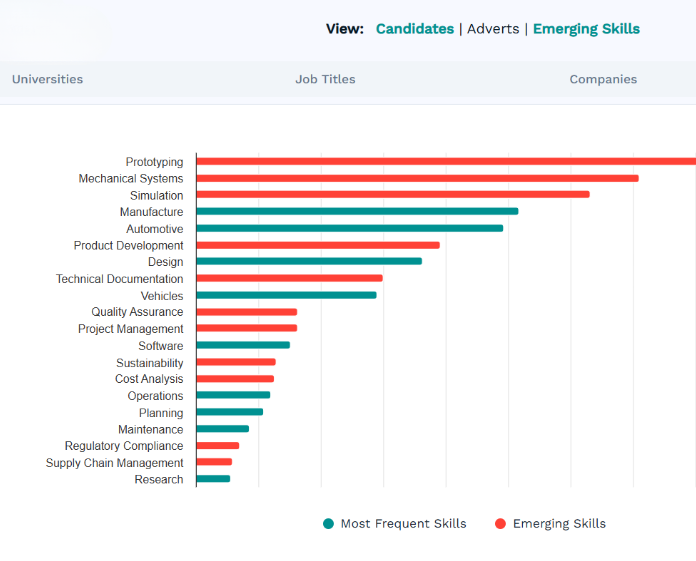
Image shows the Signal Skills capability within the Horsefly platform
The organizations best positioned for the AI-driven labor market will be those that treat workforce planning as a continuous, data-driven discipline, one which combines human expertise with the intelligence needed to adapt to change.
Frequently Asked Questions
How is AI impacting current labor market trends?
Current evidence suggests AI is primarily contributing to job transformation rather than widespread job elimination. Organizations are using AI to automate certain tasks, improve productivity, and redesign workflows, while demand for new skills and capabilities grows.
What tasks can AI automate within a typical job?
AI is particularly effective at supporting routine cognitive tasks such as data processing, summarization, pattern recognition, and generating content from existing information. Tasks requiring judgment, creativity, relationships, and strategic decision-making generally remain more dependent on human expertise.
Are new jobs being created because of AI?
Yes. Organizations are creating roles focused on implementing, managing, and governing AI systems, including AI trainers, AI product managers, MLOps engineers, and responsible AI specialists.
Which skills are becoming more important in the AI era?
Critical thinking, problem-solving, creativity, collaboration, and AI literacy are becoming increasingly important across many functions. Employees who combine AI capability with deep domain expertise are likely to be especially valuable.
How can companies prepare their workforce for AI adoption?
Companies should evaluate roles at the task level, identify changing skill requirements, invest in employee development, create internal mobility opportunities, and use current labor market data to guide workforce decisions.
Will AI increase wages or inequality?
The impact is uncertain and likely to vary across occupations, industries, and levels of access to AI tools. AI may increase productivity and opportunity for some workers while creating challenges for others who lack access to training or AI-enabled workflows.
What challenges do companies face when hiring AI talent?
Organizations often face limited talent pools, unclear job titles, evolving compensation expectations, and competition for candidates who combine technical AI knowledge with industry expertise.
To gain a clearer idea of how AI can affect your company, contact us today for a strategic consultation.
Sources: Horsefly Analytics