.png?width=2000&name=Horsefly-Logo-NewTag_White%20(3).png)
What Are Salary Research Tools?
Salary research tools are platforms, databases, or analytical systems that provide data on compensation across roles, industries, locations, and experience levels. They exist to take the guesswork out of pay decisions.
At their most basic, they help you answer questions like: "Are we paying market rate?" or "What should we offer a cloud architect in Austin versus Dublin?" At their most sophisticated, they feed directly into workforce planning and talent strategy.
Tools generally fall into a few categories: job board salary features (user-contributed data aggregated from job listings or profiles), recruitment firm guides (sector-specific, periodically published), professional survey platforms (employer-reported, high accuracy, higher cost), and labor market intelligence platforms (real-time, global, built for strategic decisions). Each serves a different use case, and choosing the right one depends on what you actually need the data to do.

Key Features to Look for in a Salary Research Tool
Not all salary data is created equal. Before committing to any salary checker tool, here are the things worth evaluating.
Data accuracy and source. How is the data collected? User-submitted data is abundant but inconsistent. Employer-reported survey data tends to be more accurate. Real-time platforms that pull from thousands of live sources give you the most current picture. The U.S. Bureau of Labor Statistics (BLS) and the UK's Office for National Statistics (ONS) provide foundational benchmarks, but they're not fast enough for competitive hiring decisions.
Granularity. Can you view job market data? Can you filter by location, industry, company size, seniority, and specific skill sets? A national average salary for "software engineer" is not very useful. A breakdown by city, experience level, and in-demand skill, cross-referenced against supply and demand, is actionable.
Geographic scope. If you're hiring across multiple markets or planning international expansion, you need global coverage. Some tools are strong regionally but thin internationally.
Freshness. Salary data from 18 months ago can be significantly off, especially in fast-moving sectors. Look for tools that update regularly, ideally daily or in real time.
Total compensation context. Base salary is only part of the picture. Benefits data, equity, bonuses, and cost of living context help you build packages that actually compete. Some platforms will even offer salary negotiation tips.
Cost and accessibility. Free salary benchmarking tools offer broad stroke estimates. Premium platforms offer depth, accuracy, and the ability to make genuinely strategic decisions.
What Are the Best Salary Benchmarking Tools?
Here is a structured look at some of the main salary comparison tools, what they do well, and where they fall short.
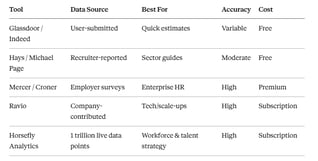
Glassdoor / Indeed Best for: Job seekers and hiring managers who want a quick directional sense of market rates (the prevailing salary or wage for a specific job role within a particular industry, location, and experience level).
These platforms aggregate salary data directly from users, making the coverage broad and accessible. For a general sense of what a role pays in a given city, they are useful starting points. The limitation is the self-reporting model. People tend to round up, leave out equity, or report at different points in their careers, which creates noise in the data. For strategic compensation planning, treat these as a rough reference rather than a source of truth.
Hays / Michael Page Salary Guides Best for: Understanding sector-specific benchmarks in the industries they recruit for.
Recruitment firms publish annual salary guides that are genuinely useful for understanding trends in the sectors they specialize in. The guides are well structured and readable. The obvious caveat: recruitment firms have commercial interests tied to salary inflation in certain areas, and their data reflects the roles they actively place, not the full market.
Mercer / Croner Best for: Enterprise HR teams that need validated, survey-based compensation data for formal benchmarking.
These are the gold standard for accuracy, drawing on large-scale employer surveys rather than user submissions. They are particularly strong for structured HR processes, pay equity and salary analysis, and regulatory compliance. The trade-off is cost and accessibility. These platforms are built for enterprise buyers, not quick lookups, and they are not designed for real-time talent market analysis.
Ravio Best for: Scale-ups and tech companies benchmarking compensation against peers.
Ravio is a newer entrant that aggregates live compensation data (information related to employee pay, including base salary, bonuses, commissions, equity, and benefits) from participating companies, making peer benchmarking more accessible than traditional survey platforms. It is particularly strong for fast-growing tech businesses. The data pool is still narrower than established platforms, and its sector coverage outside of technology is more limited.
Horsefly Analytics Best for: Talent acquisition leaders, RPOs, workforce planners, and HR teams who need compensation data as part of a broader labor market picture.
Horsefly's Compensation Insights capability pulls from over 1 trillion data points across 65 countries and 170,000 locations to give you market benchmarking that reflects actual supply and demand conditions. Rather than showing you a static salary range, it connects compensation data to talent availability, difficulty of hire, and geographic movement, so you understand not just what a role pays but whether you can realistically compete for that talent in a given market.
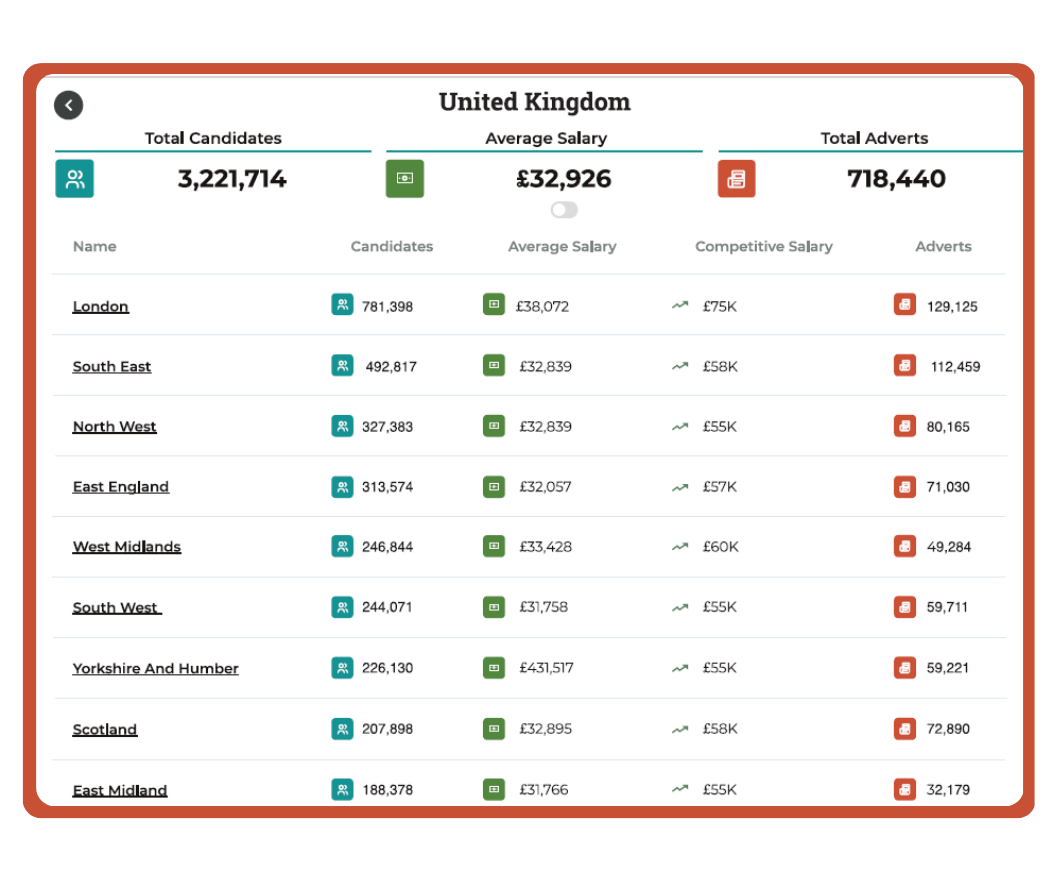 Image shows the Compensation capability from Horsefly Analytics
That means you can compare your compensation packages against global industry standards, identify pay disparities, optimize budgets based on real cost-of-talent data, and build offers that reflect what the market actually looks like today, not six months ago. For organizations doing serious workforce planning, that context makes a material difference.
How to Effectively Use Salary Research Tools
Getting value from these tools comes down to how you use them, not just which ones you pick.
Start with your own data. Know the role, location, level of experience, and specific skills involved before you go looking. Vague inputs produce vague outputs.
Use more than one source. Cross-referencing two or three tools gives you a defensible range and highlights where data conflicts. Single-source benchmarking creates risk.
Pay attention to data freshness. Always check when the data was last updated. In high-demand roles, salary expectations can shift meaningfully in a short period.
Build a range, not a number. The goal is to identify a competitive range that reflects the full market, not anchor on a single figure that may not hold up to scrutiny.
Factor in total compensation. Salary is one variable. Benefits, remote flexibility, equity, and career development all affect what talent actually values, and Horsefly's EVP Intelligence capability helps you understand how your overall offering compares to what the market is providing. For additional information on this, you can get in touch for more expert guidance.
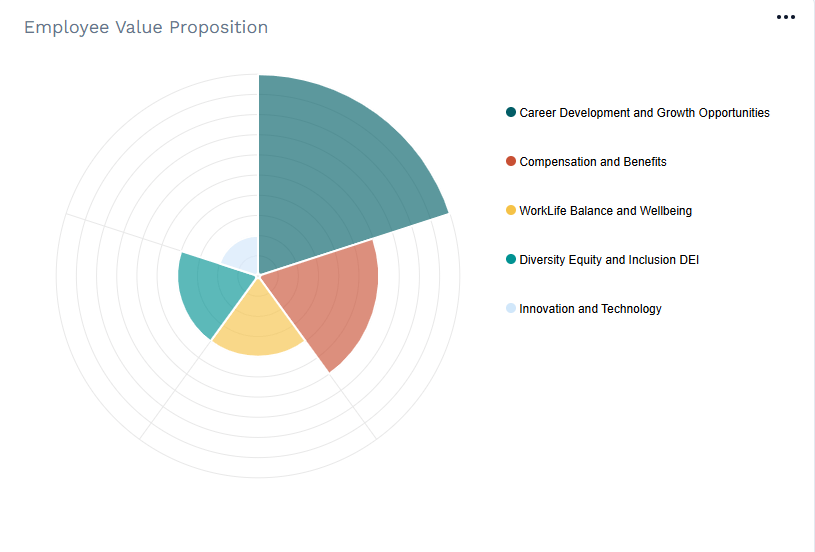
Image shows the EVP capability within the Horsefly platform
FAQ About Salary Research and Benchmarking
What is a salary benchmarking tool? A salary benchmarking tool lets you compare the compensation offered by your organization against external market data, so you know whether you are competitive for the roles you need to fill.
How accurate are salary research tools? Accuracy depends entirely on the data source. User-submitted data (Glassdoor, Indeed) reflects general trends but can be inconsistent. Survey-based tools (Mercer) are more accurate but slower to update. Real-time platforms that draw from live market data, like Horsefly, offer the most current and granular view.
When should you use salary research tools? Any time you are making a hiring decision, reviewing compensation structures, planning headcount for a new location, or assessing pay equity. Quarterly reviews are a reasonable cadence for most organizations. In fast-moving markets, more frequent checks make sense.
Empower Your Strategy With Accurate Data
Compensation decisions made without reliable data are expensive mistakes in slow motion. The right compensation research tools do not just tell you what a role pays. They tell you whether you can compete for that talent, where the best value locations are, and how to build packages that hold up in a real market.
If you are ready to benchmark compensation against real, global labor market intelligence, explore Horsefly with a strategic consultation today.
Sources: Horsefly Analytics, US Bureau of Labor Statistics (BLS), UK Office for National Statistics (ONS), Glassdoor, Indeed, Hays, Michael Page, Mercer, Croner, Ravio