.png?width=2000&name=Horsefly-Logo-NewTag_White%20(3).png)
When trying to answer the question, how much do data scientists make? This involves looking at a few different areas and additional information. According to the U.S. Bureau of Labor Statistics, the median annual wage for data scientists was $112,590 in 2024, with the middle half of the profession earning between roughly $87,000 and $145,000. That is the most conservative, government-backed figure available, and it is a reasonable floor for national benchmarking.
Job board data tells a slightly richer story once bonuses and total compensation enter the picture. Indeed puts the average base salary closer to $131,000. ZipRecruiter's figure sits nearer $123,000, with a typical range of $98,500 to $136,000 and top earners above $173,000. Glassdoor, which factors in bonuses and equity, reports average total pay around $156,000, with a likely range of roughly $123,000 to $203,000.
Break that annual figure down, and a data scientist's average salary per month lands somewhere between $7,250 and $13,000, depending on which dataset and compensation structure you are using. For talent acquisition and strategic workforce planning teams, the takeaway is not to fixate on any single number. It is to understand which factors are pushing a given role toward the top or bottom of that range, and that is where the real planning value sits.

Data Scientist Salary Benchmarks: A Global Snapshot
Data scientist salary US figures only tell part of the story if your organization hires, or competes for talent, across borders. Cost of living, local demand, and currency all shift what "competitive" looks like from one market to the next.
|
Country |
Approx. Average Annual Salary (USD) |
Context |
|
United States |
$112,590 to $130,764 |
National median (BLS) to job board average (Indeed) |
|
Australia |
$120,000+ |
Among the highest paying markets outside the US, alongside Switzerland |
|
Canada |
Approximately $73,000 to $100,000 (CAD 100,000 to CAD 137,000 locally) |
Toronto, Vancouver, and Montreal lead on volume of roles |
|
Germany |
Approximately $85,000 |
Europe's strongest data science market, led by Berlin, Munich, and Frankfurt |
|
United Kingdom |
Approximately $67,000 to $80,000 |
London accounts for over half of all UK data science roles |
|
India |
Approximately $12,000 |
Rapidly growing market, especially in Bangalore, Hyderabad, and Mumbai |
A word of caution on this table, and on any global salary comparison: these figures come from different survey methodologies and currency conversions, so treat them as directional rather than exact. Purchasing power matters more than the headline number. A data scientist in Berlin earning the equivalent of $85,000 with lower rent, cheaper healthcare, and more statutory leave may be better off in real terms than a US counterpart earning $130,000 in a high-cost city. This is exactly the kind of nuance that matters for international recruitment and location planning, and it is worth modeling properly rather than assuming US figures translate one-to-one.
Data Scientist Average Salary by Years of Experience
Experience remains the single clearest driver of pay in this field, and the jump between career progression stages is steep. Broadly, the market splits into three tiers: entry level data scientist salary, mid level data scientist salary, and senior data scientist salary or lead, though the table below breaks those down further.
|
Experience Level |
Typical Base Salary Range |
|
Entry level (0 to 1 year) |
$84,000 to $100,000 |
|
Early career (1 to 4 years) |
$100,000 to $135,000 |
|
Mid level (5 to 8 years) |
$130,000 to $160,000 |
|
Senior and staff |
$160,000 to $250,000+ |
|
Principal or leadership (AI, ML leads) |
$250,000 to $400,000+, including equity |
A newly qualified data scientist can expect an entry-level offer somewhere in the $84,000 to $100,000 band, though Glassdoor data shows this range stretching as wide as $178,000 at the top end for talent joining well-resourced tech firms straight out of specialized graduate programs. Compensation accelerates fastest between years three and seven, as data scientists move from executing assigned analysis to owning strategy and mentoring others. That shift in responsibility, from tactical execution to strategic leadership, is what justifies the jump, not tenure alone. By the principal or head of data science level, total compensation at major technology and finance employers regularly clears $300,000 once bonuses and stock are included.
For HR leaders, this progression is useful beyond individual offers. It is a template for building your own internal career bands and promotion criteria, tied to demonstrated scope of ownership rather than years of service.
Data Scientist Average Salary by Location
Location shifts the number almost as much as experience does, and the pattern will be familiar to anyone who has built a location strategy before: cost of living and industry concentration both drive the premium. The table below shows data scientist salary by location:
|
Location |
Average Annual Salary |
|
District of Columbia |
$131,104 |
|
California |
$130,606 |
|
Massachusetts |
$128,866 |
|
Washington |
$128,392 |
|
New York |
$125,882 |
|
National average |
$112,590 to $130,764 |
San Francisco, Seattle, New York City, and the Princeton to Trenton corridor consistently rank among the highest-paying metro areas, largely because they combine dense tech employer bases with a high cost of living. Some markets are catching up fast without the same price tag attached. Charlotte, for example, has become a genuine data science hub on the strength of its financial services sector, with salaries in the $96,000 to $133,000 range that are competitive with far pricier coastal and best-paying cities once cost of living is factored in.
This same data is exactly what remote work compensation strategies should be built on. If a role can be performed from anywhere, the question becomes whether to anchor pay to the employee's location, a national average, or somewhere in between, and each choice has direct budget implications at scale. It is also the kind of pattern that a location strategy should be built around more broadly, not just where salaries are lowest, but where the ratio of talent supply, cost, and skill depth works in your favor.
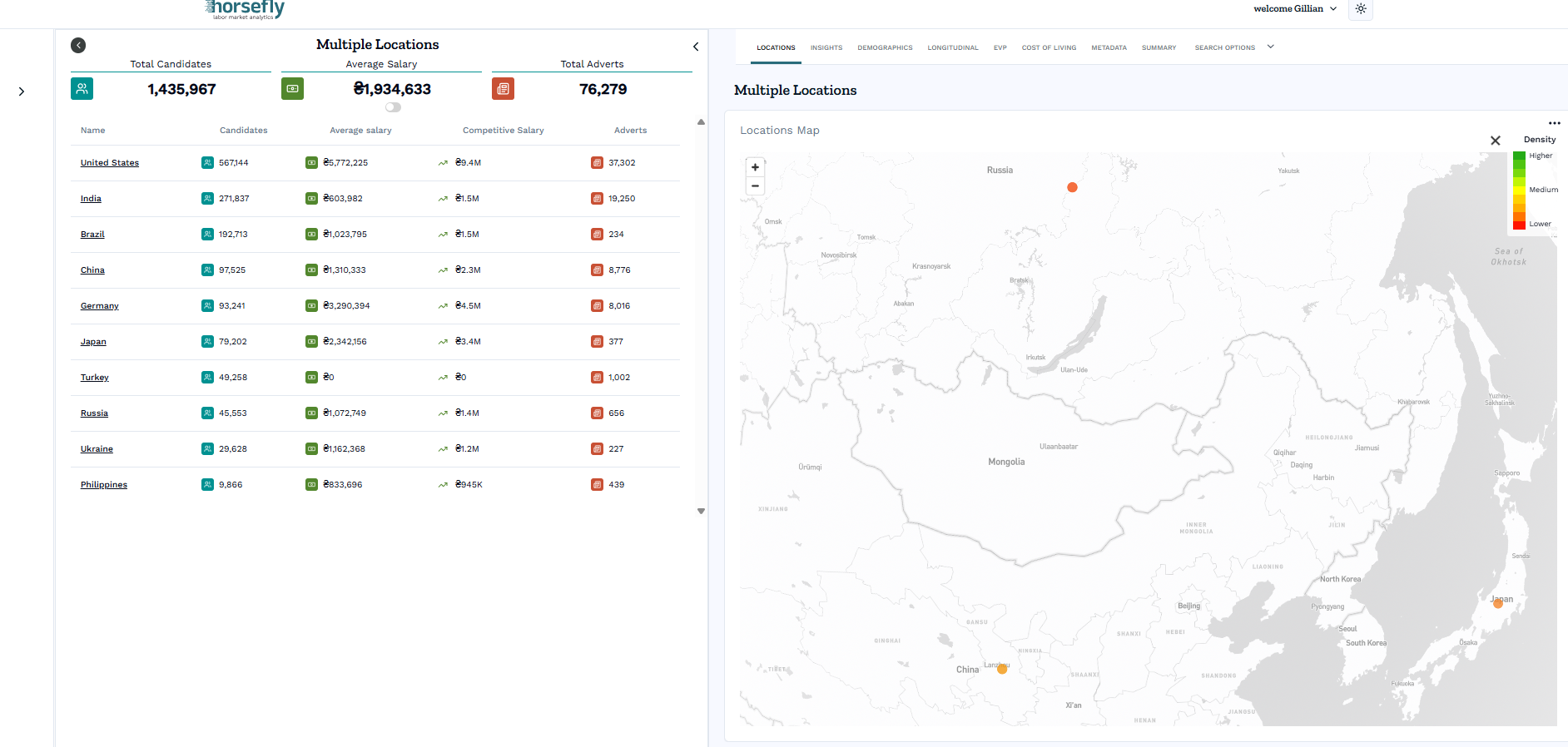
Images shows a global look into the data on the role of data scientist
Data Scientist Average Salary by Industry and Company Size
Industry choice is an underused lever. The same job title and same experience level can carry a meaningfully different price tag depending on the sector, even salary by city can vary greatly. The below chart looks at the variations of data scientist salary by industry:
|
Industry |
Median Total Pay |
|
Information technology |
$178,717 |
|
Media and communications |
$161,588 |
|
Telecommunications |
$160,731 |
|
Pharmaceutical and biotechnology |
$154,416 |
|
Financial services |
$151,690 |
|
Public sector and nonprofit (mid level) |
$90,000 to $110,000 |
Pharma, financial services, and tech industry salary levels are often higher. They pay a premium because the business value of a strong data science function is direct and measurable: faster fraud detection, better drug discovery pipelines, sharper product decisions. Public sector, education, and nonprofit roles pay noticeably less, though they typically offer trade-offs such as stronger work-life balance and, in the US, student loan forgiveness programs that can meaningfully offset the gap over a career.
Company size cuts across all of this. Larger, established employers tend to pay more in base salary and cash bonus, and Glassdoor data on the closely related machine learning engineer role shows bigger companies paying more than a third above smaller ones for comparable work, a pattern that holds directionally across data science roles too. Startups typically counter with equity, offering less certainty but a higher ceiling if the company performs well. Neither structure is inherently better, but they attract different kinds of talent, and your offer strategy should reflect which trade-off you are actually asking someone to make.
Benchmarking Against Related Tech Roles
Not every data role commands the same pay, and the terms get used loosely enough that it is worth being clear about the gaps. Searches for data analytics jobs salary often turn up figures well below the salary for a data scientist, and that difference is real, not a reporting quirk.
|
Role |
US Average Salary |
|
Data Analyst |
$70,000 to $95,000 (early career), $110,000 to $120,000 (senior) |
|
Data Scientist |
$130,764 |
|
Data Engineer |
$136,776 |
|
Machine Learning Engineer |
$189,770 |
So, what’s the reason for the difference between a data scientist vs data analyst salary? A data analyst typically focuses on reporting, dashboards, and descriptive statistics, work that is valuable but has a lower barrier to entry than building predictive models or production machine learning systems. A data engineer salary factors in that they build and maintain the pipelines and infrastructure that data scientists depend on, less modeling, more systems and scale, and that infrastructure focus commands a slightly higher average than the data scientist role itself. A machine learning engineer salary sit at the top of this comparison because the role blends data science with production-grade software engineering, deploying and maintaining models at scale rather than just building them.
For workforce planners, the distinction matters most when writing job descriptions and setting budgets. A role labeled "data scientist" that is actually scoped like a data analyst position will either overpay for the work or underpay for the title, and either mistake shows up fast in your Difficulty of Hire and retention numbers. Getting the title, scope, and salary band aligned before you post the role saves that pain later.

The High Value Skills Driving Top Salaries
Job title and years of experience only tell part of the story. Skill depth is where a lot of the real variation hides.
Python remains the baseline expectation, appearing in over half of all data scientist job postings, alongside SQL, which shows up in anywhere from a third to nearly three-quarters of listings depending on the industry. R also appears regularly, particularly in research-heavy and academic-adjacent roles. Having these is table stakes, not a differentiator.
The differentiators are further up the stack. Big data tools such as Spark and Hadoop show up consistently in postings for roles working with high-volume, distributed datasets, and experience there tends to correlate with the more senior, infrastructure-adjacent end of the pay scale. Machine learning frameworks including TensorFlow and PyTorch are similarly table stakes for any role touching production models. Certifications and business intelligence tool expertise can lift compensation by ten to twenty percent, according to Robert Half's most recent salary guide. Cloud-specific machine learning credentials carry an even sharper premium: Google Cloud Professional Cloud Architect certification is associated with salaries of $140,000 to $175,000, AWS Machine Learning Specialty with $130,000 to $160,000, and Microsoft Azure Data Scientist certification with $135,000 to $160,000. Demand for natural language processing skills nearly quadrupled as a share of job postings within a single year, and agentic AI experience is one of the fastest-growing requirements employers are screening for.
Soft skills carry real financial weight too, even though they are harder to quantify than a certification. The ability to explain a model's limitations to a non-technical stakeholder, to tie a finding directly to revenue or cost, and to lead a project rather than just execute it, are consistently what separates senior compensation from mid-level pay. Technical depth and technical skills get a data scientist hired. Business communication and leadership are what get them promoted into the roles paying $200,000 and above.
The practical implication for hiring teams is simple: a job description that lists "Python" and stops there is competing on the most crowded, least differentiated part of the market. A job description built around the specific tools, specializations, and business impact that actually move pay will surface, and retain, stronger talent. Horsefly's Signal Skills Intelligence is built for exactly this problem, it flags which are rising, in-demand skills before they become standard requirements, so your job postings and compensation benchmarks reflect where the market is heading rather than where it has already been.
The Role of Education and Certifications
Academic qualifications still move the needle, though less absolutely than they once did. Bachelor's degree graduates typically earn in the $95,000 to $110,000 range early in their careers. Master's degree holders generally start higher and advance into mid-level positions faster, which is why so many data scientists pursue one mid-career rather than at entry level. PhD holders entering specialized research roles, particularly in biotech or AI research, can command $140,000 or more from the outset.
Is a master's degree a necessity? Increasingly, no. A growing share of US data science job postings, over three-quarters by some estimates, now accept non-degree alternatives, and roughly a quarter carry no formal education requirement at all. Many successful data scientists start as data analysts and move into the role within two or three years by building programming, statistical, and machine learning skills on the job, without the need for specific data science qualifications. What tends to matter more than the credential itself is a demonstrable portfolio and the ability to connect analysis to business outcomes.
Professional certifications, covered in more detail in the skills section above, have become a practical substitute for some of what a further degree used to signal, particularly cloud and machine learning-specific credentials from AWS, Google Cloud, and Microsoft Azure. For talent leaders building job requirements, treating a master's degree as a hard filter may be screening out strong talent unnecessarily. Treating specific, verifiable skills and certifications as the filter tends to produce a stronger shortlist.
Data Scientist Job Outlook
If salary tells you what to budget, outlook tells you how urgently to plan. The BLS projects data scientist employment will grow 33.5 percent between 2024 and 2034, making it the fourth fastest-growing occupation in the entire US economy and the fastest-growing within the mathematical sciences. That translates to roughly 23,400 openings a year and total employment climbing from 245,900 to 328,300 over the decade.
That growth is not evenly distributed. Demand is concentrating around AI implementation, applied machine learning, and roles that combine technical depth with the ability to translate findings into business outcomes. Robert Half projects data scientist pay to rise 4.1 percent year over year into 2026, more than double the 1.6 percent projected across the technology sector as a whole. Put plainly, the profession is not just growing; it is pulling away from the rest of the labor market on both headcount and pay.
Our Data Methodology: Where to Find Reliable Global Salary Data
Every figure in this article traces back to a named, credible source, the Bureau of Labor Statistics, Glassdoor, Indeed, ZipRecruiter, Salary.com, and Robert Half, because methodology matters as much as the number itself. Government wage surveys, crowd-sourced job board data, and recruiter-facing salary guides all measure slightly different things, base pay versus total compensation, self-reported figures versus verified job postings, and a workforce strategy built on the wrong one can miss the mark badly.
This is exactly the gap that a platform like Horsefly Analytics is built to close. Horsefly's Compensation Insights let you benchmark packages against industry standards globally rather than relying on a single national average, while Cost of Living Insights connect wage data to real, current living expenses so you can craft offers grounded in what a role is worth in a specific market, not just what a national survey suggests. Longitudinal Intelligence goes a step further, tracking how pay, demand, and skill requirements have shifted over time, so you can see pressure building in a role before it shows up as a retention problem.
Behind the scenes, this is powered by continuous aggregation across public labor market datasets and Horsefly's own proprietary intelligence platform, with AI agents and structured data processes keeping the underlying figures refreshed and validated daily rather than relying on a single annual survey. That is the difference between a salary guide you read once a year and a labor market analytics view you can actually plan against. Book a strategy session to see what your business can uncover.
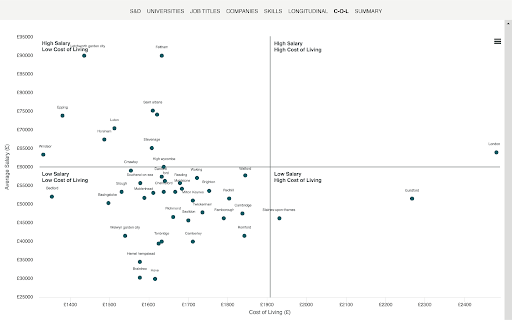
Image shows the cost of living data from the Horsefly platform
Strategic Salary Planning for Talent Leaders
A salary figure on its own is a data point. Used well, it becomes the foundation for three decisions every HR and talent acquisition leader has to make repeatedly: where to hire, what to pay, and how urgently to move.
Horsefly's Supply and Demand Insights show talent availability and scarcity across regions and roles in real time, so you can weigh a lower salary market against how hard that market actually is to recruit in. Difficulty of Hire Insights flag which roles will demand more time and budget before you commit resources to them, and Skills Insights benchmark your workforce's capabilities against market standards, so you know exactly where the gaps are before they become urgent. For teams thinking further ahead, AI Impact Analysis replaces guesswork about how automation will reshape data roles with evidence grounded in real labor market movement.
If your workforce planning already leans on outsourced recruitment support, this same data set strengthens the business case for it too. Our RPO guide walks through how outsourced recruitment models use exactly this kind of market intelligence to fill specialized, hard-to-source roles faster.
Summing up Salaries
Data scientist salaries in the US span an enormous range, roughly $84,000 for an entry-level analyst to well over $300,000 for a principal leading an AI team, and almost none of that spread is random. Experience, location, industry, company size, education, and specific skill depth each pull the number in a predictable direction. The organizations that plan well are not the ones chasing a single average. They are the ones who understand which levers apply to their specific roles and markets, who set competitive offers and manage budgets with that nuance in mind, and who have the data to prove it when the budget conversation comes up.
See how Horsefly's real-time labor market intelligence can help you build a cost-effective, skilled workforce by booking a strategic consultation today.
Sources: Horsefly Analytics, U.S. Bureau of Labor Statistics, Indeed, ZipRecruiter, Glassdoor, Robert Half, Salary.com