.png?width=2000&name=Horsefly-Logo-NewTag_White%20(3).png)
There's a persistent confusion between HR reporting and HR analytics, and it costs organizations real money. Your HRIS generates reports, telling you headcount by department, time-to-fill by requisition, turnover percentages by quarter, etc. That documentation is valuable, but it’s not intelligence.
Enterprise HR analytics starts where reporting ends, connecting internal workforce data with external labor market intelligence, applying statistical and machine learning models, and producing strategic foresight that shapes business decisions.
The evolution has been gradual but decisive. First-generation HR technology was about record-keeping, ensuring compliance, tracking payroll, managing benefits. Then, second-generation systems added workflow automation and self-service portals. What we're seeing now is a third wave, where workforce intelligence platforms integrate real-time data from dozens of sources (from job postings to salary surveys, demographic trends, skills taxonomies, and competitor hiring patterns). This answers questions that a traditional HRIS was never designed to address.
One example would be that an HRIS tells you that your attrition rate in data science roles was 18% last year. In contrast, an enterprise HR analytics platform tells you:
-
That attrition is concentrated among mid-career professionals in three specific metros
-
That competitor hiring activity in those markets spiked 40% over the same period, that your compensation sits at the 35th percentile for comparable roles
-
That two alternative locations offer 3x the talent supply at 20% lower cost. One is a number. The other is a strategy.
Judgment is still important in data-driven decision-making, but the goal is to equip leaders with the information density they need to make faster, better-informed calls on workforce investments.

Core Benefits That Drive Competitive Advantage with Workforce Data
The payoff from enterprise HR analytics falls into four areas that directly impact business performance.
Strategic Workforce Planning Becomes Proactive
Analytics helps organizations forecast future skill gaps, identify internal talent pools, and build workforce pipelines before demand increases.
Talent Acquisition Becomes More Precise
By revealing effective sourcing channels, talent-rich markets, and skills availability, analytics helps organizations focus recruitment efforts where they are most likely to succeed.
Retention Becomes Data-Driven
Analytics identifies the workforce factors that often precede employee departures, enabling leaders to address risks earlier and develop more targeted retention strategies.
Cost Optimization Becomes Evidence-Based
Organizations can make more informed decisions around location strategy, compensation, and workforce investments by understanding the true cost and availability of talent across markets.
The AI Advantage in People Analytics
AI and machine learning are the technical foundation that makes enterprise-scale people analytics possible, rather than merely being buzzwords.
When a global enterprise generates workforce data across dozens of systems, languages, and skills frameworks, AI can normalize these variations, connect fragmented information, and create a unified view of workforce capabilities at a scale that manual processes cannot achieve.
Three AI applications stand out for their practical impact:
Predictive Insights for Attrition and Demand
Machine learning models can identify patterns linked to employee turnover and forecast future workforce needs. By connecting business growth signals with talent requirements, organizations gain the visibility needed to plan hiring before shortages emerge.
Natural Language Processing for Unstructured Data
Performance reviews, employee feedback, exit interviews, and job postings contain valuable insights that traditional systems often overlook. NLP can uncover emerging skills gaps, shifts in sentiment, and external market trends hidden within large volumes of text.
Skills-Based Talent Matching
Instead of relying solely on job titles, AI can analyze roles based on their underlying skills, match them against internal talent inventories, and identify employees with potential for upskilling or career mobility.
At Horsefly Analytics, we focus on using AI to surface actionable workforce insights, helping leaders make informed decisions without adding unnecessary complexity.

How the AI Impact capability appears within the Horsefly platform
The Analytics Maturity Model: From Descriptive to Prescriptive
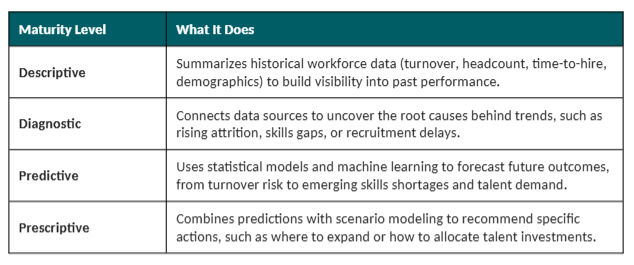
Understanding where your organization sits on the analytics maturity curve is the first step toward knowing where to invest. The four levels represent distinct capabilities, moving from understanding past performance to recommending future workforce decisions.
Descriptive Analytics Builds Workforce Visibility
Descriptive analytics summarizes historical workforce data such as turnover, headcount, time-to-hire, and workforce demographics. While essential for visibility, it only explains past performance rather than helping leaders anticipate future workforce needs.
Diagnostic Analytics Reveals the Causes Behind Trends
Diagnostic analytics identifies the factors behind workforce trends by connecting data sources and uncovering patterns. It helps leaders understand the drivers behind challenges such as rising attrition, skills gaps, or recruitment delays.
Predictive Analytics Forecasts Future Workforce Needs
Predictive analytics uses statistical models and machine learning to forecast future workforce outcomes, from likely employee turnover to emerging skills shortages and future talent demand. These insights give leaders a stronger foundation for proactive planning.
Prescriptive Analytics Guides Strategic Workforce Decisions
The most advanced level, prescriptive analytics combines predictions with scenario modelling to recommend actions. It can help leaders evaluate decisions such as where to expand, how to allocate talent investments, or which workforce strategies are most likely to achieve business goals.
The jump from descriptive to predictive is the hardest one. It requires clean, connected data, analytical talent, and organizational willingness to act on probabilistic recommendations. Most enterprises are somewhere between diagnostic and predictive, which is exactly where the highest-ROI investments in analytics capability tend to land.
Key Features of Enterprise HR Analytics Software to Help You Choose Your Platform
The market for HR analytics software is crowded, and feature lists blur together quickly. Here's what actually matters when you're evaluating platforms for a global enterprise.
Data Integration That Spans Internal and External Sources
Your HRIS and ATS data alone won't answer strategic questions. The platform must be able to blend internal workforce data with external labor market intelligence, including real-time job posting volumes, compensation benchmarks, talent supply and demand by skill and geography, and competitor hiring activity.
Without this external dimension, you're analyzing your own organization in a vacuum.
At Horsefly Analytics, we've built integrations that pull from thousands of data sources globally, because we've seen too many analytics projects fail when they can't connect internal needs with external market realities.

Global Coverage with Local Granularity
A platform that covers North America well but treats Southeast Asia as a single market is useless for a global enterprise evaluating locations in Vietnam versus the Philippines. You need data that's granular at the city and skill level across every market where you operate or plan to expand.
Advanced Modeling, Not Just Dashboards
Data visualization is important, but dashboards alone aren’t what create strategic value. The real question is whether the platform can help you explore different scenarios and make better decisions. Can it model future talent supply and demand for specific skills and markets? Can it show how your compensation compares with competitors? A platform that only produces attractive charts without deeper analytical capabilities is just creating more information, not better insights.
Scalability and Security
The platform needs to handle the data volumes, user counts, and access controls that come with a 50,000+ employee organization operating across multiple jurisdictions with different data privacy requirements.
Usability for Non-Technical Stakeholders
If only your data science team can operate the platform, adoption will be limited. The most effective HR analytics tools make sophisticated analysis accessible to HR business partners, talent acquisition leaders, and workforce planners who aren't writing SQL queries.
A Strategic Framework for Implementing HR Analytics
Organizations frequently fall into the trap of investing heavily in platforms and then struggling to generate value because they skipped foundational steps.
1️⃣Start with Business Questions, Not Technology
The most common mistake is buying a platform and then figuring out what to do with it. Instead, identify the three to five workforce decisions that carry the most financial weight or strategic importance. This could be anything from improving your global location strategy to reducing time-to-fill for revenue-critical roles. Or, maybe it's building a skills-based talent marketplace. Define clear KPIs for each, then select technology that addresses those specific challenges.
2️⃣Assess Your Data Honestly
Data readiness is the unglamorous bottleneck that derails most analytics initiatives. Are your job architectures standardized? Is your skills taxonomy consistent across business units? Do your systems integrate, or are they siloed? You don't need perfect data to start, but you need to know where the gaps are and have a plan to close them.
3️⃣Start Focused, Then Expand
Rather than attempting an enterprise-wide analytics rollout, pick one high-impact use case, prove value, and build from there. A successful pilot in talent acquisition analytics creates the organizational momentum and executive sponsorship needed for broader adoption. Agile decision-making in HR requires the same iterative approach that product teams have used for years.
4️⃣Invest in People, Not Just Platforms
Yes, analytics tools generate insights, but it’s people who turn insights into action. You need a combination of analytical capability (people who can build models and interpret results) and business acumen (people who can translate analytical findings into workforce strategy). The most effective teams pair data specialists with senior HR business partners who understand the organizational context.
5️⃣Benchmark Relentlessly
Internal metrics without external benchmarks are incomplete. Your time-to-fill means nothing in isolation, and your compensation data only becomes actionable when you compare it against market rates by role, level, and geography. Connecting to external workforce metrics and benchmarks, whether through a platform like ours or through dedicated research, is what transforms internal reporting into market-aware strategy.
Managing the Ethical Environment of AI in HR
Using AI to make decisions that affect people's careers carries obligations that go beyond legal compliance. This is an area where many organizations underinvest, and the consequences (reputational, legal, and human) can be severe.
Algorithmic Bias
This is a real and present risk. If your training data reflects historical hiring patterns that underrepresented certain groups, your model will perpetuate those patterns. A hiring algorithm trained on ten years of engineering resumes from a company that historically hired predominantly from a narrow set of universities will, unsurprisingly, favor candidates from those universities.
Mitigating algorithmic bias requires deliberate action, including regular audits of model outputs across demographic groups, diverse training datasets, and human oversight at decision points. No AI system should be making autonomous hiring or promotion decisions without human review.
Data Privacy Varies Dramatically by Jurisdiction
The regulatory environment for workforce data is complex and getting more restrictive, from GDPR in Europe to CCPA in California, PIPL in China, and LGPD in Brazil. Your analytics platform and governance framework must account for where data is stored, how it's processed, who has access, and how long it's retained. This is particularly challenging for global organizations that need to analyze workforce data across dozens of jurisdictions simultaneously.
Transparency Builds Trust
Employees and candidates deserve to understand, in general terms, how AI is being used in decisions that affect them. Organizations that treat their analytics capabilities as black boxes erode trust and create legal exposure. Data governance policies should be clear, accessible, and regularly reviewed.
At Horsefly Analytics, we prioritize the use of aggregated, anonymized labor market data precisely because it enables powerful workforce intelligence while respecting individual privacy. The ethical design of analytics systems is a prerequisite for sustainable adoption.

The Future of Workforce Intelligence
Several trends will reshape HR analytics over the next three to five years.
Real-Time External Data Integration Will Become Standard
The gap between internal workforce data and external labor market intelligence will continue to close. Platforms that continuously analyze job postings, salary data, skills trends, and competitor activity will give organizations the strategic foresight needed to make faster, more informed workforce decisions.
Skills Will Become the Primary Unit of Workforce Analysis
As roles evolve faster than traditional job descriptions can keep up, organizations will shift from job-based planning to skills-based workforce strategies. Analytics platforms that map skills, track supply and demand, and model future capability needs will become essential for building adaptable workforces.
Analytics Will Enable More Personalized Workforce Strategies
From career development and mobility to retention and inclusion initiatives, organizations will increasingly use workforce intelligence to identify trends, target interventions, and create more effective employee experiences.
The organizations building analytics capabilities today are solving current workforce challenges while simultaneously creating the infrastructure needed to adapt to a labor market that will look fundamentally different in five years.
Building Your Data-Driven Workforce Strategy With Horsefly Analytics
The path from basic HR reporting to enterprise-grade workforce analytics follows a clear trajectory: connect your data, add external market intelligence, apply analytical models that move from descriptive to prescriptive, and build the organizational capability to act on what you learn.
Everyone has data, so the competitive advantage lies in the speed and quality of decisions enabled by data. Organizations that can answer "Where should we hire?", "What should we pay?", "Who's likely to leave?", and "What skills will we need?" with data-backed precision will consistently outperform those relying on intuition and fragmented information.
At Horsefly Analytics, we built our platform around the challenges workforce leaders face every day, turning complex talent data into decisions they can act on. We’ve seen the difference it makes when organizations have access to accurate, timely, global workforce intelligence. The technology is here, and the data available today is more powerful than ever. The real challenge is using that insight to make workforce decisions with the same level of analytical confidence already expected in finance, marketing, and operations.
For workforce leaders, the question is how quickly they can bridge the gap between the data they have and the decisions they need to make.
Schedule a strategic consultation and see how Horsefly Analytics can help you close the gap between the workforce data you have and the strategic decisions you need to make.
Frequently Asked Questions
What is the main difference between HR reporting and strategic HR analytics?
HR reporting summarizes historical workforce data, such as headcount and turnover. Strategic HR analytics combines internal and external data with advanced analytics to identify trends, predict outcomes, and support better workforce decisions.
How does enterprise HR analytics help improve talent acquisition and retention efforts?
Analytics helps organizations identify the best talent sources, uncover new hiring markets, and predict factors that contribute to employee turnover, enabling more proactive recruitment and retention strategies.
What specific benefits do AI and machine learning bring to people analytics?
AI helps organizations unify workforce data, predict talent trends, extract insights from unstructured information, and match employee skills to future workforce needs.
What are the four levels of HR analytics maturity, and what do they mean for a business?
The four levels are descriptive (what happened), diagnostic (why it happened), predictive (what will happen), and prescriptive (what should we do). Each stage enables more proactive and strategic workforce decisions.
What are the critical first steps for successfully implementing an enterprise HR analytics initiative?
Start by identifying key workforce challenges, assessing data readiness, and selecting a focused use case that can demonstrate measurable value before expanding across the organization.
How can organizations measure the return on investment (ROI) from enterprise HR analytics?
ROI can be measured through improvements such as reduced time-to-fill, lower attrition, optimized hiring spend, and better workforce investment decisions supported by external market data.
What ethical considerations are most important when applying AI to HR decision-making?
Organizations must address algorithmic bias, protect workforce data privacy, maintain transparency, and ensure human oversight when using AI in decisions that affect employees.
Sources: Horsefly Analytics, GDPR, CCPA, PIPL, LGPD