.png?width=2000&name=Horsefly-Logo-NewTag_White%20(3).png)
Traditional HR analytics tells you what happened. For example, it can tell you that time-to-hire went up, that turnover spiked in Q3, or that your training completion rates are at 78%. These are useful operational metrics, but they describe symptoms without diagnosing causes. And they rarely connect to business outcomes in ways that compel a CFO or CEO to act.
Enterprise people analytics is a different discipline. It examines how work actually gets done across an organization by combining workforce data with operational, financial, and external labor market intelligence. The goal is to achieve a complete view of workforce dynamics that informs strategy. This includes where to expand, what skills to build versus buy, which teams are structured for performance and which are structured for friction, and what the external talent market looks like for the roles that matter most.
In other words, while HR analytics helps you look backwards, enterprise people analytics helps you navigate the future.
This shift from descriptive to predictive and prescriptive analysis is what separates organizations that react to workforce problems from those that anticipate them. When people analytics connects internal workforce patterns to external labor market data (such as supply, demand, compensation benchmarks, and competitor hiring activity), it becomes a strategic instrument that supports decisions about site selection, M&A talent integration, workforce restructuring, and geographic expansion.
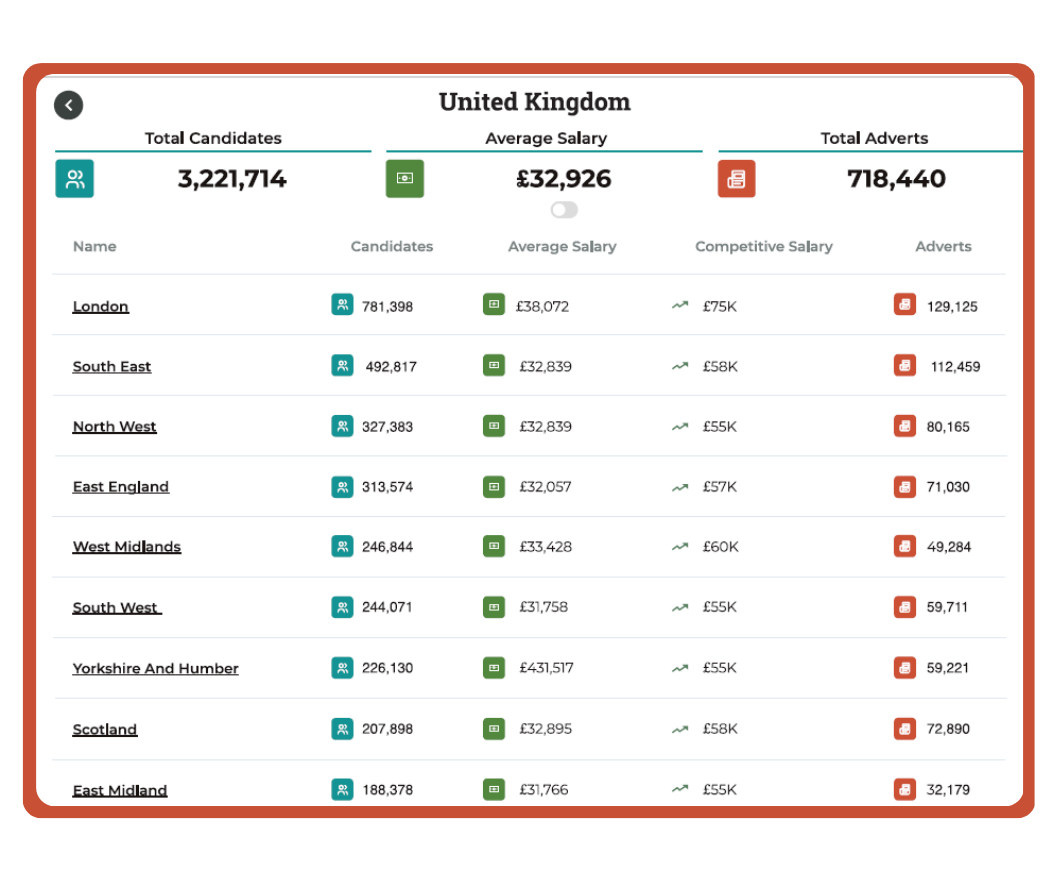 The Compensation functionality within Horsefly
The Strategic Benefits for a Global Enterprise Organization
The benefits cluster around three areas:
Productivity
This improves when you can identify where work is getting stuck. People analytics can reveal that a product development team's cycle time is 40% longer than a comparable team. Rather than reflecting talent quality, this could be due to collaboration patterns, such as too many handoffs, meetings that pull key contributors away from deep work, or dependencies on a single bottleneck role. These are structural problems, invisible in traditional metrics, that analytics can surface and quantify.
Engagement and Retention
Engagement benefits because the signals of disengagement are usually visible in data well before an employee submits a resignation, for instance, changes in collaboration patterns, reduced participation in discretionary activities, and shifts in communication frequency. These behavioral indicators, when analyzed in aggregate across teams, allow HR leaders to intervene proactively rather than scrambling to backfill. A 5% reduction in voluntary attrition for a 10,000-person enterprise can represent millions in avoided replacement costs, not counting the institutional knowledge lost.
Decision Quality
This is the benefit that resonates most at the executive level. When workforce planning is grounded in data rather than assumptions, decisions about where to locate a new engineering center, whether to build AI capabilities internally or acquire them, or how to restructure a sales organization all become defensible, testable propositions rather than political negotiations. The competitive edge comes from making these calls faster and with better information than competitors.
There's a compounding effect, too. Organizations that use people analytics to improve retention spend less on recruitment, freeing up budget for development programs and further improving retention. The flywheel takes time to build, but once it's moving, the returns accelerate.
How Data Sources and Integration Fuel the Engine
The power of enterprise people analytics depends entirely on the breadth and quality of data feeding it. The typical sources include:
-
Internal systems: HRIS platforms provide the foundational employee records, while performance management systems contribute review data, goal completion, and manager assessments. Learning management systems track skill development, and applicant tracking systems capture hiring funnel data.
-
Collaboration and communication tools: These platforms generate metadata about how work flows through an organization. More than just reading emails, this includes aggregate patterns such as meeting frequency, response times, network breadth, and cross-functional collaboration density. These signals are among the most powerful predictors of team performance and individual disengagement.
-
External labor market data: This is where most internal analytics programs hit a wall. Understanding your own workforce in isolation, without context about the external talent market, limits your ability to benchmark compensation, assess talent availability for planned expansions, or understand competitor hiring strategies. External data on labor supply and demand by skill, geography, and role is what transforms internal analytics into true workforce intelligence.
The challenge here is integration. Most enterprises have these data sources scattered across dozens of systems that don't communicate natively, and, therefore, data quality varies. Additionally, this can cause definitions to differ (one business unit's "senior engineer" is another's "staff engineer").
Building a unified data foundation requires deliberate investment in data governance, taxonomy alignment, and integration architecture. It's unglamorous work, and it's where many implementations falter. Organizations that skip this step end up with sophisticated analytics tools producing unreliable outputs.
At Horsefly Analytics, we've learned that the external data layer is often the missing piece. Internal data tells you what's happening inside your walls, but external labor market intelligence tells you what's coming and what’s possible.

The Role of AI in Understanding Workforce Potential
No human team can manually analyze the volume of data that enterprise people analytics requires. A global organization might generate millions of collaboration data points weekly across tens of thousands of employees. So AI isn’t just needed to accelerate this analysis; it’s actually what makes it possible.
The practical applications fall into several categories:
Pattern Recognition at Scale
AI models can identify correlations between hundreds of variables simultaneously, from team composition and communication patterns to project outcomes, manager behaviors, and compensation relative to market benchmarks. These models surface connections that would take human analysts months to uncover, if they found them at all.
Predictive Analytics
This is where the real strategic value lives. Rather than reporting that attrition was 18% last year, AI models can flag which employee segments are at elevated risk of departure in the next quarter and estimate the business impact. They can forecast talent supply shortages for specific skills in specific geographies 12 to 24 months ahead, giving workforce planning teams time to respond with training programs, adjusted sourcing strategies, or location decisions.
Augmented Analytics
This refers to AI systems that not only produce analysis but also generate recommendations and proactively surface insights. Instead of requiring an analyst to formulate the right question, augmented analytics platforms continuously monitor for anomalies and opportunities, alerting leaders when something warrants attention.
Explainable AI
It's reasonable for leaders to question AI recommendations if they can't see how they were reached. If a model suggests restructuring a team or identifies a group as being at risk of attrition, decision-makers need an explanation in addition to just a prediction. The strongest platforms provide that context by showing the factors behind the recommendation, the model's confidence level, and potential actions to take. Without that transparency, managers are far less likely to trust or use the insights.
Human Judgment
One thing most people get wrong about AI in people analytics is expecting it to replace human judgment, but, instead, it augments it. AI can tell you that a team shows patterns consistent with burnout, but it can't tell you that the team lead just went through a personal crisis that temporarily affected team dynamics. Human context still matters. The value of AI is in directing human attention to where it's needed most.
Calculating the ROI of People Analytics
Quantifying a single ROI number for people analytics is difficult because the benefits flow through multiple channels. But just because something is difficult to measure precisely doesn’t mean it’s difficult to demonstrate.
Let’s consider the following calculation approaches, and then we can delve in for a deeper look:
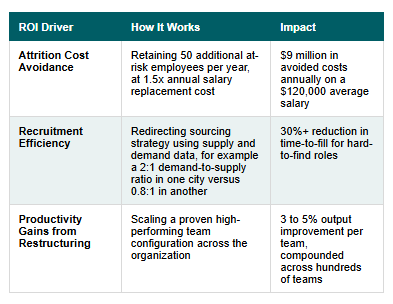
Attrition Cost Avoidance
If your analytics program identifies at-risk populations early enough to retain even 50 additional employees per year, and your average cost of replacement is 1.5x annual salary, the math becomes straightforward. For roles with an average salary of $120,000, that's $9 million in avoided costs annually. Even if the analytics program cost $2 million to implement and run, the return is clear within the first year.
Recruitment Efficiency
When labor market intelligence shows that a specific skill set (say, cloud security engineers with Kubernetes experience) has a 2:1 demand-to-supply ratio in your target city but a 0.8:1 ratio in an alternative location, redirecting your sourcing strategy saves months of unfilled positions and premium salary costs. We've seen organizations reduce time-to-fill for hard-to-find roles by 30% or more simply by using supply and demand data to inform where and how they source.
Productivity Gains from Restructuring
When analytics reveals that a particular team configuration consistently outperforms others (controlling for talent quality), scaling that structure across the organization creates measurable productivity improvements. Even a 3 to 5% improvement in output per team, compounded across hundreds of teams, represents substantial business value.
The key is to define baseline metrics before implementation. Measure attrition rates, time-to-fill, cost-per-hire, and productivity proxies before the program launches, then track changes over time. Attribution will never be perfect, but directional evidence combined with the qualitative value of better strategic decisions makes a strong business case.

Data Privacy and Ethical Considerations
This is the section that determines whether your people analytics program earns employee trust or destroys it. Getting privacy wrong creates legal exposure and poisons the well for data-driven HR permanently within your organization.
Reputable people analytics solutions use several technical approaches to protect individual privacy while preserving analytical value:
-
Anonymization removes or encrypts personally identifiable information before analysis. The analytics engine works with patterns across populations, not individual records.
-
Aggregation ensures that results are only presented at group levels large enough to prevent re-identification. If a team has only four members, their data gets rolled into a larger organizational unit. Minimum group sizes (typically 5 to 15 depending on the sensitivity of the metric) prevent managers from reverse-engineering individual data from team-level insights.
-
K-anonymity is a formal privacy framework that ensures each person's data is indistinguishable from at least k-1 other people in any analysis output. If k=10, every data point displayed represents at least 10 individuals, making it impossible to identify any single person.
-
Differential privacy takes this further by adding calibrated statistical noise to query results. Even if someone runs multiple queries trying to isolate an individual, the noise prevents convergence on any person's actual data. This approach, developed in academic research and adopted by organizations like the U.S. Census Bureau, offers strong mathematical privacy guarantees.
Governance and Ethics
Complying with GDPR, CCPA, and other regional privacy regulations is essential, but legal compliance alone isn't enough. Employees also need to understand what data is being collected, how it's being used, and what safeguards are in place to protect it. Organizations that are open about their people analytics programs, whether through clear data policies, ethics committees, or regular communication, are far more likely to build trust and encourage adoption.
One mistake to avoid is using people analytics to monitor individual performance. If employees feel collaboration data is being used to track their personal productivity, confidence in the program quickly disappears. The goal should always be to identify broader workforce trends that support better organizational decisions, not to scrutinize individual behavior.
Bridging the Insight-to-Action Gap During Implementation
The most common failure mode in people analytics is the gap between generating an insight and actually acting on it. For instance, a dashboard that shows rising attrition risk in the engineering organization means nothing if no one is accountable for developing and executing an intervention plan.
Here's what separates successful implementations from expensive shelf-ware:
Start With a Business Problem, Not a Technology Purchase
The organizations that succeed begin with specific, high-stakes questions, such as why they’re losing senior engineers in APAC at twice the rate of EMEA, or where they should locate their new data science hub to improve for talent availability and cost. Technology should be selected to answer priority questions rather than deployed in search of a problem.
Secure Executive Sponsorship Beyond HR
When the CFO or COO is a co-sponsor, people analytics gets treated as a business initiative rather than an HR project. This matters for budget, for cross-functional data access, and for ensuring that insights lead to action.
Invest in Data Quality Before Advanced Analytics
Organizations often spend months building sophisticated machine learning models on top of HRIS data that hasn't been audited in years, meaning their job titles are inconsistent, location data is outdated, and reporting structures don't reflect how work actually flows. Cleaning the data first may be tedious, but it's non-negotiable.

Build Analytics Literacy in HR
The people analytics team can produce brilliant analysis, but if HR business partners and talent acquisition leaders can't interpret and act on the findings, the investment is wasted. Training programs that build data literacy across the HR function are as important as the analytics platform itself.
Create Feedback Loops
When an insight leads to an intervention, measure the outcome. Did the retention program that analytics recommended actually reduce attrition in the targeted group? Did the restructured team improve its cycle time? These feedback loops both validate the analytics and create organizational learning that improves future interventions.
Manage Change to Drive Adoption
Change management is often overlooked, but it can determine whether a people analytics initiative succeeds or fails. People analytics challenges established ways of making decisions, and leaders who have relied on intuition for years may be reluctant to trust data that contradicts their instincts. Organizations that acknowledge this upfront, build trust through early wins, and clearly explain how insights are generated are far more likely to see strong adoption over time.
Choosing the Right Enterprise People Analytics Software Partner
The vendor market includes platforms focused on internal workforce analytics and those focused on external labor market intelligence. Few cover both with equal depth.
When evaluating solutions, weigh these factors:
Global Data Coverage
If you operate across 30 countries, you need a solution that provides reliable labor market data in all of them, not just the U.S. and Western Europe. Many solutions have significant blind spots in Asia Pacific, Latin America, the Middle East, and Africa. Ask vendors to demonstrate their data coverage in your specific operating geographies and for your specific role families.
Data Freshness and Granularity
Annual compensation surveys are outdated the moment they're published. Real-time or near-real-time data on talent supply, demand, salary benchmarks, and competitor activity is what enables timely decisions. And the data needs to be granular enough to distinguish between a "software engineer" and a "software engineer with 5+ years of experience in embedded systems," because those are entirely different talent markets.
Integration Capabilities
The solution needs to complement your existing tech stack (HRIS, ATS, BI tools), not create another data silo. API availability, pre-built connectors, and flexible data export options matter.
Analytical Depth
Some platforms simply present the data, while others help you make sense of it by answering the questions that matter most. Where are talent supply and demand shifting? Which skills command the biggest salary premiums in different markets? And how does your employer brand compare with competitors when hiring for critical roles?
Privacy Commitment
Ask specifically about anonymization methodology, compliance certifications, and how aggregate-only analysis is enforced technically. Vague answers here are a red flag.
At Horsefly Analytics, we've built our platform around the conviction that internal workforce data without external labor market context produces incomplete answers. Our focus on global labor market intelligence, covering talent supply and demand, compensation benchmarks, competitor hiring activity, and skills availability across a wide range of countries, is designed to give workforce planning leaders the external context they need. We complement internal analytics platforms rather than replace them, providing the "outside-in" perspective that turns workforce planning from an internal exercise into a market-aware strategy.
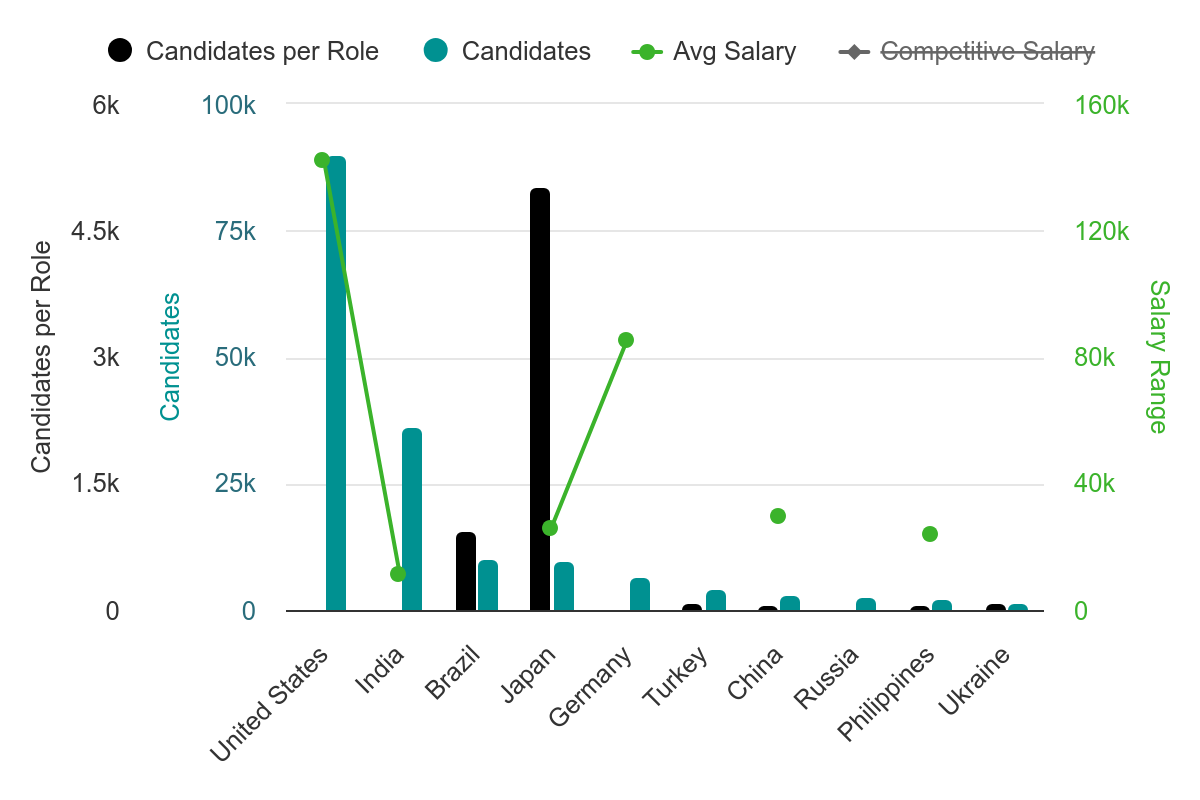
A global view from the Supply and Demand capability in Horsefly
The Future of Data-Driven Workforce Strategy
The organizations that will win the talent competition over the next decade are those that treat workforce intelligence with the same rigor they apply to financial intelligence or customer intelligence. The tools and data exist. What separates leaders from laggards is the willingness to invest in the capabilities, the governance, and the organizational change required to act on what the data reveals.
Several trends will accelerate this shift. Skills-based workforce planning is replacing job-title-based planning, requiring far more granular analytics about what capabilities people actually have versus what's needed. Geographic flexibility in hiring is expanding the aperture from local to global talent markets, making external labor market intelligence more important than ever. And the pace of skill obsolescence is shortening planning horizons, demanding continuous rather than annual workforce forecasting.
The organizations we work with are moving beyond asking "what happened?" and even beyond "what will happen?" to the most powerful question of all: "what should we do about it?" That progression from descriptive to predictive to prescriptive analytics is the maturity curve that enterprise people analytics enables.
The competitive advantage belongs to those who get there first.
Request a strategic consultation to see how Horsefly Analytics combines workforce and labor market intelligence to help you make smarter, data-driven workforce decisions.
Frequently Asked Questions
What is enterprise people analytics and how does it differ from basic human resource reporting?
Enterprise people analytics goes beyond descriptive HR metrics, which only tell what happened. It integrates workforce data with operational, financial, and external labor market intelligence to provide predictive and prescriptive insights, informing strategic decisions about talent, productivity, and future workforce needs rather than just reporting past events.
Why is external labor market data crucial for strategic workforce intelligence?
External labor market data provides essential context, offering insights into talent supply, demand, compensation benchmarks, and competitor hiring strategies. This allows organizations to move beyond internal views, enabling informed decisions on site selection, M&A talent integration, and competitive positioning in the global talent market.
How can organizations protect employee data privacy in people analytics initiatives?
Organizations protect employee data through anonymization, aggregation to group levels, k-anonymity, and differential privacy. Transparency with employees about data collection, usage, and strong privacy frameworks like GDPR compliance builds trust and ensures ethical use, preventing surveillance of individual performance.
What role does AI play in improving people analytics and workforce forecasting?
AI makes large-scale pattern recognition and predictive analytics possible, identifying complex correlations that human analysts might miss. It can forecast talent shortages or disengagement risks months in advance, augmenting human judgment by directing attention to critical areas rather than replacing decision-making entirely.
What strategic advantages do global enterprises gain from people analytics solutions?
Global enterprises gain improved productivity by identifying structural bottlenecks, enhanced engagement and retention through early disengagement signals, and superior decision quality for workforce planning. This data-driven approach fosters a competitive edge by enabling faster, more informed strategic talent decisions across diverse markets.
How do companies calculate the ROI for their people analytics investments?
Companies calculate ROI by quantifying avoided costs from reduced attrition, improved recruitment efficiency through optimized sourcing, and productivity gains from better team structures. Defining baseline metrics before implementation and tracking changes over time provides compelling directional evidence for the business case.
What are the biggest hurdles when implementing enterprise people analytics tools and how can they be overcome?
Major hurdles include poor data quality, lack of executive sponsorship beyond HR, and the gap between insight generation and action. Overcome these by starting with a clear business problem, securing cross-functional executive support, investing in data governance, and building analytics literacy across the HR function.
Sources: Horsefly Analytics, GDPR, CCPA