.png?width=2000&name=Horsefly-Logo-NewTag_White%20(3).png)
Most global enterprises still make critical talent decisions using outdated data, intuition, or fragmented labor market insights. As workforce costs continue to rise and skills become harder to find, those decisions increasingly carry significant financial and operational risk.
Talent decisions have moved beyond HR to become a board-level priority. When a technology company considers opening an engineering hub in a new region, the challenge goes beyond just finding developers to understanding the supply of specialists with the right skills, future compensation trends, competitor hiring activity, and how one location compares with another. Those questions require enterprise talent intelligence, not manual research or isolated reports.
Enterprise talent intelligence applies AI and large-scale data analytics to answer workforce questions with the same rigor that finance teams apply to capital allocation. It combines internal workforce data (who you have, what they can do, where they're going) with external labor market intelligence (who's available, what they cost, and where demand is headed) to produce actionable insights.
The need for this intelligence is only growing. Skill half-lives are shrinking, geopolitical disruption can reshape labor markets overnight, and compensation expectations shift faster than traditional surveys can capture. The cost of making the wrong workforce planning decision at enterprise scale can quickly run into the tens of millions.
HR leaders who treat talent intelligence as a "nice-to-have" analytics layer are missing the point. It's the intelligence infrastructure that connects workforce strategy to business outcomes.
The Core Components of an Enterprise Talent Intelligence Platform
Three components make or break an enterprise talent intelligence platform. Get any one of them wrong, and the insights won't be trusted, adopted, or useful.
The Data Foundation
Everything starts here. A platform is only as good as the data it ingests, normalizes, and connects. Internally, that means employee records, performance data, skills profiles, learning completions, and attrition patterns. Externally, it includes labor market data such as job postings, talent supply and demand signals, compensation benchmarks, workforce demographics, and competitor hiring activity.
At Horsefly Analytics, our data foundation covers more than 170,000 cities worldwide, drawing on over one trillion data points. That level of granularity matters because enterprise workforce decisions are made at the city, not just the country, level.

The AI and Analytics Engine
Raw data is only valuable if it can be turned into actionable insight. The analytics engine maps skills across different job titles, forecasts future talent demand, and models workforce scenarios, helping organizations understand not just what is happening today, but what is likely to happen next.
The sophistication of the AI determines whether a platform delivers simple reporting or meaningful strategic intelligence.
The User Interface and Integration Layer
Insights only create value if they fit into existing ways of working. Enterprise talent intelligence platforms should integrate with HRIS, ATS, and learning management systems so workforce data can inform planning, hiring, compensation, and location decisions without creating additional manual processes.
How AI Transforms Workforce Data into Strategic Insights
AI is the mechanism that makes talent intelligence possible at enterprise scale. No human team can manually analyze labor supply across dozens of countries, map skills across thousands of roles, and model workforce scenarios simultaneously. AI makes that level of analysis possible in seconds.
One of its biggest strengths is predictive analytics. Rather than simply reporting what happened, AI identifies emerging trends, forecasts future talent demand, predicts attrition risk, and models compensation changes, helping organizations make proactive workforce decisions instead of reactive ones.
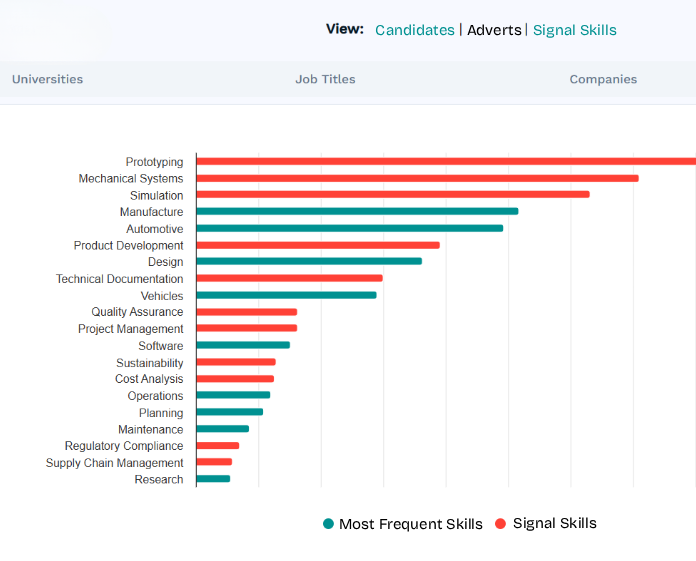 A view of Horsefly’s Signal Skills functionality to help identify emerging or trending skills
AI also improves skills intelligence. Because employee skills data is often incomplete or outdated, machine learning can infer capabilities from job histories, projects, learning activity, and other workforce data, creating a more accurate view of organizational skills than self-reported profiles alone.
Generative AI (GenAI) is making these insights more accessible by allowing users to ask complex workforce questions in natural language instead of building manual reports. Agentic AI goes a step further by continuously monitoring labor market data and proactively surfacing opportunities, risks, and emerging trends before users even know to look for them.
The principle of transparency remains essential, however. If a platform can't explain how it reached a recommendation or prediction, stakeholders are unlikely to trust it. Explainable AI is fundamental to adoption, particularly when workforce decisions affect people's careers.
Strategic Applications Beyond Recruitment
The most common misconception about talent intelligence is that it's a recruiting tool. While recruiting is one application, often it's not even the highest-value one.
-
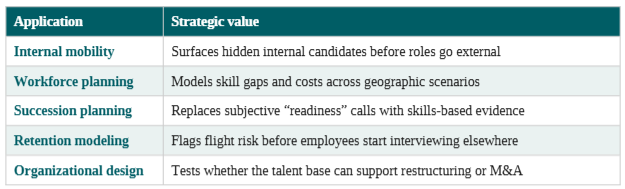
Internal mobility represents one of the largest untapped ROI opportunities for enterprises. Most organizations have employees with skills that would be perfect for open roles elsewhere in the company, but nobody knows about the match. Talent intelligence platforms analyze skills profiles across the entire workforce and surface internal candidates before a requisition ever goes external. The cost differential between an internal move and an external hire is substantial, with lower recruiting spend, faster ramp-up, and higher retention rates.
-
Workforce planning is where talent intelligence connects most directly to business strategy. When a financial services firm plans to launch a digital banking product line, talent intelligence can model exactly which skills the initiative requires, how many of those skills exist internally, what the gap looks like, how long it will take to close through hiring versus development, and what the total cost will be across different geographic scenarios. That's a fundamentally different conversation than "we need to hire some developers."
-
Succession planning benefits from the same skills-mapping capability. Rather than relying on managers' subjective assessments of who's "ready" for leadership, talent intelligence can identify employees with the actual skill profiles and career trajectories that predict success in target roles.
-
Retention modeling uses internal and external signals together. If the external market suddenly heats up for a specific skill set (compensation rising, job postings spiking, competitors expanding), talent intelligence can flag which of your employees with those skills are at highest flight risk before they start interviewing.
-
Organizational design is the most strategic application. When companies restructure, merge, or enter new markets, they need to understand whether their existing talent base can support the new structure. Talent intelligence provides the data to make those decisions with precision rather than assumption.
Closing Critical Skill Gaps with Precision
Skill gaps are at the root of many workforce planning challenges, yet most organizations struggle to define them beyond broad statements. Without a clear understanding of existing capabilities and future workforce needs, it's difficult to make effective talent decisions.
Enterprise talent intelligence closes that gap by mapping workforce skills against future business requirements, revealing shortages by competency, team, geography, and timeline.
With that level of visibility, organizations can take targeted action. Some gaps are best addressed by upskilling existing employees, while others require external hiring, specialist contractors, or even acquisitions. Rather than applying the same solution everywhere, talent intelligence helps leaders choose the most effective approach for each gap.
Crucially, these decisions must be viewed alongside external labor market data. A skill shortage on paper may be realistic to hire for in one region but prohibitively expensive or scarce in another. By combining internal workforce insights with real-time market intelligence, organizations can build workforce strategies that are both ambitious and achievable.
Using Global Labor Market Data for a Competitive Edge
Internal data tells you what you have, but external labor market data tells you what's possible, what it costs, and where the risks are. Without both, you're making decisions with half the picture.
The applications are practical. Real-time labor market data helps organizations benchmark compensation, evaluate talent supply across different locations, and monitor competitor hiring activity. Together, these insights support more informed decisions about hiring, expansion, workforce planning, and investment before market shifts become costly.
The value of that intelligence depends on its depth and granularity. A platform that provides only national or regional averages can miss significant differences between cities and even local talent markets. For example, the availability and cost of DevOps engineers can vary considerably between central London, outer London, Manchester, and Edinburgh.
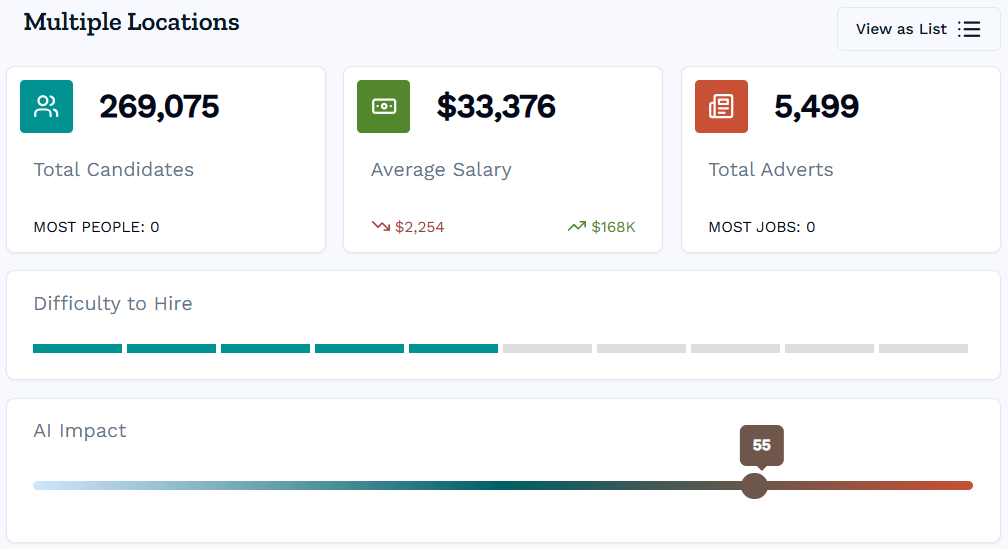
Image shows an example of DevOps data from the Horsefly platform
For organizations evaluating a new technology hub in Asia-Pacific, comparing countries alone isn't enough. They need to understand the relative talent supply, compensation levels, attrition rates, and competitive hiring activity across cities such as Hyderabad, Ho Chi Minh City, and Kuala Lumpur. That level of detail leads to more confident workforce decisions than relying on broad regional averages.
Granular labor market intelligence also supports DE&I initiatives by helping organizations understand the diversity of local talent pools, identify sourcing channels that reach underrepresented groups, and benchmark workforce representation against market availability.
Evaluating Enterprise Talent Intelligence Solutions: Key Features
If you're evaluating platforms, here's what actually matters:
Data Quality, Breadth, and Freshness
Ask vendors exactly how many data sources they aggregate, how many geographies they cover at the city level, and how frequently data is refreshed. Push for specifics, such as how many data points? How many cities? What's the latency between a labor market change and its reflection in the platform? This is the single most common area where vendors overpromise and underdeliver.
Skills Taxonomy Sophistication
How does the platform define and categorize skills? Is it using a rigid, predefined list, or a dynamic, AI-driven taxonomy that adapts as new skills emerge? Can it map adjacent skills and infer latent competencies? A static taxonomy from 2020 won't capture the skills shaping workforce needs today.
Predictive Analytics Depth
Can the platform forecast talent supply and demand? Model attrition risk? Project compensation trends? There's a meaningful difference between platforms that offer descriptive analytics (here's what happened) and those that provide predictive and prescriptive analytics (here's what will happen, and here's what you should do about it).
Integration Capability
Will the platform connect to your HRIS, ATS, LMS, and business intelligence tools? Or does it require a parallel workflow? Integration determines whether insights reach decision-makers or die in a standalone dashboard.
Scenario Modeling
Can you run what-if analyses? "What if we move this function to Kraków instead of Dublin?" "What if our primary competitor doubles their hiring in our key market?" Scenario modeling is what separates strategic planning tools from reporting tools.
Ethical AI and Compliance
Does the vendor audit for algorithmic bias? Can they demonstrate compliance with data privacy regulations across all operating geographies? Given the regulatory trajectory in the EU, the US, and Asia-Pacific, this is a requirement, not a bonus feature.
Comparing the Leaders: A Look at the Vendor Environment
Enterprise talent intelligence providers generally fall into three categories: end-to-end talent platforms, consultancy-led services, and specialist labor market intelligence providers. End-to-end platforms focus on managing the employee lifecycle, consultancy-led solutions combine technology with strategic advisory services, while specialist providers deliver deep labor market data and workforce analytics.
Many enterprises use a combination of these approaches. The right solution depends on your organization's priorities, whether that's improving internal talent management, accessing expert workforce guidance, or making strategic decisions using granular, real-time labor market intelligence.

Handling Implementation and Ethical Considerations
Implementation Challenges
Implementation fails more often because of organizational issues than technical ones. The biggest mistake is treating talent intelligence as an HR initiative rather than a business capability. If workforce insights never reach the leaders making location, investment, and organizational design decisions, the platform won't deliver strategic value.
Success depends on starting with a clear business use case, such as workforce planning, site selection, or cost optimization, then demonstrating measurable results before expanding. Organizations should also plan for data integration, as HR data is often fragmented and inconsistent, and invest in change management to build trust and encourage adoption across HR and business teams. Executive sponsorship is critical throughout the process.
Responsible AI and Governance
As AI plays a larger role in workforce decisions, responsible governance is essential. Vendors should be able to demonstrate how they identify and mitigate algorithmic bias, comply with data privacy regulations across all operating regions, and provide transparency around how workforce data is collected, used, and incorporated into recommendations.
Strong governance not only reduces regulatory risk but also builds confidence among employees and decision-makers, increasing trust in the insights the platform provides.
Building Your Business Case for Talent Intelligence
The business case for talent intelligence rests on three pillars:
Cost Reduction
Cost savings are often the easiest part of the business case to put a number on. Start by looking at your current cost per hire across key roles and locations, then consider what better internal mobility could save. Even moving 10% more roles to internal candidates could cut recruiting costs by millions at enterprise scale. More accurate compensation decisions can add to those savings, too, helping you avoid overpaying for talent while reducing the attrition costs that come from paying below market.
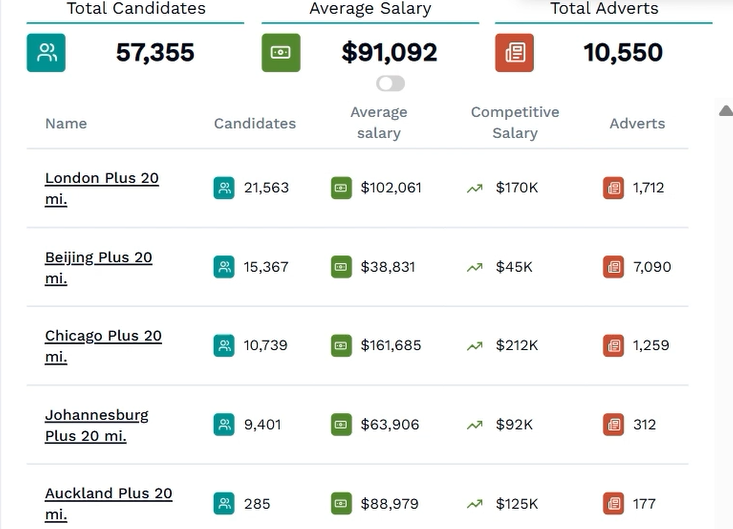
A view of some global compensation data from within Horsefly
Risk Mitigation
This is harder to quantify but often more valuable. What's the cost of opening a technology center in a market where you can't actually fill roles fast enough? What's the revenue impact of a critical skill gap that delays a product launch by six months? What's the exposure if a key competitor quietly hires away your top talent in a specific function? Talent intelligence doesn't eliminate these risks, but it makes them visible and actionable before they become crises.
Speed
Speed compounds both of the above. Faster access to accurate labor market data means faster hiring decisions, faster location assessments, and faster responses to competitive threats. In markets where talent moves quickly, the difference between a decision made in days versus months can determine whether you secure the talent or your competitor does.
When building the case internally, frame talent intelligence as infrastructure, not as an HR project. Finance has Bloomberg terminals. Sales has CRM platforms. Workforce strategy needs its own intelligence layer. The organizations that invest in this capability now will make better, faster decisions about their single largest expense category for years to come.
Start with a pilot tied to a specific, high-visibility business decision. Deliver results. Then expand. That's the path we've seen work most consistently at Horsefly Analytics, and it's the approach we'd recommend to any HR leader ready to move from intuition to intelligence.
Ready to put talent intelligence to work?
Schedule a strategic consultation to see how Horsefly Analytics can help you identify talent opportunities, compare global labor markets, and make workforce decisions backed by real-world data.
Frequently Asked Questions
What is enterprise talent intelligence and why is it a C-suite priority now?
Enterprise talent intelligence uses AI and big data to provide strategic insights into global workforces and labor markets, moving talent decisions from operational to board-level discussions. It helps make data-driven decisions about talent allocation, compensation, and risk, impacting billions in spend.
How does artificial intelligence transform raw workforce data into strategic talent insights?
AI engines transform raw data into signals through predictive analytics, forecasting skill demand, attrition risk, and compensation trends. It also infers latent skills from various sources, making talent intelligence scalable and providing forward-looking capabilities for strategic planning.
What are the key business applications of enterprise talent intelligence beyond just recruiting?
Beyond recruiting, enterprise talent intelligence significantly enhances internal mobility by identifying internal candidates for open roles. It also optimizes workforce planning, succession planning, retention modeling, and organizational design, directly impacting business strategy and cost savings.
How can organizations use talent intelligence to accurately identify and close critical skill gaps?
Organizations must first map actual employee competencies using AI-driven skills inference, then model future skill requirements aligned with business strategy. The gap between these two pictures reveals precise skill needs, guiding targeted upskilling, hiring, or strategic acquisitions for closure.
What steps are involved in successfully implementing an enterprise talent intelligence platform?
Successful implementation involves securing executive sponsorship and engaging business leaders from the start. Key steps include robust data cleanup and integration from existing HR systems, followed by comprehensive change management and training to ensure user adoption and trust in the platform's insights.
What critical features should HR leaders prioritize when evaluating enterprise talent intelligence solutions?
Prioritize data quality, breadth, and freshness, ensuring city-level granularity and frequent refreshes. Evaluate skills taxonomy sophistication, predictive analytics depth, and seamless integration capabilities with existing HR systems. Scenario modeling and ethical AI practices are also essential for strategic value and compliance.
What is the core difference between enterprise talent intelligence and traditional HR analytics?
Traditional HR analytics typically describe past events, like headcount or turnover rates. Enterprise talent intelligence, however, uses AI and external market data for predictive and prescriptive insights, informing future strategic workforce decisions, identifying risks, and guiding actions before issues arise.
Sources: Horsefly Analytics