.png?width=2000&name=Horsefly-Logo-NewTag_White%20(3).png)
Labor market analytics is the process of collecting and analyzing workforce data to understand trends in employment, skills availability, compensation, and talent supply. It helps organizations make more informed decisions about hiring, workforce planning, and talent strategy.
Unlike traditional reporting, which explains what has already happened, labor market analytics helps organizations identify patterns and make forward-looking decisions. For example, it can reveal where critical skills are concentrated, how compensation compares across markets, and where talent shortages may affect future hiring plans.
By combining workforce data with external labor market insights, organizations can better understand talent availability, anticipate workforce changes, and align hiring strategies with business goals.
The Core Components of Labor Market Analysis
A thorough labor market analysis covers several interdependent areas. Treating them in isolation is a common mistake. Here's what a complete picture includes:
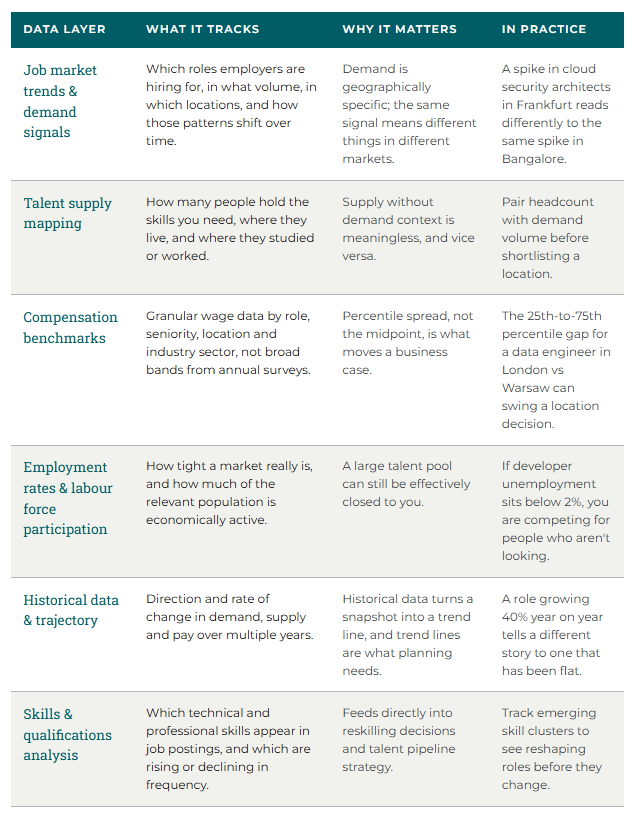
Each of these components generates value. Combined, they create the context that single data points lack.
Why Labor Market Analytics Matters for Strategic Workforce Decisions
The strategic benefits land in three areas that matter most to senior HR leadership: cost, speed, and risk.
Optimize Talent Costs Without Compromising Hiring
Analyzing wage data across markets prevents both overpayment and the false economy of underpaying (which drives attrition and replacement costs that dwarf any savings). When you can benchmark compensation for a niche role across 15 countries with current data, you make offers that are competitive without being wasteful. We've seen organizations reduce recruitment costs by redirecting sourcing spend toward markets where target talent is abundant rather than scarce.
Improve Hiring Speed with Better Market Insights
Hiring timelines stretch when teams search in the wrong places or compete in overheated markets. Analytics identifies where specific in-demand skills exist in higher concentrations, allowing talent acquisition teams to focus their efforts. A search that takes 90 days in one city might take 30 in another, simply because supply-demand dynamics differ.
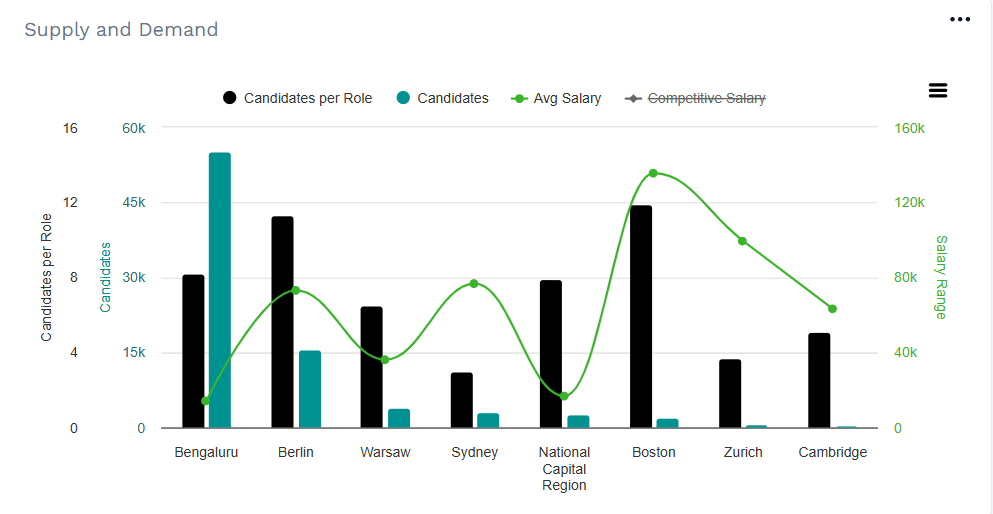
The Supply and Demand functionality in Horsefly
Reduce Workforce Planning Risks Before They Escalate
Workforce planning without forward-looking data is planning blind. What happens if your primary talent market experiences a regulatory shift, a competitor opens a large office nearby, or a key skill becomes obsolete? Analytics surfaces these risks before they become crises.
There's also a competitive position argument. Organizations that understand the talent market better than their competitors hire better people, faster, and at a more sustainable cost. The gap between data-informed and intuition-driven HR strategy widens every year.
Decoding Skill Supply and Demand
Understanding where skills exist, how demand is changing, and where gaps are emerging allows organizations to make better workforce decisions. Skills analysis helps HR teams move beyond current hiring needs and plan for future capability requirements.
Understanding Skill Demand
Skill demand analysis examines which capabilities employers are seeking, how frequently they appear in job postings, and how market conditions affect competition for those skills. By analyzing large volumes of workforce data, organizations can identify which skills are becoming more valuable and where demand is increasing.

Identifying Emerging Skills
Some skills gain momentum before they become mainstream. Tracking changes in job requirements helps organizations spot emerging capabilities early and decide when to invest in hiring, training, or internal development.
Finding and Addressing Skill Gaps
A skill gap occurs when an organization needs capabilities that are difficult to find in the available labor market. Identifying these gaps early allows businesses to evaluate different strategies, such as developing existing employees through upskilling and reskilling or expanding talent searches into new markets.
Why Continuous Skills Analysis Matters
Skills markets continue to evolve as technology, business models, and industry requirements change. Regular analysis helps workforce teams adjust their talent strategies, anticipate future needs, and avoid reacting only after critical skills shortages emerge.
Working with Global vs. Regional Labor Markets
Regional labor market data helps you hire locally. Global data helps you think strategically. The distinction matters because most organizations default to hiring where they already have offices, even when the data suggests better options exist.
Understanding the talent supply for embedded systems engineers in Munich is useful. Comparing that supply (and its associated labor costs, competition intensity, and growth trajectory) against Kraków, Hyderabad, and Austin is strategic.
Here's a concrete example:
A technology company looking to build a cybersecurity team of 50 people might start by searching in their headquarters city. But our data might show that the target market has only 3,000 professionals with the required skills, with four major competitors actively hiring the same profiles.
Meanwhile, a secondary city in another country has 8,000 qualified professionals, lower competition from peer companies, and compensation expectations 35% below the primary market. That's a location planning decision that saves millions over three years.
For global workforce management, the variables multiply. Regulatory environments, visa considerations, cost of living adjustments, and cultural factors all interact with raw talent supply data. A talent hotspot means little if labor regulations make it impractical to hire there at scale.
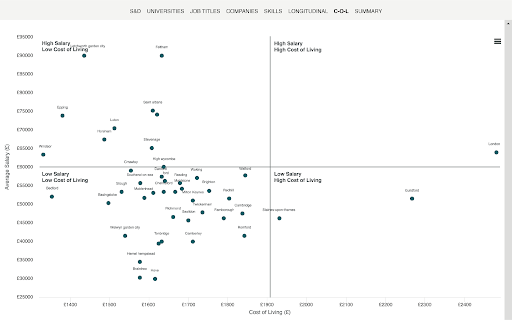
Image shows the cost of living data in the Horsefly platform
The organizations that get this right don't just compare cities. They build composite views: talent density, compensation ranges, competitor presence, university pipeline strength, attrition risk, and infrastructure quality. That requires global data with local granularity, which is exactly the kind of analysis we've built our platform to deliver.
Sourcing Reliable Labor Market Data
The quality of workforce insights depends on the quality of the data behind them. Different sources provide different levels of detail, accuracy, and relevance for workforce decisions.
Public and Industry Data Sources
Government data, such as employment statistics, wage trends, and occupational forecasts, provides a reliable foundation for understanding broad labor market conditions. However, it is often updated periodically and may not provide the detail needed for specific hiring decisions, such as skill availability in a particular location or role.
Industry reports and surveys can add context around workforce trends, but they are typically designed for general analysis rather than real-time talent planning.
Advanced Labor Market Analytics Platforms
Modern analytics platforms combine data from multiple sources, including job postings, professional profiles, compensation data, and education trends, to provide a more detailed view of talent markets. This allows organizations to understand where skills exist, how demand is changing, and how competitive different hiring markets are.

Why Data Quality Matters
Labor market data requires ongoing cleaning, validation, and normalization to remove duplicates, outdated information, and inconsistencies. Without this process, organizations risk making decisions based on incomplete or inaccurate insights.
Reliable labor market analytics gives HR teams a clearer view of talent supply, demand, and market conditions, helping them make workforce decisions with greater confidence.
Choosing the Right Labor Market Analytics Tools
When evaluating labor market analytics tools, the criteria should map directly to the decisions you need to make.
Data Coverage
Does the platform cover the geographies where you operate or plan to expand? A tool that's strong in North America but weak in Southeast Asia won't support a global workforce strategy. We've built our coverage to span a wide range of countries specifically because the organizations we work with can't afford geographic blind spots.
Data Depth
Can you access historical data to identify trends, or only current snapshots? Workforce planning requires trajectory, not just position. Look for platforms that offer multi-year trend analysis.
Update Frequency
Quarterly updates might work for annual planning exercises but fall short for active hiring decisions. Daily or near-daily refresh rates keep your intelligence current.
Granularity
Can the tool distinguish between a "data analyst" and a "senior data analyst" in terms of skills, compensation, and supply? Can it break down a single job title into its component skills? The value of a talent intelligence platform lives in the details.
Data Taxonomy
This is an area most buyers overlook. How does the platform classify and relate job titles, skills, and industries? A poor taxonomy means that searching for "software engineer" misses results classified as "software developer" or "application engineer." A strong taxonomy connects related roles and skills intelligently, giving you a complete view rather than a fragmented one.
Integration Capabilities
Can the platform feed data into your existing HR technology stack, including your ATS, HRIS, or workforce planning tools? Standalone insights are less valuable than insights embedded in your existing workflows.
Note: The biggest trap in tool selection is choosing based on interface design rather than data quality. A beautiful dashboard built on incomplete data will lead you to confident, wrong decisions.
Putting Analytics into Action: Strategic Applications
Theory is useful, but application is what justifies the investment. Here are the ways we see organizations use labor market analytics to drive real outcomes:
Talent Acquisition
A financial services firm needs to hire 200 data engineers over the next 18 months. Rather than posting jobs and hoping, they analyze which cities have the highest concentration of professionals with the required skills, what competitors in those cities are paying, and which universities are producing graduates with relevant qualifications. Recruitment marketing spend shifts toward the three cities with the best supply-to-demand ratios. Time to fill drops. The quality of hire improves.
Compensation Benchmarking
A manufacturing company suspects it's losing senior operations managers to competitors but isn't sure whether compensation is the issue. Analyzing current market rates for that role across their operating regions reveals they're paying at the 30th percentile in two locations. Targeted adjustments in those markets reduce attrition by bringing offers in line with competitors, without blanket raises across the organization.
Workforce Planning and Transformation
A technology company planning a three-year shift toward AI-driven products needs to understand which skills exist internally, which need to be hired, and which can be developed through reskilling. Labor market analytics shows that hiring machine learning engineers at scale is prohibitively expensive in their headquarters market but feasible in two international locations. Simultaneously, internal employees with adjacent skills (strong Python developers, for example) are identified as reskilling candidates.
Diversity, Equity, and Inclusion
Understanding the demographic composition of talent pools in different markets allows organizations to set realistic DE&I targets and identify sourcing strategies that expand the candidate pipeline rather than drawing from the same limited pool competitors use.
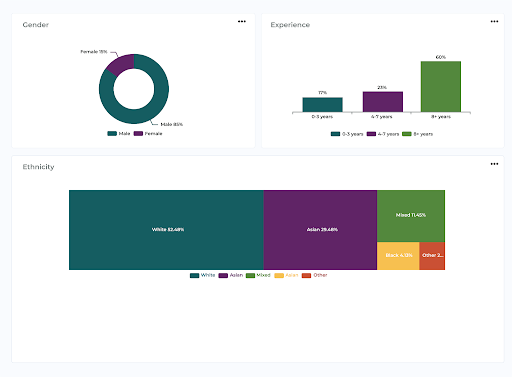
A view of the DEI data from the Horsefly platform
Market Entry Decisions
Before opening an office in a new country, analytics answers questions that due diligence teams often miss: Is the talent actually there? What are competitors paying? How fast is the talent pool growing or shrinking? What are attrition rates in the region?
Building Your Data-Driven Workforce Strategy
The most effective way to begin is to identify the three to five business questions your workforce strategy needs to answer right now. "Where can we find 50 qualified regulatory affairs specialists in APAC at a cost below our current London benchmark?" is a useful question. "We need better data" is not.
Once the questions are clear, assess your current data gaps. Most organizations discover that they have reasonable internal data (headcount, attrition, and compensation) but almost no external data about market conditions, competitor activity, or talent supply. That external layer is where analytics platforms add the most value.
Then pilot before scaling. Pick one strategic decision (a new office location, a hard-to-fill role, a compensation review) and apply analytics to it. Compare the outcome to how you would have made that decision without the data. The difference is usually enough to justify broader adoption.
Why Work With Horsefly Analytics?
At Horsefly Analytics, we work with organizations at every stage of this process. Some come to us with a specific question about a single market. Others need a global talent intelligence capability embedded in their ongoing planning cycle. Both starting points are valid.
The organizations that get the most from labor market analytics share one trait: they treat workforce intelligence as an ongoing discipline rather than a periodic exercise. Markets shift. Competitors move. Skills emerge and decline. A workforce strategy built on last year's data is already drifting from reality.
The question isn't whether your organization needs labor market analytics. It's whether you can afford to keep making workforce decisions without it.
Contact us for a strategic consultation today.
Frequently Asked Questions
How does labor market analytics differ from basic HR reporting?
Labor market analytics shifts the focus from simply reporting "what happened" to informing "what should we do" by providing actionable insights. It transforms raw data, like attrition numbers, into strategic recommendations, such as identifying compensation gaps linked to talent loss and suggesting alternative, cost-effective talent markets.
What key components are essential for a complete labor market analysis?
A comprehensive analysis integrates job market trends, talent supply mapping, granular compensation benchmarks, employment rates, and historical data. Additionally, it includes detailed skills and qualifications analysis. Combined, these components provide a full context for strategic workforce decisions rather than isolated data points.
How can businesses use labor market analytics to lower talent acquisition costs?
Businesses can reduce recruitment costs by identifying markets with abundant target talent and competitive compensation. Analytics helps redirect sourcing spend toward these high-supply, lower-cost locations, preventing overpayment in saturated markets and streamlining hiring efforts. This precision minimizes wasteful expenditure and improves hiring efficiency.
What types of data sources are considered reliable for labor market analytics?
Reliable labor market analytics relies on dedicated platforms that aggregate and clean data from diverse sources in near real-time. These include job postings, professional profiles, government filings, compensation disclosures, and educational outputs. Unlike slow government reports or broad industry surveys, these platforms offer granular, current, and global insights.
How often should companies update their skill supply and demand data?
Companies should review skill supply and demand data at least quarterly, but for rapidly evolving areas like AI and automation, monthly reviews are more appropriate. Labor markets shift quickly, so frequent updates ensure workforce strategies remain aligned with current trends, allowing timely adjustments to training or hiring plans.
What considerations are important when evaluating labor market analytics tools?
When evaluating tools, prioritize data coverage across wide and relevant geographies, historical data depth, and a high update frequency. Granularity in distinguishing roles and skills, a robust data taxonomy for accurate classification, and integration capabilities with existing HR systems are also crucial for actionable insights.
Can labor market analytics help identify new international locations for hiring?
Yes, labor market analytics is crucial for identifying optimal international hiring locations by comparing talent density, compensation ranges, and competitor presence across various cities. It also factors in university pipelines, attrition risk, regulatory environments, and infrastructure quality to inform strategic global expansion decisions.
Sources: Horsefly Analytics