Contents:
Key Takeaways:
1. Start narrow and work backwards from business goals. Ask leaders for the three to five priorities that will drive the next two to three years, then identify the capabilities those require. A small first-version taxonomy for one critical area beats cataloging every skill in the company, and validating it against external labor market data shows what skills are actually called and which cluster together. Assign an owner and a quarterly review so it doesn’t go stale.
2. Combine methods to assess the skills you have. Self-reporting is cheap, but people overstate or understate, manager views carry bias, and formal assessments are costly and weak on judgment-heavy skills. The strongest approach uses AI inference for a starting profile, employee validation to correct it, and manager or assessment input for the skills that carry the most weight in staffing decisions. Inferred skills should be shown to employees for confirmation rather than written silently into their records.
3. Internal mobility is where it all connects, and the barrier is cultural. An employee who is 70% of the way to a scarce skill is usually a faster, cheaper bet than an external hire, and redeployment is often the quickest return. But managers who hoard talent keep mobility low, however good the data is, so leadership expectations and incentives need to reward releasing people. Measure from day one, report ranges rather than inflated single numbers, and compare against baselines to keep the CFO’s trust.
—-----------------------------------------
The Shift from Roles to Skills in Workforce Strategy
Most enterprise workforce plans still count headcount by job title, which is why so many fail the moment business priorities change. Below, we lay out a practical method for moving to skills-based workforce planning: how to build a taxonomy, assess what you have, embed skills across the talent lifecycle, handle the hard parts of implementation, and measure whether it is paying off.
Traditional workforce planning treats the job description as the unit of supply and demand. That worked when roles changed slowly, and a title reliably predicted a bundle of tasks. Today, the same title can mean very different things across business units, countries, and acquired companies, and job descriptions are often out of date before the requisition is approved.
Skills-based workforce planning makes skill the unit of analysis instead. You forecast the capabilities the business will need, map the ones you already have, and then decide whether to build, buy, borrow, or redeploy to close the gap. Roles still exist, but as containers for skills, rather than the thing you plan around.
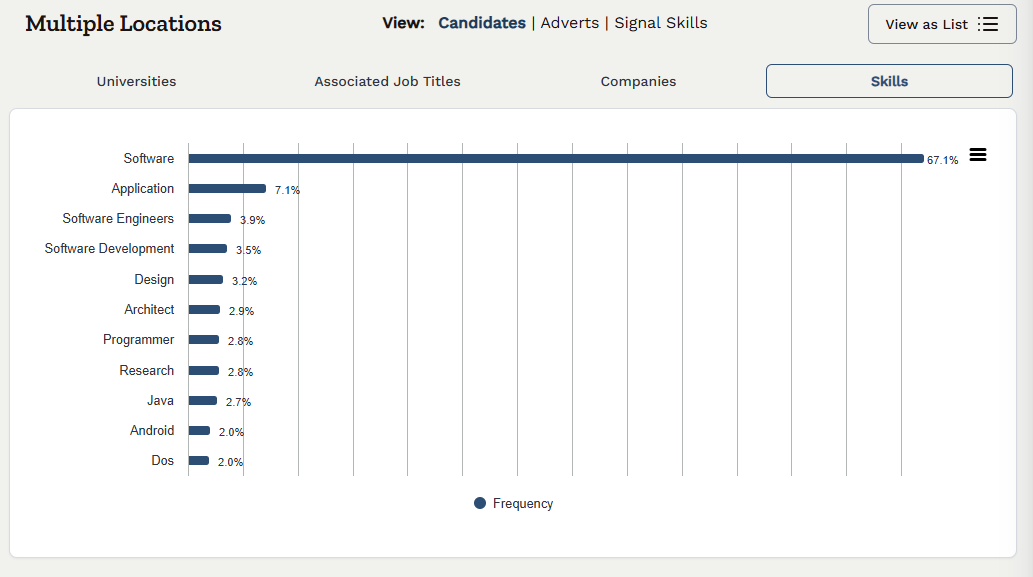
A view of the Skills capability in Horsefly
Why a Skills-Based Approach Creates a Competitive Edge
The benefits fall into three groups:
Organizational Agility and Resilience
The fastest return comes from redeployment. When you can see skills across the organization, you can staff a new initiative from inside before opening external requisitions. A resilient workforce is one where you know which capabilities are concentrated in too few people and can act before someone resigns.
Competitive Advantage
If your scarcest skills are spread across low-priority work, you are paying premium rates for people who are not moving the business forward. Skills visibility lets you put your rarest capabilities on your most important problems, which is where faster product cycles and innovation come from. It also changes how you compete for external talent: when you hire for capabilities, you widen the candidate pool within the niche markets where competitors are fighting over the same few profiles.
Employee Growth and Retention
Employees who can see which skills lead to which opportunities have a reason to stay and build. Upskilling becomes targeted rather than generic, and talent development conversations focus on capabilities rather than titles. The engagement payoff is real, but only if internal opportunities actually open up.
Step 1: Building Your Foundational Skills Taxonomy
A skills taxonomy is the shared vocabulary that lets recruiting, L&D, finance, and business leaders talk about capability in the same terms.
Start narrow, rather than trying to catalog every skill in the company at once.
Our recommended sequence:
1. Start from business goals. Ask leaders which three to five strategic priorities will drive the business over the next two to three years. Work backward to the capabilities those priorities require. This gives you a short list of critical skills that matter commercially and earns executive attention.
2. Validate against external labor market data. Compare your list against how skills appear in job postings and talent profiles across the target markets to find out what they are called, which commonly cluster together, and to find any you have missed.
3. Structure it in layers. Use broad skill families, specific skills, and proficiency levels.
4. Map skill sets to roles, loosely. Connect your framework to existing roles so you can translate between the old model and the new. Treat these mappings as indicative: two people in the same role may hold different skills.
5. Assign ownership and a refresh cadence. Include a defined process for adding, merging, and retiring skills, ideally reviewed quarterly against market signals.
A good first-version taxonomy for a critical business area can be small. Depth in the skills that matter beats breadth across skills that do not.
Step 2: Assessing and Understanding Your Current Skills Environment
Once you know which skills you need, you need an honest picture of which ones you have. It pays to use several methods:
-
Self-reporting is cost-effective and gives employees ownership. However, some people overstate; many, particularly in cultures where self-promotion is discouraged, understate.
-
Manager evaluations add a second view but carry their own bias, and managers rarely see the full range of what their people do, especially in matrixed or project-based organizations.
-
Formal assessments and certifications are reliable for technical skills that can be tested, but they are expensive to run broadly and poor at capturing judgment-heavy capabilities.
-
AI-driven skills inference analyzes existing internal talent data (project records, performance reviews, learning histories, work outputs) to suggest which skills a person likely holds. Inferred skills should be presented to employees for confirmation rather than written silently into their records.
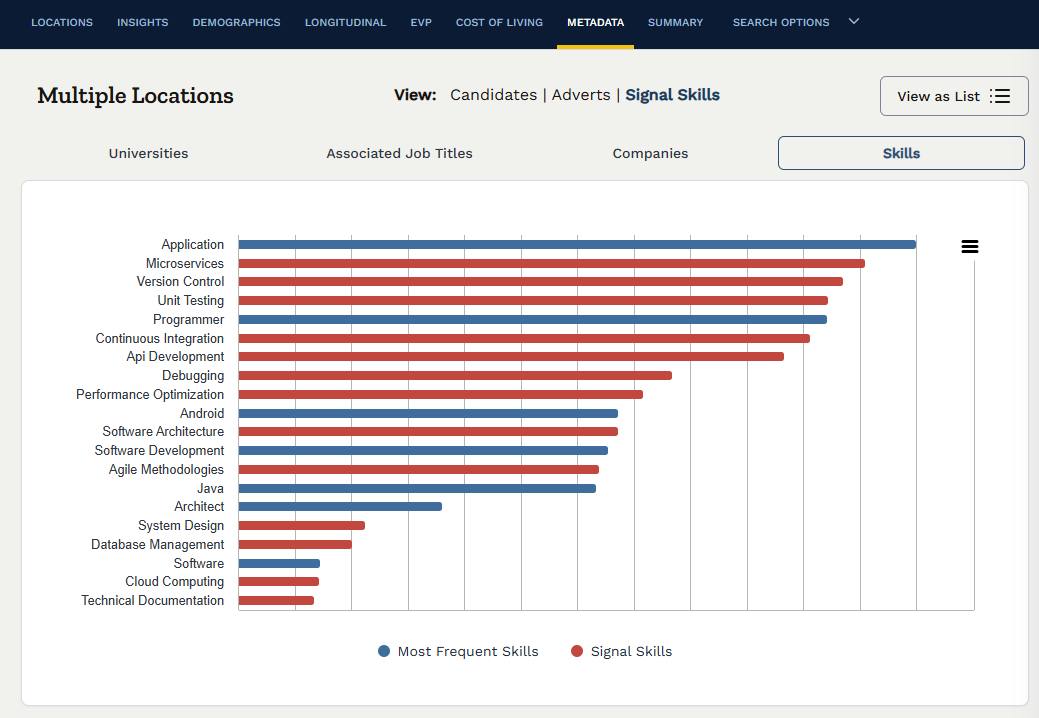
Signal Skills within Horsefly
In practice, the strongest results come from combining methods: inference to generate a starting profile, employee validation to correct it, and manager or assessment input for the skills that carry the most weight in staffing decisions.
Step 3: Integrating Skills into Your Talent Lifecycle
Integration is where skills-based planning either becomes the operating model or remains a slide deck.
Recruitment
Skills-based hiring starts with the requisition. Replace inflated requirement lists with the specific capabilities the work demands and the proficiency needed for each. Separate must-haves from things a capable hire can learn in the first six months. This alone widens sourcing pools, particularly for niche roles where insisting on an exact title and industry background eliminates most viable candidates. Sourcing teams should search for skill clusters and adjacent skills, not just matching job titles.
Learning and Development
L&D budgets are frequently spread across generic catalogs with weak links to business needs. Once you know your gaps, you can build reskilling pathways that move specific people from adjacent skills to target skills. An employee who is 70% of the way to a scarce capability is almost always a faster and cheaper bet than an external hire, provided the pathway is concrete and time is protected for learning.
Performance and Career Development
Career development shifts from vertical ladders to skill progression. Employees can see which skills open up which roles or projects, and managers can hold development conversations grounded in a common framework. Some organizations also add skill growth to performance discussions.
Internal Mobility
This is where everything connects. An internal talent marketplace, or even a simple process that checks internal skill matches before external requisitions open, turns data into redeployment. The hard part is cultural: managers who hoard talent. Without leadership expectations and incentives that reward releasing people to other teams, mobility stays low regardless of how good the data is.
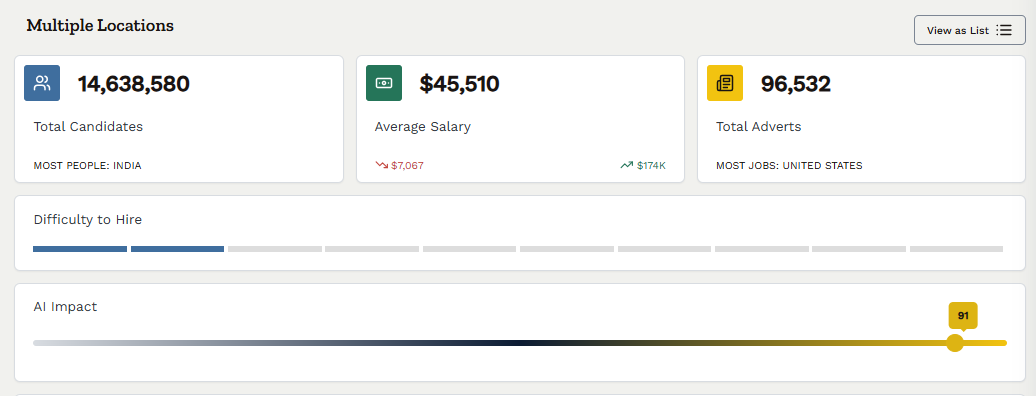
The AI Impact functionality in Horsefly
The Critical Role of Technology and Talent Intelligence
Skills-based planning is not practical on spreadsheets beyond a pilot. A global enterprise has tens of thousands of employees, thousands of skills, dozens of markets, and labor conditions that shift month to month. Keeping that current by hand is not realistic.
Technology does three jobs here.
First, AI and automation take on the heavy lifting: normalizing skills language across systems, suggesting updates as new skills emerge, inferring skills from internal data, and matching people to opportunities. This frees workforce planning teams to spend their time on decisions rather than data cleanup.
Second, workforce analytics software turns the internal skills inventory into something leaders can query. Which skills are concentrated in a handful of people? Which business units have surplus capability that another unit needs?
Third, and most often underweighted, talent intelligence platforms supply the external half of the equation: real-time, global data on skill supply, demand, and cost. This is the context that changes decisions. Before committing to a new hub, you need to know whether the skills you need exist there in sufficient depth, how many employers are competing for them, and what compensation benchmarks look like. Before approving a large reskilling program, you want to know whether buying the skill would be faster or cheaper in a particular market.
At Horsefly Analytics, this is the problem we focus on. Our platform is built to give HR and talent leaders a data-first view of global labor markets so that decisions about where to hire, what to pay, and whether to build or buy rest on market evidence rather than anecdotes or outdated salary surveys.

Managing the Challenges of Implementation
Every skills-based transformation we have seen hits the same three walls. Planning for them up front is the difference between a stalled pilot and an operating model.
Change Management
Job titles carry status, pay bands, and identity. Telling a senior leader that their organization will now be viewed as a pool of skills can feel like a threat, and employees may worry that skills profiles are a prelude to restructuring. Resistance is rational, and it should be treated that way.
Start with a business problem a specific leader cares about, such as staffing a strategic program or reducing contractor spend in one function, and prove value there. Be explicit with employees about how their skills data will and will not be used. Show early wins in the form of real internal moves and development opportunities. Avoid launching with an enterprise-wide mandate before anyone has seen the model work.
Data Integration and Privacy
Skills data lives in fragments across the HRIS, applicant tracking system, learning platform, project tools, and performance system, often with different identifiers and inconsistent records, especially after acquisitions. Connecting these HR systems is usually the longest workstream, and it is routinely underestimated.
Privacy and ethics deserve equal weight. Skills inference touches performance reviews and work records, and data protection rules vary across the countries you operate in. Ethical AI use means transparency about what is being inferred and from which sources, giving employees the ability to view and correct their profiles, and regular audits to check that inferred skills or recommendations are not disadvantaging particular groups. Involve legal, works councils where relevant, and your data protection team early, not after the pilot.
Keeping the Taxonomy Current
A taxonomy that was accurate at launch can be misleading within a year. New tools appear, skill names shift, and some capabilities become commoditized while others become scarce. The fix is governance: a named owner, a regular review cycle, and external market signals feeding in so you see changes in demand before they show up as failed searches.
Measuring the ROI of Your Skills-Based Strategy
Executive support fades quickly if a skills program is justified only with qualitative stories. It can be measured, and it should be, from the start. Establish baselines before you launch so you have something to compare against.
The metrics we recommend tracking fall into four groups:
Talent acquisition efficiency
-
Time-to-hire for roles defined by skills versus traditional requisitions
-
Talent acquisition costs per hire, including agency and contractor fees
-
Size of qualified candidate pools for hard-to-fill roles
-
Offer acceptance rates, which improve when compensation decisions use current market benchmarks
Internal mobility and redeployment
-
Internal mobility rate (share of open roles filled internally)
-
Percentage of strategic projects staffed from internal talent
-
Cost avoided by redeploying rather than hiring, calculated using your actual external cost per hire
Capability and learning
-
Progress in closing priority skills gaps, measured against the target skills defined in Step 1
-
Time for reskilled employees to reach target proficiency
-
Proportion of L&D spend tied to identified critical skills
Business outcomes
-
Time to staff and launch new initiatives
-
Project completion times where skills-based staffing was used
-
Retention of employees in critical skill areas
The last group matters most to the C-suite. Connecting talent metrics to business outcomes is what moves skills planning from an HR line item to a recognized driver of performance. If you can show that a product launch was staffed in weeks from internal talent rather than months of external search, the business case largely makes itself.
Be disciplined about attribution. Not every improvement in time-to-hire comes from the skills model, so compare against control groups or pre-launch baselines where you can, and report ranges rather than inflated single numbers. Credibility with the CFO is worth more than an impressive headline.
Preparing Your Organization for a Skills-First Future
The organizations that make this shift work share a few traits. They start with a business problem rather than a taxonomy. They pair internal skills data with external market evidence. They give someone clear ownership and treat governance as ongoing. And they measure from day one.
None of this requires a big-bang transformation. A single function, a defined set of critical skills, and a clear business question are enough to start, and a successful pilot gives you the evidence to expand.
The direction of the future of work is clear: skill requirements will keep shifting faster than org charts can be redrawn. A talent strategy built on titles will keep lagging behind that change. A skills-first organization can see what it has, what it needs, and what the market will bear, and can act on that while competitors are still rewriting job descriptions. The agile workforce that results will be the one able to staff the next strategic priority before anyone else has finished scoping it.
See how Horsefly's Talent Intelligence Platform can power your skills-based strategy.

Frequently Asked Questions
What exactly is skills-based workforce planning, and why is it important for businesses today?
Skills-based strategic workforce planning focuses on individual capabilities, not just job titles, to forecast talent needs. It's crucial because it increases organizational agility, enabling faster internal redeployment and strategic staffing. This approach helps businesses adapt quickly to changing priorities and seize new opportunities.
How do companies build an effective skills taxonomy for workforce planning?
Begin by identifying critical skills needed for strategic business goals, not existing job descriptions. Validate this list against external labor market data to ensure relevance. Structure the skills framework in layers with clear proficiency levels, assign ownership for regular updates, and map it loosely to roles.
What are the best methods for accurately assessing employee skills across an organization?
Combining multiple methods yields the strongest results. Use AI inference to generate initial profiles, then have employees validate them. Incorporate manager evaluations and formal assessments for critical technical skills. This multifaceted approach helps overcome individual biases and provides a comprehensive view of capabilities.
How does a skills-first approach improve internal mobility and talent development?
A skills-first approach creates transparent career pathways by showing which skills unlock specific opportunities or projects. It enables targeted upskilling linked to business needs, rather than generic training. This fosters higher employee engagement and retention by providing clear growth trajectories within the organization.
What are the biggest challenges companies face when implementing a skills-based workforce strategy?
Key challenges include managing resistance to change, as job titles are linked to identity and status. Extensive data integration across disparate HR systems is also complex and time-consuming. Lastly, maintaining an accurate and current skills framework requires continuous effort and governance.
How quickly can an organization expect to see measurable results from adopting skills-based planning?
The fastest returns come from improved organizational agility through internal redeployment, often visible within months. Competitive advantages, such as better allocation of rare skills, follow. Employee growth and retention benefits, while significant, typically take longer to fully materialize and demonstrate impact.
How can organizations address employee concerns about job security during a skills-based workforce transformation?
Be transparent about how skills data will be used, focusing on growth and opportunities, not just restructuring. Demonstrate early wins through successful internal moves and development pathways. Start with a pilot to prove value and build trust, rather than implementing an enterprise-wide mandate initially.
Sources: Horsefly Analytics