.png?width=2000&name=Horsefly-Logo-NewTag_White%20(3).png)
If it’s done well, workforce planning stops being a reactive scramble and becomes a proactive strategy. Instead of hiring in a panic when a critical role opens up, you've already anticipated the need. Instead of discovering a skills gap mid-project, you've been building capability for months. It aligns your people strategy with your business strategy, so talent decisions stop happening in a vacuum.
According to the CIPD, organizations that invest in strategic planning are significantly better positioned to meet future challenges and adapt to change. That's not a coincidence. It's what happens when people decisions are treated as seriously as financial ones.
The Workforce Planning Process: A Step-by-Step Guide
Workforce analysis isn't a one-time exercise. It's an ongoing cycle. Here's how it typically works:
1. Analyze your current workforce
Start with an honest audit of what you have. Who's in your organization, what skills do they hold, and where are the gaps? This includes looking at demographics, role distribution, performance, and flight risk. A solid workforce analysis gives you the baseline for everything that follows.
2. Forecast future demand
Where is the business going? New markets, new products, new ways of working all translate into new talent needs. Work with leadership to understand the strategic direction and map that to the roles and skills you'll need to execute it. Factor in growth projections, technology changes, and planned retirements.
3. Identify skills gaps
Once you know where you are and where you need to be, the skills gap becomes visible. This is the difference between the capabilities you have and the capabilities your future needs require. Labor market analytics (data and insights on the external labor market) and skills inference tools can help you understand not just what skills your people list, but what skills the market demands.
4. Develop an action plan
A workforce plan without an action plan is just a document. This is where strategy turns into execution: who you'll hire, what you'll train, which roles you'll restructure, and where you'll look for talent. More on this in the implementation section below.
5. Monitor and evaluate
Workforce planning is a living process. Labor markets shift, business priorities change, and your plan needs to keep pace. Build in regular reviews, track your key metrics, and be willing to adjust. What worked last year might not be the right approach next year.
The Strategic Importance of Workforce Planning
Here's the thing about workforce planning: when it's working, you don't notice it. Roles get filled. Teams perform. The business hits its goals. When it's not working, everyone notices. Projects stall, hiring takes too long, key people leave and take institutional knowledge with them.
Linking workforce planning directly to business strategy is what separates organizations that thrive from those that are constantly firefighting. Strategic workforce planning means your talent management isn't operating on a separate track from your operational processes. It's integrated. Talent decisions inform business decisions, and business decisions inform talent decisions.
The World Economic Forum's Future of Jobs reports consistently highlight that the organizations best equipped for change are those that treat workforce development as a strategic priority, not an HR admin function. When your talent strategy is aligned with your business strategy, you're not just filling seats; you're building the organization's capacity to compete.
Leveraging Data and Analytics for Effective Operational Workforce Planning
Gut instinct has its place in the workplace, but resource planning isn't one of them. Data-driven workforce planning means using real labor market intelligence to inform every stage of the process. That includes skills assessments to understand what your workforce actually knows, labor market trends to understand what's happening externally, and predictive analytics to model where things are heading.
Platforms like Horsefly Analytics provide access to over 1 trillion data points across 170,000 towns and cities in 65 countries, covering 815,000 unique job titles and skills in 39 languages. That kind of granularity means you can move beyond assumptions and make decisions grounded in reality. To see this in action, contact us to book a strategy session.

Predictive analytics can help you forecast where hiring will be challenging before you start recruiting. Prescriptive analytics goes a step further, recommending specific actions based on what the data shows. Skills inference helps you identify what your workforce is capable of even when that capability isn't explicitly stated. And longitudinal intelligence lets you track how talent supply, demand, and compensation have shifted over time, so you can spot pressure building before it becomes a problem. This results in fewer surprises, smarter decisions, and workforce strategies that actually hold up.
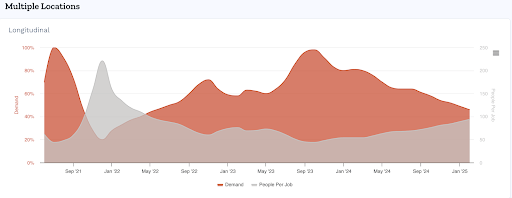
Image shows the Longitudinal capability from the Horsefly platform
Action Plans and Implementation: Building a Future-Ready Workforce
Once you know your gaps, you need a plan to close them. The "buy, build, borrow, bot" framework is a useful lens here:
- Buy means recruiting externally.
When you need skills fast and the talent exists in the market, hiring is often the quickest route. Talent acquisition strategies should be informed by supply and demand data so you know which roles will be tough to fill and where to focus your sourcing efforts.
- Build means developing skills internally.
Upskilling (improving existing skills) current employees is often more cost-effective than external hiring, and it supports retention too. Reskilling goes further, preparing employees for entirely new roles as business needs evolve.
- Borrow means tapping into new talent streams.
Contingent workers (temporary on contract workers), contractors, or RPO (Recruitment Process Outsourcing) partnerships for skills you need temporarily or at scale. This gives you flexibility without the long-term commitment.
- Bot means automation.
Where roles are being transformed or replaced by technology, workforce planning needs to account for that shift, identifying where automation creates capacity and where it creates new skills requirements.
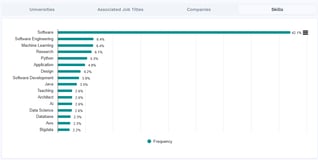
Image shows Skills intelligence from the Horsefly platform
Talent mobility matters here too. Before looking externally, ask how easily you can move people around internally. Organizations with strong internal mobility programs are better at retaining talent and filling roles faster. Horsefly's Skills Insights help organizations align training and development with market demands, so you're building the capabilities that actually matter. Unlock more insights on this by getting in touch.

Benefits of Effective Workforce Planning
Still wondering if this is worth the investment? Consider what good workforce planning actually delivers:
- Reduced labor costs
When you're not making reactive hires, paying premium rates for urgent placements, or carrying roles you don't need, your workforce spend becomes significantly more efficient.
- Improved productivity and efficiency
Teams with the right skills in the right roles perform better. It's not complicated. Skills gaps create bottlenecks. Workforce planning removes them.
Better employee retention and engagement. Employees who can see a clear path for development are more likely to stay. Workforce planning that includes upskilling and reskilling sends a signal that the organization is invested in its people.
- Smarter, faster decision-making
When talent decisions are backed by data, they're faster and more defensible. No more second-guessing whether a role is needed or whether a location makes sense.
- Agility to respond to change
The organizations that handled rapid change best in recent years were the ones that already knew their workforce, their gaps, and their options. Workforce planning builds that readiness before you need it.
- Identifying and responding to changing customer needs
As your market shifts, your talent needs shift with it. Strategic workforce planning keeps your organization capable of delivering what customers need, now and in the future.
Make Your Workforce Planning Work Harder
Workforce planning is only as good as the data behind it. If you're working from incomplete information, you're making informed guesses at best.
Horsefly Analytics gives HR leaders and talent teams access to the labor market intelligence needed to plan with confidence: from difficulty of hire insights and global heat maps to skills benchmarking and predictive scenario modeling. It's the difference between hoping your workforce strategy will work and knowing it will.
Ready to see it in action? Request a custom consultation and find out how Horsefly can power your workforce planning strategy.
Sources: Horsefly Analytics, The World Economic Forum, SHRM