.png?width=2000&name=Horsefly-Logo-NewTag_White%20(3).png)
Here, we take a look at the various types of talent management resources and tools:
Applicant Tracking Systems (ATS)
An Applicant Tracking System is the operational backbone of most recruiting functions. It manages job postings, collects applications, tracks talent through the hiring pipeline, and keeps hiring managers and recruiters aligned.
Key features typically include resume parsing, workflow automation, interview scheduling, and reporting dashboards. For high-volume hiring, an ATS is essentially non-negotiable. The main benefit is simple: less admin, more focus on the actual people you are trying to hire.
Candidate Relationship Management (CRM)
A CRM for recruiting works a lot like a sales CRM, except instead of managing customer relationships, you are nurturing talent pipelines. These platforms help teams stay connected with silver-medal talent, passive prospects, and past applicants who were not quite right for a previous role but might be perfect for the next one.
Think of it as your long game. These tools let recruiters build talent communities, run targeted campaigns, and keep warm relationships alive without everything living in someone's inbox.
Candidate Sourcing Software
Sourcing tools help you find talent before they find you, or before your competitors do. They aggregate data from professional networks, job boards, and public sources to surface relevant profiles based on skills, experience, and location.
This is where labor market intelligence platforms like Horsefly add significant value. Rather than just searching for names, Horsefly's X-Ray Search Intelligence lets you build Boolean (a method of searching using operators like AND, OR, and NOT) search strings in seconds, validate them against real profiles before committing, and launch directly into Google without juggling multiple tabs. You are not guessing where the talent is. You are finding it. Get in touch for more expert guidance on this.
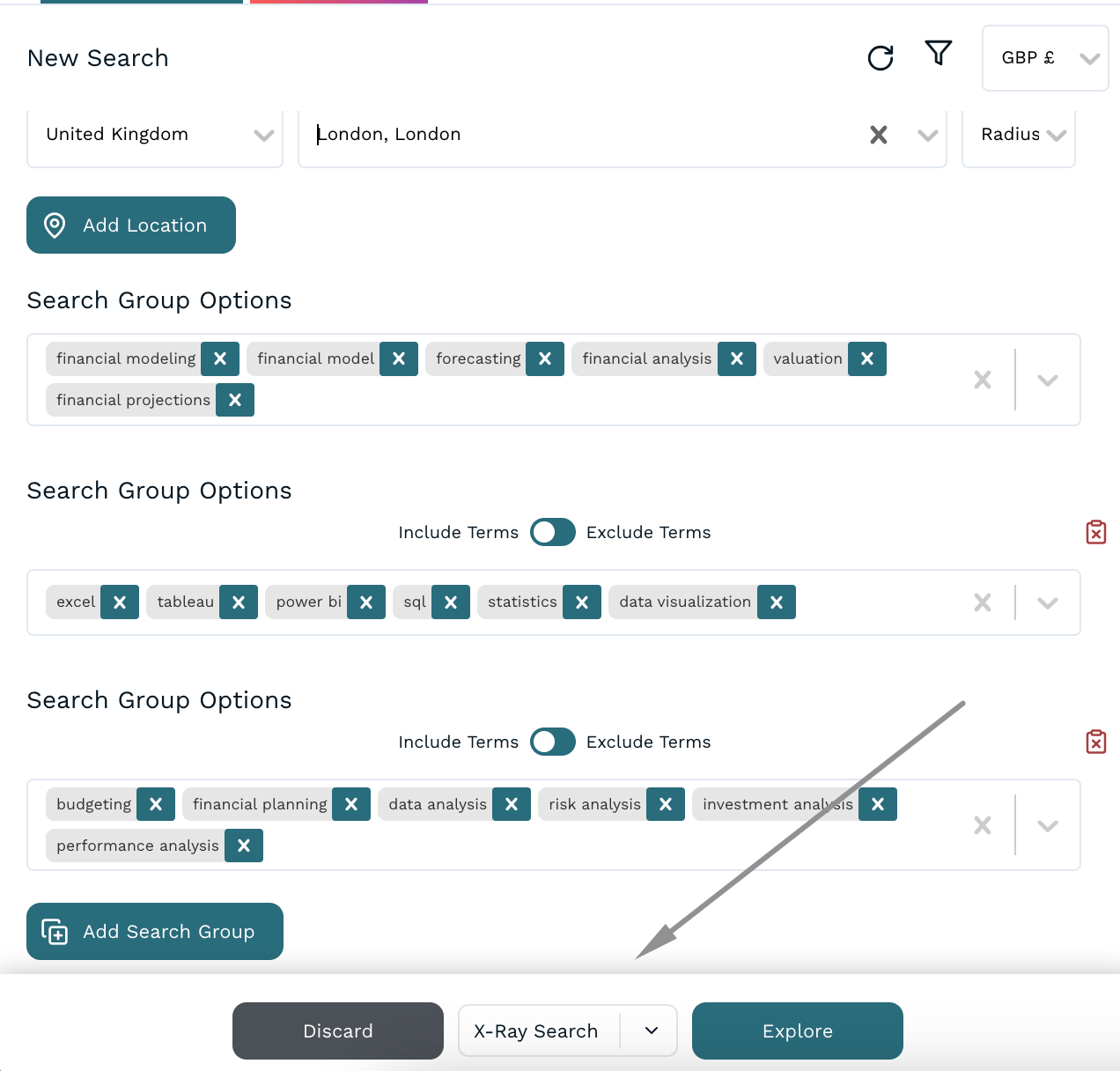
Image shows the Horsefly X-Ray Search functionality within the platform
Candidate Screening Software
Once applications start coming in, screening tools help separate the relevant from the noise quickly and fairly. These types of hiring platforms use rule-based filtering, skills assessments, and increasingly AI-driven matching to prioritize talent who meet the core requirements of a role.
The upside is speed and consistency. The risk, which we will cover shortly, is that automated screening can introduce or amplify bias if the underlying criteria are not well designed.
Interview Software
Interview platforms have evolved well beyond video calls. Modern tools offer structured interview frameworks, question libraries, scoring rubrics, and async video interviews that give hiring teams flexibility without sacrificing rigor.
The benefit is consistency: every interviewer is working from the same framework, which reduces subjectivity and makes it easier to compare talent fairly.
Reference Checking Software
Reference checks are one of the most underused and under-optimized steps in the hiring process. Platforms can automate the outreach and collection process, turning a manual, time-consuming task into a structured data-gathering exercise.
Good reference checking tools also help you spot patterns across responses, giving hiring managers richer context before making a final decision.
Candidate Experience Analytics Platforms
How talent feels about your hiring process matters, both for your offer acceptance rate and your employer brand. Candidate experience platforms gather feedback at key touchpoints, identifying where friction exists and where drop-off is happening.
Tools in this category help teams understand the hiring process from the talent's perspective, which is a perspective that is easy to lose sight of when you are deep in the operational side of recruiting.
Candidate Assessment Software
Assessment tools measure skills, cognitive ability, personality, and cultural alignment. Platforms let hiring teams go beyond the resume to evaluate how someone is likely to perform in a specific role or environment.
The most effective assessments are role-relevant and validated. Assessments that are not tied to actual job performance can do more harm than good, both legally and in terms of the talent experience.
Software for Diverse and Inclusive Hiring
DEI-focused (Diversity, Equity, and Inclusion) tools help organizations identify and address bias in job descriptions, sourcing strategies, screening processes, and hiring outcomes. Some platforms analyze the language in job postings to flag exclusionary phrasing. Others track diversity metrics across the funnel to show where underrepresented groups are dropping off.
Horsefly's DEI Insights functionality takes this further by giving teams access to comprehensive labor market data to identify and recruit diverse talent, set meaningful benchmarks, and track progress over time. Inclusive workforce planning backed by real data is a very different proposition from good intentions backed by guesswork. Schedule a custom consultation to see how this can work for your business.
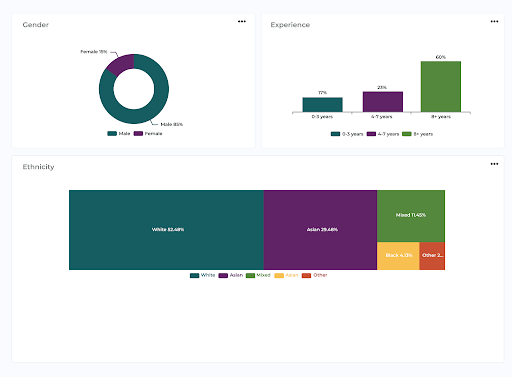
Image shows the DEI functionality on the Horsefly platform
Onboarding Software
The hiring process does not end at offer acceptance. Onboarding platforms can streamline paperwork, compliance, equipment setup, and early-stage training, helping new hires become productive faster and reducing the risk of early attrition.
Research consistently shows that strong onboarding experiences significantly improve retention. If your onboarding is a pile of PDFs and a calendar invite, there is a tool for that.
Internal Mobility Software
One of the most overlooked talent acquisition strategies is the talent you already have. Internal mobility platforms help organizations map existing skills, identify development opportunities, and fill open roles with internal talent before going to the external market.
Tools that do this use skills intelligence (helps expand candidate pools with equitable, AI-driven job recommendations) to match employees to open roles, stretch assignments, and learning opportunities. For organizations focused on retention and workforce resilience, this category deserves serious attention.
The Rise of AI in Talent Acquisition
Artificial Intelligence has moved from buzzword to infrastructure in recruiting. It is embedded in almost every category of talent acquisition tool now, doing everything from writing job descriptions to scoring applications to predicting which talent is most likely to accept an offer.
How AI Is Transforming Recruiting
AI's core value in talent acquisition is speed and scale. Natural Language Processing (NLP) allows platforms to parse resumes, extract skills, and match profiles to job requirements at a volume no human team could replicate manually. Generative AI (used for content creation and process automation) is increasingly used to draft job descriptions, outreach messages, and interview questions.
Predictive analytics, meanwhile, is shifting talent acquisition from reactive to strategic. Platforms like Horsefly use historical labor market data to model forward scenarios, helping organizations anticipate where hiring will be difficult before they commit resources. Horsefly's Longitudinal Intelligence capability overlays supply and demand on a single view, tracks how roles and skills have shifted over time, and enables scenario planning grounded in real data rather than assumptions. Contact us to discuss your needs in more detail.
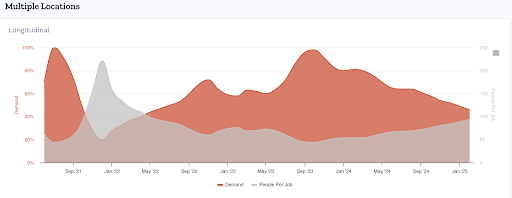
Image shows the Longitudinal capabilities within the Horsefly platform
Benefits of AI Integration
The efficiency gains are real. AI-powered screening tools reduce time-to-hire. Automated scheduling eliminates the back-and-forth that slows down every pipeline. Skills-based matching, like Horsefly's Signal Skills Intelligence, spots emerging skills before they become mainstream requirements, helping talent teams get ahead of future hiring needs rather than scrambling to catch up.
Better data also means better decisions. When hiring managers can see real-time talent availability, accurate Difficulty of Hire scores, and compensation benchmarks against current market data, they make smarter calls faster.
Potential Pitfalls
AI in recruiting is not without risk. The most discussed issue is bias: if a model is trained on historical hiring data that reflects past discrimination, it will replicate that discrimination at scale. This is not theoretical. It has happened at major organizations, and it is an ongoing challenge across the industry.
Data privacy is the other major concern. AI tools collect and process significant volumes of personal data, and compliance with GDPR, CCPA, and other regional regulations is not optional. Transparency also matters: talent have a reasonable expectation of understanding how automated tools are being used to evaluate them.
In short, AI is a powerful tool; use it thoughtfully, audit it regularly, and make sure your workforce remains in the loop on consequential decisions.
Measuring the ROI of Talent Acquisition Tools
Investing in recruiting software is easy to justify in theory. Proving the return on investment (ROI) in practice is harder, but it is not impossible if you track the right things.
Key Metrics to Track
Time-to-hire measures how long it takes to move from job opening to accepted offer. Reducing this has direct cost implications.
Cost-per-hire captures all the expenses associated with filling a role, including recruiter time, tool costs, and advertising spend.
Employee retention rate is the metric that ties talent acquisition quality to long-term business outcomes. Hiring well reduces attrition. Hiring poorly is expensive.
Talent satisfaction scores, collected at key points in the hiring process, reflect the quality of the experience you are delivering and its impact on your employer brand.
How to Calculate ROI
A straightforward approach: identify your baseline metrics before implementing a tool, then measure the same metrics after a defined period (typically six to twelve months). If an ATS reduces your average time-to-hire from 45 days to 28 days, calculate the cost of those 17 days in recruiter time and productivity loss for the unfilled role. Compare that saving against the annual cost of the tool. That is your starting point.
For labor market intelligence platforms, the ROI calculation includes avoided mistakes: roles opened in locations where talent supply does not support the hire, compensation offers that miss the market, or workforce plans built on outdated data. These costs are harder to see but very real.
Demonstrating Value to Stakeholders
Translate metrics into business language. Reduced time-to-hire means faster revenue generation from new hires. Lower cost-per-hire means more budget for strategic priorities. Higher retention rates mean lower replacement costs. The talent team's contribution to business performance becomes visible when you measure it the right way.
Implementing Talent Acquisition Tools: A Step-by-Step Guide
Assess Your Needs First
Before looking at vendors, get clear on where your current process breaks down. Are you losing good talent because hiring takes too long? Are you making location decisions without accurate market data? Are your sourcing efforts returning the wrong profiles? Define the problem before shopping for the solution.
Integrate With Existing Systems
Most organizations already have an HRIS, and many have an ATS. New tools need to connect cleanly with what you already have. Look for platforms with open APIs (Applicant Programming Interface) and a track record of integration with the systems in your stack. A tool that sits in isolation is a tool your team will stop using within six months.
Train Your Team
Adoption is where most implementations fail. Budget time and resource for proper onboarding, and identify internal champions who can model good usage and support their colleagues. The best tool in the world delivers zero value if no one uses it correctly.
Optimize Continuously
Set a review cadence, quarterly at minimum, to assess whether the tools in your stack are delivering against the metrics you defined at the outset. Markets change, hiring needs evolve, and the tools you need in 12 months may be different from the ones that made sense today.
Legal and Ethical Considerations
Data Privacy
If your recruiting tools collect personal data from talent (and they all do), you are operating under data protection regulations. GDPR applies across Europe. CCPA applies in California. Other regions have their own frameworks, and compliance requirements vary significantly. Work with legal counsel to ensure your data collection, storage, and processing practices meet the requirements of every market you operate in.
AI Bias
Bias in AI recruiting tools is a genuine and well-documented risk. Regular audits of your automated screening and scoring tools are not optional: they are a business and legal necessity. Ensure that the criteria your tools are optimizing for are actually predictive of job performance, not proxies for characteristics that have no bearing on someone's ability to do the job.
Transparency With Talent
Talent should understand when and how automated decision-making is being used in their application process. In some jurisdictions, this is a legal requirement. Practically, transparency also builds trust and supports a stronger employer brand. If you would not be comfortable explaining your AI tools to the people they are evaluating, that is worth examining.
Compliance Across Borders
For global organizations, legal compliance in talent acquisition is genuinely complex. AI regulations, data localization requirements, and labor laws vary by country. Build legal review into your tool selection process, not as an afterthought.
Where Talent Acquisition Analytics Fits In
Talent acquisition analytics sits at the intersection of all these tools. It is the layer that turns operational data into strategic insight, answering not just "what happened" but "what should we do next."
Platforms like Horsefly provide the labor market intelligence that makes every other element of your talent acquisition strategy more effective. Supply and Demand Insights show where talent pools are growing or shrinking in real time. Compensation Insights ensure your offers are competitive without overspending. Skills Insights and Signal Skills Intelligence help you understand which skills are emerging and where to find them before everyone else is chasing the same talent.
The organizations that win at talent acquisition are not the ones with the most tools. They are the ones that combine the right talent acquisition analytics software with accurate data and clear strategic thinking.
Ready to see what accurate labor market intelligence looks like in practice? Book a strategy session with Horsefly Analytics and find out what your talent strategy has been missing.
Sources: Horsefly Analytics, Gov.UK, GDPR, CCPA, Forbes