Contents:
Key Takeaways:
1. Internal data alone produces weak predictions. Your HRIS knows who left, but not that a competitor opened an office two miles away and is hiring your exact profile at a premium. Predictions become reliable when workforce data is read against the external market: attrition risk against local demand for the same skills, and pay bands against current rates in each city. Many failed analytics initiatives build impressive internal models and then wonder why the forecasts missed.
2. Timing is what separates predictive from reactive HR. In the expansion example, the old model fills 40% of roles in six months because requisitions open in the headquarters city. With forecasts in hand before the decision is final, the CHRO can show that the headquarters market is thin and that two alternative cities offer deeper supply at 20% lower cost. Insights matter most before commitments are made, when they can still shape the decision rather than explain it afterwards.
3. Explainability and human accountability make turnover models usable. A flight-risk list handed to managers without context can produce clumsy retention conversations or quiet deprioritization of “at-risk” people. If the model shows why risk is elevated, such as local pay moving past your band, the response is a compensation adjustment, not a perks program. Test outputs for disparate impact, remove proxy variables like ZIP code, restrict individual risk scores to a small group, and keep people making the final decisions.
Beyond Spreadsheets: The New Era of Strategic HR
Most enterprise workforce plans are built on data that was already outdated when the quarter started. This article lays out how AI workforce analytics closes that gap: the core applications, an implementation checklist, the ethical guardrails, and the metrics that prove ROI to your CFO.
The pattern is familiar. Headcount data sits in the HRIS. Compensation lives in a separate system, often owned by Total Rewards. Market intelligence arrives as a consultant's report or a salary survey that took six months to compile. By the time someone stitches these together in a spreadsheet, the business has already committed to a new market entry, and talent acquisition is scrambling to fill roles in a city nobody modeled.
What fills the gap is usually instinct. A senior leader "knows" Kraków is a good engineering hub, or assumes the compensation band from last year's survey still holds. Sometimes the instinct is right, but often it costs months of failed searches and declined offers because the number was 15% below what the local market now pays.
We see the same root problem across global enterprises: the decisions that matter most in workforce planning (where to locate, what to pay, which skills to build versus buy) get made with the least reliable data. AI workforce analytics addresses that directly. The question for most HR leaders is how to adopt it without repeating the data fragmentation that created the problem.
What is AI Workforce Analytics?
AI workforce analytics applies machine learning to large volumes of internal workforce data and external labor market data to find patterns, forecast outcomes, and recommend actions.
The distinction from traditional people analytics matters. Conventional people analytics is descriptive: it tells you your attrition rate last quarter, your average time-to-fill, your gender split by level. It's useful, but a dashboard showing that engineering attrition hit 18% tells you nothing about which engineers leave next or why.
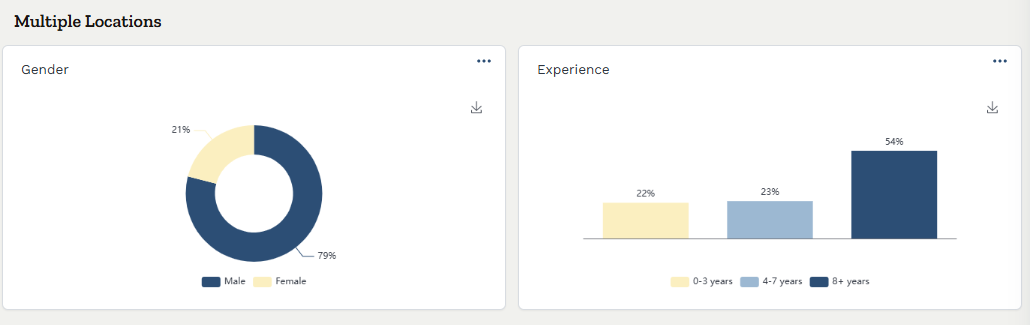
A view of some demographic capabilities within Horsefly
AI-driven analytics works across three levels:
-
Descriptive: What happened, consolidated across systems rather than siloed.
-
Predictive: What is likely to happen, based on patterns the models detect across thousands of variables a human analyst would never cross-reference.
-
Prescriptive: What to do about it, such as which locations offer the deepest supply of a given skill at an acceptable cost.
The second point most people get wrong: internal data alone produces weak predictions. Your HRIS knows who left. It does not know that a competitor opened an office two miles away and started hiring your exact profile at a premium. Predictive analytics only becomes reliable when you compare your workforce data against what is happening in the external labor market. Most failed analytics initiatives we've seen built impressive internal models and then wondered why the forecasts missed.
The Core Applications Driving Business Value
Four use cases account for most of the value we see enterprises capture.
Predicting Employee Turnover
Models trained to predict employee turnover look at signals such as tenure relative to peers, time since last promotion, compensation position against the external market, manager changes, and local demand for the employee's skill set. The output is a risk score by individual, team, or location.
The hard part is acting on it. A flight-risk list handed to managers without context tends to produce clumsy retention conversations or, worse, quiet deprioritization of "at-risk" people. The value comes when the model explains why risk is elevated. If a cluster of data scientists in one city is flagged because local market pay has moved past your band, the retention strategy is a compensation adjustment, not a perks program.
Identifying and Bridging Skills Gaps
Skills gap analysis compares the workforce skill sets you have against what your strategy requires, then against what the market can supply. That third comparison is where most internal-only tools fall short. Knowing you need 200 cloud security engineers over two years is half the answer. The other half is whether to hire them, and where, or reskill existing staff because external supply is too thin or expensive.
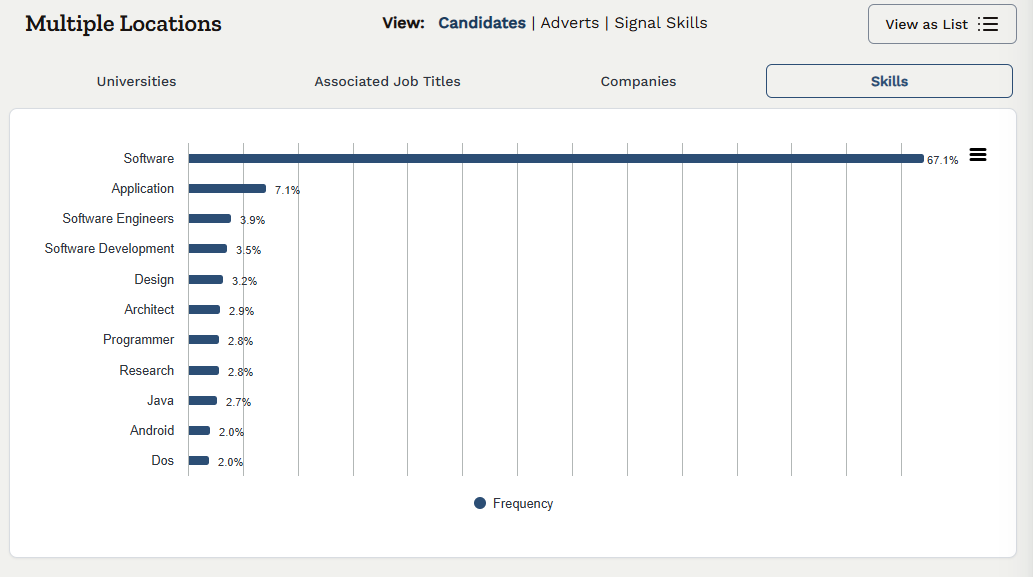
Image shows the Skills capability within Horsefly
Talent Acquisition and Location Strategy
Talent intelligence changes how talent acquisition plans searches. Instead of posting a role and hoping, recruiters can see candidate supply, competitor demand, and typical compensation for a role in a given city before opening the requisition. For location decisions (a new hub, nearshore center, or shift to distributed hiring), this is the difference between a defensible business case and an expensive guess.
Compensation Benchmarking
Compensation uncertainty drives a large share of failed hires. Annual salary surveys lag the market, especially for in-demand skills where pay can move several times a year. AI analytics built on live market data gives Total Rewards and recruiters current benchmarks by role, skill, and location, which directly affects offer acceptance rates.
From Reactive Reports to a Predictive Workforce Strategy
Consider how a typical expansion plays out under the old model.
The executive team approves a new product line requiring 300 hires over 18 months. HR receives the headcount number after the decision is made. Talent acquisition opens requisitions in the existing headquarters city because that's where hiring managers sit. Six months in, they've filled 40% of roles, time-to-fill has doubled, and agency fees are climbing. A monthly report explains all of this in detail, but nothing in it could have prevented it.
Now run the same scenario with predictive workforce planning in place.
The CHRO joins the planning conversation before the decision is final, with talent forecasts in hand. The analysis shows that the headquarters market has fewer than half the qualified candidates needed, with three major competitors hiring the same profile. Two alternative cities show deeper supply at 20% lower cost, with stronger university pipelines in the relevant disciplines. The plan that gets approved splits hiring across locations, with a realistic timeline and budget the CFO can trust.
The difference is timing. Actionable insights matter most before commitments are made, when they can still shape business objectives rather than react to them. That shift, from reporting on decisions to informing them, is what earns HR a seat in strategic planning.
It also changes the cadence. Static reports run monthly or quarterly. Predictive models refresh as data changes, so a workforce plan becomes a living document that adjusts when a competitor announces layoffs or a new regulation reshapes a market.
How Horsefly Delivers Unmatched Global Workforce Intelligence
Everything above depends on the quality and reach of the underlying data. This is where we built Horsefly Analytics to be different.
Global Reach at Real Granularity
Our platform draws on over 1 trillion data points to deliver labor-market intelligence across more than 170,000 towns and cities worldwide.
But scale alone isn't enough. Labor supply and compensation for a software engineer can vary significantly between locations, even within the same country. Bangalore, Pune and Coimbatore, for example, represent distinct markets that national-level averages may not fully capture.
Horsefly Analytics enables organizations to compare talent availability, skills and compensation at a more granular geographic level, helping them make better-informed decisions about where to hire and how to benchmark pay, even in locations that are often overlooked by traditional salary surveys.

Blending External Market Data with Your Internal Data
As we noted earlier, internal data alone produces weak predictions. Our Horsefly Analytics platform blends external labor market analytics with your own workforce data, so you can see your people against the market they compete in. Your attrition risk is read against local demand for the same skills. Your pay bands are compared against current market rates in each city where you operate. Your skills inventory is set against what the external market can actually supply.
This combination is what makes predictive accuracy possible. A turnover model that knows your compensation position relative to the live market in a specific city will outperform one that only knows tenure and performance ratings.
What This Looks Like in Practice
For a Head of Workforce Planning, our talent intelligence platform answers questions like:
-
Where can we hire 150 data engineers in the next year, and at what cost?
-
Which of our current locations are becoming harder to recruit in, and why?
-
How does our pay for critical roles compare to the market in each city we operate in?
-
Which skills should we build internally because external supply is too constrained?
We designed it so that smarter decisions don't require a team of data scientists to interpret. The insights are built for the HR and talent leaders who own the outcomes.
Implementing an AI Analytics Platform: Key Considerations
Buying a platform is the easy part. The organizations that get value from AI workforce analytics treat implementation as a change program, not a software installation.
Start with Data Quality
Any model is only as good as its inputs. If job titles are inconsistent across regions, termination reasons are often coded as "other", or your HRIS and payroll systems disagree on headcount, predictions will inherit those errors. Before going live, audit the internal data that will feed the models. You don't need perfection. You do need to know where the gaps are so you can weight conclusions accordingly.
Data integration deserves equal attention. Map which systems need to connect (HRIS, ATS, compensation, learning) and who owns each. Integration work is where timelines slip, so scope it honestly.

A Checklist for Choosing a Platform
When evaluating an AI workforce analytics platform, press vendors on these questions:
1. Coverage: Does the external data cover every market where you hire or plan to, at city level?
2. Freshness: How often is market data updated? Quarterly refreshes won't catch fast-moving skill markets.
3. Blending: Can it combine external market data with your internal data, or are they separate views?
4. Explainability: Can the platform show which factors drive a prediction, or does it return an opaque score?
5. Security and compliance: How is employee data stored, and does the vendor meet data protection requirements in your operating regions?
6. Usability: Can HR business partners and recruiters use it directly, or does every question route through an analyst?
Plan for Change Management
The most common failure we see is a capable platform that nobody uses. Recruiters stick with familiar habits, hiring managers distrust model outputs, and leadership reverts to instinct the first time a forecast is inconvenient. Pick two or three high-visibility decisions and use the platform to drive them publicly. Early wins build credibility faster than training sessions do.
Managing the Ethics of AI in HR
AI in HR touches people's livelihoods. HR leaders who skip this conversation tend to have it forced on them later, by employees, regulators, or the press.
Mitigating Bias
Algorithms learn from historical data, and historical workforce data reflects historical decisions, including biased ones. A promotion model trained on a decade of decisions where women were promoted more slowly will learn to rate women as lower-potential. Mitigating bias requires deliberate work: testing model outputs for disparate impact across gender, ethnicity, age, and other protected characteristics; removing proxy variables that encode bias indirectly (ZIP code, for instance, can stand in for race); and keeping humans accountable for final decisions on hiring and promotion.
Our view is that AI should inform people decisions, not make them. A model can flag that a candidate pool is thin or that a team carries elevated flight risk, but a person decides what to do.
Employee Privacy and Transparency
Employee privacy concerns are legitimate. Using individual-level data to predict who might resign can feel like surveillance if handled carelessly. Practical safeguards include restricting individual risk scores to a small group with a clear purpose, using aggregated views wherever individual data isn't required, and complying with regional rules such as GDPR, which often impose stricter requirements in Europe than elsewhere.
Transparency matters as much as compliance. Tell employees what data is used and why. Organizations that explain their approach openly face far less resistance than those that try to keep analytics quiet.
Handled well, these ethical considerations are what make the program durable. A system employees and regulators trust is one you can expand.
Measuring the ROI of AI-Powered Workforce Analytics
Your CFO will ask for the business case. Here's how to build one that holds up.
Establish Baselines First
Before deployment, capture current performance on the metrics you expect to improve. Without a baseline, any improvement claim becomes an anecdote. Pull at least 12 months of history where possible, segmented by region and role family.
The Metrics That Move
-
Time-to-hire: Better location targeting and realistic market expectations shorten searches. Each day a revenue-generating role sits open has a calculable cost.
-
Recruitment costs: Fewer failed searches mean lower agency spend and less wasted advertising. This is often the fastest-returning line item.
-
Employee turnover: Replacing a skilled employee commonly costs a substantial share of annual salary once you count recruitment, onboarding, and lost productivity. Retaining even a handful of critical people a year can cover the platform investment.
-
Offer acceptance rates: Offers built on current local benchmarks get declined less often, which cuts rework and protects candidate relationships.
-
Location decision outcomes: Compare cost-per-hire and fill rates in sites chosen with market data against historical expansions.
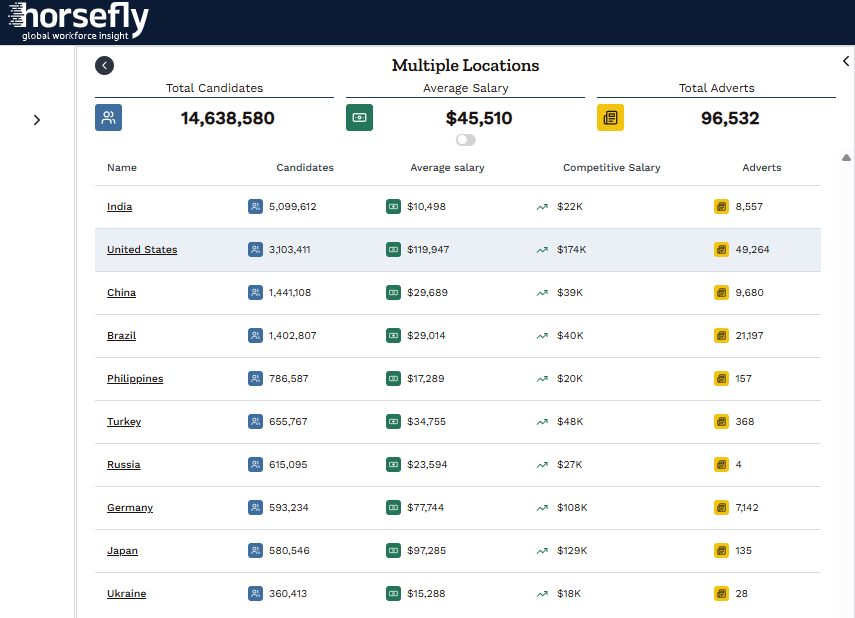
Image shows a view of the Locations data within Horsefly
Frame It as Risk Reduction
Some of the largest returns are avoided losses: the expansion into a market that couldn't supply the talent, or the pay band that would have triggered an exodus. These are harder to quantify, but a single avoided mistake in a major location decision can exceed years of platform cost. Present both the measurable efficiency gains and the downside protection, and the investment reads as a lever on business outcomes and hiring efficiency rather than an HR overhead line.
Building Your Future-Ready Workforce Today
The thread running through every section is timing. Reactive HR explains decisions after they've been made. Predictive HR shapes them while there's still room to choose a different city, pay band, or build-versus-buy approach to a skill shortage.
That timing advantage compounds. Organizations that forecast talent needs accurately enter new markets faster, lose fewer critical people, and spend less filling roles, while competitors are still reconciling spreadsheets. As the future of work brings faster skill turnover and more distributed hiring, the gap between those two groups will widen.
Getting there takes three things: clean, integrated internal data; external market data deep enough to reflect how talent markets actually work in different locations; and the discipline to use both ethically and consistently. Strategic workforce planning built on that foundation is a competitive advantage that is hard for rivals to copy.
At Horsefly Analytics, we built our platform to supply the external half of that equation at a depth no internal team can replicate, and to blend it with the data you already hold. If your next major workforce decision is still being made on last year's survey, that's the place to start.

Frequently Asked Questions
How is AI workforce analytics different from traditional people analytics dashboards?
Traditional people analytics describes past events, like last quarter's attrition rate. AI workforce analytics goes beyond this to predict future outcomes and prescribe actions, consolidating data across systems and incorporating external market intelligence for deeper insights into workforce dynamics.
What signals does AI workforce analytics use to predict employee turnover risk?
AI models predict turnover by analyzing signals such as an employee's tenure, time since their last promotion, compensation against current market rates, manager changes, and local demand for their specific skills. This provides a detailed risk score and reasons for elevated risk.
What specific types of data are essential for accurate AI workforce planning predictions?
Accurate AI workforce planning relies on blending internal workforce data from HRIS, ATS, and compensation systems with extensive external labor market data. This combination allows models to understand internal trends in the context of broader talent supply, demand, and compensation shifts.
How does AI improve talent acquisition decisions and location strategy?
AI provides real-time insights into candidate supply, competitor demand, and typical compensation by role, skill, and city before hiring. This enables data-driven decisions on where to locate new hubs, optimize recruitment strategies, and create defensible business cases for expansion.
What key metrics should a CFO look at to prove ROI of AI workforce analytics?
CFOs should track improvements in time-to-hire, reduced recruitment costs, lower employee turnover rates, and higher offer acceptance rates. Quantifying avoided losses from poor location or compensation decisions also demonstrates significant financial return and risk reduction.
What are the most important ethical considerations for using AI in human resources?
Key ethical concerns include mitigating algorithmic bias, which can perpetuate historical discrimination, and ensuring employee privacy and transparency regarding data usage. Organizations must test for disparate impact and clearly communicate how AI informs, rather than dictates, people decisions.
How long does it typically take to implement an AI workforce analytics system and see results?
Implementing an AI workforce analytics system involves data integration and change management, not just software installation. While initial setup varies, organizations can often see initial benefits and actionable insights within a few months by focusing on key, high-visibility decisions to build trust and demonstrate value.
Sources: Horsefly Analytics, GDPR