.png?width=2000&name=Horsefly-Logo-NewTag_White%20(3).png)
HR reporting tells you what already happened. Workforce analytics tells you what to do about it.
That distinction sounds simple, but it separates organizations that react to talent crises from those that prevent them. A quarterly turnover report shows attrition climbing in your Singapore engineering team. Workforce analytics can help explain why it's happening, which roles may be most exposed, what the market is paying, and where alternative talent pools exist.
The shift from reporting to analytics reflects a broader change in how HR contributes to business decisions. When other functions use current data and forecasts to make decisions, static headcount reporting provides limited context for workforce planning. Workforce analytics closes that credibility gap by transforming raw employee data, combined with external labor market intelligence, into the same kind of actionable strategic insight that finance and operations teams have used for years.
For global enterprises specifically, the stakes are higher. You're making decisions across dozens of labor markets simultaneously, each with different supply and demand dynamics, regulatory environments, and compensation norms. A workforce analytics platform gives you a unified lens to compare these markets, identify where talent is concentrated, and align your workforce strategy with business objectives like cost control, speed to market, and geographic expansion.
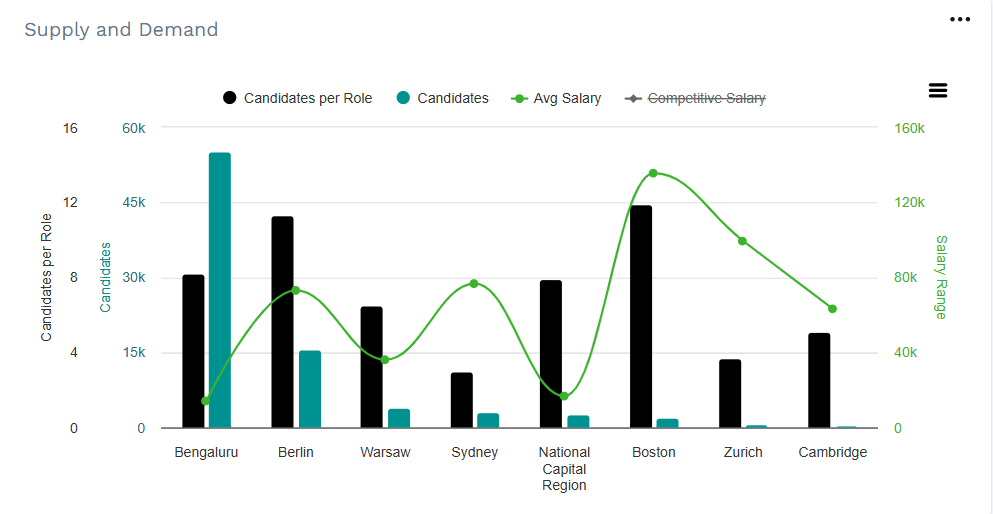
An example of global supply and demand data from Horsefly’s platform
Organizations with mature analytics capabilities fill roles faster because they know where to look. They negotiate compensation using market benchmarks rather than assumptions. But salary data needs context: markets differ in whether figures are gross or net, base or total compensation, and how current the underlying data is.
They forecast skill shortages before those shortages become emergencies. And they make location decisions, whether for a new tech hub or a shared services center, based on actual labor supply data rather than anecdotal impressions.
Core Capabilities: What to Demand from Your Analytics Platform
Not all workforce analytics platforms solve the same problems. Some focus inward on your existing employee data. Others focus outward on labor market intelligence. The best enterprise solutions do both and connect them.
Data Collection and Integration
Your platform is only as useful as the data flowing into it. More data does not necessarily mean better analysis. The underlying sources need to be reliable and comparable.
It’s helpful if it integrates with your HRIS, HCM suite, payroll systems, and applicant tracking system. However, the harder question is whether it can also ingest external data: labor market supply and demand figures, compensation benchmarks by geography and role, competitor hiring activity, and skills trend data.
Many enterprises discover too late that their analytics platform creates a beautiful dashboard of internal data but can't answer the question, "How does our compensation for data engineers in Berlin compare to the market?" If external data isn't part of the core architecture, you'll end up paying for a separate market intelligence subscription and manually stitching the two together.

Analysis and Visualization
Complex workforce data is useless if only your data science team can interpret it. The platform needs to translate multi-dimensional datasets into visualizations that an SHRM-certified VP can use in a board presentation without calling IT first. Look for configurable dashboards, scenario modeling tools, and the ability to drill down from a global view to a specific city or job family.
Security and Compliance
Workforce data is sensitive by definition. Any platform handling employee records, compensation information, and diversity metrics must comply with GDPR, CCPA, and whatever jurisdiction-specific regulations apply to your operations. Encryption, role-based access controls, and audit trails aren't optional features. They're baseline requirements.
Talent Management and Performance Metrics
The more sophisticated platforms connect recruitment data to retention data to performance data, letting you trace the full employee lifecycle. This matters because high-performing organizations don't just track headcount. They track whether the people they hired are productive, engaged, and staying.
The AI Advantage: Predictive Analytics in Modern HR
AI and machine learning can make workforce analysis faster and more scalable. But their usefulness still depends on the quality and consistency of the underlying data.
Descriptive analytics tells you that 18% of your software engineers left last year. Diagnostic analytics shows that most of them were in their second year and had been passed over for promotion. Predictive analytics tells you which current employees match that same profile and are likely to leave in the next six months. Prescriptive analytics recommends specific interventions, like targeted retention bonuses or accelerated development programs, to prevent it.
AI-driven forecasting is particularly valuable for skill demand planning. When your business announces a new product line or a geographic expansion, you need to know which skills you'll require, how available those skills are in your target markets, and how long it will typically take to hire for them. Machine learning models can process millions of job postings, professional profiles, and labor market signals to generate those forecasts in hours rather than weeks.

A word of caution, though: predictive models are only as good as the data they're trained on. If your internal data is incomplete or biased, the predictions will reflect those flaws. Any serious evaluation of AI capabilities should include questions about data quality requirements, model transparency, and how the vendor handles bias detection. The worst outcome is making confident decisions based on flawed predictions.
AI is particularly useful for identifying patterns across large datasets. It can help track compensation shifts, emerging skill clusters, and changes in hiring activity on a scale that would be difficult to manage manually. But the quality of those insights still depends on the data underneath them.
Generative AI does not solve poor data quality. It can make an answer easier to understand, but it cannot make inconsistent sources comparable or turn weak evidence into reliable intelligence. And when it surfaces an insight, like a sudden spike in demand for a niche skill set in a market you hadn't considered, it creates opportunities that manual analysis would simply miss.
A Comparative Review of Top Enterprise Workforce Analytics Software
The following sections analyze four platforms that serve different segments of the enterprise workforce analytics market. We've evaluated each based on criteria that matter most for global operations: data reach, strategic planning capabilities, integration depth, AI features, and how well each platform addresses the core pain points of workforce planning leaders. No single platform does everything perfectly. The goal is to help you identify which one aligns best with your specific priorities.
Horsefly Analytics: Best for Global Talent Intelligence and Market Data
At Horsefly Analytics, we built our platform to solve a specific problem that we saw global enterprises struggling with repeatedly: the inability to get accurate, timely, and granular labor market data across every geography where they operate or plan to expand.
Our platform covers over 170,000 locations worldwide, which gives workforce planning teams the ability to compare talent supply, demand, compensation, and competitive activity across markets with a level of granularity that internal HR data alone can't provide. We've developed a proprietary job title taxonomy that maps real-world roles across countries and industries. That's important because a job title isn't necessarily a comparable job: "Software Engineer" can mean something quite different in Mumbai than it does in Munich.
What makes our approach different is the combination of external labor market intelligence with the ability to layer in your internal talent data. This means you're not just looking at what the market is doing in isolation. You're comparing it against your own workforce composition, identifying gaps, and modeling scenarios for workforce planning, location strategy, and skills intelligence.
We see our strongest fit with organizations making high-stakes decisions about where to locate operations, how to price roles competitively across multiple geographies, and where to find scarce talent for hard-to-fill positions. Horsefly is particularly suited to organisations that need external labour-market intelligence for location planning, compensation strategy, and talent acquisition.
Our focus is giving you the external market context that most other platforms lack, so your internal workforce decisions are grounded in reality rather than assumptions.

ADP Workforce Now: Best for Integrated Payroll and HR Analytics
ADP's strength comes from the sheer volume of payroll data it processes. When you're already running your payroll through ADP, the analytics layer benefits from direct access to compensation data, headcount changes, overtime patterns, and compliance metrics without additional integration work.
For compensation benchmarking specifically, ADP's dataset is hard to beat within the markets it covers deeply, particularly the United States. Turnover analysis, time-to-fill tracking, and regulatory compliance reporting are well-developed features. The platform works best for enterprises that want workforce analytics tightly coupled with their existing payroll and HR administration infrastructure.
The limitations become apparent when your needs extend beyond internal data. ADP's analytics are primarily built on the data it already collects through its HR and payroll services. If you need external labor market intelligence, global supply and demand data, or competitive hiring analysis across dozens of countries, you'll likely need to supplement ADP with a separate market intelligence platform. For enterprises with operations concentrated in ADP's strongest markets, this may be a reasonable tradeoff. For truly global organizations operating across emerging markets, it's a gap worth considering.
Pricing tends to be bundled with broader ADP services, which can make it cost-effective if you're already an ADP customer but expensive to adopt purely for analytics.
Visier: Best for People Analytics and Strategic Planning
Visier has earned its reputation in the people analytics space through strong visualization capabilities and a library of pre-built analytical models that cover common HR questions: Why are people leaving? Where are our diversity gaps? How effective is our recruiting funnel?
The platform excels at making internal workforce data accessible to non-technical stakeholders. Its pre-configured analytics, covering areas like talent acquisition efficiency, diversity and inclusion metrics, and employee lifecycle analysis, mean you can get value relatively quickly without building every report from scratch. For HR leaders who need to answer board-level questions about workforce composition and trends, Visier provides a polished interface.
Where Visier is less differentiated is in external labor market data. The platform is primarily designed to analyze the workforce you already have, using the data your existing systems generate. Strategic workforce planning within Visier works well for internal scenario modeling, like projecting retirement waves or identifying promotion pipeline bottlenecks. But when planning extends to external questions such as where to find talent you don't have yet, what competitors are paying, or how labor supply is shifting in markets you're considering, the platform's reach is more limited.
Visier's integration capabilities are solid, with connectors for major HRIS and HCM platforms. Implementation timelines vary depending on data complexity, but enterprises with clean, centralized HR data tend to get up and running faster.
Leapsome: Best for Unified Performance and Engagement Analytics
Leapsome approaches workforce analytics from a different angle than the other platforms reviewed here. Its core strength is connecting performance management, employee engagement surveys, goal tracking, and learning data into a single analytical view.
For organizations where the primary analytics challenge is understanding the relationship between engagement, development, and business outcomes, Leapsome offers a compelling unified platform. You can track how engagement scores correlate with performance ratings, identify teams where goal completion is lagging, and spot patterns in feedback data that suggest cultural or management issues.
The employee well-being dimension is worth noting. Leapsome includes tools for tracking engagement trends over time, pulse surveys, and 360-degree feedback analysis. This gives people analytics teams a richer picture of the employee experience than platforms focused purely on operational HR metrics.
The tradeoff is scope. Leapsome is not designed for labor market intelligence, location strategy, or global compensation benchmarking. Its data is almost entirely internal, generated by employees using the platform's performance and engagement features. For enterprises whose primary pain point is external market visibility or global workforce planning, Leapsome solves a different problem. But for those focused on maximizing the productivity and retention of their existing workforce through better performance and engagement analytics, it fills a clear need.
Feature-by-Feature: A Direct Comparison of Leading Solutions
The table below compares the four platforms across the dimensions that matter most for enterprise workforce analytics decisions. Use it as a starting point, not a final answer. Your specific priorities (global reach vs. internal depth, market intelligence vs. performance analytics) should determine which tradeoffs are acceptable.
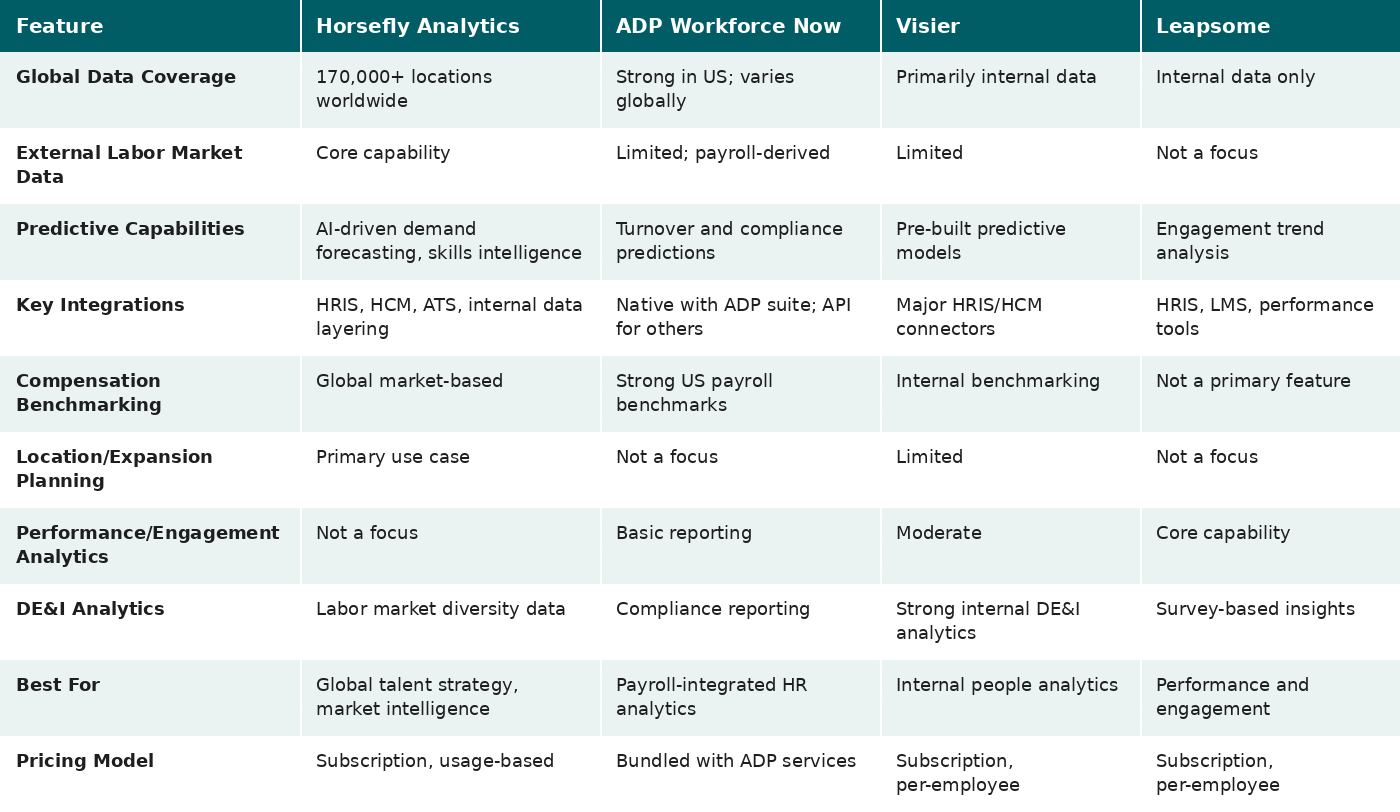
Organizations with primarily domestic operations and an existing ADP relationship may find ADP sufficient. Those focused on internal people analytics and visualization will gravitate toward Visier. Leapsome serves the engagement-to-performance connection well. For enterprises making global workforce decisions, Horsefly provides the external labour-market intelligence that internal HR systems often cannot.
How to Choose Your Partner: A Framework for Evaluating Vendors
Selecting workforce analytics software is a procurement decision, but it's also a strategic one. Here's a practical framework for evaluation that goes beyond feature checklists.
Start With Your Primary Use Case
Are you trying to improve internal people analytics (retention, engagement, DE&I visibility)? Or are you trying to gain external market intelligence for talent acquisition, location planning, and competitive positioning? Most enterprises need both eventually, but knowing which problem is more urgent will narrow your shortlist quickly.
Map Your Data Reality
How clean is your internal HR data? How many systems would need to integrate? If your HRIS data is fragmented across regions and business units, a platform with strong data ingestion and normalization capabilities matters more than one with pretty dashboards. Ask vendors specifically how they handle messy, multi-source data.
Evaluate Global Reach Honestly
If you operate in 30 countries, a platform with deep US data and limited international coverage creates a blind spot that no amount of internal analytics can fill. Ask for specific coverage maps, not just country counts.
Test the AI Claims
Every vendor in this space claims AI capabilities. Ask for specifics. What models do they use? How often are they retrained? What data quality thresholds are required for predictions to be reliable? Can they show you prediction accuracy metrics from existing customers?

How the AI Impact capability appears in the Horsefly platform
Assess Implementation Realistically
Enterprise implementations take time. Ask about typical timelines for organizations of your size and complexity. Understand what internal resources you'll need: data engineering support, change management, and analyst training. A platform that takes 12 months to implement and requires a dedicated analytics team may not be right for an organization that needs answers in 90 days.
Confirm Compliance Posture
Request documentation on GDPR compliance, CCPA readiness, data residency options, and security certifications (SOC 2, ISO 27001). If the vendor hesitates or provides vague answers, that's a red flag.
Check the Support Model
Post-implementation support varies enormously. Some vendors provide a dedicated customer success manager and regular strategy reviews. Others hand you a knowledge base and a ticket system. For workforce analytics, where the value depends on ongoing adoption and expanding use cases, active vendor support correlates directly with ROI.
A final, less obvious consideration: ask about the vendor's data sources. Where does their external labor market data come from? How frequently is it updated? What happens when data sources change or become unavailable? The reliability of your strategic decisions depends on the reliability of the underlying data.
Future-Proofing Your Workforce with Strategic Analytics
The organizations that will win the talent competition over the next five years aren't necessarily those with the biggest budgets. They're the ones that see market shifts first and act on them fastest.
Workforce analytics software is the mechanism for that speed. A platform with deep global data and strong predictive capabilities lets you identify emerging skill shortages before they drive up costs, spot untapped talent markets before your competitors discover them, and model the workforce implications of business decisions before committing capital.
But the technology alone doesn't create value. The organizations that get the most from workforce analytics are the ones that embed it into their decision-making processes, from board-level strategy discussions to individual hiring manager choices. They build the muscle of asking, "What does the data say?" before every major workforce decision.
At Horsefly Analytics, we've watched organizations transform from reactive to proactive in how they approach talent strategy. The common thread isn't the size of their analytics team or the sophistication of their models. It's the commitment from senior leadership to treat workforce intelligence with the same rigor they apply to financial intelligence.
The tools are ready. The data exists. The question for every global HR leader reading this is whether your current platform gives you the external market context, the predictive depth, and the global reach to make the workforce decisions your business strategy demands. If the answer is no, get in touch and discover how we can help fix that.
Frequently Asked Questions
What is the main difference between traditional HR reporting and strategic workforce analytics?
Traditional HR reporting summarizes past events, like quarterly turnover rates. Strategic workforce analytics, however, proactively uses data to understand why things happened and what to do next, helping organizations prevent talent issues and make future-oriented decisions based on predictive insights.
How does artificial intelligence (AI) enhance workforce analytics for skill demand planning?
AI enhances skill demand planning by processing vast amounts of external data, like job postings and labor market signals, to forecast future skill needs. Machine learning models predict required skills, their availability in target markets, and typical hiring timelines, replacing weeks of manual analysis with rapid insights.
What are the most important features to look for in an enterprise workforce analytics platform?
Key features include robust data integration with internal HRIS and external market data, intuitive analysis and visualization tools, and stringent security with compliance protocols like GDPR. Sophisticated platforms also connect recruitment, retention, and performance metrics for a holistic view.
How can global companies ensure their workforce analytics platform provides accurate international talent data?
Global companies must choose platforms offering extensive geographical coverage with granular labor market data across many locations. Verify the vendor's proprietary job title taxonomies and external data sources to ensure accurate, comparable talent supply, demand, and compensation benchmarks globally, not just domestically.
What are the risks of biased data when using AI-driven predictive models in workforce analytics?
Biased internal data used to train AI models can lead to flawed and confident predictions, resulting in poor workforce decisions. It is crucial to question vendors about their data quality requirements, model transparency, and how they implement bias detection to ensure reliable and ethical outcomes.
What are common challenges companies face when implementing new workforce analytics software?
Common challenges include fragmented or messy internal HR data across systems, requiring significant cleanup and integration efforts. Additionally, securing internal resources like data engineering support and ensuring effective change management and user training are vital for successful adoption and long-term value.
How does workforce analytics directly contribute to a company's financial and business objectives?
Workforce analytics directly contributes by enabling faster hiring, better compensation negotiations through real market benchmarks, and proactive skill shortage forecasting. This leads to cost control, improved speed to market, and strategic geographic expansion decisions grounded in reliable labor supply data, enhancing overall business performance.
Sources: Horsefly Analytics, GDPR, CCPA, SHRM, ADP Workforce Now, Visier, Leapsome