.png?width=2000&name=Horsefly-Logo-NewTag_White%20(3).png)
Why Strategic Workforce Analytics Is a C-Suite Priority
Workforce decisions directly affect costs, growth, and business continuity. Talent shortages, changing compensation, and global competition make it harder to know where to hire, what to pay, and which skills to prioritise.
Workforce analytics gives leaders a clearer view of talent supply, compensation, hiring activity, and emerging skills. This helps organisations make faster, evidence-based decisions about hiring, expansion, and workforce planning.
For the C-suite, the value is financial. A CFO can compare the talent availability and labour costs of potential locations, while HR leaders can identify skills gaps and retention risks before they become larger business problems.
Core Capabilities of an Enterprise-Grade Analytics Platform
Not all workforce analytics tools are built for enterprise complexity. Here's what separates a platform designed for global operations from a glorified reporting dashboard.
Data Aggregation and Unification
The first requirement is the ability to pull data from multiple internal systems (HRIS, payroll, ATS, learning management systems) into a single view. Most enterprises run different systems across regions, often the result of acquisitions or local compliance requirements. If the platform can't normalize that data into a unified model, you're still working with fragments.
But internal data alone is insufficient. An enterprise-grade platform must also layer in external labor market intelligence: talent supply and demand signals, compensation benchmarks, competitor hiring patterns, and skills taxonomy data across global markets.
AI-Powered Skills Intelligence
Static job title taxonomies are more useless. The same role can carry different titles across industries and geographies, and the skills required for that role shift faster than annual reviews can capture. Look for platforms that use AI to map skills rather than titles, creating a dynamic, changing picture of what your workforce can do versus what you'll need it to do. This capability is the foundation for skills gap analysis, internal mobility programs, and strategic workforce planning.
Predictive Analytics
Historical reporting tells you what happened. Predictive analytics tells you what's likely to happen, whether that's turnover risk in a specific team, a tightening talent market for a role you'll need to hire for in Q3, or a compensation gap that's about to trigger attrition. The models should be explainable (not black boxes) and tunable to your organization's specific context.
Visualization and Actionable Insights
Data that sits in spreadsheets doesn't drive decisions. The platform should offer dashboards that different stakeholders can actually use: a CHRO needs a different view than a regional recruiting manager. The outputs should be actionable, meaning they point toward specific decisions rather than just presenting information.
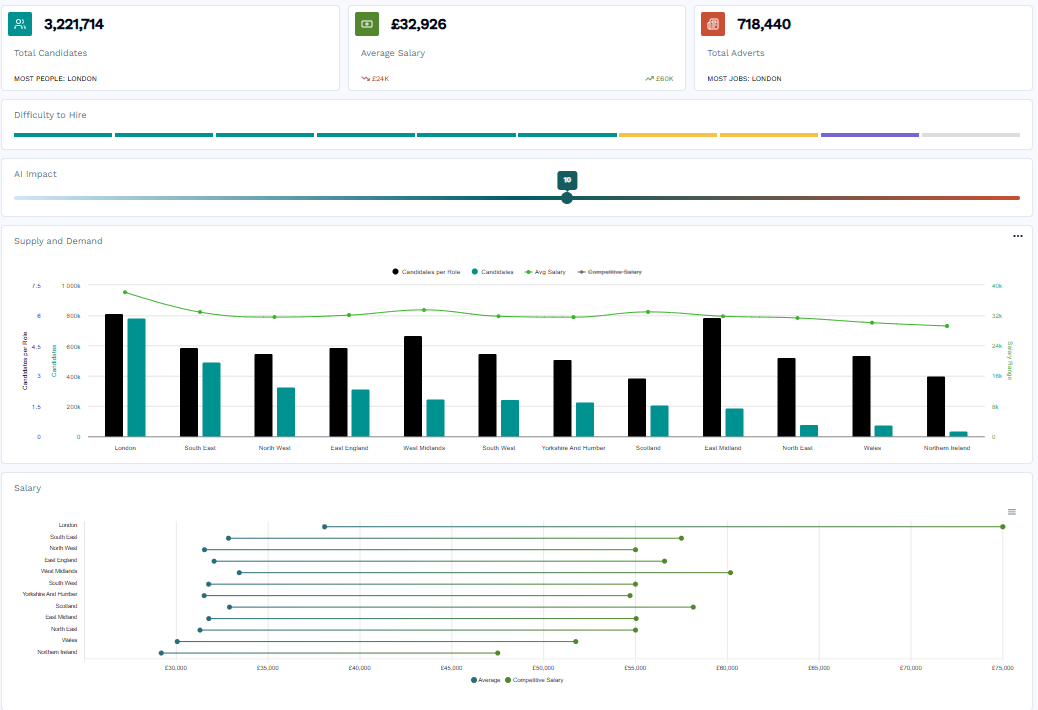
A dashboard view from within the Horsefly platform
The Business Impact: Quantifying the ROI of Workforce Analytics
The ROI conversation for workforce analytics is often muddied by vague claims about "better decision-making." Here's how to think about it concretely.
Reduced Time-to-Fill
When you have real-time data on talent availability by location and skill set, you stop wasting sourcing effort in markets where the talent doesn't exist. Our clients consistently find that access to granular supply and demand data cuts weeks off searches for specialized roles, because recruiters focus effort where candidates actually are.
Lower Cost-Per-Hire
Data-driven decisions about where to source, what to pay, and which channels to use directly reduce acquisition costs. The savings compound as you scale, particularly for organizations hiring hundreds or thousands of roles annually.
Retention Cost Avoidance
Replacing a mid-level professional typically costs 50-200% of their annual salary when you account for lost productivity, recruiting, and onboarding. Predictive attrition models that flag flight risks three to six months before departure give you a window to intervene. Even preventing a small percentage of voluntary departures across a large workforce produces measurable savings.
Labor Cost Optimization
For organizations considering new locations for shared services centers, technology hubs, or manufacturing operations, analytics that compare total labor costs (not just salary, but benefits, taxes, and availability premiums) across candidate cities prevent expensive location mistakes. We've seen cases where the "obvious" choice for a new hub turned out to be pricier on a total cost basis than an alternative market with comparable talent supply.
Workforce Planning Accuracy
When headcount forecasts are based on market data rather than manager requests, budgets become more reliable. Finance teams value this precision because it reduces the variance between planned and actual labor spend.
Driving Performance and Engagement with Data
Engagement data becomes more useful when combined with performance data. This can reveal which management behaviours, onboarding experiences, and team structures are linked to stronger outcomes.
Sentiment analysis can also identify themes in survey comments, exit interviews, and internal communications that structured surveys may miss, such as workload, career progression, or manager issues.
Analytics can then show what high performers do differently, including the skills they use and learning paths they follow. This gives organisations a data-driven basis for improving development and retention.
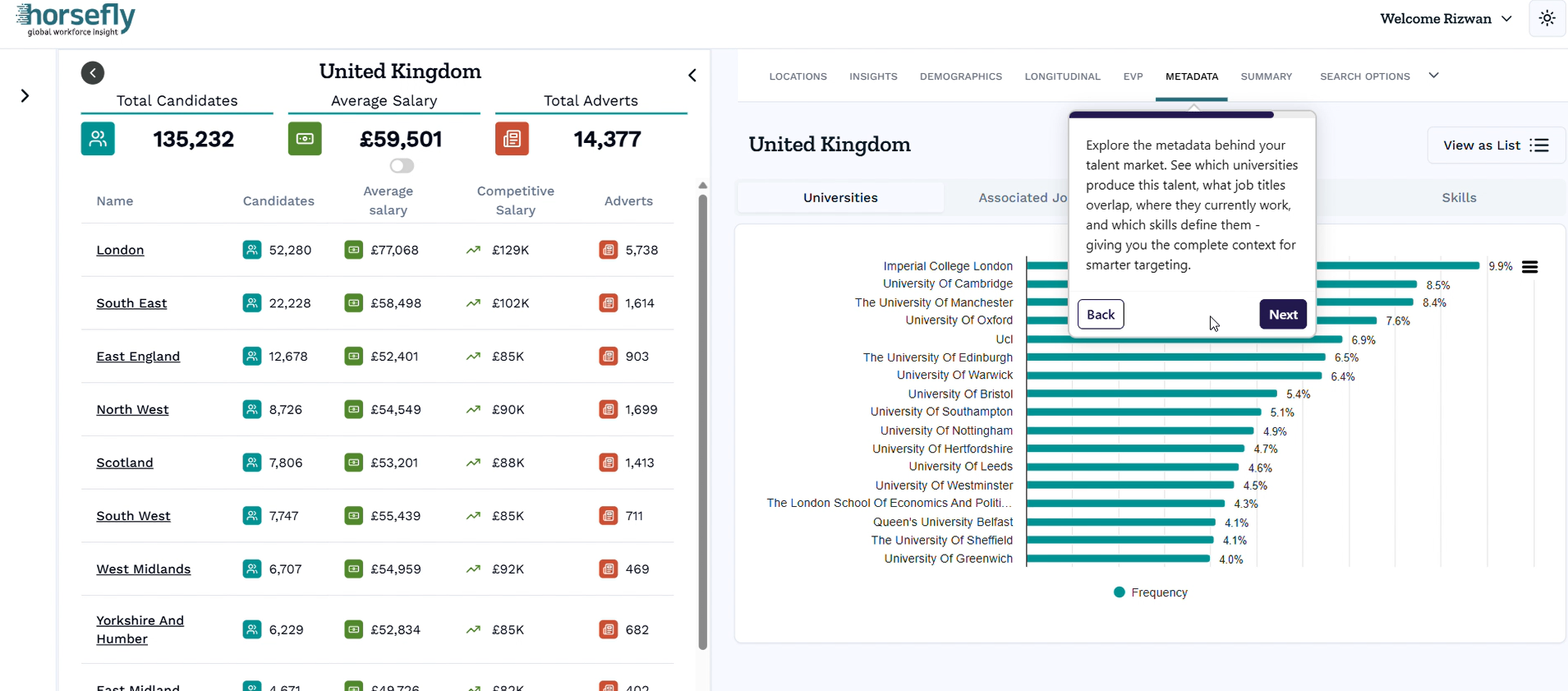
Image shows the metadata from Horsefly’s platform, which can help make decisions based on skills, companies, universities, and job titles
Critical Evaluation Criteria for Global Enterprises
This is where many procurement processes fall short. Enterprise buyers focus heavily on features and not enough on the infrastructure that determines whether the tool will actually work at their scale and within their constraints.
Scalability
Can the platform handle your data volume not just today, but in three years? If you're a 50,000-employee organization planning acquisitions, you need a platform architected for growth. Ask vendors about performance benchmarks at data volumes 3-5x your current state. Cloud-native architectures generally handle this better than legacy on-premises solutions.
Integration
Pre-built connectors to major HRIS platforms (Workday, SAP SuccessFactors, Oracle HCM), payroll systems, and ATS solutions are baseline expectations. But integration quality varies enormously. Some connectors sync daily; others sync in real time. Some handle bidirectional data flow; others only pull data in. API flexibility matters because you'll inevitably need to connect a system the vendor didn't anticipate.
Ask specific questions: How many API calls are supported? What's the latency on data sync? Can we push insights back into our ATS or HRIS workflow?
Security and Compliance
For global enterprises, this is non-negotiable and complex. The platform must comply with GDPR, CCPA, and any region-specific data protection regulations you're subject to. Workforce data is among the most sensitive data an organization holds.
Evaluate: Where is the data stored? Can you ensure data residency requirements are met for specific jurisdictions? What encryption standards are used at rest and in transit? Does the vendor undergo regular third-party security audits (SOC 2, ISO 27001)? How is access controlled at the role level so that a regional HR manager only sees data relevant to their region?
Data Quality and Coverage
This one gets overlooked surprisingly often. A platform's analytics are only as good as its underlying data. For external labor market intelligence, ask: How many data sources feed the platform? How frequently is the data refreshed? What's the geographic coverage? Can it provide granular data for emerging markets, not just the US and Western Europe?
At Horsefly Analytics, we've invested heavily in global data coverage precisely because we've seen what happens when enterprises make expansion decisions based on platforms that only have depth in a handful of mature markets. The gap between what the data shows and what the market actually looks like can lead to costly missteps.

Strategic Use Cases Beyond the HR Department
The enterprise value of workforce analytics extends well beyond talent acquisition and HR operations. The most mature organizations we work with have made these platforms a shared resource across functions.
Finance
Accurate headcount forecasting linked to labor market cost data gives CFOs confidence in forward-looking budgets. Rather than applying a flat inflation rate to labor costs, finance teams can model location-specific, role-specific cost trajectories. This is especially valuable for organizations with significant contingent workforce spend, where cost variability is higher.
Operations
In manufacturing and logistics, shift scheduling based on workforce availability data, skill certifications, and fatigue models improves both productivity and safety outcomes. Identifying workflow bottlenecks caused by understaffing in specific skill areas becomes possible when you can see the data across shifts and locations.
Sales and Revenue
Understanding which team compositions, territories, and management structures produce the best sales outcomes allows for deliberate replication. If analytics reveals that sales teams with a specific ratio of experienced to junior reps consistently outperform, you can structure teams intentionally rather than by happenstance.
Corporate Strategy and M&A
Before acquiring a company, understanding the target's workforce composition, the local talent market for their key roles, and the likely cost of retention packages changes how you model deal value. We've seen due diligence processes transformed when acquirers had real data on talent availability in the target's markets, rather than relying on the seller's HR team for estimates.
DE&I
Analytics makes representation patterns visible across hiring funnels, promotion rates, and compensation bands. More importantly, it identifies where in the process disparities emerge, allowing targeted interventions rather than broad programs that don't address root causes.
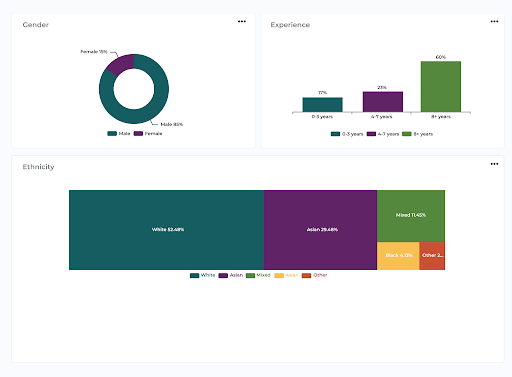
Image shows the DEI capability within Horsefly
Using AI and Predictive Modeling for Future-Readiness
The AI capabilities in workforce analytics platforms range from genuinely useful to marketing buzzwords. Here's how to evaluate what matters.
Useful AI processes large, unstructured datasets and surfaces patterns humans would miss or take months to find. This includes analyzing millions of job postings to identify emerging skill requirements, processing open-text survey data to detect sentiment shifts, and mapping career path patterns across large populations to identify optimal development sequences.
Predictive modeling should address specific, high-value questions:
- Which employees are most likely to leave in the next six months, and why?
- Which roles will be hardest to fill in our target markets 12 months from now?
- What will happen to our talent pipeline if a major competitor opens a new office in our primary sourcing market?
The "and why" part matters enormously. A model that says "this employee has a 72% flight risk" is useful. A model that adds "driven primarily by compensation gap relative to market and tenure without promotion" is actionable. The first tells you to worry. The second tells you what to do.
Be skeptical of vendors who can't explain how their models work or what data trains them. AI applied to workforce decisions carries real ethical and legal risk, particularly in hiring and performance evaluation. You need to understand the models well enough to defend their use.
We approach this carefully at Horsefly Analytics because the stakes are high. AI that reinforces existing biases or produces unexplainable recommendations creates more risk than it mitigates.

Using Analytics to Identify and Close Critical Skills Gaps
Skills gaps are the pain point we hear about most from enterprise leaders. The challenge is that most organizations don't have an accurate picture of the skills they currently have, let alone the skills they'll need.
An effective analytics platform builds a skills inventory by pulling data from multiple sources: performance reviews, project assignments, training completions, certifications, and self-reported skills profiles. No single source is complete or accurate on its own, but the combination creates a reasonably reliable picture.
The strategic value comes from comparing that inventory against your business plan. If the strategy calls for expanding AI-driven product capabilities, the platform should quantify exactly how many people with the required skills you have, where they sit in the organization, and what the gap looks like. Then, critically, it should tell you whether it's faster and cheaper to build those skills internally through upskilling or to buy them from the external market, based on real data about talent availability and cost.
Internal talent mobility is where this gets particularly interesting. Many enterprises have the skills they need; they're just in the wrong part of the organization. Analytics that maps adjacent skills and identifies employees who are one training intervention away from qualifying for a hard-to-fill role creates enormous value. It's faster than external hiring, cheaper, and dramatically better for retention.
Our workforce planning analytics capabilities are built around this exact problem: connecting internal skills data with external market intelligence to give organizations a complete picture of their options for closing gaps.
Working Through Implementation and Driving User Adoption
Successful implementation depends on more than the technology. Data quality, change management and user adoption are just as important.
Plan for Implementation
For a global enterprise, core implementation can take three to six months, followed by further refinement as data issues are identified and users adopt the platform.
Prepare Your Data
Data migration is often the most challenging stage. Job titles, compensation structures and employee identifiers may differ across systems, so allow time for data cleansing and standardisation.
Focus on Adoption
A platform only creates value when people use it. Provide clear training and show HR teams and managers how the analytics support their day-to-day decisions.
Start with a Pilot
Begin with one business unit or region and a clear use case. Demonstrate value, capture results, and use those lessons to support a wider rollout.
Evaluate Vendor Support
Assess the implementation team as well as the technology. Look for experience with organisations of similar scale, dedicated implementation support, and clear post-launch support.
Aligning Your Tool with a Global Workforce Strategy
Selecting a workforce analytics platform is a decision that will shape how your organization makes talent decisions for years. The checklist below captures the evaluation criteria that matter most for global enterprises.
Questions to ask every vendor:
-
What is your data coverage by geography, and how granular is it at the city and role level in non-Western markets?
-
How frequently is your external labor market data refreshed?
-
Which HRIS, ATS, and payroll systems do you integrate with natively, and what does custom integration require?
-
Where is workforce data stored, and can you meet data residency requirements for our operating jurisdictions?
-
What security certifications do you hold, and when was your last third-party audit?
-
How do your predictive models work, and can you explain the methodology in plain language?
-
What does your implementation support look like for a global enterprise with multiple HR systems across regions?
-
Can you demonstrate ROI achieved by organizations similar to ours in size and complexity?
-
How do you handle changing skills taxonomies, and how frequently is your skills intelligence updated?
-
What does your pricing model look like at our scale, and are there usage limits that could constrain adoption?
The right tool isn't the one with the longest feature list. It's the one that matches your specific data infrastructure, operates reliably across your geographies, and is actually usable by the people who need to make decisions with it every day. We built Horsefly Analytics around these principles because we've seen too many enterprises invest in platforms that look impressive in a demo and gather dust in practice.

Choose a strategic partner that brings both the data depth and the implementation expertise to make workforce analytics a genuine operating capability, not a shelfware purchase. The organizations that get this right will make smarter decisions about where to find talent, what to pay, how to develop their people, and where to grow, faster and with more confidence than those still stitching together spreadsheets and survey data.
Frequently Asked Questions
Why is workforce analytics a C-suite priority for large companies today?
Workforce analytics is a C-suite priority because labor is the largest controllable expense for most enterprises, and data-driven decisions directly impact financial outcomes. It provides competitive positioning by forecasting talent availability, costs, and emerging skills, enabling faster product launches and smoother expansions for market advantage.
What essential capabilities should a robust enterprise workforce analytics platform include?
An enterprise workforce analytics platform must aggregate internal and external data, including global labor market intelligence. It should feature AI-powered skills intelligence, predictive analytics for future insights, and user-friendly visualizations that provide actionable insights to various stakeholders across the organization.
How do organizations quantify the return on investment (ROI) from implementing workforce analytics?
Organizations quantify ROI by tracking metrics like reduced time-to-fill, lower cost-per-hire, and retention cost avoidance through predictive attrition models. Additionally, labor cost optimization for new locations and improved workforce planning accuracy directly contribute to measurable financial savings and budget reliability.
What critical security and compliance considerations are vital for global workforce analytics platforms?
Global platforms must comply with data protection regulations like GDPR and CCPA. Key considerations include secure data storage with encryption, meeting data residency requirements, undergoing regular third-party security audits (e.g., SOC 2), and implementing robust role-based access control to protect sensitive workforce information.
How do companies effectively identify and close critical skills gaps using workforce analytics?
Companies identify skills gaps by building a comprehensive skills inventory from diverse internal data sources. They then compare this inventory against strategic business needs to quantify gaps. The platform can determine whether to build skills internally via upskilling or acquire them externally, optimizing talent strategy.
What is a realistic timeline and the biggest challenge for implementing an enterprise workforce analytics platform?
A realistic timeline for core functionality ranges from three to six months, with further refinement over several more months. The biggest challenge is often data migration and cleansing, as existing internal data is frequently messy and requires significant effort to standardize for accurate analysis.
How can enterprises ensure employee privacy and foster trust when deploying workforce analytics tools?
Enterprises ensure privacy and trust by being transparent about data usage, focusing on aggregated insights rather than individual surveillance. Adhering to strict data governance, offering explainable AI models, and respecting regional compliance standards are crucial. Strong communication about the tool's benefits for career development also helps.
Sources: Horsefly Analytics, GDPR, CCPA