Contents:
Key Takeaways:
1. Treat build vs. buy as a portfolio of four options, not a binary. Build develops existing staff, buy hires permanently, borrow uses contractors or partners, and bot automates or augments tasks. Each carries a different cost, timeline, and effect on retention. Defaulting to buy is the common mistake, and in tight markets it means longer time-to-fill, inflated offers, and settling for whoever is available.
2. Compare options on total cost of capability, not salary or day rate. Include acquisition cost, time-to-productivity, carrying cost, and risk, then subtract retained value, over a horizon of about three years. Price the vacancy, probability-weight risks like mis-hires or failed training, and estimate retention and innovation effects conservatively. The model is only as good as its inputs, so skill availability, local pay, and time-to-hire need credible market data. Also benchmark pay before a build program, or competitors may reap the benefit of the skills you develop.
3. Match the option to urgency, skill specificity, and strategic importance. Needed within a quarter points to buy, borrow, or bot, while a need a year out makes build viable. Proprietary skills are better built, and portable ones are easy to buy or borrow. Core capabilities should be owned, temporary initiatives borrowed, and undifferentiated work automated. For scarce skills like cloud security, blend all three: borrow for immediate cover, buy a senior lead, and build an internal cohort. Revisit the mix each planning cycle, and make knowledge transfer from contractors and senior hires explicit.
—-------------------------------------------
Why 'Build vs. Buy' Is an Outdated Model
Most enterprises close skills gaps the expensive way: a critical role opens, the business wants it filled yesterday, and the requisition goes to an agency before anyone asks whether an internal candidate, contractor, or piece of software could do the job. But the traditional build vs. buy talent development strategy no longer reflects how work gets done. Skills in data, cloud, and AI evolve quickly, specialist talent pools are thin, and more tasks can be automated outright.
The Four Bs framework replaces that binary choice with a more practical question: what's the cheapest, fastest, and most durable way to get the capability you need?
-
Build: Develop the capability in your existing workforce.
-
Buy: Hire it permanently from the external market.
-
Borrow: Access it temporarily through contractors, freelancers, consultants, or partners.
-
Bot: Automate the task or augment people with AI so fewer resources are needed.
Each option has a different cost profile and distinct implications for retention and innovation. A sound talent development strategy uses all four deliberately.
The 'Build' Strategy: Cultivating Internal Talent
Build is the option leaders praise most and fund least. Internal development is valuable, but it takes protected time, budget, and manager attention; resources that often disappear when quarterly targets tighten.
Done properly, build means upskilling employees in their current roles, reskilling them for adjacent ones, and creating clear career pathways that show where new skills can lead. Without that last step, upskilling is a perk, not a talent pipeline.
The benefits go beyond filling roles. Visible career paths support retention, while internal moves preserve institutional knowledge, from customer relationships to the workarounds that keep operations running. Build can also create capabilities unique to your systems and processes, without agency fees.
But build has limits:
-
It takes time. Reskilling for a new discipline can take months before someone reaches full productivity.
-
It needs a starting point. If the expertise does not exist internally, there may be no one qualified to teach it.
-
It can fuel attrition. Newly skilled employees become more marketable; if pay falls behind the market, competitors may reap the benefit of your investment.
-
It can reinforce existing assumptions. Developing talent exclusively from within risks limiting fresh perspectives.
Before investing in a build program, benchmark pay for the target skill in your key markets. If the market offers significantly more than you plan to pay, budget for the increase upfront, or risk losing the talent you have just developed.
The 'Buy' Strategy: Acquiring Skills on the Open Market
When a business needs a capability this quarter, buy may be the fastest route. External hiring brings new skills, fresh perspectives, and, in some cases, direct knowledge of competitors.
Buy is strongest when three conditions coincide: the need is urgent, the skill is absent internally, and the role will remain important for years. Senior specialists and leaders launching new functions often fit this pattern.
The costs are where plans go wrong. Beyond agency fees, salary, and signing bonuses, leaders must account for:
-
Ramp-up time. External hires must learn your systems, people, and processes before reaching full productivity.
-
Cultural fit. A senior mis-hire can disrupt teams and add significant replacement costs.
-
Pay compression. A market-rate premium for an external hire can create resentment among experienced employees, and put retention at risk.
-
Talent scarcity. In tight markets, hiring takes longer and costs more, while the business absorbs the impact of an unfilled role.
The common mistake is treating buy as the default and the other three Bs as exceptions. In tight markets, that approach can mean longer time-to-fill, inflated offers, and settling for candidates who remain available rather than those who best fit the role.
Buying well starts before the search. You need to know how many qualified people are available in each location, which employers are competing for them, and what they earn. For organizations working with recruitment process outsourcing (RPO) partners, talent market intelligence can also strengthen sourcing strategies and help ground recruitment recommendations in evidence.

Expanding the Framework: 'Borrow' and 'Bot' Strategies
Borrow
Borrow means accessing skills without adding permanent headcount, such as contractors, consultants, interim executives, managed service providers, and talent-sharing partners. It works best for time-bound projects, fluctuating demand, or temporary specialist expertise.
The advantage is flexibility: scale up for a system migration, scale down when it ends, or test a capability before committing to a permanent hire. A contractor engagement can also provide a trial run for a future role.
The tradeoffs:
-
Higher day rates. Specialist contractors often cost more than equivalent salaried employees.
-
Knowledge loss. Expertise leaves with the contractor unless it is transferred to your team.
-
Legal exposure. Misclassification and co-employment rules vary by country.
-
Limited long-term stake. Contractors may have less incentive to invest in your culture or future outcomes.
Borrow works well for projects but poorly as a permanent workaround. If you have borrowed the same capability for years, you may be paying a premium to avoid making a decision.
Bot
Bot covers automation and AI: from robotic process automation for rules-based tasks to AI tools that augment knowledge workers and workflows that remove tasks entirely. The focus should be on tasks, not whole roles. Automation rarely eliminates every responsibility in a role; more often, it changes the workload, headcount required, and skills people need.
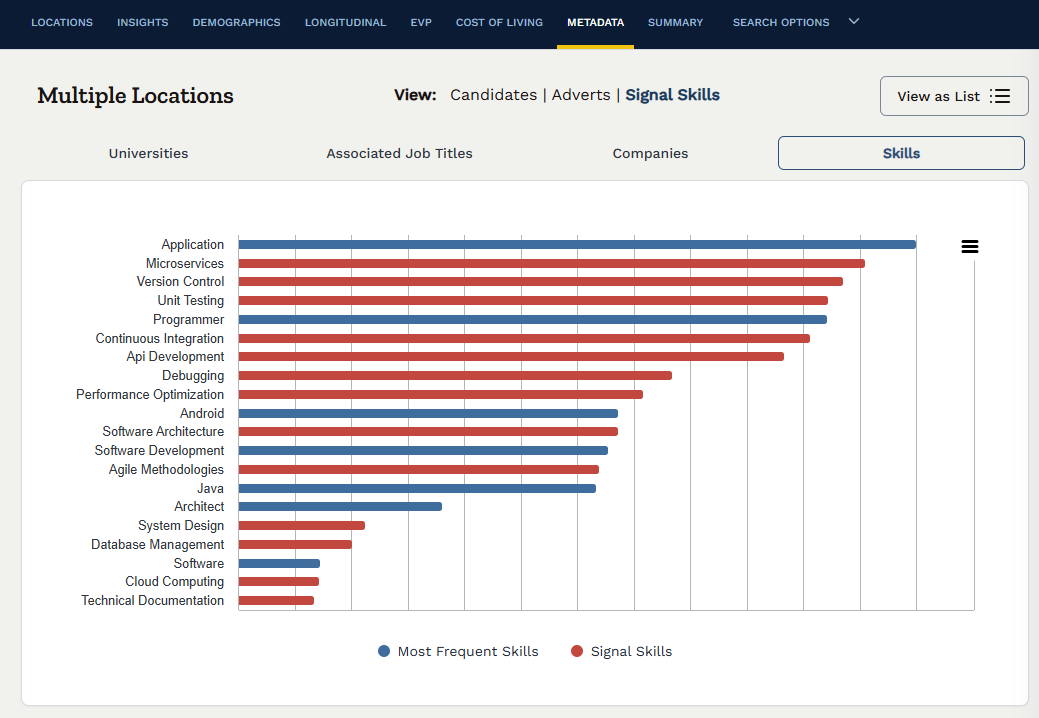
Signal Skills to help businesses see which skills are gaining traction in real time
Bots are best suited to high-volume, repetitive work with clear rules and limited need for judgment. They are less suitable when success depends on relationships, ambiguity, or human accountability.
But automation has people costs too. Projects need people to manage and maintain the tools, while automated tasks may leave employees needing redeployment or reskilling. Organizations that focus only on cost reduction risk losing workforce trust; those that pair automation with development are better placed to maintain it.
A Data-Driven Cost-Benefit Analysis of the Four Bs
Comparing the four options based on salary or day rate alone leads to poor decisions. Talent acquisition analytics can help quantify hiring costs and outcomes, while a broader cost model compares all four options over a defined horizon, typically three years, using five components:
Total cost of capability = Acquisition cost + Time-to-productivity cost + Carrying cost + Risk cost − Retained value
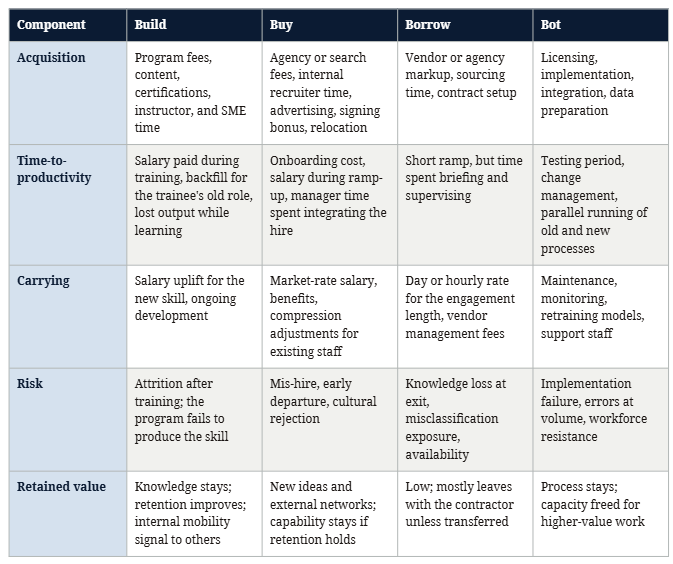
Three adjustments make the model more useful.
1. Price the vacancy. An unfilled critical role can delay projects, increase overtime, and cost revenue. Multiply the daily cost of the gap by the realistic time each option would take to deliver the capability.
2. Probability-weight the risks. Estimate both the likelihood and financial impact of events such as a failed training program, mis-hire, or automation project that underdelivers.
3. Account for retention and innovation. Estimate these effects conservatively so they influence the decision rather than disappearing from the spreadsheet.
The result is only as reliable as its inputs. Skill availability, local compensation, and time-to-hire all affect the calculation. Without credible market data, the model is guesswork.
Key Factors for Your Talent Development Strategy Decision
Run every significant capability gap through these five questions before choosing an option. They narrow the field and show you which combination fits.
1. How Urgent Is the Need?
Needed within a quarter: buy, borrow, or bot. Needed in a year or more: build becomes viable and often preferable.
2. How Specific Is the Skill?
Generic, portable skills (common programming languages, standard finance processes) are widely available and easy to buy or borrow. Proprietary skills tied to your products, systems, or customers are better built, because no external candidate arrives with them.
3. What Does Your Budget Actually Allow?
Build spreads cost over time but requires sustained investment. Buy front-loads cost. Borrow converts cost to variable spend. Bot requires capital up front and returns over years.
4. Can Your Organization Develop People?
A build strategy needs managers who coach, experts with time to teach, and time for employees to learn. If those conditions are missing, a build program will fail, no matter how well you design it. An assessment of your learning capacity matters as much as employee skills.
5. Is This Capability Central to Your Long-Term Business Goals?
If a capability defines your competitive position for the next five years, own it through build or buy. If it supports a temporary initiative, borrow it. If it is necessary but undifferentiated, consider automating it. Tie every major talent management decision to a named organizational objective. If you cannot name one, question the requisition.

Applying the Framework: Role-Specific Strategy Selection
Here is how the framework plays out for roles we see talent leaders deliberate over most often.
Future leaders: Build
Effective leaders in large enterprises need years of context about how decisions get made, who holds influence, and what the organization has already tried. External leadership hires bring fresh perspectives, but failing to build could cause employees to leave in search of advancement.
Senior AI or Machine Learning Engineer: Buy
If expertise is absent internally and the product roadmap cannot wait, hire the specialist. Use their knowledge to develop the next generation internally.
Campaign Manager for a Product Launch: Borrow
A six-month launch with a fixed end date and specialized channel expertise fits project-based work perfectly. Hiring permanently leaves you with a role to justify after launch.
High-Volume Data Entry, Invoice Matching, or Candidate Scheduling: Bot
Automate rules-based, repetitive, and measurable work, then redeploy the previous employees into roles that need judgment.
Cloud Security Specialist in a Tight Market: Blend
Borrow a specialist consultancy to cover immediate risk, buy a senior hire to own the function, and build a cohort of internal engineers alongside them over the following year. This pattern works for most scarce technical capabilities.
Implementing a Successful Blended Talent Strategy
Most enterprises already use all four Bs. The problem is that learning and development, talent acquisition, procurement, and IT often make decisions independently, optimizing their own budgets rather than the total cost of capability.
Four changes can bring those decisions together:
-
Create one capability plan. Define the skills the business needs and when, then decide how to deliver them. Training, hiring, contractor spend, and automation should support the same plan.
-
Share decisions across functions. Bring talent acquisition, L&D, procurement, and technology leaders together regularly to review major gaps against the cost model.
-
Make knowledge transfer explicit. Build development expectations into contractor engagements and senior hires so external expertise strengthens internal capability.
-
Check internal mobility first. Give qualified internal candidates visibility before taking critical roles to market.
Continuous learning makes the whole model work better. It makes build more effective, helps teams integrate external expertise, and prepares employees for roles reshaped by automation.
Revisit the mix during each planning cycle. A capability you borrowed last year may now justify building; a role you bought may now be partly automated. The right balance evolves with business needs.
Building Your Future-Proof Workforce Plan with Global Intelligence
The Four Bs replace a binary choice with a portfolio decision. Each option carries different costs, timelines, and long-term effects on retention and innovation, and the right answer for any capability depends on urgency, specificity, budget, learning capacity, and strategic importance. A future-proof workforce comes from making that decision deliberately for every significant gap, then revisiting it as conditions change.
Every one of those decisions depends on external facts. Whether to build or buy hinges on how scarce a skill is and what it costs. Whether to borrow depends on contractor availability and rates by country. Whether a location can support a new team depends on talent supply, competition for that talent, and compensation benchmarks there. When that intelligence is fragmented across agency anecdotes, outdated salary surveys, and hiring manager intuition, the cost model above collapses into guesswork.
At Horsefly Analytics, we built our platform around this problem. We give talent and workforce planning leaders accurate, real-time global labor market intelligence so they can see where skills exist, who competes for them, and what they cost before committing budget to any of the four Bs. Smarter decisions start with knowing the market you are deciding on, and workforce analytics grounded in real global data is how talent leaders turn the Four Bs from a framework into a plan the CFO will fund.

Frequently Asked Questions
What are the pros and cons of building talent internally versus hiring externally?
Building talent internally strengthens employee retention, preserves institutional knowledge, and develops skills tailored to your organization's systems and processes. However, it takes time, requires investment in training and manager support, and carries the risk that trained employees may leave. Hiring externally provides faster access to specialist skills and fresh perspectives, but can involve recruitment fees, longer onboarding, cultural fit risks, and salary compression among existing employees.
When is it more effective to build talent vs. buy talent?
Build is most effective when the skills are specific to your organization, the capability is important to long-term business goals, and there is enough time to develop employees. Buy is generally more effective when the need is urgent, the required expertise is unavailable internally, and the role is expected to remain necessary for years. For scarce technical skills, a blended approach can combine external recruitment with internal development to build long-term capability.
What are the costs associated with building talent vs. buying talent?
Building talent involves training programs, certifications, instructor time, employee salaries during training, backfill, and ongoing development. Buying involves recruitment and agency fees, advertising, signing bonuses, relocation, market-rate salaries, benefits, and onboarding costs. A fair comparison should also account for time-to-productivity, the cost of vacancies, potential attrition or mis-hires, and the long-term value of retained knowledge and improved employee retention.
How does a blended talent strategy work?
A blended talent strategy combines four options: Build, Buy, Borrow, and Bot. Organizations develop existing employees, hire permanently when external expertise is needed, use contractors for temporary or specialist work, and automate suitable tasks with technology or AI. The approach starts with a shared workforce plan that identifies capability gaps, then selects the most appropriate combination based on urgency, cost, skill availability, and strategic importance. Regular reviews and deliberate knowledge transfer help the organization build lasting capabilities while meeting immediate needs.
What are the long-term implications of each approach on retention and innovation?
Building talent can improve retention by giving employees clear development and career opportunities, while preserving institutional knowledge. Buying introduces external ideas, experience, and professional networks, but over-reliance on external recruitment can create resentment and weaken retention. Borrowing provides specialist expertise and flexibility, although knowledge may leave when a contract ends unless it is transferred internally. Bot strategies can free employees to focus on higher-value work, but poorly managed automation can undermine workforce trust. Combining the approaches helps balance internal knowledge, external innovation, flexibility, and productivity.
Are there specific roles or skills where build or buy is clearly superior?
Building is generally preferable for future leaders and capabilities tied closely to an organization's proprietary systems, products, and processes. Buying is often the better choice for senior AI or machine learning specialists when expertise is absent internally and needed quickly. Borrowing suits time-limited projects, such as a product launch, while automation works well for repetitive, rules-based tasks such as invoice matching, data entry, and candidate scheduling. For scarce technical capabilities such as cloud security, a blended approach can be more effective: borrow expertise to address immediate needs, buy a senior specialist to lead the function, and build internal skills over time.
Sources: Horsefly Analytics