.png?width=2000&name=Horsefly-Logo-NewTag_White%20(3).png)
Not all platforms are built the same, but the best talent intelligence software shares a core set of capabilities that separate genuine insight from dressed-up dashboards.
AI-Powered Sourcing and Search
The best platforms move beyond job titles to understand skills. Horsefly's Search Builder, for example, analyzes historical data from specialized industries to build optimized, skill-based searches, surfacing relevant talent that title-only searches would miss entirely. Boolean logic is simplified so you spend less time wrestling with syntax and more time acting on results.
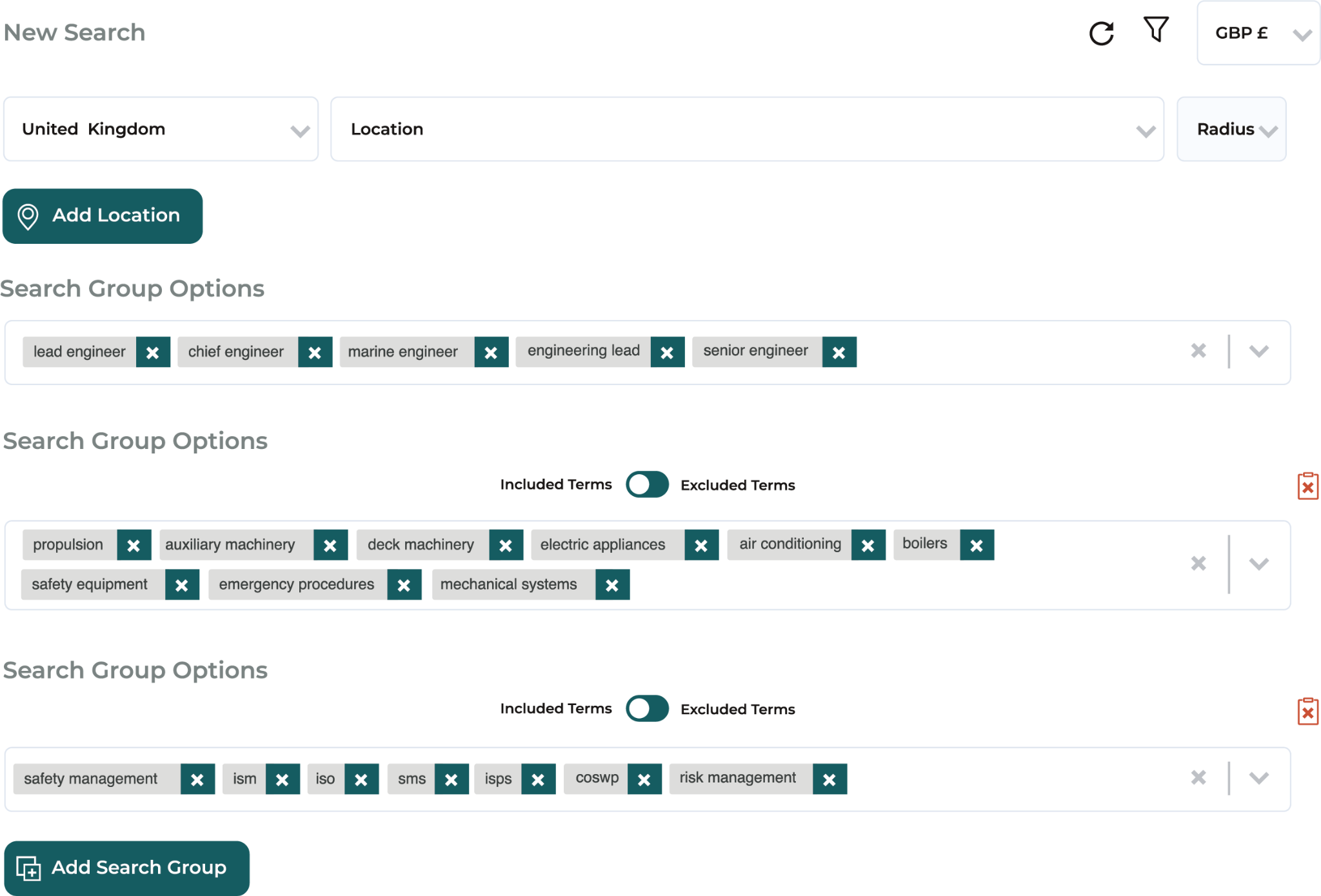
Image shows Horsefly’s AI Search Builder
Skills Mapping and Gap Analysis
Understanding what skills your workforce has, what the market offers, and where the gaps are is foundational to any serious workforce strategy. A good platform maps current skill frequency, surfaces emerging skills before they become mainstream requirements, and benchmarks your team's capabilities against competitors. Horsefly's Skills Insights and Signal Skills Intelligence give you both the current state and the forward view in one place. If you’d like to see how you can gain valuable insights from capabilities such as these, contact us for a strategy session to find out more.
Workforce Planning and Forecasting
Static workforce plans don't survive contact with a shifting labor market. Talent intelligence platforms with Longitudinal Intelligence, like Horsefly's, let you track how roles, skills, and pay have shifted over time, overlay supply and demand in a single view, and model forward scenarios using real historical data. You can see pressure building in a talent pool before it becomes a hiring emergency.
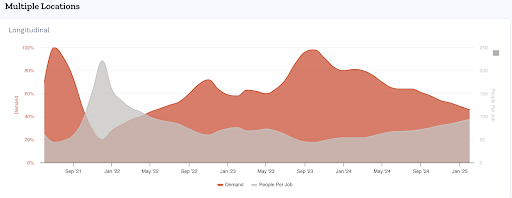
Image shows Horsefly’s Longitudinal data
Talent Market Data Analysis
Supply and demand data tells you where the talent is, how competitive the market is for specific roles, and which locations offer the best combination of availability and cost - giving you a genuinely global, granular view of the labor market.
Diversity. Equity, Inclusion (DEI) Insights
Talent intelligence platforms support more inclusive hiring by providing data on diverse talent pools, helping set meaningful DEI benchmarks, and tracking progress over time. It’s crucial to have an understanding of how diversity factors affect hiring challenges across different markets and roles, so your commitments come with a credible strategy attached.
Compensation and Cost of Living Data
Attracting talent is one thing. Affording them is another. Platforms that integrate compensation benchmarking and cost of living data help you build competitive offers, identify pay disparities, and make smarter decisions about where to locate teams. Compensation insights should compare packages against global industry standards, while Cost of living insights help you identify prime locations for expansion.
Integration with ATS and HRIS Systems
Talent intelligence doesn't live in a vacuum. The best platforms connect cleanly with your existing Applicant Tracking System (ATS) and Human Resources Information System (HRIS), so insights feed directly into the workflows your team already uses.
The technology is only as good as the plan behind it. Here's how to make talent intelligence implementation stick.
Start with clear objectives and KPIs
Before you log in for the first time, define what success looks like. Are you trying to reduce time-to-fill? Improve quality of hire? Build a more diverse pipeline? Your Key Performance Indicators (KPIs) should be specific, measurable, and tied to real business outcomes, not just platform usage metrics.
Audit your existing tech stack
Map out your current ATS and HRIS setup before onboarding. Understand where data lives today, where the gaps are, and how a talent intelligence platform will plug in. The goal is insight that flows into existing workflows, not a separate system that creates more work.
Integrate before you accelerate
Get the technical connections in place first. Clean data in, reliable insights out. Horsefly's platform is designed for seamless integration, launching searches directly, exporting data as PDF or CSV, and slotting into existing reporting without friction.
HR leaders should invest in training and change management
This is where implementations succeed or stall. Recruiters and HR professionals don't just need to know how to use the tool; they need to understand why it changes how they work. Training should cover both the platform mechanics and the shift in mindset from reactive recruiting to proactive, data-driven decision-making.
It’s important to remember that adoption doesn’t happen automatically. Nominate internal champions, build early wins into your rollout plan, and make sure leadership visibly endorses the shift.
Measure, learn, and iterate for smarter talent decisions
Set a review cadence to verify the effectiveness of your talent management strategies. Are the KPIs you defined at the start moving in the right direction? Look at your talent management, where is the platform being used well, and where is adoption lagging? Use what you learn to refine both your platform configuration and your internal processes. Talent intelligence is not a one-time setup, it's an ongoing capability. If you’d like more expert guidance on this, get in touch.

More data and smarter AI create real opportunity. They also create real responsibility.
Data privacy and compliance
Talent intelligence platforms handle significant amounts of personal and workforce data. Depending on where your organization operates, you'll need to comply with frameworks including GDPR in Europe, CCPA in California, and equivalent regulations across other jurisdictions. Before onboarding any platform, understand what data it collects, how it's stored, who can access it, and how long it's retained. Ask vendors directly about their compliance posture and data governance practices.
Avoiding AI bias in hiring
AI trained on historical data can replicate historical biases. If past hiring patterns skewed toward certain demographics, an AI system that learns from those patterns will perpetuate the problem at scale. Responsible talent intelligence vendors audit their models for bias, are transparent about the limitations of their data, and build tools that support, rather than automate, human decision-making.
Horsefly's DEI Insights are designed to surface the data that makes more inclusive hiring possible, giving teams visibility into diverse talent pools and the market context to act on it.
Fairness, transparency, and human oversight
Talent intelligence should inform decisions, not make them unilaterally. Maintain clear accountability: humans make the call, the data informs it. Be transparent with your own teams about how these tools are used and what role they play in hiring and workforce decisions. If you need more information on these issues, you can get in touch to discuss your needs.