.png?width=2000&name=Horsefly-Logo-NewTag_White%20(3).png)
The case for LMI software isn't complicated: better data leads to better decisions. But the practical benefits go further than that.
Smarter workforce planning
Instead of reacting to talent shortages after they've hit, you can see pressure building in the job market before it becomes a problem. Platforms like Horsefly Analytics provide longitudinal intelligence that tracks how roles, skills, and pay have shifted historically, enabling organizations to model forward scenarios with confidence. To learn more about this, you can contact us for expert guidance.
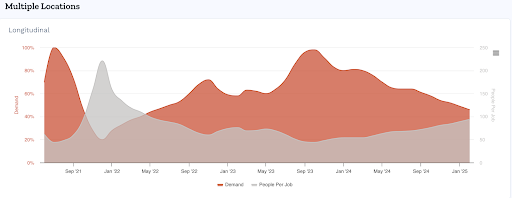
Image shows longitudinal data from the Horsefly platform
More effective talent acquisition
Know where the talent actually is, what skills they have, and what it will cost to hire them before you open a requisition. That kind of supply and demand visibility saves time, reduces wasted spend, and helps you target the right locations and channels.
Reduced hiring costs
Understanding Difficulty of Hire before you commit resources means you can plan realistically: set timelines, allocate budget, and avoid the expensive surprises that come with underprepared campaigns.
Better DEI outcomes
Comprehensive data helps organizations identify diverse talent pools and set meaningful benchmarks, rather than relying on instinct or limited internal data.
Stronger skills strategy
With signal skills intelligence that detects emerging skills before they go mainstream, you can future-proof your workforce development programs and build training plans that reflect where the market is actually going.
Competitive advantage
When others are still guessing, you're planning, and that gap compounds over time.
Not all labor market intelligence platforms are built the same. Here's what to evaluate before you commit.
Data sources and global coverage
Volume matters, but so does breadth. Horsefly Analytics draws on 1 trillion data points from thousands of online sources, covering 170,000 towns and cities across 65 countries. A platform with narrow geographic coverage or limited data sourcing will give you an incomplete picture, especially if your workforce strategy spans multiple regions.

Skills ontology
A skills ontology is the structured vocabulary a platform uses to classify and relate skills. The quality of this taxonomy directly affects how useful the skills data is. Look for platforms that cover a wide range of job titles and skills, and that update that taxonomy as the market evolves. Horsefly's unique taxonomy covers 815,000 job titles and skills in 39 languages.
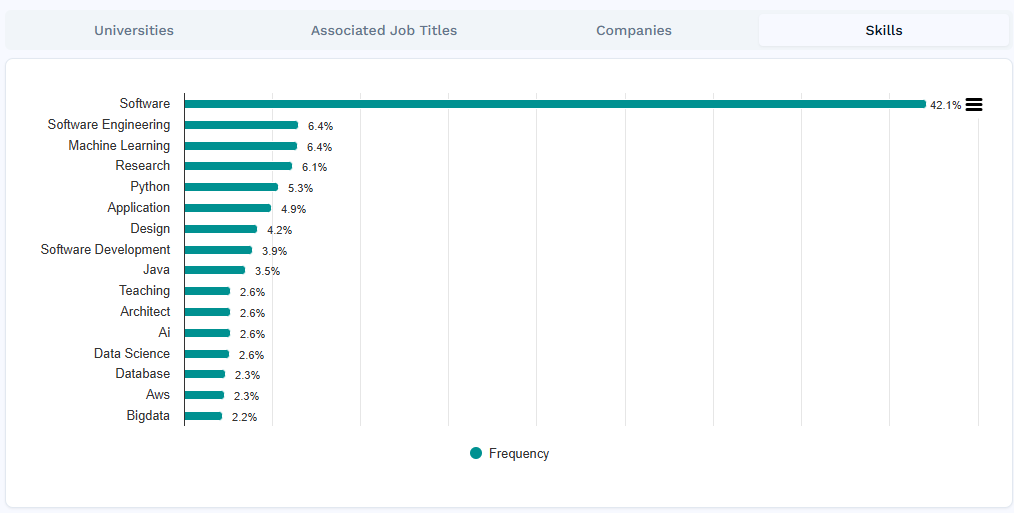
Image shows skills data from the Horsefly platform
Analytical capabilities
Supply and demand analysis, longitudinal trending, compensation benchmarking, AI impact analysis, and DEI insights are all table stakes for a serious LMI platform. If a tool only shows you job postings volume, it's not doing enough.
AI and machine learning
AI-powered labor market intelligence platforms go beyond descriptive market analytics. Look for predictive capabilities: platforms that can forecast how roles are likely to evolve, flag which skills are gaining momentum, and model scenarios based on historical trends.
Reporting and visualization
Insights are only useful if they're accessible. A good platform should offer intuitive dashboards, exportable data in formats like PDF and CSV, and global heat maps that let you visualize talent distribution at a glance.
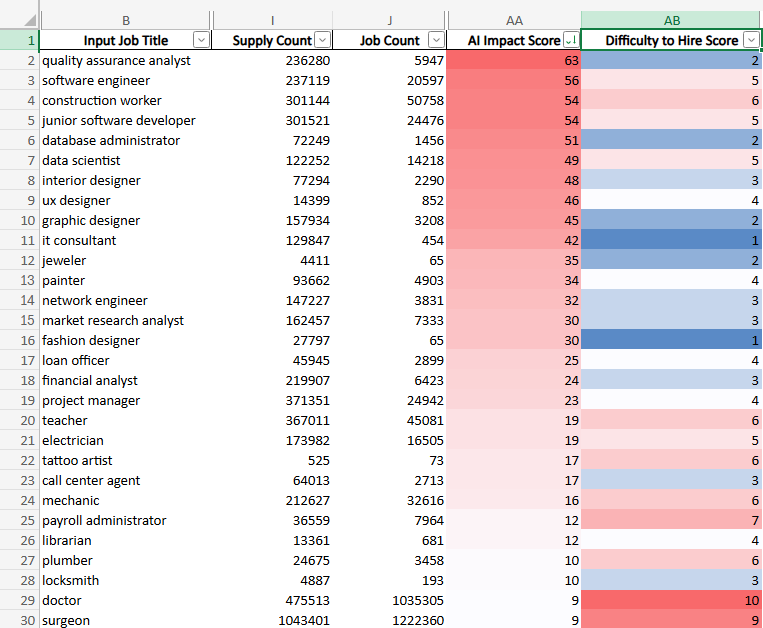
Example CSV data for a variety of job roles
Integration with existing HR systems
Standalone insights tools create silos. The best LMI software integrates with your ATS (Applicant Tracking System), HRIS (Human Resources Information System), and CRM (Customer Relationship Management) platforms, so data flows directly into the systems your team already uses. It’s also worth looking into whether an API (Application Programming Interface) for direct data access could be useful for you when it comes to integration.
Data accuracy and validation
Ask how often data is refreshed and how it's validated. Horsefly refreshes and validates data daily, which matters enormously when you're making time-sensitive talent intelligence decisions. Accurate data isn't a nice-to-have; it's the entire point.

Bias mitigation
If the platform uses AI to generate insights, it should also have clear processes for identifying and addressing algorithmic bias, particularly in applications that touch hiring and workforce composition.
Not all labor market intelligence tools are built to do the same job. Understanding the different categories helps you zero in on what your organization actually needs, rather than buying capability you'll never use.
Job posting aggregators collect and structure data from job boards and career sites to give a real-time read on hiring activity. They're useful for spotting demand signals but typically offer limited depth beyond what employers are currently advertising. If you want to understand what's happening in the market right now, they're a reasonable starting point. If you want to understand why, or what's coming next, they'll leave you short.
ATS-integrated intelligence tools embed market data solutions directly into existing applicant tracking systems, which keeps things tidy for teams already deep in a particular ecosystem. The trade-off is flexibility: the insights are only as broad as the platform they're built into, and they tend to serve one workflow well rather than informing strategy across the business.
People analytics platforms focus primarily on internal workforce analytics, helping organizations understand the talent they already have. They're strong on retention, performance, and internal mobility, but they look inward by design. Without external market context, it's difficult to benchmark salaries, measure ROI, plan proactively, or understand how your workforce compares to what's available outside your walls.
Academic and economic labor market research tools draw on government datasets, occupational classifications like SOC (Standard Occupational Classification) and CIP (Classification of Instructional Programs), and institutional research to provide macro-level labor market analysis. These are well-suited to policy, higher education, and economic development use cases, but they often lack the granularity and real-time currency that commercial talent strategy requires.
Comprehensive labor market intelligence platforms are built to do all of the above in a single, operationally usable interface. They combine external labor market data with skills intelligence, compensation benchmarking, supply and demand analytics, DEI insights, and predictive modeling, and they're designed for practitioners who need to act on the data, not just analyze it.
Horsefly Analytics sits firmly in this last category. Built for HR leaders, talent acquisition professionals, and workforce planners, its platform pulls from 1 trillion data points across thousands of online sources, covering 815,000 job titles and skills in 39 languages across 170,000 locations in 65 countries. Supply and demand, longitudinal business intelligence, AI impact analysis, compensation benchmarking, DEI insights, global heat maps, and skills trend detection are all available in one interface, with no data science background required. Data is refreshed and validated daily, so the picture you're working from reflects the market as it actually is, not as it was six months ago, making your data driven decisions even stronger.