Contents:
Key Takeaways:
1. Forecast demand first, then staffing, then planning. The most common mistake is jumping straight to headcount. Demand forecasting predicts the work and skills the business will need, driven by revenue, product roadmaps, and production volumes. Staffing forecasting turns that into headcount using productivity, utilization, and attrition. Workforce planning then decides how to close the gap. Forecasts built from HR data alone only project past hiring patterns, so business driver data is what gives a forecast predictive power.
2. Test complex models against a simple baseline. Build a seasonal time series or driver-based regression first, then compare more advanced models on held-out data. If a complex model can’t beat the baseline, use the baseline. Gradient boosting and ARIMAX often outperform LSTMs on typical enterprise datasets, and ensembles tend to work best. The real advantage of machine learning is continuous updating and quantified uncertainty, a range with probabilities rather than a single number.
3. Win buy-in with a retrospective test, and treat bias controls as model quality. Take a decision from 12 to 24 months ago and show what the forecast would have predicted using only data available then. Bring HR business partners in as co-owners who can document overrides. On bias, removing a gender or ethnicity field doesn’t remove it, since proxies like commute distance or university can correlate with protected characteristics. Audit training data, test for disparate impact, require explainability, and keep named humans accountable.
Why Accurate Staffing Predictions Are No Longer Optional
Most enterprise workforce plans are built on last year's headcount plus a growth percentage handed down from finance, and that method fails the moment a product launch slips, a competitor opens a hub in your best talent city, or a skill you need becomes scarce. Below, we lay out how to build a workforce demand forecast that holds up under those conditions: the data, methods, implementation sequence, ROI formula, and bias controls that keep AI-driven forecasts defensible.
The cost of getting this wrong runs in both directions. Overstaff, and you carry salaries, benefits, and real estate for work that never materializes, followed by layoffs that damage your employer brand in the same talent markets you'll need to recruit from again. Understaff, and you pay agency premiums, overtime, and delayed revenue while your existing teams burn out and leave.
At Horsefly Analytics, we work with global enterprises that compete for the same scarce engineers, quants, and manufacturing specialists. The organizations that consistently win competition don't have bigger recruiting budgets. They see demand earlier, giving them months to choose pipelines and locations, and decide whether to build, buy, or borrow talent. That lead time is where competitive advantage in workforce strategy comes from, and it only exists when forecasting is tied directly to business objectives rather than run as an annual HR exercise.

Demand vs. Staffing vs. Planning
Steering committees use these three terms interchangeably, and this confusion causes real problems. Teams end up debating headcount numbers before anyone has agreed on what work needs doing.
-
Workforce demand forecasting predicts the future work and skills an organization will need, starting from business drivers such as revenue targets, product roadmaps, production volumes, and transaction growth.
-
Staffing forecasting translates that demand into headcount. It accounts for productivity rates, utilization, shift patterns, and expected attrition to answer how many people, in which roles, at which locations, and by when.
-
Workforce planning is the broader strategy that encompasses both. It decides how to close the gap between the workforce you have and the workforce you'll need, through hiring, internal mobility, reskilling, contingent labor, automation, or location strategy.
The most common mistake we see is skipping straight to headcount. Demand comes first, staffing second, planning third.
The Benefits of Workforce Forecasting
The benefits fall into four areas:
Financial Control
Labor is usually the highest controllable cost in the enterprise. Forecasting lets you hire to demand instead of reactively at premium rates. When you know six months ahead that a region will need 25 additional analysts, you can recruit through standard channels at market compensation. When you find out six weeks ahead, you pay agency fees, signing bonuses, and the productivity cost of rushed onboarding. Forecasting also exposes the opposite problem: teams staffed for demand that peaked two quarters ago.
Alignment with Business Goals
Market expansion and new product lines fail quietly when talent arrives late. A forecast tied to the product roadmap tells you whether the skills for a planned launch exist in your chosen location at a cost the business case can absorb. Sometimes the right answer is to change the location or launch date, which is far cheaper before the commitment.
Risk Mitigation
Forecasting surfaces skill gaps before they become delivery failures. It also identifies concentration risk: critical capabilities held by a handful of people nearing retirement, or roles sourced from a single labor market where a competitor is about to open a large site.
Employee Retention and Experience
Chronic understaffing is one of the most reliable predictors of voluntary turnover we know of. Overloaded teams lose people, which increases the load on whoever remains. Planning workloads against realistic demand reduces the burnout cycle. Forecasting also gives you time to offer internal candidates development paths into emerging roles before you recruit externally.
Workforce Analytics: Essential Data for Accurate Forecasts
We have watched sophisticated models produce confident nonsense because job codes changed mid-dataset or a reorganization made three years of history incomparable. Data quality work determines whether the program succeeds.
Internal Historical Data
Start with what you already own:
-
Workforce history: Headcount by role, level, location, and cost center, ideally at monthly granularity for at least three years.
-
Turnover and mobility: Voluntary and involuntary attrition, internal transfers, promotions, and retirement eligibility.
-
Hiring trends: Requisition volumes, time-to-fill, offer acceptance rates, and source effectiveness by role family.
-
Business drivers: Sales data, project pipelines, production schedules, customer volumes, and transaction counts.
The business driver data is where most programs fall short. HR teams often build forecasts from HR data alone, producing a projection of past hiring patterns rather than a forecast of future needs. The relationship between, say, contracted project revenue and required delivery headcount is what gives a forecast predictive power.
External Market Data
Internal data tells you what you need. External data tells you whether you can get it, and at what price:
-
Labor supply: The size and growth of the talent pool for specific skills in specific locations, graduate pipelines, and migration patterns.
-
Labor demand and competitor activity: How many employers are hiring for the same skills, and where competitors are expanding.
-
Compensation benchmarks: Current market rates by role, level, and geography, plus wage growth trends.
-
Market trends: Emerging skills, declining skills, and how role definitions are shifting.
This is the data that is slowest and hardest to assemble internally, and it's the problem we built Horsefly Analytics to solve. Our talent intelligence solutions give workforce planners fast access to global labor market data, so a decision doesn't wait weeks for a consultant report.

Data Hygiene
Before modeling, standardize job architecture across regions, reconcile HRIS and finance headcount (they rarely match), flag structural breaks such as acquisitions and reorganizations, and document every assumption. A single, governed dataset beats five richer but contradictory ones.
Forecasting Methods: From Traditional to AI-Powered
There is no single best forecasting methodology. The right choice depends on data volume, forecast horizon, and how stable the business is. We use a combination in nearly every engagement.
Traditional Qualitative Methods
The Delphi method gathers anonymous estimates from a panel of experts over several rounds, sharing aggregated results between rounds until views converge. It's useful when you have little historical data, such as for a new business unit or a new technology capability. Its weakness is that experts anchor on recent experience and rarely anticipate structural change, so we treat it as a hypothesis to test, not a forecast to act on.
Traditional Quantitative Methods
Time series analysis projects future values from historical patterns, capturing trend and seasonality. It works well for stable, high-volume roles such as contact center agents or seasonal manufacturing staff. It works poorly when the future differs from the past, which is precisely when you most need a good forecast.
Regression analysis models headcount as a function of business drivers: revenue, units produced, and accounts managed. It is transparent and easy to explain to a CFO, which is underrated. Its limitation is that it assumes fairly linear, stable relationships and struggles with many interacting variables.
Predictive Analytics and Machine Learning
Advanced predictive analytics earns its place when you have many variables, nonlinear relationships, and enough data to train on. A few model families matter most in workforce forecasting:
ARIMA and its seasonal variant SARIMA are statistical time series models that handle trend, seasonality, and autocorrelation more rigorously than simple projections. ARIMAX extends them with external variables, so you can model attrition as a function of both its own history and local labor market tightness. These models are a sensible baseline and often harder to beat than vendors suggest.
Gradient boosted trees (such as XGBoost or LightGBM) excel at combining dozens of drivers, including internal metrics, market data, and calendar effects, and capturing interactions between them. They are particularly strong for attrition prediction and role-level demand where the relationships are messy.
Recurrent neural networks, especially LSTM models, can learn long-range patterns in sequential data. They need large datasets and careful tuning, and in our experience they are overused. For most enterprise workforce datasets, which typically hold a few years of monthly data per role family, an LSTM rarely outperforms a well-built gradient boosting or ARIMAX model, and it is much harder to explain.
Ensemble approaches combine several models and weight them by recent accuracy. These consistently perform best in our work because no single model wins across all role families and horizons.
The real advantage of machine learning in AI forecasting is not raw accuracy. It's the ability to update continuously as new data arrives and to quantify uncertainty, giving you a range with probabilities rather than a single number pretending to be precise.
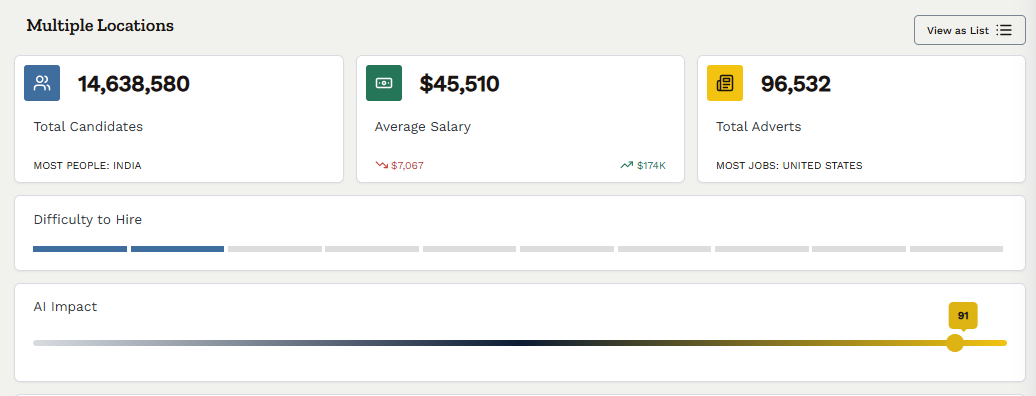
A view of Horsefly’s AI Impact to help businesses forecast for their own roles
A Step-by-Step Framework for Implementation
1. Define Objectives and Scope
Pick the decision the forecast will inform. "Improve workforce planning" is not an objective. "Determine engineering hiring volume and location mix for the next 18 months to support the platform roadmap" is. Start with two or three critical role families rather than the entire enterprise. A narrow pilot that changes a real decision builds more credibility than a broad program that produces dashboards nobody uses.
2. Consolidate and Cleanse Data
Assemble internal and external data for the pilot scope. Expect this to consume 50 to 70 percent of the effort in the first cycle. Map job codes to a common skills taxonomy, reconcile headcount sources, and agree on definitions with finance before modeling begins.
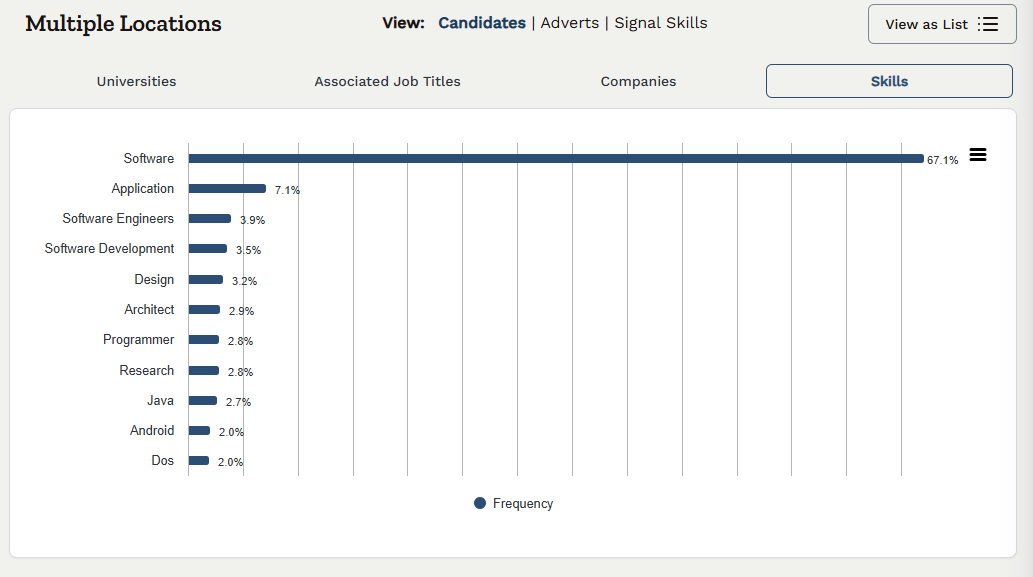
The Skills capability within Horsefly
3. Select and Test Forecasting Models
Build a simple baseline first, such as a seasonal time series or a driver-based regression. Then test more advanced forecasting models against it using holdout periods: train on data through a given date and measure how well each model predicts the following year. If a complex model can't beat the baseline on held-out data, use the baseline.
4. Validate Forecasts and Run Scenarios
Review outputs with business leaders who know the operational reality. They will catch problems no model can, like a planned plant automation or a client contract about to be lost. Then build scenario planning into the process: a base case, an upside case, and a downside case, each tied to explicit business assumptions. Scenarios convert a forecast from a prediction that will be wrong into a set of prepared responses.
5. Translate Insights into a Talent Plan
For each scenario, define the response: how many hires, from which markets, through which channels, at what compensation, and which gaps you'll close through internal mobility, reskilling, or contingent labor. Assign owners and trigger points. For example: "If Q2 bookings exceed X, open the second wave of requisitions in location Y."
6. Monitor, Measure, and Refine
Track forecast accuracy against actuals monthly. Investigate large misses, retrain models on a regular cadence, and expand scope one role family at a time once the pilot proves its value.

Managing Common Hurdles in Forecasting Implementation
Breaking Down Data Silos
Headcount sits in the HRIS, budgets sit in finance, project pipelines sit in the CRM or PMO, and market data sits in a consultant's slide deck. Each owner has legitimate reasons to protect their data.
What works: don't attempt a full data integration program up front. Negotiate a narrow data-sharing agreement for the pilot scope, with a named owner in each function. Show each data owner what they get back. Finance, for example, gets a headcount forecast that reconciles to its budget model. Reciprocity moves data faster than executive mandates.
Securing Executive Buy-In
Executives have seen workforce analytics projects produce attractive dashboards and no decisions. Skepticism is reasonable.
The most effective approach we've seen is a retrospective test. Take a decision from 12 to 24 months ago, such as a hiring surge or a site launch, and show what the forecast would have predicted using only data available at the time, compared with what actually happened. A concrete account of avoided agency spend or a launch delay that could have been prevented, makes the case better than any vendor presentation.
Managing Change with HR Business Partners
HR business partners often see centralized forecasts as a threat to their relationships with business leaders, or as a black box overriding their judgment. If they don't trust the forecast, they won't use it, and the business leaders they advise won't either.
Bring HRBPs into the validation step as co-owners. Give them the ability to adjust forecasts with documented reasoning, then track whether their overrides improve or reduce accuracy. Over a few cycles, this creates a productive feedback loop: the model learns from their context, and they learn where their instincts are reliable.
Accounting for Black Swan Events
No model predicted the pandemic hiring whiplash, and they won't predict the next major shock either. Pretending otherwise damages credibility.
Keep forecast horizons short where market conditions are volatile, maintain scenario plans for extreme cases, and build flexibility into the talent plan itself: contingent labor agreements, cross-trained internal pools, and hiring commitments staged in waves rather than made all at once. The goal is a workforce plan that bends without breaking when the forecast is wrong.
Calculating the ROI of Your Forecasting Practices
Few forecasting programs measure their own return, which makes them easy targets in the next budget cycle. Build the measurement in from the start.
Key Metrics to Track
-
Time-to-fill: Earlier visibility should shorten it, because pipelines are built before requisitions open.
-
Recruitment costs: Agency fees, premium sourcing, signing bonuses, and relocation, which typically fall when hiring is planned rather than reactive.
-
Overstaffing costs avoided: Fully loaded cost of positions not filled because the forecast showed demand wouldn't support them, plus avoided severance.
-
Understaffing costs avoided: Overtime, contractor premiums, and revenue delays attributable to vacancies.
-
Productivity: Output per employee in teams staffed to forecast versus historical baselines.
-
Regretted attrition: Changes in turnover in previously overloaded teams.
-
Forecast accuracy: Mean absolute percentage error by role family, as a leading indicator of the program's health.
The ROI Formula
ROI = [(Cost Savings + Value Gains − Investment Cost) / Investment Cost] × 100
Cost savings include reduced recruitment costs, overstaffing, and contractor spend. Value gains include revenue protected by filling critical roles on time and productivity improvements. Investment cost covers data and technology, analyst time, and change management.
An Illustrative Calculation
Consider a hypothetical enterprise that spends £1.2 million in the first year on forecasting technology, data, and a small analytics team. The forecasts let it shift 150 hires from agency to direct sourcing at an average saving of £2,000 each (£1.8 million), cancel 20 planned positions that demand didn't support at a loaded cost of £110,000 each (£2.2 million), and cut contractor overtime by £500,000. That's £4.5 million in savings before counting any value gains.
ROI = [(£4.5M − £1.2M) / £1.2M] × 100 = 275 percent
These numbers are illustrative, not a benchmark. Your figures depend on scale and starting maturity. Two cautions apply. First, attribution is hard: be conservative and agree on the methodology with finance before results come in. Second, value gains such as protected revenue are real but contested, so present them separately from hard cost savings to protect credibility.
The Future of Forecasting: AI, Ethics, and Building a Fairer Workforce
Real-Time Data and Automation
The annual planning cycle is giving way to continuous forecasting. Models refresh as new hiring data, business metrics, and labor market signals arrive, and automation handles the routine work of data pipelines, retraining, and anomaly alerts. The near-term practical result is that workforce planners spend less time assembling spreadsheets and more time on the scenario decisions only humans can make. Forecasts are also shifting from roles to skills, which matters as job titles fragment and the same skill appears across dozens of role definitions.
Where Bias Enters
The ethical considerations of AI in HR deserve more attention than they usually get in forecasting discussions, which tend to focus on hiring algorithms. Forecasting models carry their own risks.
Historical data encodes historical decisions. If a company has promoted few women into engineering leadership, a model trained on that history will forecast future leadership supply from the same narrow pool and treat it as natural. If certain locations were historically overlooked, the model will underweight their talent supply, and the forecast becomes self-fulfilling as recruitment investment follows it.
Bias also enters through proxy variables. Attrition models that use commute distance, tenure gaps, or university attended can correlate with protected characteristics even when they are excluded from the data. Removing a gender or ethnicity field does not remove the bias.
Mitigation Strategies
These are the practices we consider necessary, not aspirational:
-
Audit training data before modeling. Examine representation across demographic groups, locations, and role families, and document known historical distortions.
-
Test outputs for disparate impact. Compare forecasts and model-driven recommendations across groups. If an attrition model flags one demographic group as high-risk at twice the rate of another, investigate before anyone acts on it.
-
Broaden the data. External labor market data helps correct for internal history. It shows the real talent supply in a location or demographic, not just the slice your past recruiting reached.
-
Require explainability. Planners should be able to see which drivers produced a forecast. If a model can't explain its output in terms a business leader would accept, it shouldn't drive decisions about people.
-
Keep humans accountable. Use models to inform decisions, not make them. Named individuals should own every workforce decision, with the authority and obligation to override model recommendations.
-
Monitor continuously. Bias can emerge as data drifts. Make fairness metrics part of routine model monitoring, alongside accuracy.
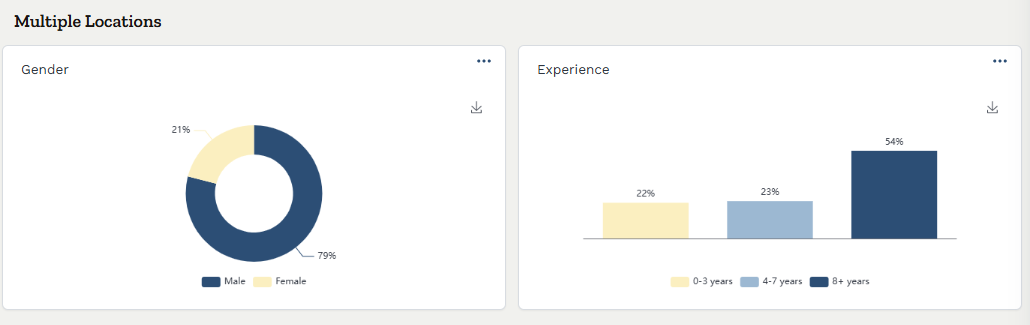
An image of some of the demographic views within Horsefly
AI regulation in employment decisions is tightening in several jurisdictions, and global enterprises will face differing requirements across markets. Building these controls now costs far less than retrofitting them after a regulatory inquiry or a public incident.
From Workforce Planning to Strategic Advantage
The organizations that get this right share a few habits. They forecast work and skills before headcount and pair internal history with external market data. They also pick methods based on tested accuracy, plan in scenarios, measure ROI with finance from day one, and treat bias controls as part of model quality.
Each of those habits depends on fast, reliable access to global labor market intelligence. Knowing you need 200 machine learning engineers is only useful if you also know where they are, who else is hiring them, and what they cost. At Horsefly Analytics, our global talent intelligence is built to answer exactly those questions, so your forecasts translate into location strategies, hiring plans, and a future-ready workforce your competitors will struggle to match.
If your forecasts still stop at the edge of your own HRIS, explore how the Horsefly Analytics platform can bring global market intelligence into your workforce planning.

Frequently Asked Questions
What is the difference between workforce demand forecasting and staffing forecasting?
Workforce demand forecasting predicts the future work needed and the skills required to perform it, driven by business objectives like revenue targets. Staffing forecasting then translates that demand into the necessary headcount, considering productivity, utilization, and expected attrition to determine how many people are needed.
Why is accurate workforce demand forecasting important for businesses?
Accurate forecasting prevents costly overstaffing or understaffing, saving on salaries and agency fees. It ensures talent aligns with strategic business goals, mitigates skill gap risks before they impact delivery, and improves employee retention by preventing burnout from chronic understaffing.
What types of data are essential for building reliable workforce forecasts?
Essential data includes internal historical workforce, turnover, hiring trends, and critical business drivers like sales and production volumes. Crucially, external market data on labor supply, competitor demand, compensation benchmarks, and emerging skill trends is also needed for comprehensive insights.
How can companies manage bias in AI-driven workforce forecasts?
Mitigate bias by auditing training data for historical distortions, testing outputs for disparate impact across demographic groups, and broadening data with external labor market intelligence. Ensure model explainability, keep humans accountable for all decisions, and continuously monitor fairness metrics to prevent emergent bias.
What is a step-by-step process for implementing workforce demand forecasting?
First, define specific objectives for critical roles. Next, consolidate and cleanse internal and external data. Select and test various forecasting models, validating outputs with business leaders. Finally, translate these insights into a detailed talent plan with assigned owners, and continuously monitor and refine accuracy.
How often should a company update its workforce demand forecast?
Workforce demand forecasts should be updated continuously as new business metrics and labor market signals become available, especially for dynamic roles. For more stable areas, reviewing and refreshing forecasts quarterly or semi-annually ensures they remain aligned with evolving strategic objectives and market realities.
What are common challenges when implementing workforce forecasting, and how can they be overcome?
Common challenges include breaking down data silos, securing executive buy-in, and managing change with HR business partners. Overcome these by negotiating narrow data-sharing agreements, demonstrating clear ROI through retrospective tests, and involving HRBPs as co-owners in validating forecasts.
Sources: Horsefly Analytics