.png?width=2000&name=Horsefly-Logo-NewTag_White%20(3).png)
Every strong international workforce plan starts in the same place: the business strategy, not the org chart. If the company is entering a new market, launching a product, or cutting costs, that ambition needs to translate into a talent requirement before a single job description gets written.
This is where forecasting earns its keep, as instead of reacting to open roles as they appear, workforce planning leaders map business plans forward and ask what skills, roles, and headcount those plans will demand, in which countries, and on what timeline. That means auditing the current workforce honestly: where are the skills gaps, which roles are hardest to backfill, and where is the business already stretched thin.
Strategic alignment also forces a useful discipline. It is easy to plan for the roles you know you need. It is harder, and more valuable, to plan for the roles the business will need in 18 months. Organizations that get this right build effective workforce plans that flex with strategy, rather than plans that need rebuilding every time strategy shifts. That is the difference between workforce planning as an administrative task and workforce planning as a genuine input to how the business grows.
Navigating the Complexities of Global Compliance and Culture
Here is where international workforce planning stops being theoretical. Every country has its own labor laws, tax obligations, and statutory benefits, and none of them are interchangeable. What counts as standard severance in one market might be illegal in another. Payroll cycles, contractor classifications, and minimum benefits all vary, often significantly, and getting them wrong is not a paperwork issue, it is a legal and financial one.
Culture adds another layer entirely, with communication norms, management expectations, and attitudes toward work-life balance differing across regions, and assuming a playbook that works in one country will translate cleanly to another is a common, avoidable mistake. A management style that reads as direct and efficient in one culture can read as abrupt or even disrespectful in another.
A simple framework can offer some help with international compliance. Before entering a new market or region, strategic workforce planning teams should evaluate three things: the legal landscape (labor law, tax treatment, statutory requirements), the cultural landscape (communication style, hierarchy expectations, typical benefits norms), and the practical landscape (talent availability, cost of living, competitive intensity). None of these should be guesswork; they should be grounded in real, current data, because labor law and market conditions change, and last year's assumptions are not a safe foundation for this year's decisions.
Location planning tools exist for exactly this reason: to replace assumptions with evidence before you commit resources to a new market.
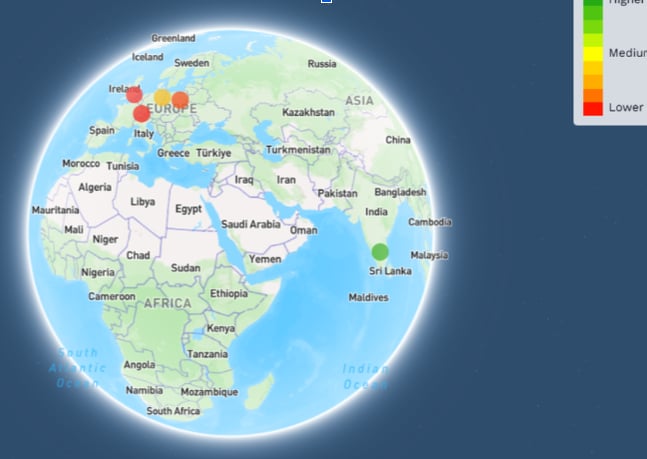
Image shows how the Horsefly global heat map displays location data
Leveraging Technology and Data for Smarter Workforce Decisions
Spreadsheets got workforce planning this far. They will not get it much further. Modern talent intelligence platforms exist because global workforce decisions need more than a shared file and a best guess, they need current, reliable data at a scale no single team can manually assemble.
This is where artificial intelligence and predictive analytics earn their place in the conversation. Rather than reacting to hiring problems as they surface, these tools forecast talent supply and demand ahead of time, model different workforce scenarios, and flag where costs can be reduced without cutting corners. Horsefly's labor market intelligence platform, for example, draws on more than 1 trillion data points from thousands of online sources, covering 170,000 towns and cities across 65 countries, with a taxonomy of over 815,000 job titles and skills in 39 languages.
That scale matters because it replaces unreliable, fragmented data with something you can actually build a strategy on. Capabilities like Compensation Insights let teams benchmark pay against global standards and catch equity issues before they become retention problems. Supply and Demand Insights show where qualified talent is genuinely available, not just where you assume it is. Difficulty of Hire Insights flag which roles will take real time and effort before recruiting even starts, so resourcing decisions get made with accurate information rather than optimism.
For workforce planning leaders specifically, AI Impact Analysis and Longitudinal Intelligence are worth a closer look. Instead of guessing how automation might reshape a role over the next few years, these tools show how roles, skills, and pay have shifted historically, and use that pattern to forecast what is coming next. That is the kind of foresight that turns a workforce plan from a snapshot into something genuinely forward-looking.
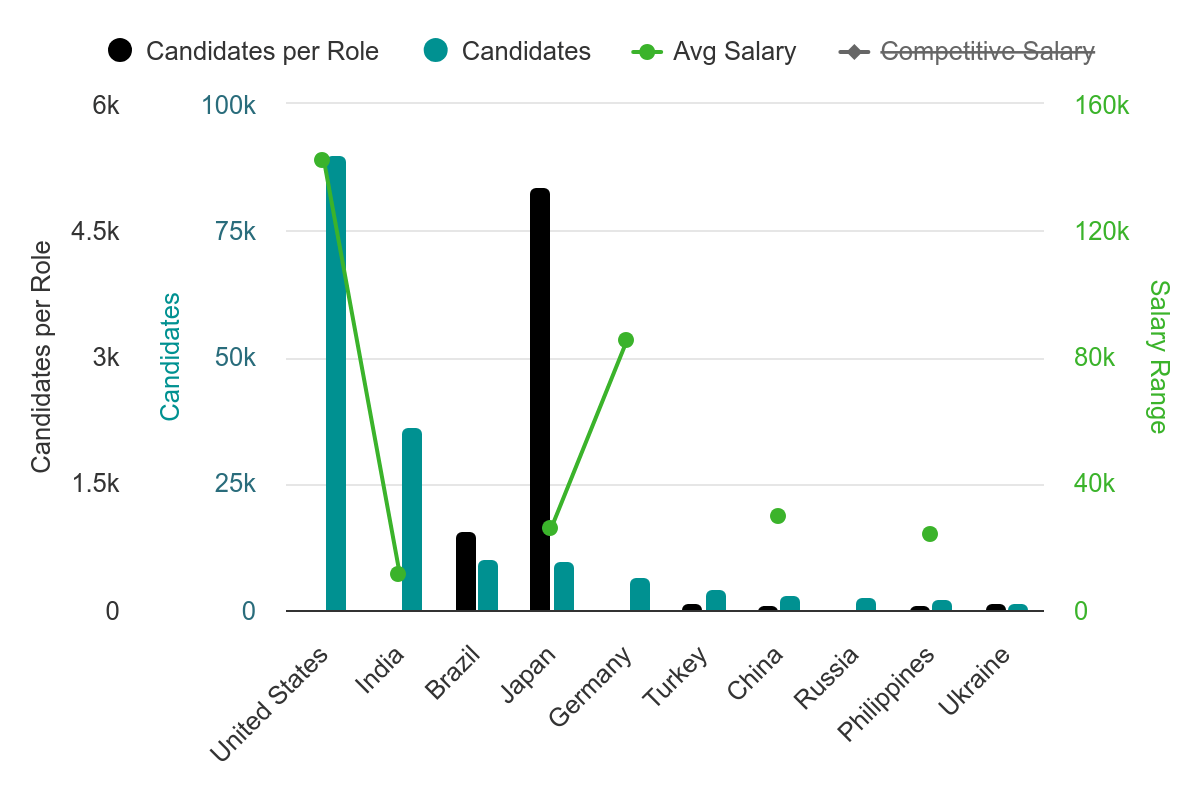
Image shows helpful global hiring insights from the supply and demand data from inside the Horsefly platform
Executing Global Talent Acquisition and Skills Management
A plan is only as good as the hiring and skills strategy behind it. Global talent acquisition starts with a hard question: where does the talent you need actually live, and is it easier to find it externally or build it internally?
That build vs buy decision runs through every workforce plan. Reskilling existing employees is often faster and cheaper than an external search, particularly for niche or emerging skills where the external market is thin everywhere. But reskilling only works if you’ve done your research and skills planning so you’re aware which skills are worth investing in, which is where talent acquisition data becomes genuinely useful rather than a nice-to-have. For markets where building an internal team is not yet practical, many organizations turn to an RPO partner to scale hiring quickly without sacrificing quality.
Skills insights can benchmark your workforce against industry standards and flag where future skill requirements are heading, so training budgets go toward the skills the market will actually reward. And intelligence into signal skills can spot skills that are gaining momentum before they become standard job requirements, giving talent management teams a genuine head start.
Put together, this is what skills-based management looks like in practice: identifying internal mobility opportunities, building career paths around real market data, and closing skills gaps deliberately instead of reactively. It is a stronger foundation than hiring your way out of every problem, and it tends to be considerably more cost-effective too.
Overcoming Key Challenges in International Planning
No international workforce plan operates in a vacuum. Geopolitical shifts, currency swings, and economic instability can all reshape a hiring plan overnight, and pretending otherwise does not make a company more resilient; it makes it more exposed.
The honest answer is that these challenges do not disappear with good planning, they become manageable with it. Companies with accurate, current data can see disruption coming and adjust before it becomes a crisis, rather than finding out about a labor market shift after it has already cost them talent or budget.
Distributed teams bring their own version of this challenge. Cross-cultural communication and collaboration do not happen automatically just because everyone has the same video conferencing software. They need frameworks: clear norms for how decisions get made, how feedback is given, and how teams stay connected across time zones. Get this right and geography stops being a barrier to productivity. Get it wrong, and even a well-staffed global team will underperform, simply because nobody built the connective tissue to hold it together.

Measuring Success: KPIs for Global Workforce Planning
A workforce strategy without metrics is really just an opinion. To know whether international workforce planning is actually working, track it across four categories.
Cost efficiency. Cost per hire by region and labor cost variance against budget show whether your hiring is financially sustainable, not just operationally successful.
Hiring velocity. Time-to-fill for critical roles reveals where your process is genuinely competitive and where it is quietly losing talent to faster movers.
Talent quality and retention. New hire performance ratings and regrettable attrition rate by country tell you whether you are hiring well, not just hiring fast. A low time to fill means little if the people you hire are not the right people and do not stay or do not perform.
Strategic impact. The percentage of critical roles filled internally, and how closely workforce outcomes track against strategic goals, show whether workforce planning is actually driving the business forward or simply keeping pace with it.
Most guidance on this topic stops at cost-per-hire, but that’s not enough for a genuinely global operation. Tracking all four categories together, and reviewing them by region rather than as a single global average, is what turns workforce data into decisions you can actually act on; you need quality global workforce management. Horsefly's Summary Tab Intelligence is built for exactly this: real-time, context-aware insights tailored to your specific search, rather than a generic dashboard showing everyone the same numbers.
Building a Future-Proof Global Workforce Strategy
International workforce planning is not a project with an end date. It is an ongoing discipline that gets revisited as business goals shift, as new markets open, and as labor markets move in ways nobody predicted twelve months ago. Companies that treat it as a one-time exercise end up rebuilding their plan from scratch every time something changes. Companies that treat it as a living process for securing their future workforce simply adjust.
The businesses that win here are the ones that can make fast, well-informed talent decisions while everyone else is still gathering information. That is not a matter of working harder; it is a matter of having better data and the discipline to act on it.
Horsefly brings together compensation benchmarking, skills intelligence, cost of living data, and predictive data analytics into a single platform built for exactly this kind of decision-making, at global scale. If you are ready to replace guesswork with genuine labor market intelligence to start making smarter decisions on anything from succession planning to skills based hiring for gaining that competitive edge, schedule a strategic consultation to find out more.
Sources: Horsefly Analytics