.png?width=2000&name=Horsefly-Logo-NewTag_White%20(3).png)
The Business Impact of Data-Driven Compensation
Benchmarking for its own sake is pointless, but done well, it can drive results across three areas every HR leader is measured on.
Talent Acquisition
When your compensation benchmarking strategy is anchored in accurate market data, you can build competitive offers without guessing and without overpaying just to be safe. You know exactly what a role commands in a specific market, so you can move fast and confidently when you find the right talent, rather than negotiating in the dark. This is where a strong talent acquisition strategy and solid employee salary benchmarking data work hand in hand for strong talent attraction and employee retention.
Talent Retention
Pay is rarely the only reason someone leaves, but it is one of the fastest ways to lose them. Fair, market-aligned, competitive pay tells your people that you value them at the same rate the market does. Get this wrong, and even your most engaged employees will start answering recruiter messages.
Internal Equity and DEI
This is where benchmarking earns its keep as more than a recruiting tool. Objective, external market data gives you a defensible basis for pay decisions that is not clouded by internal politics, tenure assumptions, or unconscious bias. It helps you spot pay gaps before they become a headline, and gives your diversity initiatives something concrete to measure against, rather than good intentions alone.
Put together, these three outcomes are the difference between compensation as an administrative task and compensation as a genuine competitive advantage and all of them mean a better chance when looking to attract and retain talent.

A 5 Step Framework for Effective Salary Benchmarking
Salary benchmarking is not vague guesswork, and skipping a step is usually where things start going wrong, or worse, opening you up to legal risk. Here is the five-step process for moving from ad hoc benchmarking to a repeatable strategy.
Step 1: Job Architecture
This is where employee salary benchmarking really starts, and it begins internally, not externally. You need clean job descriptions and consistent job leveling across your organization. If your "Senior Software Engineer" in one office does the same job as your "Staff Engineer" in another, your benchmarking data will be meaningless. Get your job architecture straight first.
Step 2: Data Source Identification
Decide where your market data will come from: traditional compensation surveys, government labor statistics, or a modern talent intelligence platform. Each source carries tradeoffs in cost, recency, and depth, covered in more detail in the next section.
Step 3: Data Collection and Validation
This is where accuracy actually gets tested. Gather your data and interrogate it. Is the sample size large enough to mean anything? Is it recent, or is it a survey someone ran two years ago and forgot to update? Validate everything before building a single pay band on top of it.
Step 4: Salary Benchmarking Analysis
Now compare your internal roles against the external benchmarks you have gathered, typically at the 25th, 50th, and 75th percentiles. This tells you not just what the market rate is, but where you want to sit against it: are you aiming to lead the market, match it, or lag slightly in exchange for other perks?
Step 5: Strategy Integration
Finally, turn your analysis into salary bands and weave the findings into your broader compensation strategy. Benchmarking that lives in a spreadsheet nobody opens again is not strategy; it is busywork. This is where a platform like Horsefly's Compensation Insights earns its place, feeding current market numbers straight into the bands you build, instead of last year's guesswork.
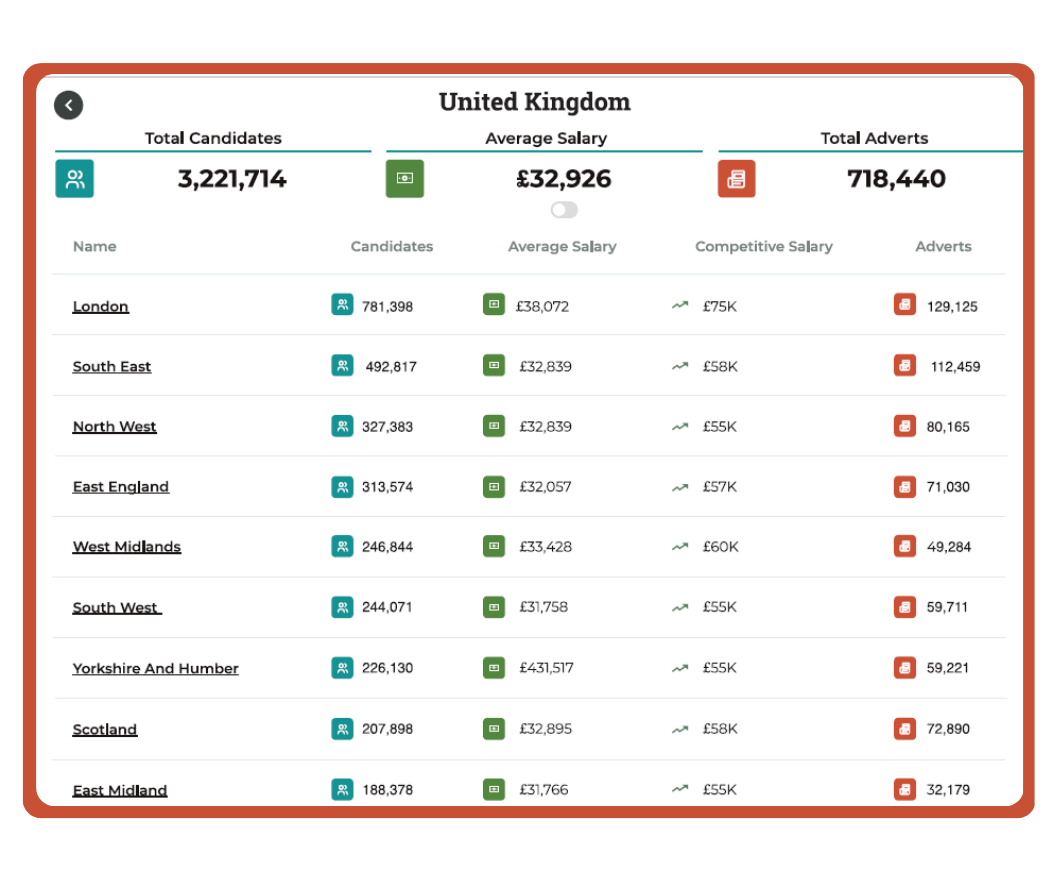
A view of Horsefly’s Compensation data to help you build compensation packages
That’s the framework; simple to describe, harder to execute consistently, which is exactly why so many companies fall back on stale surveys and hope for the best. Get in touch for more expert guidance.
Choosing Your Data: Sources, Reliability, and Accuracy
Not all data is created equal, and this is the part most guides skate over. Traditional compensation surveys have their place, but they come with real limitations: they are often a snapshot from months ago by the time you see them, they rely on self-reported figures from participating companies, and they rarely offer the granularity a global workforce needs.
Granularity is the word to focus on. Pay varies by location, industry, company size, and even by neighborhood in some major cities. A national average tells you almost nothing useful when you are trying to work out what to pay talent in Austin versus rural Ohio, let alone comparing markets across continents. This is exactly why location specific data matters more than most benchmarking guides admit, and why market salary benchmarking has to be granular to be worth anything.
Modern talent intelligence platforms solve this by pulling from a far wider range of sources than any single survey could cover, then using AI and machine learning to validate and aggregate the data into something you can actually trust. Horsefly, for example, draws on data points from thousands of online sources, refreshed and validated daily, covering job titles and skills across dozens of languages and tens of thousands of towns and cities worldwide. That is a meaningfully different picture than a survey updated once a year.
The bottom line is that, if your benchmarking data is not recent, granular, and validated, you are not benchmarking. You are guessing with extra steps.

Navigating Common Benchmarking Challenges
Even with the right framework, benchmarking gets messy in practice. A few challenges come up again and again.
Data reliability
Small sample sizes and outdated sources skew results more than people realize. If only three companies reported data for a role in a given market, that is not a benchmark, that is an anecdote. Always check your sample size before trusting a number.
Internal buy-in
Data alone does not win an argument with a finance leader who thinks compensation is already generous enough. Bring the numbers, but also bring the business case: turnover costs, time to fill, and the cost of losing talent to a competitor who paid up. Numbers plus consequences move budgets faster than numbers alone.
Niche and newly created roles
This is the challenge that trips up almost everyone, and where most guides simply stop talking. When a role is brand new, highly specialized, or so niche that direct market comparisons barely exist, traditional benchmarking falls apart. The fix is to shift from job title comparisons to skills-based analysis: instead of asking what a "Senior Machine Learning Platform Architect" makes, ask what the underlying skills are worth in the market, then build your number from there. Horsefly's Signal Skills Intelligence is built for exactly this situation, analyzing skills-level data to fill in gaps that title-based searches miss entirely.
None of these challenges are reasons to skip benchmarking. They are reasons to build a process sturdy enough to handle the messy, real-world cases, not just the easy ones.
Legal and Compliance: Benchmarking for Pay Equity
This is the section too many guides skip entirely, and that is a mistake. Salary benchmarking is not just a talent strategy tool; it is a legal one.
Pay equity laws are expanding, not shrinking. Wherever you operate, you likely already face requirements to justify pay differences between employees doing comparable work, and "we've always paid it this way" does not hold up in an audit or a lawsuit. Objective, market-based benchmarking data gives you exactly the kind of defensible evidence you need: an external, unbiased reference point showing your pay decisions are grounded in market reality, not internal favoritism or historical accident.
Regular pay equity audits should use your benchmarking data as their foundation. Run them at least annually, and whenever you make significant changes to your job architecture or compensation bands. Look specifically for patterns: are certain roles, locations, or groups consistently paid below market while others sit above it? Those patterns are exactly what regulators and plaintiffs' attorneys look for, so you should be looking for them first.
Treating pay equity as a compliance checkbox misses the point. Done properly, it is simply good benchmarking practice applied with a bit more rigor and a legal lens. If you are already running the process described in this guide, you are most of the way to being audit-ready. The gap is usually documentation, not data.
The Technology Shift: Modern Salary Benchmarking Tools vs. Manual Methods
For years, salary benchmarking meant spreadsheets, annual survey subscriptions, and a lot of manual cross-referencing. That approach is not dead, but it is increasingly outmatched.
Manual methods struggle with three things: speed, scale, and freshness. By the time a spreadsheet-based process delivers an answer, the market may have already moved. And if you operate across multiple countries or hundreds of roles, manual methods simply cannot keep pace.
Modern talent intelligence platforms close that gap. Look for a few key features when evaluating salary benchmarking tools. Integration with your HRIS or ATS matters, so benchmarking data connects directly to the systems you already use, rather than living in a separate silo. Global data coverage matters even more if you hire beyond a single country. And increasingly, AI-powered, predictive capability separates the genuinely useful platforms from the merely adequate ones.
This last point is worth dwelling on. Horsefly's Longitudinal Intelligence tracks how roles, skills, and pay have shifted over time, then overlays supply and demand so you can spot pressure building in a market before it becomes a problem, not after. Pair that with AI Impact Analysis for understanding how automation is likely to reshape roles, and Supply and Demand Insights for real-time market availability, and you get a genuinely forward-looking view of compensation, not just a rearview mirror.
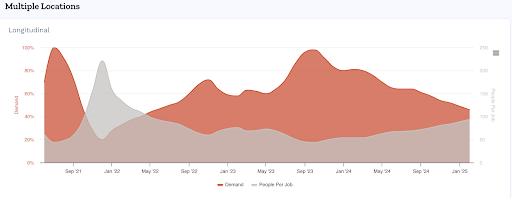
An example of how the longitudinal data appears within the Horsefly platform
Modern platforms are not a luxury upgrade from spreadsheets. They are the only realistic way to keep pace with a labor market that changes faster than an annual survey cycle can track.
Case Study: How a Global Tech Firm Can Cut Time to Hire by 30 Percent
Consider a composite example built from patterns seen across the industry: a global technology company struggling with high recruitment costs and painfully slow hiring for specialized engineering roles. Its existing process relied on a single annual compensation survey and a lot of internal guesswork whenever a genuinely new role came up.
The company shifted to a strategic, ongoing benchmarking process built on real-time market data. Job architecture was cleaned up first, so titles matched across regions. Then it layered in skills-based analysis for its hardest-to-fill engineering roles, replacing "what does a similar title pay" with "what do these specific skills command in this specific market."
The results, tracked over two quarters, were a 30 percent reduction in time to hire for specialized engineering roles, driven largely by faster, more confident offer decisions. Offer acceptance rates climbed 15 percent, since offers were grounded in current market reality rather than outdated numbers nobody quite trusted. And when the company ran its next pay equity audit, its engineering teams came back clean, with compensation validated against granular, defensible market data rather than internal assumption.
None of this required a bigger team or a bigger budget. It required better data, applied consistently.
Building a Future-Proof Compensation Strategy
Salary benchmarking is not a project you finish. It is an ongoing function, the same way financial planning or market research never really "completes." Markets shift, skills gain and lose value, and the talent you are competing for has more visibility into pay than any generation before them.
The organizations that get this right treat benchmarking as infrastructure: something built once, then fed with accurate, granular, and current salary and benefits data continuously, not revisited in a panic once a year when someone quits unexpectedly. That is the shift from reactive compensation, scrambling to match an offer after a resignation letter lands, to predictive workforce planning, where you already know where pressure is building before it costs you your best people.
Horsefly exists to make that shift possible: granular data across a huge global footprint, refreshed daily, built to support exactly the kind of ongoing, strategic benchmarking this guide has walked through. If you are ready to move your compensation strategy from guesswork to genuine strategy, we would like to help.
Looking to find out more with the help of comprehensive salary insights? Get in touch to book a strategic consultation today.
Sources: Horsefly Analytics