.png?width=2000&name=Horsefly-Logo-NewTag_White%20(3).png)
Automation of Tasks vs. Augmentation of Human Capabilities
The most important framing shift in understanding AI's workforce impact: AI automates tasks, not jobs. Most roles are a bundle of tasks, some highly routine, some deeply human. AI is very good at the former and still genuinely limited on the latter.
Repetitive, rule-based activities such as data entry, document processing, initial screening, or templated report generation are squarely in AI's wheelhouse. These are the tasks that consume significant working hours while delivering relatively little cognitive value. Handing them off to AI tools isn't a threat to those workers; it's time savings.
Where it gets more interesting is augmentation. Research from Harvard Business School has shown that knowledge workers using AI tools perform significantly better on complex tasks than those working without them. In this model, AI handles the heavy lifting of information gathering and drafting, while human labor requires judgment, creativity, and contextual understanding to be applied.
High complementarity roles, where AI enhances rather than creates job loss, tend to involve social interaction, physical context, or complex decision-making where the stakes of getting it wrong are high.
Think of a data analyst who uses AI to process datasets in minutes rather than days, or a talent acquisition lead whose use of AI is to surface accurate labor market intelligence before committing budget to a hiring campaign.
The Creation of New Jobs, Roles and Evolution of Existing Ones
Every major technology wave creates jobs that didn't previously exist. AI is no different. The roles emerging in response to AI adoption include prompt engineers, AI trainers, AI ethicists, machine learning operations specialists, and human-AI collaboration designers. These aren't niche roles for tomorrow. They're being hired for today.
Beyond brand new titles, existing workforce roles are evolving fast. Analysts are becoming AI-assisted strategists. Recruiters are becoming talent intelligence professionals. Content teams are shifting toward editorial oversight and AI orchestration.
The common thread is humans moving up the value chain, focusing on work where their judgment, empathy, and contextual knowledge add something AI cannot replicate.
According to the US Bureau of Labor Statistics, roles in data science and related fields are projected to grow significantly over the coming decade, with demand consistently outpacing supply. Organizations that understand this shift and plan accordingly will have a material advantage in attracting and retaining the people who can operate at that level.
Changes in Required Skills for the Future Workforce
The World Economic Forum's Future of Jobs reports consistently point toward the same cluster of in-demand capabilities: critical thinking, complex problem-solving, creativity, and communication. The "4Cs," as they're sometimes called, represent skills that are genuinely hard to automate and increasingly valuable as AI handles more of the cognitive load.
Digital literacy is now table stakes. The ability to work with AI tools, understand their outputs, and know when to trust them versus when to apply human judgment is fast becoming a core professional competency rather than a specialist skill.
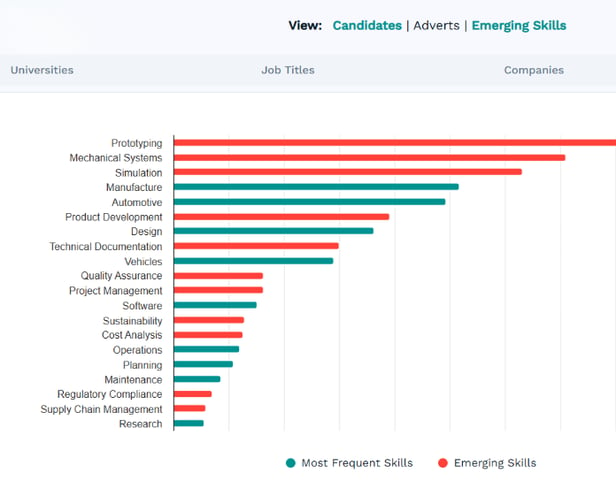
Image shows the Signal Skills capability within the Horsefly platform that helps you spot job market shifts first
Adaptability matters too. The pace of skill change means that specific technical skills may have a shorter shelf life than ever before. Workers and organizations that treat learning as ongoing rather than front-loaded will fare considerably better than those who don't.
Increased Productivity Gains from AI and Economic Growth Forecasts
The macroeconomic case for AI adoption is compelling. Goldman Sachs estimates that widespread AI adoption could raise global GDP by 7% over 10 years, driven primarily by productivity gains across knowledge-intensive industries. PwC's projections are even more bullish, with potential contributions to the global economy of up to $15.7 trillion by 2030.
These gains won't arrive uniformly or immediately. Economists reference the Productivity J-Curve: when organizations invest in new technology, they typically see a temporary dip before significant gains materialize. The dip reflects learning curves and integration overhead. The upswing, for those who navigate it well, can be substantial. ONS data from UK firms already shows businesses with higher AI adoption reporting measurable improvements in output per employee, with 18% of UK firms saying they will increase AI adoption within months.
AI's Influence on Wages, Employment Rates, and Cost Savings
AI's impact on wages is uneven, and that unevenness matters. Research cited by the Tony Blair Institute indicates that workers with AI-complementary skills, those who can work effectively alongside AI tools, are already commanding wage premiums in many markets. Conversely, roles with high task automation exposure face downward wage pressure as AI reduces the time required to complete core duties.
Job displacement is real, but needs context. Daron Acemoglu and colleagues have argued that the net employment effect of AI may not be as quick as we first thought. Initial displacement can precede widespread job creation, creating a difficult transition window that policy and organizational strategy need to address.
Frictional unemployment, temporary joblessness during role transitions, is expected to increase as AI accelerates labor market churn. Businesses that invest in retraining, internal mobility, and talent intelligence will manage that churn better than those caught unprepared.
On cost, AI is delivering real savings for early adopters through workflow automation, faster analysis, and reduced time-to-insight. The organizations seeing the best return are those that have been intentional about which workflows to automate and which to augment.
Industry, Demographic and Occupational Exposure to AI
Varied Impacts Across Sectors and Geographies
No sector is untouched, but the depth and speed of AI impact varies. Marketing, financial services, legal, and software development are among the highest-exposure sectors. Healthcare and education show high potential for AI, particularly in diagnostics, personalized learning, and administrative burden reduction.
Manufacturing's exposure profile is different: physical automation is a decades-long story, but AI is now being applied to quality control, predictive maintenance, and logistics optimization in ways that meaningfully reshape the labor profile.
Some advanced economies could face higher AI exposure than emerging markets, given the concentration of knowledge-intensive roles, but also stand to capture proportionately larger productivity gains. When looking at the UK economy, ONS data highlights regional differences in labor market composition that affect both exposure and resilience.
To help you understand workforce trends within your industry, get in touch to take a deeper look at this with our help.

Which Jobs Are Most at Risk and Which Are Augmentable?
Research from Tyna Eloundou et al. at OpenAI introduced a useful framework for assessing risk. Their Beta metric scores tasks based on whether an LLM can make them at least twice as fast, providing a more granular measure of exposure than broad occupational categories.
Using this and related methodologies, roles with high automation exposure include data entry clerks, customer service roles following structured scripts, bookkeepers, and certain categories of computer programmers engaged in routine coding tasks. These are automatable jobs, roles where AI can handle core tasks without significant loss of quality.
Augmentable jobs are a larger category. Doctors, lawyers, HR business partners, researchers, consultants, and many creative roles contain significant components that AI can accelerate or improve, while the human remains essential for judgment, accountability, and client relationship management. Anthropic's own economic research suggests that a high percentage of occupations fall into this augmentation category rather than full displacement.
Observed exposure, a more sophisticated measure that combines theoretical LLM capability with real-world usage data, shows that actual displacement risk is somewhat lower than theoretical models predict. But the trajectory is clearly upward as models improve and adoption broadens.
Socio-Economic and Demographic Disparities
The distribution of AI's impact is not equitable, and that's a problem that organizations and policymakers need to take seriously.
Early-career workers face a particular challenge. Many entry-level roles serve as on-ramps into professions, providing foundational workplace experience that builds toward more senior positions. If AI automates those entry points faster than the broader structure adapts, the long-term pipeline of experienced talent in affected fields becomes a concern.
There is also an education and wage correlation. Lower-wage, lower-education roles face higher automation exposure. Higher-wage roles tend to be more augmentable. Without deliberate intervention, AI could meaningfully widen existing socio-economic gaps rather than narrow them. Access to AI-enhanced services, quality retraining, and the digital infrastructure needed to benefit from the technology is not uniformly distributed.
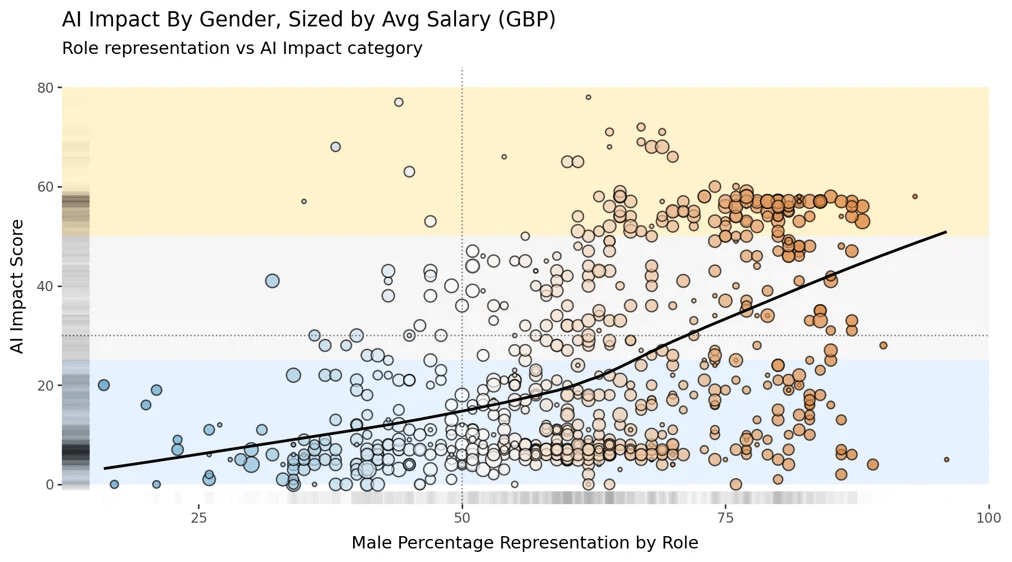
Gender effects are also documented. A report from Horsefly looks at those occupations exposed to AI and suggests that some jobs typically associated more with women (healthcare, education etc.) have a lower AI impact rate than higher-paying, more male-dominated industries, as shown in the below image.
Organizations with DEI commitments should incorporate AI workforce planning into those frameworks, not treat them as separate workstreams. If you’d like more information on this, you can get in touch for more expert guidance.

Upskilling and Reskilling for In-Demand AI-Complementary Skills
The most valuable thing most workers can do right now is develop skills that make them more effective alongside AI rather than more replaceable by it. That means building data literacy, understanding how to use and evaluate AI tools in your field, and sharpening the judgment-intensive capabilities that AI cannot replicate.
Prompt engineering, the ability to craft effective inputs to AI models to generate reliable outputs, is already a transferable professional skill, and learnable without a computer science degree. Combining it with domain expertise creates meaningful leverage.
Data analytics skills have been high-demand for years, but the gap between supply and demand remains large. Workers who can move between data interpretation and strategic recommendation are consistently among the most sought-after profiles in Horsefly's labor market intelligence data.
The broader principle is that learning should be continuous rather than episodic. Waiting for a role to feel threatened before upskilling is a losing strategy in a market moving this fast. Get in touch today to discuss your needs when it comes to setting up an AI-driven workforce.

Leveraging AI Tools to Augment Human Capabilities
The simplest and most practical piece of advice for most knowledge workers: start using the AI technologies available. AI capabilities and tools available today can materially improve productivity in writing, research, analysis, and planning. Workers who integrate them thoughtfully into daily workflows build intuition for where AI helps and where it needs supervision. That intuition is itself a professional skill.
Experimentation matters. Organizations that create space for teams to test AI applications without requiring immediate ROI justification consistently see better adoption outcomes and surface use cases that centralized IT procurement would never identify.
Maintaining Well-being and Mental Health in a Changing Landscape
This dimension of the impact of AI on job roles is under-discussed. Job displacement anxiety is real and documented: research consistently shows that uncertainty about job security is more psychologically harmful than actual unemployment in many cases, partly because it is indefinite and hard to plan around.
Organizations implementing AI should communicate transparently about what is changing and why, and provide clear information about retraining opportunities. Letting fear of disruption fester through silence undermines the productivity gains AI is supposed to deliver. For individuals experiencing significant career anxiety and reduced enjoyment at work, engaging with employee assistance programs, professional communities, and structured retraining paths beats waiting for certainty before acting.
Staying Informed, Flexible, and Proactive
Labor markets are moving fast and the information environment is noisy. Cutting through requires accurate, timely data on what is actually happening to specific tasks within jobs, skills, and geographies rather than generalized predictions.
Workforce intelligence platforms like Horsefly provide exactly this visibility, showing how skills and labor demand is shifting in real time, where talent pools are growing or shrinking, and how compensation is evolving for AI-adjacent roles. That intelligence is the difference between reactive firefighting and proactive workforce planning. Building your professional network into communities navigating similar transitions accelerates that intelligence further.