.png?width=2000&name=Horsefly-Logo-NewTag_White%20(3).png)
Talent acquisition software is the broad category of tools that help organizations find, attract, evaluate, and hire people. At its most basic, it's a system to stop things from falling through the cracks. At its most advanced, it's a strategic asset that tells you where to hire, what to pay, and what skills your workforce will need in three years.
The market has expanded well beyond the old-school applicant tracking system. Modern platforms blend sourcing intelligence, labor market analytics, DEI insights, compensation benchmarking, and AI-powered automation. The result is that organizations that use these tools well genuinely outperform those that don't, in time-to-hire, quality of hire, cost of hire, and workforce planning accuracy.
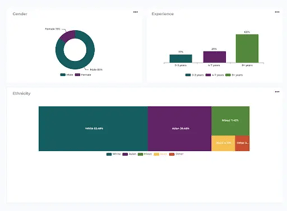
Image shows the DEI capability from the Horsefly platform
The stakes are high and hiring the wrong person costs an estimated 30% of their annual salary. Making strategic workforce decisions without real data costs considerably more. Talent acquisition software exists to reduce both risks.
Not all platforms cover the same ground. Here's what to look for and why each feature matters:
Applicant Tracking System (ATS) Capabilities
An ATS is the operational backbone of recruitment. It handles resume parsing, application workflows, interview scheduling, compliance management, and candidate communications. The best modern ATS tools have moved beyond simple database management to automate repetitive tasks, flag compliance risks, and surface relevant talent from existing pipelines.
What to evaluate: How well does it integrate with your existing HR recruitment software stack? How configurable are the workflows? Does it scale for high-volume hiring?
Talent Relationship Management
Where an ATS manages active applicants, a talent relationship management (CRM) function manages relationships over time. That means building talent pools, nurturing passive talent through targeted communications, and ensuring your pipeline is warm before a role even opens.
This feature matters most for organizations hiring at volume or in competitive skill areas where talent is scarce.
AI and Automation
AI within recruitment platforms has gone from buzzword to basic expectation. The practical applications include automated resume screening, AI-powered sourcing, chatbot-led pre-screening, interview scheduling, and predictive analytics on hiring outcomes.
The key question is whether the AI is actually reducing bias and improving quality, or just automating bad decisions faster. Evaluate vendors on transparency of their AI models and whether they support diversity outcomes.
Labor Market Analytics and Intelligence
This is where the most forward-thinking platforms are investing heavily, and it's where the strategic value really kicks in. Labor market analytics tools give you visibility into talent supply and demand across geographies, compensation benchmarks by role and market, skill availability, hiring difficulty by location, and emerging skill trends.
Platforms like Horsefly Analytics sit in this space, drawing on over 1 trillion data points across 65 countries and 170,000 locations to help organizations make evidence-based workforce decisions - before committing to a hire, a location, or a talent strategy.

Integrations
Talent acquisition software platforms are rarely the only tool in the room. Look for native integrations with your HRIS, payroll system, background screening providers, assessment tools, and job boards. API availability matters too, especially for enterprise organizations with complex tech stacks.
Reporting and Analytics
You should be able to measure everything that matters: time-to-hire, cost-per-hire, source effectiveness, offer acceptance rates, diversity metrics, and pipeline health. If a platform can't tell you what's working, it can't help you improve.
Candidate Experience Platform Features
This is easy to underweight. The talent you're trying to hire is evaluating you just as much as you're evaluating them. Career site quality, mobile application experience, communication touchpoints, and interview process design all affect whether your best-fit talent completes the process or drops out halfway through.
The market breaks down into several distinct categories. Most organizations use more than one.
Applicant Tracking Systems (ATS)
The ATS is the most established category and the most widely used.
What they do well: Managing active applicants through a structured hiring process. Collaboration between hiring managers and recruiters. Compliance documentation. Job posting distribution. Pipeline reporting.
Best for: Organizations that need structured, repeatable hiring workflows. Particularly strong for mid-market and enterprise companies hiring across multiple departments.
Watch out for: Many legacy ATS platforms were built before mobile, before AI, and before anyone cared much about candidate experience. They can feel clunky. Evaluate carefully if your hiring volume is high or your talent market is competitive.
Pricing: Generally subscription-based, ranging from a few hundred dollars per month for small, medium business (SMB) tools to six-figure annual contracts for enterprise solutions.
Recruitment CRM and Sourcing Platforms
These tools are focused on building and maintaining talent pipelines over time rather than just processing active applications.
What they do well: Proactive sourcing, talent community building, employer brand nurturing, re-engagement of past applicants, and long-term pipeline health.
Best for: Organizations in competitive talent markets where passive talent outreach is critical. Also strong for high-volume hiring where warm pipelines reduce time-to-fill.
Watch out for: CRM (Candidate Relationship Management) tools require ongoing investment to maintain. Talent pools go cold without regular nurture. If your team won't commit to the ongoing effort, the ROI diminishes quickly.
Pricing: Mid-to-high range, typically priced per user or per module. Enterprise contracts are common.
AI-Powered Sourcing and Screening Tools for AI Talent Acquisition
These tools focus on using AI to find and surface talent from across the web, combining social profiles, public data, and internal databases.
What they do well: Finding talent that wouldn't otherwise apply. Reducing sourcing time dramatically. Surfacing diversity talent pools. Skills-based matching beyond job title.
Best for: Talent acquisition teams doing significant direct sourcing, particularly for technical or specialist roles.
Watch out for: Data accuracy varies. The quality of AI matching depends heavily on how well skills and roles are defined. Some tools have faced scrutiny over bias in their models.
Pricing: Typically per-seat subscription. SMB-friendly options exist alongside enterprise tiers.
Workforce and Labor Market Intelligence Platforms
This is the strategic layer of the talent acquisition tool stack. Rather than managing the recruitment process itself, these platforms tell you where to recruit, what to pay, what skills are available, and how competitive specific markets are.
Horsefly Analytics sits firmly in this category. With a taxonomy of 815,000 job titles and skills across 39 languages, supply and demand data across 170,000 global locations, and capabilities like Difficulty of Hire, Signal Skills, and Compensation Insights, Horsefly gives talent leaders the data they need to plan with confidence rather than gut feel.
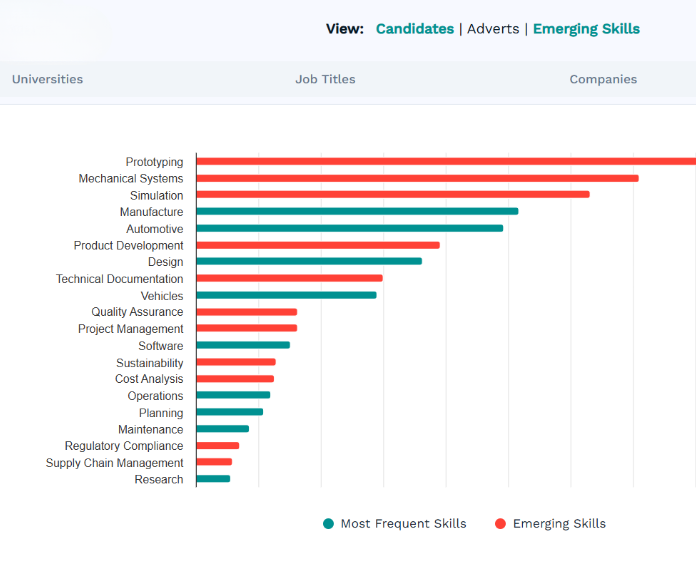
Image shows the Signal Skills capability within the Horsefly platform
Difficulty of Hire shows which roles will take more time and effort to fill before you start recruiting, enabling smarter resource planning and more accurate hiring timelines.
Supply and Demand Insights overlay talent supply and demand on a single view, so you can see where talent pools are growing, shrinking, or relocating, and plan your strategy accordingly.
Signal Skills Intelligence spots skills that are rising in demand before they become mainstream requirements, giving workforce planners a genuine head start.
Compensation Insights benchmarks your packages against real market data globally, helping you build competitive offers and identify pay equity gaps.
Global Heat Maps let you visualize where specific skills actually live, including niche capabilities you might not have thought to look for, so location and remote hiring decisions are grounded in evidence.
What they do well: Strategic workforce planning, location decisions, compensation benchmarking, DEI planning, skills gap analysis, and forward-looking talent intelligence.
Best for: Enterprise organizations, RPOs, and talent strategy functions that need to make evidence-based workforce decisions at scale. Particularly valuable for global organizations navigating multiple labor markets simultaneously.
Watch out for: These tools require a data-literate user base to extract full value. The ROI is real, but it comes from using the insights to drive decisions, not just generating reports. This is why, with Horsefly, you will have a dedicated Customer Success Manager who will be there to walk you through using the platform and ensuring you know exactly how to get the most out of it. To hear more about this, contact us for more expert guidance.

All-in-One Talent Suites
Some vendors include talent acquisition modules within broader HR platforms.
What they do well: Consolidation. If you're already running Workday, for example, for HR, having recruiting in the same system reduces integration complexity and improves data consistency across the employee lifecycle.
Best for: Large enterprises where system consolidation and HR data integrity across the full employee lifecycle are the primary priorities.
Watch out for: Best-of-breed point solutions almost always outperform suite modules on individual functionality. If deep recruiting capability is the priority, you may find suite-based ATS tools limiting. Most enterprise TA teams augment their suite with specialist tools.
Pricing: Suite pricing is notoriously opaque. Expect significant negotiation.
Video Interviewing and Assessment Platforms
These tools sit at the evaluation end of the process, offering async video interviews, structured interview guides, and skills assessments.
What they do well: This recruiting software helps to reduce time in the early screening stages. Enabling hiring decisions based on demonstrated capability rather than resume keywords. Supporting remote and global hiring.
Best for: High-volume hiring and any role where early screening takes disproportionate recruiter time.
Watch out for: AI-driven video assessment tools have faced real criticism around bias and transparency. Scrutinize the science behind any assessment tool carefully.
Here's the honest version of this process.
Start With the Problem, Not the Feature List
The single most common mistake in talent acquisition systems selection is starting with vendor demos before you've diagnosed what's actually broken. Before you talk to anyone, document your current pain points: where are hires falling through the cracks? Where are you losing talent in the process? Where are your hiring managers unhappy? What decisions are you currently making without reliable data?
Define Your Actual Budget and ROI Case
The price talent acquisition software providers quote can range from free tiers to seven-figure enterprise contracts. Be honest about what you can spend, and build a concrete ROI case before committing. Time-to-hire reduction, quality-of-hire improvement, and cost savings from reducing agency dependency are the three most common ROI levers. Quantify them for your context.
Prioritize Ruthlessly
You probably can't have everything. Decide which capabilities are non-negotiable for your hiring volume, markets, and team structure, and which are nice-to-have. A 50-person company and a 50,000-person global enterprise have almost nothing in common in this decision.
Think About Integration Before You Sign
A new platform that doesn't connect cleanly to your HRIS, payroll, or existing tools will create more problems than it solves. Before finalizing any vendor, map out every integration requirement and confirm each one is supported.
Test With Real Use Cases
Don't evaluate software on a demo scenario. Bring your actual roles, your actual workflows, and your actual hiring managers into the trial. The tool that performs well on a polished demo and the tool that performs well when your recruiter is trying to fill a niche engineering role in a market they've never hired in before may be very different products.
Ask the Right Questions in Vendor Conversations
How is your data sourced and how often is it updated? What does implementation actually look like, and what does success look like at 90 days? Who owns the relationship after the contract is signed? What does your customer support look like when something breaks at 8am on a Monday?